Overview
- Pteranodon was a large pterodactyloid pterosaur from the Late Cretaceous (approximately 86–84.5 million years ago) of the Western Interior Seaway of North America, with wingspans reaching approximately 6–7 meters, making it one of the largest flying animals known from the Cretaceous prior to the discovery of azhdarchid giants.
- The genus exhibits dramatic sexual dimorphism, with presumed males bearing large, elongated cranial crests and females having smaller, more rounded crests, a pattern supported by statistical analysis of hundreds of specimens from the Smoky Hill Chalk of Kansas.
- Pteranodon was a soaring marine piscivore that likely hunted fish over the open waters of the Western Interior Seaway using dynamic soaring and surface-skimming flight strategies, analogous in ecological role to modern albatrosses and pelicans despite being only distantly related to birds.
Pteranodon is an extinct genus of large pterodactyloid pterosaur from the Late Cretaceous of North America, known primarily from hundreds of specimens recovered from the Smoky Hill Chalk Member of the Niobrara Formation in western Kansas, with additional material from adjacent states.1, 10 Living approximately 86 to 84.5 million years ago (Santonian to early Campanian), Pteranodon soared over the Western Interior Seaway, a shallow epicontinental sea that divided North America into eastern and western landmasses during much of the Late Cretaceous.10 With wingspans reaching approximately 6 to 7 meters in the largest individuals, Pteranodon was among the largest flying animals of the Cretaceous and has become one of the most recognizable and extensively studied of all pterosaurs, represented by more individual specimens than any other pterosaur genus.1, 6
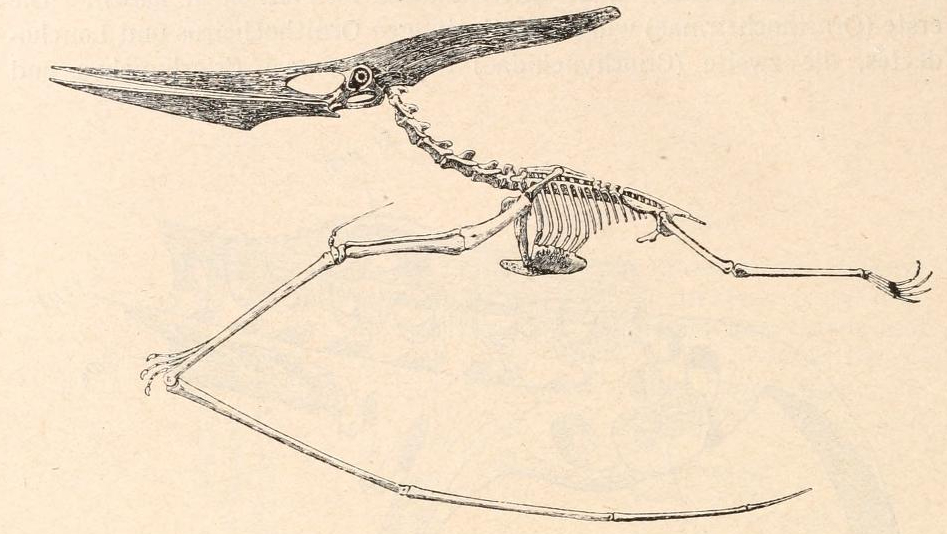
._Die_St%C3%A4mme_der_Wirbeltiere.jpg)
Anatomy and flight
The body plan of Pteranodon was highly adapted for soaring flight over open marine environments. The skull was elongated and narrow, with long, toothless jaws that terminated in sharp, pointed tips, and a prominent cranial crest that projected posteriorly from the back of the skull.1, 7 The loss of teeth, a derived condition shared with several other pterodactyloid lineages, reduced skull weight and may have been compensated for by a keratinous rhamphotheca (beak covering) that sheathed the jaw margins.4, 6 The postcranial skeleton was pneumatized and lightly built, with thin-walled, air-filled bones that minimized body mass while maintaining structural strength, a pattern common to all pterosaurs but particularly pronounced in large species.6, 12 Body mass estimates for the largest Pteranodon individuals range from approximately 20 to 35 kilograms, remarkably light for an animal with a 7-meter wingspan, reflecting the extreme skeletal pneumaticity of the group.12
The flight mechanics of Pteranodon have been analyzed in detail since the pioneering aerodynamic study of Bramwell and Whitfield in 1974, who concluded that the animal's long, narrow wings, with an estimated aspect ratio of approximately 9 to 10, were well suited for dynamic soaring, the technique used by modern albatrosses to extract energy from wind shear above ocean surfaces.8 More recent biomechanical analyses by Michael Habib and others have supported this interpretation, noting that the wing proportions and skeletal pneumaticity of Pteranodon indicate a soaring specialist capable of covering vast distances over the open seaway with minimal flapping effort.9 The wing membrane, or brachiopatagium, extended from the enormously elongated fourth finger to the body, with an additional membrane (the propatagium) between the wrist and the shoulder, and a smaller membrane (the cruropatagium) possibly extending along the hind limbs, though the exact extent of the cruropatagium in pteranodontids remains debated.6
Sexual dimorphism and population structure
One of the most thoroughly documented aspects of Pteranodon biology is the pronounced sexual dimorphism in crest morphology and overall body size. S. Christopher Bennett's extensive analyses of the large Pteranodon sample from the Smoky Hill Chalk, encompassing over 1,100 catalogued specimens, demonstrated that the genus falls into two distinct morphs: larger individuals with narrow pelvic canals and tall, elongated cranial crests, and smaller individuals with broader pelvic canals and smaller, more rounded crests.5, 14 Bennett interpreted the large-crested morph as male and the small-crested, broad-pelved morph as female, reasoning that the broader pelvis would have been necessary for egg passage and that the exaggerated male crest likely functioned as a sexually selected display structure.5
This dimorphic pattern is the basis for the current species-level taxonomy, in which the two recognized species, Pteranodon longiceps (with a relatively shorter, more posteriorly directed crest) and Pteranodon sternbergi (with a larger, more upright crest), may represent sexual morphs or temporally successive populations rather than biologically distinct species, a question that remains unresolved.2, 7, 11 Bennett also identified growth stages within the Pteranodon sample, defining year-classes based on bone histology and skeletal size that indicate the animals reached skeletal maturity at approximately 3 to 4 years of age, with the distinctive cranial crest developing fully only in mature individuals.3, 14 The cranial crests of pterosaurs more broadly have been interpreted as structures involved in species recognition and sexual selection, with comparative analyses by Hone, Naish, and Cuthill supporting a signaling function over aerodynamic or thermoregulatory hypotheses.13
Ecology and the Western Interior Seaway
The ecological role of Pteranodon was that of a marine piscivore, analogous in many respects to modern pelagic seabirds such as albatrosses, pelicans, and boobies. The long, toothless jaws were well suited for snatching fish from near the surface, and the animal's soaring capabilities would have allowed it to range widely over the Western Interior Seaway in search of prey schools.4, 6, 10 Fossilized fish remains have been found associated with Pteranodon specimens, including a famous example in which a fish skeleton was preserved in the throat region of a Pteranodon specimen, indicating that the animal swallowed fish whole or in large pieces.10 Bennett's reappraisal of the mandibular crescents, bony projections on the lower jaw, suggested they may have anchored a gular pouch similar to that of modern pelicans, though this interpretation remains debated.4
The Western Interior Seaway, over which Pteranodon flew, was a rich marine ecosystem populated by mosasaurs, plesiosaurs, large predatory fish such as Xiphactinus, diverse sharks, and abundant schooling fish including Enchodus and clupeids.10 Pteranodon specimens are found far from any reconstructed Cretaceous shoreline, in chalks deposited hundreds of kilometers from land, indicating that these animals were fully pelagic and capable of sustained flight over open water, likely returning to nesting colonies on the nearest available land only for reproduction.6, 10 The concentration of hundreds of Pteranodon specimens in the Smoky Hill Chalk, while partly a function of preservational bias in marine chalk deposits, also suggests that the Western Interior Seaway was a core habitat for the genus and that population densities were substantial.1, 10
Taxonomic history and significance
Pteranodon was first described by Othniel Charles Marsh in 1876, making it one of the first pterosaurs known from North America and among the first large pterosaurs described from anywhere in the world.1 The genus has had a complex taxonomic history, with numerous species erected on the basis of fragmentary material, many of which have subsequently been synonymized or reassigned. The current consensus recognizes two valid species, P. longiceps and P. sternbergi (the latter sometimes placed in its own genus, Geosternbergia), though the species-level taxonomy continues to be debated.7, 11
Pteranodon occupies a central position in the scientific understanding of pterosaur biology. The sheer abundance of material has made it a model taxon for studying pterosaur growth, population biology, sexual dimorphism, and flight mechanics, subjects that are difficult or impossible to investigate in most pterosaur genera, which are known from only a handful of specimens.1, 6 Phylogenetically, Pteranodon belongs to the Pteranodontia, a clade of derived pterodactyloids that also includes the nyctosaurids and is closely related to the Azhdarchoidea, the group that produced the largest known flying animals, the azhdarchid pterosaurs of the latest Cretaceous.6, 11 While Pteranodon was a marine soaring specialist, the azhdarchids were predominantly terrestrial stalkers, illustrating the remarkable ecological breadth that pterosaurs achieved by the end of the Cretaceous, before the end-Cretaceous extinction brought the entire lineage to an end.6
References
Pteranodon (Reptilia: Pterosauria): the age structure of two orthogenetically varying species
A critical reappraisal of the mandibular crescents of pteranodontian pterosaurs and their significance for feeding ecology
New material of the pterosaur Pteranodon (Pteranodontia, Pteranodontidae) from the Late Cretaceous of Kansas
The aerodynamics of Pteranodon and Nyctosaurus, two large pterosaurs from the Upper Cretaceous of Kansas