Overview
- Temnospondyls were one of the most diverse and long-lived groups of early tetrapods, spanning from the Early Carboniferous to the Early Cretaceous — a range of roughly 200 million years — and radiating into thousands of species that occupied freshwater, terrestrial, and even marginal marine environments on every major landmass.
- Body plans ranged from small, fully terrestrial insectivores to enormous, flat-headed aquatic ambush predators exceeding five meters in length, making temnospondyls the dominant amphibian-grade tetrapods of the late Paleozoic and much of the Mesozoic.
- Whether temnospondyls include the ancestors of modern amphibians (frogs, salamanders, and caecilians) remains one of the most contested questions in vertebrate paleontology, with the temnospondyl hypothesis, the lepospondyl hypothesis, and polyphyly models each supported by different data sets.
Temnospondyls are an extraordinarily diverse clade of early tetrapods that first appeared during the Early Carboniferous period, around 330 million years ago, and persisted in some lineages until the Early Cretaceous, roughly 120 million years ago.1, 2 Across that vast span of time they radiated into thousands of species inhabiting freshwater lakes and rivers, swampy Carboniferous coal forests, arid Permian uplands, and even coastal marine environments.6 Their name, meaning "cut vertebra," refers to the distinctive structure of their intercentra and pleurocentra — the paired bony elements that compose each vertebral centrum — which was one of the first anatomical features used to distinguish them from other early tetrapod groups.14 Ranging from tiny, salamander-sized insectivores to massive, crocodile-like aquatic predators exceeding five meters in length, temnospondyls were the most species-rich amphibian-grade tetrapods in Earth's history, and their evolutionary relationships remain central to understanding the origin of life on land and the ancestry of living amphibians.1, 13
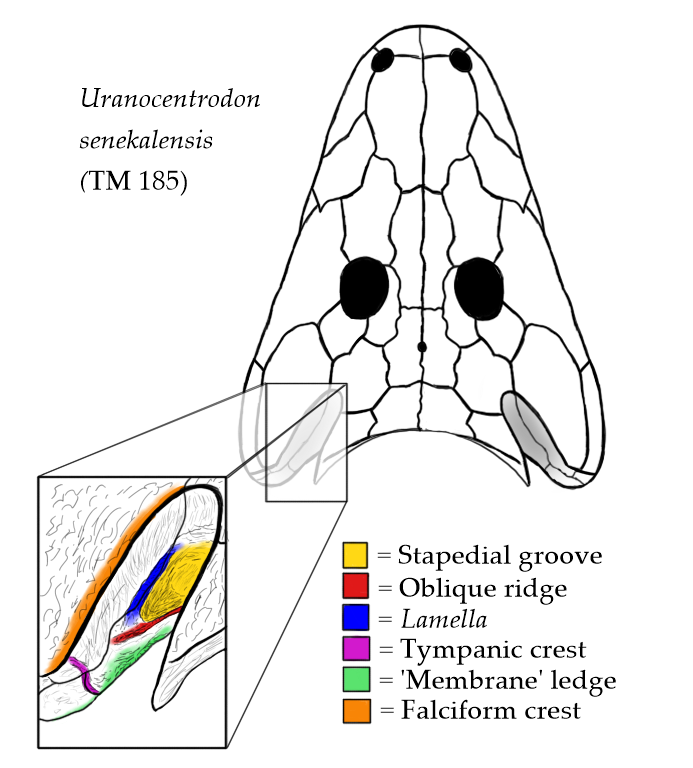

Anatomy and body plan
The temnospondyl skeleton reflects an ancestral tetrapod bauplan modified across many lineages for different modes of life. The skull is typically broad and dorsoventrally flattened, with a fully roofed dermal skull table pierced by openings for the orbits, nares, and a pineal foramen.2, 18 In many lineages the skull bore elaborate sculpture of pits and ridges on its external surface, a feature interpreted as evidence for the embedding of blood vessels and sensory organs within the overlying skin.6 The palate was usually equipped with large fangs on the vomer and palatine bones in addition to rows of smaller marginal teeth, a dental arrangement suited to capturing prey in a rapid bite.2, 18 Many aquatic temnospondyls retained lateral line sulci on the skull surface — grooves that housed the mechanosensory lateral line organs used for detecting water movement — a feature indicating that these animals remained at least partly aquatic throughout life.1, 15
Postcranially, temnospondyls possessed four well-developed limbs with digits, a bony pectoral and pelvic girdle, and a vertebral column whose precise construction varied by subgroup. In primitive forms the vertebral centra were composed of a large, crescent-shaped intercentrum and a pair of smaller pleurocentra, a condition known as rhachitomous, while in more derived stereospondyls the intercentrum expanded to form the dominant weight-bearing element and the pleurocentra were reduced or lost entirely.2, 14 The ribs were generally robust and in some terrestrial species bore uncinate processes that may have aided ventilation of the lungs. Body size ranged enormously: dissorophoid temnospondyls such as Amphibamus were less than 20 centimeters in total length, while the Triassic stereospondyl Mastodonsaurus had a skull alone exceeding one meter.10, 16
Ecological diversity and key genera
The ecological range of temnospondyls was remarkable. During the Late Carboniferous and Early Permian, forms such as Eryops megacephalus — one of the best-known temnospondyls — occupied a semi-aquatic, crocodile-like niche in the river systems and floodplains of equatorial Pangaea.9 Eryops reached approximately two meters in length and possessed a powerfully built skull, stout limbs, and a body proportioned for ambush predation at the water's edge.9, 6 Contemporaneous with Eryops were smaller, more fully terrestrial temnospondyls such as the dissorophids and trematopids, which had well-ossified limbs, relatively small heads, and adaptations suggesting they lived and fed primarily on land.16
By the Triassic period, temnospondyl diversity had shifted dramatically toward large-bodied, fully aquatic forms classified within Stereospondyli. Mastodonsaurus giganteus, from the Middle Triassic of Europe, exemplifies this trend: it possessed a skull roughly 1.25 meters long, a flattened body, reduced limbs, and a gape capable of engulfing sizable prey.10, 15 Other notable Triassic stereospondyls include the metoposaurids, which were cosmopolitan lake-dwellers, and the trematosaurids, some of which invaded marine environments — an unusual feat for amphibian-grade tetrapods.15, 2 Perhaps the most remarkable late survivor was Koolasuchus cleelandi, a large brachyopoid from the Early Cretaceous of southeastern Australia, which lived in cold polar rivers at a time when most temnospondyl lineages had long since vanished from lower latitudes.11, 12 The persistence of Koolasuchus in high-latitude refugia, apparently excluded from warmer regions by competition with crocodylomorphs, extended the total range of the group by tens of millions of years beyond what was previously known.11
Evolutionary history and classification
Temnospondyls appeared during the Visean stage of the Early Carboniferous, part of a broader radiation of early tetrapods that followed the colonization of land in the Late Devonian.1, 7 The group's early diversification was closely linked to the expansion of coal-swamp forests across equatorial Pangaea, which provided abundant invertebrate prey and a complex, humid habitat mosaic.17 By the Late Carboniferous, temnospondyls had diversified into several major subclades, including Edopoidea, Dvinosauria, Eryopoidea, and Dissorophoidea, the last of which includes the small, often terrestrial forms most frequently cited as potential ancestors of modern amphibians.14, 2
The end-Permian mass extinction, which devastated marine and terrestrial ecosystems approximately 252 million years ago, extinguished many temnospondyl lineages but spared the stereospondyls, which went on to undergo a significant radiation during the Triassic.6, 15 Stereospondyls became the dominant amphibian-grade predators in Triassic freshwater ecosystems worldwide, with capitosauroids, metoposauroids, and brachyopoids documented from every continent including Antarctica.15 The end-Triassic extinction event then reduced stereospondyl diversity sharply, leaving only a few brachyopoid lineages in Gondwanan refugia that persisted into the Jurassic and, in the case of Koolasuchus, the Early Cretaceous.12
Higher-level classification of temnospondyls has been revised repeatedly as phylogenetic methods have been applied to larger morphological data sets. Ruta and Coates published one of the most comprehensive phylogenetic analyses of Paleozoic limbed vertebrates in 2007, recovering Temnospondyli as a well-supported clade characterized by a suite of cranial and postcranial synapomorphies including the presence of a broad cultriform process of the parasphenoid and a distinctive configuration of the palatal bones.5 Within Temnospondyli, the deepest split separates the edopoids (primitive, large-headed forms) from a more derived clade that includes all remaining families, though the exact branching order among the major subgroups continues to be debated.2, 5
The lissamphibian origin debate
Whether modern amphibians — the Lissamphibia, comprising frogs (Anura), salamanders (Caudata), and caecilians (Gymnophiona) — descended from temnospondyls is one of the longest-running controversies in vertebrate paleontology.13 Three principal hypotheses compete. The temnospondyl hypothesis, advocated most prominently by Ruta, Coates, Schoch, and Milner, posits that lissamphibians are derived dissorophoid temnospondyls, specifically close relatives of the Permian family Amphibamidae, whose members share features such as pedicellate teeth, a reduced skull table, and a lightly built postcranium with living frogs and salamanders.3, 5, 16 This hypothesis is supported by most large-scale morphological cladistic analyses.5
The lepospondyl hypothesis, championed by Anderson and others, proposes instead that lissamphibians evolved from within Lepospondyli, a separate clade of small Paleozoic tetrapods, and that the similarities between dissorophoids and lissamphibians are convergent.4 A third, polyphyly hypothesis suggests that frogs and salamanders derive from temnospondyls while caecilians derive from lepospondyls, meaning that Lissamphibia as traditionally defined would not be a natural (monophyletic) group.13 Molecular phylogenies strongly support lissamphibian monophyly, which constrains the polyphyly model, and recent total-evidence analyses incorporating both morphological and molecular data tend to favor the temnospondyl hypothesis, though they have not entirely resolved the question.13, 16
Paleoecology and functional biology
The functional biology of temnospondyls has been illuminated by studies of skull biomechanics, tooth morphology, bone histology, and isotopic geochemistry. Finite-element analyses of stereospondyl skulls suggest that the broad, flat cranium functioned as a lever for rapid jaw closure, consistent with a sit-and-wait ambush feeding strategy analogous to that of modern crocodilians or giant salamanders.10, 6 Many large aquatic temnospondyls possessed lateral line canals, confirming they hunted in murky water where mechanoreception was more useful than vision.15
Bone histology reveals that growth patterns varied across the clade. Some small terrestrial dissorophoids exhibit growth marks suggesting seasonal interruptions, while large stereospondyls such as Mastodonsaurus show rapidly deposited, highly vascularized fibrolamellar bone in early ontogeny, indicating fast juvenile growth rates comparable to those of some modern reptiles.6 Oxygen isotope analysis of temnospondyl bones and teeth from several Permian and Triassic sites has been used to infer body temperature and habitat use, with results generally supporting the interpretation that most large temnospondyls were primarily aquatic ectotherms.6, 2
Temnospondyls also played important roles in Paleozoic and Mesozoic food webs. In Carboniferous coal forests, small temnospondyls likely fed on insects and other invertebrates, while larger forms preyed on fish and smaller tetrapods.17 In Triassic lake ecosystems, capitosaurids and metoposaurids occupied the top predator niche later filled by crocodylomorphs, and their disappearance from lower latitudes during the Late Triassic correlates with the ecological expansion of early crocodile-line archosaurs.15, 6 The story of temnospondyls is thus one of repeated ecological reinvention across deep time — from the first four-legged forays through Carboniferous swamps to the last cold-water holdouts in Cretaceous polar Australia.
Fossil record and biogeography
Temnospondyl fossils have been recovered from every continent, reflecting the group's long temporal range and its presence on Pangaea before and during continental fragmentation.2 The richest Paleozoic temnospondyl faunas come from the red beds of Texas and Oklahoma, where genera such as Eryops, Trimerorhachis, and Cacops are preserved in fluvial and lacustrine sediments of Early Permian age.9, 17 South American Permian deposits, particularly in the Paraná Basin of Brazil, have also yielded important temnospondyl finds that demonstrate the group's Gondwanan distribution.8
Triassic temnospondyls are known from a broader geographic range still, with significant assemblages from Germany (the type locality of Mastodonsaurus), Morocco, India, Russia, South Africa, Antarctica, and Australia.15, 2 The geographic restriction of the last surviving temnospondyls to high-latitude Gondwana — specifically southeastern Australia, where Koolasuchus lived in rift valleys near the Cretaceous south pole — suggests that these final representatives survived in cool environments from which crocodylomorphs were excluded by thermal constraints.11, 12 When Australia drifted northward and warmed sufficiently to permit crocodylomorph invasion, the ecological niche occupied by Koolasuchus and its relatives was apparently filled by competitors, and the last temnospondyls vanished from the fossil record.12
References
Phylogeny of Paleozoic limbed vertebrates reassessed through revision and expansion of the largest published relevant data matrix
The skull of Mastodonsaurus giganteus (Jaeger) — new perspectives on the largest terrestrial vertebrate predator of the Triassic
The last labyrinthodont? A new brachyopoid (Temnospondyli) from the Early Cretaceous of Australia