Overview
- Phorusrhacidae, colloquially known as terror birds, were a family of large, flightless, carnivorous birds that dominated South American terrestrial predator niches for most of the Cenozoic, from the early Paleocene through the Pliocene — a span of roughly 60 million years.
- The largest phorusrhacids, such as Kelenken guillermoi, possessed skulls exceeding 70 centimeters in length and stood over three meters tall, making them among the largest predatory birds ever to exist and the apex land predators on a continent largely lacking large mammalian carnivores.
- The genus Titanis walleri dispersed into North America during the Great American Interchange, representing one of the few cases in which a South American predator successfully invaded northern faunas, though the family ultimately went extinct by approximately 1.8 million years ago.
Terror birds — formally the family Phorusrhacidae — were large, flightless, cursorial predatory birds that evolved in South America during the early Cenozoic and dominated the continent's terrestrial predator guilds for roughly 60 million years.2, 15 Appearing in the fossil record as early as the Paleocene, approximately 62 million years ago, and persisting until the Pliocene or possibly the earliest Pleistocene, phorusrhacids were the apex land predators of an island continent on which large mammalian carnivores were largely absent or ecologically subordinate.2, 14 The family encompassed a wide range of body sizes, from relatively modest forms standing about one meter tall to enormous species exceeding three meters in height with skulls larger than those of any known horse, and their evolutionary success illustrates one of the most striking examples of birds occupying ecological roles typically held by mammals on other continents.6, 7

Anatomy and adaptations
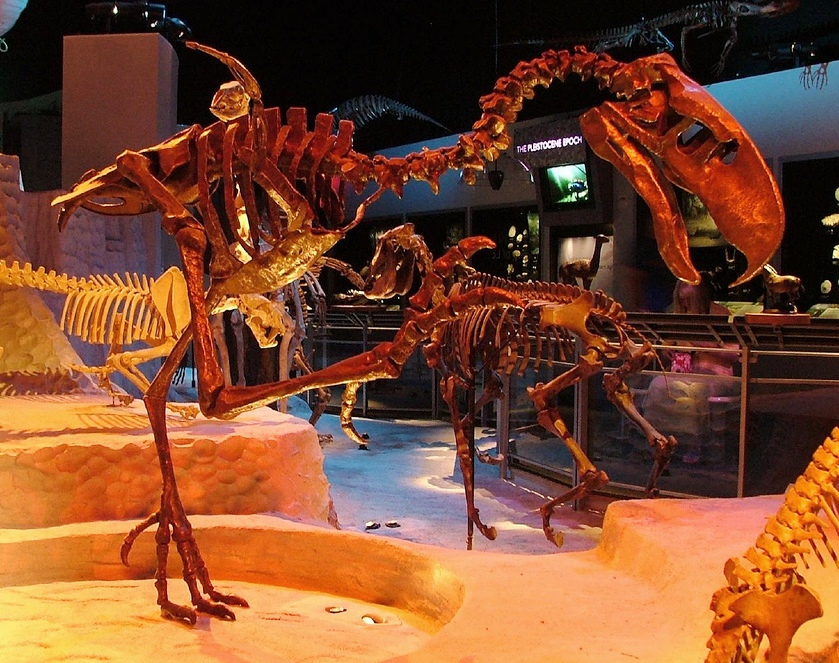
Phorusrhacids were characterized by massive, deep skulls bearing powerful, dorsoventrally compressed beaks that terminated in a sharp, recurved hook — a configuration that suggests a predatory function involving powerful downward strikes.2, 7 The skull of Kelenken guillermoi, from the middle Miocene of Patagonia, measured approximately 71 centimeters in length, making it the largest bird skull ever documented.5, 6 Finite-element analysis of the skull of the closely related Andalgalornis steulleti revealed that while the beak was exceptionally strong in the dorsoventral plane — well suited for delivering rapid, hatchet-like strikes — it was comparatively weak laterally, suggesting that phorusrhacids dispatched prey with repeated downward blows rather than by shaking or twisting as many mammalian predators do.7
The postcranial skeleton was adapted for cursorial locomotion. The hindlimbs were long and powerfully muscled, with elongate tibiotarsi and tarsometatarsi indicating a capacity for sustained high-speed running.2, 16 The wings were greatly reduced and flightless, though in some species they retained clawed digits of uncertain function — possibly used in prey manipulation or intraspecific combat.8 The overall body plan converged remarkably on that of the large cursorial theropod dinosaurs that had gone extinct 4 million years before the earliest phorusrhacids appeared, an example of evolutionary convergence driven by similar selective pressures in the predator niche.15
Diversity and classification
Phorusrhacidae are classified within Cariamae, a clade of birds whose only living representatives are the two species of seriemas (Cariama cristata and Chunga burmeisteri) — small, ground-dwelling predatory birds of South American grasslands that provide the closest living ecological analog, albeit at a fraction of the body size, to their extinct relatives.12 Within Phorusrhacidae, five subfamilies are traditionally recognized: Brontornithinae, Phorusrhacinae, Patagornithinae, Psilopterinae, and Mesembriornithinae, arranged along a gradient from the largest and most robust forms to smaller, more gracile species.2, 4
The brontornithines included the most massive phorusrhacids, with Brontornis burmeisteri from the Miocene of Patagonia estimated to have weighed 350 to 400 kilograms — approaching the mass of a large horse.2 Some analyses have questioned the phorusrhacid affinities of Brontornis, suggesting possible anseriform relationships, though it is typically retained in the family pending further study.4 The phorusrhacines, including Kelenken, Andalgalornis, and the type genus Phorusrhacos, represent the "classic" terror birds — large, long-legged, hook-beaked predators standing two to three meters tall.2, 6 The psilopterines, by contrast, were smaller and more lightly built, with some species barely exceeding one meter in height, and may have occupied a more omnivorous or insectivorous niche.2
Apex predators of an island continent
South America spent most of the Cenozoic as an island continent, geographically isolated after its separation from Antarctica and before the formation of the Isthmus of Panama.10, 11 During this prolonged isolation, the continent's large terrestrial predator roles were filled not by placental carnivorans — which dominated equivalent niches in the Northern Hemisphere — but by three groups: phorusrhacids, the metatherian sparassodonts (carnivorous marsupial relatives), and large terrestrial crocodylians.15, 14 Of these, phorusrhacids occupied the very apex of the food chain for much of the Paleogene and Neogene, preying on the diverse native ungulates (notoungulates, litopterns, astrapotheres) and other herbivorous mammals that characterized South America's endemic mammalian fauna.2, 14
The ecological dominance of phorusrhacids in this context illustrates a broader principle in island biogeography and paleobiology: in the absence of competition from established mammalian predator guilds, birds were capable of evolving to fill large-bodied carnivore niches just as effectively as mammals did elsewhere.15 South America's terror birds thus represent a natural experiment in alternative evolutionary pathways, demonstrating that the Cenozoic "Age of Mammals" was not an inevitable consequence of intrinsic mammalian superiority but rather a reflection of contingent biogeographic and ecological circumstances.15, 11
The Great American Interchange and Titanis
The formation of the Isthmus of Panama, beginning approximately three million years ago, initiated the Great American Biotic Interchange — a massive, bidirectional migration of terrestrial fauna between the previously isolated continents of North and South America.10 The interchange is often characterized as asymmetric, with northern immigrants (carnivorans, cervids, equids, proboscideans) displacing or outcompeting many South American endemic lineages, but the movement was not entirely one-directional.10, 11 Among the most remarkable southward-to-northward dispersers was Titanis walleri, a large phorusrhacid whose remains have been recovered from Pliocene and early Pleistocene deposits in Florida and Texas.8, 16
Titanis stood approximately 2.5 meters tall and is estimated to have weighed roughly 150 kilograms, making it one of the larger phorusrhacids and by far the largest avian predator known from the North American fossil record.8 Its presence in North America demonstrates that at least one phorusrhacid lineage was capable of competing in a fauna that included large placental carnivorans such as canids, felids, and ursids — organisms it had never previously encountered.8, 11 The precise timing of Titanis arrival in North America has been debated; early age estimates placed it as recently as the late Pleistocene, which would have made it contemporaneous with early humans in the Americas, but more rigorous stratigraphic work has established a late Pliocene to earliest Pleistocene age, approximately 2.5 to 1.8 million years ago.16
Extinction
The extinction of phorusrhacids has been attributed to multiple factors operating over different timescales. In South America, the arrival of northern placental carnivorans — particularly large felids such as Smilodon and canids such as Protocyon — during and after the Great American Interchange likely introduced direct competition for the apex predator niche that phorusrhacids had occupied for tens of millions of years.10, 11 The superior metabolic flexibility of placental mammals, their capacity for sustained aerobic pursuit predation, and the diversity of predatory strategies they brought may have given them a competitive edge, though direct evidence of competitive exclusion is difficult to establish from the fossil record alone.11
Climate change during the Pliocene and Pleistocene also reshaped South American ecosystems in ways that may have disadvantaged phorusrhacids. The expansion of grasslands at the expense of woodland mosaics, combined with increasing aridity and temperature fluctuations associated with Northern Hemisphere glaciation, altered prey communities and habitat structure.14 Some analyses have noted that the decline of phorusrhacids correlated not only with the arrival of placental carnivorans but also with the extinction of several groups of endemic South American herbivores on which they had presumably preyed, suggesting that bottom-up trophic disruption may have been as important as top-down competitive displacement.2, 14 The youngest confirmed phorusrhacid fossils date to approximately 1.8 million years ago, though a contested report from Uruguay has suggested survival into the late Pleistocene, around 96,000 years ago — a claim that requires further stratigraphic confirmation.9 Whether their final extinction was a gradual decline or a relatively abrupt event, the disappearance of the terror birds marked the end of a 60-million-year reign as the most formidable avian predators the world has ever known.
References
A new species of giant Phorusrhacidae (Aves) from the middle Miocene of Patagonia and the phylogeny of the Phorusrhacidae
Youngest record of phorusrhacid terror birds (Aves, Phorusrhacidae) from the late Pleistocene of Uruguay
The Great American Interchange: an invasion-induced crisis for South American mammals
Phylogenetic position of the Phorusrhacidae (Aves: Cariamae) based on morphological data
Predatory functional morphology in raptors: interdigital variation in talon size is related to prey restraint and immobilization technique
The tarsometatarsus of the phorusrhacid Titanis walleri (Aves) from the late Blancan of Florida