Overview
- Tiktaalik roseae, discovered in 2004 on Ellesmere Island in the Canadian Arctic, is a Late Devonian lobe-finned fish dating to approximately 375 million years ago that possesses a mosaic of fish and tetrapod features including a flattened skull, mobile neck, robust ribcage, and fin bones homologous to the humerus, radius, and ulna of limbed vertebrates.
- The discovery was a landmark example of predictive paleontology, as researchers Neil Shubin, Edward Daeschler, and Farish Jenkins specifically targeted Late Devonian freshwater sediments of the correct age and depositional environment to find an intermediate form between lobe-finned fishes like Panderichthys and early limbed tetrapods like Acanthostega.
- Tiktaalik's pectoral fin skeleton could support the animal's body weight and allowed limited prop-like locomotion on substrate surfaces, representing an intermediate stage in the evolution of the weight-bearing forelimb that would become essential for terrestrial vertebrate locomotion.
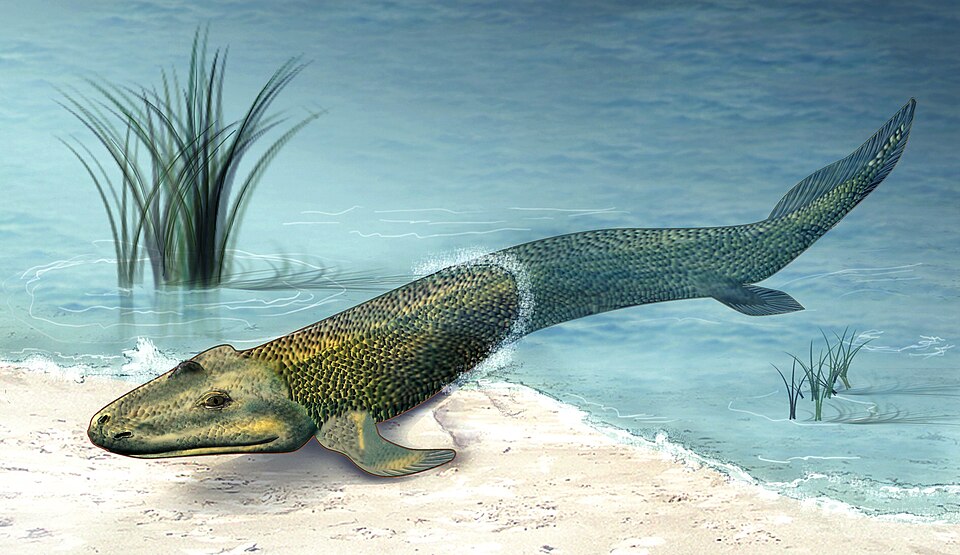
Tiktaalik roseae is a Late Devonian lobe-finned fish discovered in 2004 on Ellesmere Island in the Canadian Arctic, dating to approximately 375 million years ago. Described formally in 2006 by Neil Shubin, Edward Daeschler, and Farish Jenkins, the animal occupies a pivotal phylogenetic position between advanced lobe-finned fishes such as Panderichthys and the earliest limbed tetrapods such as Acanthostega.1, 2 Its mosaic anatomy combines a fish-like body plan with features previously known only in tetrapods, making it one of the most celebrated transitional fossils in vertebrate paleontology.
The name Tiktaalik derives from the Inuktitut word for the large freshwater fish known as burbot, chosen in consultation with elders of the Nunavut Council. The species name roseae honors an anonymous donor who supported the fieldwork.4 Multiple specimens have been recovered from the Fram Formation on southern Ellesmere Island, collectively preserving most of the skeleton and enabling detailed anatomical description of the skull, pectoral fins, pelvic girdle, axial column, and cranial endoskeleton.1, 2, 3, 5

Discovery and prediction
Tiktaalik stands out in the history of paleontology because its discovery was deliberately predicted. By the early 2000s, paleontologists understood that the transition from lobe-finned fishes to limbed tetrapods occurred during the Late Devonian period, roughly 385 to 365 million years ago. The most fish-like elpistostegalian, Panderichthys, dated to approximately 380 million years ago, while the earliest known limbed forms such as Acanthostega and Ichthyostega dated to approximately 365 million years ago.6, 9, 10 A morphological intermediate of approximately 375 million years in age was therefore expected to exist.
Shubin, Daeschler, and Jenkins identified the Fram Formation of Ellesmere Island as an ideal target. The formation consisted of Late Devonian freshwater fluvial sediments of precisely the right age, yet it had never been prospected for vertebrate fossils.4 After several field seasons beginning in 1999, the team recovered the first specimens in 2004. The discovery validated the predictive power of evolutionary theory and stratigraphy: by reasoning from phylogenetic bracketing and geological age, the researchers correctly identified where in the world and in which rock unit an intermediate form was most likely preserved.1, 4
Skull and cranial anatomy
The skull of Tiktaalik is broad and dorsoventrally flattened, resembling the shape of a crocodile's head rather than the laterally compressed skulls of most fishes. The eyes are positioned dorsally on the skull roof, an arrangement suited for peering above the waterline while the body remained submerged, much like modern crocodilians.1, 5, 9 The spiracular notch, which in fishes houses part of the gill apparatus, is reduced compared to more basal sarcopterygians but not yet enlarged into the otic notch that houses the tympanic membrane in later tetrapods.5
The cranial endoskeleton reveals a combination of fish and tetrapod conditions. The hyomandibula, a large bone that in fish braces the jaw against the braincase, is reduced in size in Tiktaalik, representing an intermediate step toward the stapes of the tetrapod middle ear.5, 14 The intracranial joint, a hinge within the braincase that allows fish to raise the front of the skull during feeding, is present but functionally reduced. This feature would be lost entirely in later tetrapods.5
Crucially, Tiktaalik possesses a mobile neck. In fish, the pectoral girdle is rigidly connected to the skull, meaning the head and shoulder move as a single unit. In Tiktaalik, the connection between skull and shoulder girdle is lost, freeing the head to move independently of the body for the first time in vertebrate evolution.1, 8 This separation was a prerequisite for the head mobility required by terrestrial predators to track and capture prey on land.
Pectoral fin and limb homology
The pectoral fin of Tiktaalik is the single most informative element of its anatomy for understanding the origin of the tetrapod forelimb. The fin skeleton contains bones directly homologous to the humerus, radius, and ulna of tetrapod arms, arranged in the same spatial relationships. Distal to these long bones, a series of radials fan outward, occupying the anatomical position where wrist bones and fingers would later appear in true tetrapods.2
Unlike the fins of more basal lobe-finned fishes, the joints of Tiktaalik's pectoral fin permitted a range of motion including flexion and extension at the elbow-equivalent joint and limited rotation at the shoulder. Biomechanical analysis indicates that the fin could be positioned beneath the body and used to prop the animal up off the substrate, bearing a portion of its body weight.2, 4 This capacity for substrate-directed force represents a functional intermediate between the lateral fin strokes of fish swimming and the weight-bearing stance of tetrapod forelimbs.
The comparison with Panderichthys is instructive. CT scanning of Panderichthys pectoral fins revealed rudimentary distal radials that may be precursors to digits, but these elements are far less elaborate than those in Tiktaalik.12 Conversely, in Acanthostega, the distal elements are fully differentiated into eight distinct digits.7, 9 Tiktaalik occupies the morphological space between these two conditions, possessing elaborated but not yet digit-bearing distal fin elements.
Pelvic girdle and hind fin
For years after the initial description, the pelvic anatomy of Tiktaalik remained unknown because the relevant portions of the skeleton had not yet been prepared. In 2014, Shubin, Daeschler, and Jenkins published a description of the pelvic girdle and hind fin, revealing that the pelvis was far more robust than expected for a fish of its grade.3 The ilium, ischium, and pubis are all present and well-ossified, forming a substantial pelvic plate comparable in relative size to those of early tetrapods.
The hind fin skeleton mirrors the elaboration seen in the pectoral fin, with a femur homolog, distal long bones, and extensive radials. The size and robustness of the pelvic girdle suggest that Tiktaalik used its hind fins for active propulsion and possibly for substrate locomotion, challenging the traditional view that hind limb elaboration lagged behind forelimb evolution during the fish-to-tetrapod transition.3 This finding indicates that the shift toward powerful hind-limb-driven locomotion began earlier in tetrapod evolution than previously recognized.
Axial skeleton and ribcage
The vertebral column of Tiktaalik displays a combination of primitive and derived features. The vertebrae themselves are relatively simple, retaining the poorly ossified centra typical of lobe-finned fishes, but the neural arches are robust and imbricated in a manner that would have stiffened the trunk against the lateral undulations used in aquatic locomotion.1, 8
The ribs are among the most tetrapod-like features of Tiktaalik's axial skeleton. They are broad, overlapping, and ventrally curved, forming a barrel-shaped ribcage that could have supported the body against gravity when the animal was out of water. In aquatic vertebrates, the surrounding water provides buoyancy and the ribs serve primarily for muscle attachment. Broad, overlapping ribs like those of Tiktaalik suggest the beginning of a weight-supporting function, preventing the viscera from collapsing under gravity during brief excursions onto land or while propping up at the water's edge.1, 4
Ecology and paleoenvironment
The Fram Formation sediments that yielded Tiktaalik represent a meandering fluvial system with shallow channels, point bars, and overbank deposits. During the Late Devonian, Ellesmere Island lay in subtropical latitudes, and the depositional environment was a warm, seasonally variable floodplain crossed by shallow streams.1, 4 This setting is consistent with the ecological scenario proposed for the fish-to-tetrapod transition, in which shallow, vegetation-choked waterways favored adaptations for navigating between pools, breathing air, and supporting the body on substrates.8, 10
The dorsally placed eyes and flattened skull profile suggest that Tiktaalik was a surface-oriented predator, lying in shallow water and ambushing prey from below. Its large size, estimated at up to 2.7 meters in total body length, placed it among the apex predators of its ecosystem.1 The combination of robust pectoral fins capable of substrate locomotion, a mobile neck for striking at prey, and a body plan suited for shallow-water environments paints a picture of an animal adapted to life at the interface between water and land.
Environmental pressures during the Late Devonian may have driven the evolution of terrestrial adaptations in elpistostegalian fishes. Fluctuating water levels, oxygen-poor water in warm shallow pools, and competition or predation in open aquatic habitats could all have favored individuals capable of navigating between water bodies or exploiting shoreline resources.8, 15
Phylogenetic position
Phylogenetic analyses consistently place Tiktaalik within the Elpistostegalia (also known as Stegocephali in some classifications), a clade of advanced lobe-finned fishes that includes the tetrapod stem lineage. Within this group, Tiktaalik falls between Panderichthys and Ventastega on the tetrapod stem, more derived than any fish but more basal than any animal possessing true digits.1, 11
The phylogenetic sequence from more basal to more derived forms runs approximately as follows: Eusthenopteron, Panderichthys, Tiktaalik, Ventastega, Acanthostega, Ichthyostega, and Tulerpeton.9, 10, 13 Each successive taxon in this series acquires additional tetrapod features while retaining progressively fewer fish-like characteristics. Tiktaalik is notable for combining a fish-like body outline, fin rays, and scales with a tetrapod-like skull, neck, ribcage, and limb-like fin skeleton, making it one of the most morphologically intermediate forms in the entire sequence.
Acquisition of tetrapod features across the fish-to-tetrapod transition9, 10
| Feature | Panderichthys | Tiktaalik | Acanthostega |
|---|---|---|---|
| Flattened skull | Yes | Yes | Yes |
| Dorsal eyes | Yes | Yes | Yes |
| Mobile neck | No | Yes | Yes |
| Robust ribs | No | Yes | Yes |
| Limb-like fin bones | Partial | Yes | Yes |
| True digits | No | No | Yes (8) |
| Fin rays | Yes | Yes | No |
| Internal gills | Yes | Reduced | Yes |
| Weight-bearing pelvis | No | Yes | Yes |
Significance for evolutionary biology
Tiktaalik holds a special place in evolutionary biology for several reasons. First, its discovery demonstrated that paleontological predictions based on evolutionary theory and stratigraphy can be tested and confirmed. The hypothesis that an intermediate form of a specific morphological grade should exist in rocks of a specific age and depositional environment was formulated before fieldwork began, and the discovery of Tiktaalik confirmed that hypothesis.1, 4
Second, the detailed anatomy of Tiktaalik illuminates the sequence and functional logic of the fish-to-tetrapod transition. Rather than a sudden leap from fins to limbs, the fossil record now documents a gradual, stepwise acquisition of tetrapod features. The mobile neck preceded the evolution of digits. The weight-bearing ribcage preceded fully terrestrial locomotion. The elaboration of the pelvic girdle began while the animal was still fundamentally aquatic.2, 3, 8 Each innovation had functional utility in the shallow-water environments that these animals inhabited, rather than representing preadaptations for a terrestrial life that had not yet begun.
Third, Tiktaalik has become one of the most effective teaching examples in evolutionary biology, illustrating concepts of transitional morphology, homology, predictive paleontology, and the relationship between form and function. Neil Shubin's popular book Your Inner Fish used Tiktaalik as the centerpiece of a broader argument about the deep evolutionary continuity between fish and human anatomy.4
Broader context of the Devonian transition
The discovery of Tiktaalik occurred within a broader wave of Late Devonian discoveries that collectively transformed understanding of the fish-to-tetrapod transition. In 2008, Ventastega curonica from Latvia was described as another intermediate form, more derived than Tiktaalik but more basal than Acanthostega, filling yet another gap in the morphological series.11 Also in 2008, CT scanning of Panderichthys fins revealed distal radials with possible homology to digits, pushing the origin of digit-like structures deeper into the fish lineage than previously recognized.12
Perhaps most surprisingly, the 2010 discovery of tetrapod trackways from the Middle Devonian of Poland, dating to approximately 395 million years ago, indicated that limbed vertebrates existed some 18 million years before Tiktaalik.15 If confirmed as genuine tetrapod tracks, these trace fossils suggest that Tiktaalik may represent a late-surviving lineage retaining ancestral morphology rather than a direct ancestor of later tetrapods. Regardless of its precise phylogenetic relationship to crown tetrapods, Tiktaalik remains invaluable as a demonstration of the morphological grade through which the transition from fish to tetrapod passed, documenting the anatomical and functional stages that characterized one of the most consequential transitions in vertebrate history.8, 10
References
Acanthostega gunnari, a Devonian tetrapod from Greenland; the snout, palate and ventral parts of the braincase, with a discussion of their significance