Overview
- Anselm of Canterbury's ontological argument, first presented in the Proslogion (1077-1078), defines God as 'that than which nothing greater can be conceived' and argues by reductio ad absurdum that such a being must exist in reality, since a being existing only in the understanding would be surpassable by one that also exists in reality.
- The Proslogion contains two logically distinct arguments: the Chapter 2 argument for God's existence in reality and the Chapter 3 argument for God's necessary existence, with the latter claiming that a being which cannot be conceived not to exist is greater than one which can, and twentieth-century philosophers Norman Malcolm and Charles Hartshorne identified this second argument as a stronger formulation that sidesteps Kant's objection about existence.
- The argument has generated nearly a millennium of philosophical debate, from Gaunilo's immediate parody objection and Thomas Aquinas's epistemic rejection to Kant's claim that existence is not a real predicate, and it remains a foundational text in the philosophy of religion whose influence extends to contemporary modal logic and analytic metaphysics.
Anselm of Canterbury's ontological argument is the founding instance of a distinctive type of argument for God's existence: one that proceeds entirely from the analysis of the concept of God, without appeal to any empirical observation about the world. First presented in chapters 2 and 3 of the Proslogion, composed between 1077 and 1078, the argument begins with the definition of God as "that than which nothing greater can be conceived" (id quo nihil maius cogitari possit) and attempts to demonstrate that a being matching this description must exist in reality as a matter of logical necessity.1 The argument is a priori — its premises appeal only to reason and conceptual analysis, not to evidence drawn from the natural world — and it has the form of a reductio ad absurdum, showing that the denial of God's existence leads to a contradiction within the very concept of God.
The ontological argument has generated nearly a millennium of sustained philosophical debate. Within Anselm's own lifetime, Gaunilo of Marmoutiers raised the objection that parallel reasoning could establish the existence of a perfect island.3 Thomas Aquinas rejected the argument on epistemic grounds in the thirteenth century.4 Immanuel Kant mounted the objection that existence is not a real predicate in the eighteenth century.5 And in the twentieth century, Norman Malcolm and Charles Hartshorne revived interest in the argument by distinguishing two separate arguments within the Proslogion and contending that the second — concerning necessary existence — escapes the classical objections.6, 7 This article examines Anselm's argument in its original context, reconstructs both of its formulations, surveys the major objections and responses, and assesses its place in the history of philosophy.
Historical context
Anselm was born around 1033 in Aosta, in what is now northwestern Italy. He entered the Benedictine monastery of Bec in Normandy in 1060, became prior in 1063, and was appointed abbot in 1078. He later served as Archbishop of Canterbury from 1093 until his death in 1109.2, 12 His philosophical and theological writings were composed primarily during his years at Bec, in the setting of a monastic community devoted to prayer, study, and contemplation. This context matters for understanding the Proslogion, because Anselm did not present his argument as a detached exercise in philosophical reasoning but as a meditation undertaken within the practice of faith — an attempt to understand through reason what he already accepted by belief.
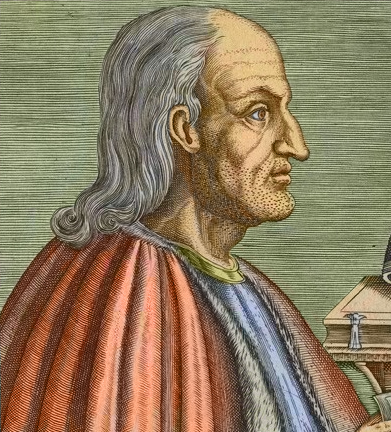

Before composing the Proslogion, Anselm had already written the Monologion (1075–1076), which offered a series of arguments for God's existence based on the degrees of goodness, greatness, and being found in the world. These arguments were complex and multi-stepped, and Anselm expressed dissatisfaction with their unwieldiness. He sought what he called a "single argument" (unum argumentum) that would, by itself and without any supporting arguments, establish that God exists and possesses all the attributes traditionally ascribed to him — supreme goodness, omnipotence, mercy, justice, and self-existence.1, 2 The Proslogion was Anselm's attempt to produce this single, self-sufficient argument.
The Proslogion is structured as a prayer — its original title was Fides Quaerens Intellectum ("Faith Seeking Understanding"), reflecting the Augustinian principle that belief precedes and motivates rational inquiry into the things believed.1, 12 The argument appears in chapters 2 and 3 of the work. Chapter 2 establishes that God exists in reality, and chapter 3 extends the conclusion to argue that God exists necessarily — that God cannot even be conceived not to exist. The remaining chapters of the Proslogion use the same conceptual framework to derive God's traditional attributes, arguing that whatever it is greater to be than not to be, God must be.
Anselm's argument was composed in an intellectual environment shaped by the methods of early Scholasticism, in which rigorous dialectical reasoning was applied to theological questions. His approach was distinctive in that it dispensed entirely with appeals to the observable world. Unlike the arguments of his near-contemporary Thomas Aquinas, who would argue a century and a half later from motion, causation, and contingency, Anselm's argument proceeded from a definition and a logical principle alone. This made it the first purely a priori argument for God's existence in the Western philosophical tradition.8, 12
The definition: "that than which nothing greater can be conceived"
The foundation of Anselm's argument is a specific definition of God: aliquid quo nihil maius cogitari possit — "something than which nothing greater can be conceived," or equivalently, "that than which nothing greater can be thought." This definition is not a description of God's nature in terms of specific attributes such as omnipotence or omniscience; rather, it is a formula that captures the concept of maximal greatness in a single phrase. Whatever qualities contribute to a being's greatness, a being than which nothing greater can be conceived possesses them all, because any being that lacked a greatness-making quality could be surpassed by one that possessed it.1, 2
Anselm does not argue for this definition as though it were a controversial claim that needs defending. He treats it as something that any person — including the "fool" (insipiens) of Psalm 14:1 who "says in his heart, 'There is no God'" — can grasp and hold in the understanding. The definition does not presuppose that God exists; it merely specifies what the word "God" means. Even the person who denies that God exists understands what is being denied, and in understanding the phrase "that than which nothing greater can be conceived," the person has this concept present in the understanding (in intellectu).1
The concept of "greatness" (maius) operative in the definition is not physical magnitude but metaphysical or axiological greatness — a measure encompassing such properties as power, knowledge, goodness, independence, and mode of existence. A being that exists independently is greater than one that depends on another; a being that exists necessarily is greater than one that exists contingently; a being that is omniscient is greater than one with limited knowledge. The definition thus functions as a maximality principle: God is the upper limit of the scale of conceivable greatness.2, 12
A critical feature of the definition is that it concerns what can be conceived, not what actually exists. The argument begins in the realm of thought and attempts to show that thought itself, properly analysed, compels the conclusion that the being in question exists in reality. This move from concept to reality is the distinctive and controversial step that has driven the argument's reception for nearly a thousand years.8
The argument from Proslogion chapter 2
In chapter 2 of the Proslogion, Anselm presents the argument that God — that than which nothing greater can be conceived — exists not merely in the understanding but also in reality. The argument proceeds by reductio ad absurdum: it assumes the opposite of what is to be proved, derives a contradiction, and concludes that the assumption must be false.1
Anselm's reasoning can be reconstructed in formal premise-conclusion structure as follows:
P1. God is defined as that than which nothing greater can be conceived.
P2. This concept exists at least in the understanding — even the fool who denies God's existence grasps the concept when hearing the words.
P3. A being that exists both in the understanding and in reality is greater than a being that exists in the understanding alone.
P4. Suppose (for reductio) that God exists only in the understanding and not in reality.
P5. Then a being greater than God could be conceived — namely, a being with all of God's conceived qualities that also exists in reality.
P6. But this contradicts the definition of God as that than which nothing greater can be conceived (P1).
C. Therefore, the supposition is false: God must exist both in the understanding and in reality.
The argument's logical structure is that of an indirect proof. Anselm begins with a definition (P1) and an uncontroversial claim about the fool's mental capacity (P2). He then introduces the principle that real existence confers greatness beyond mere conceptual existence (P3). The reductio hypothesis (P4) assumes that the being defined in P1 lacks real existence. From this assumption and the greatness principle, it follows that a greater being than the greatest conceivable being can be conceived (P5), which is a contradiction (P6). The contradiction forces the rejection of P4, yielding the conclusion that God exists in reality.1, 8
The argument, if valid, establishes its conclusion with deductive certainty — not as probable or likely, but as logically necessary given the premises. An argument is valid when the conclusion follows necessarily from the premises, regardless of whether the premises are true. An argument is sound when it is valid and all its premises are in fact true. The question of the ontological argument's soundness therefore reduces to the question of whether P1 through P3 are true.8
P1 functions as a stipulative definition, and its truth depends on whether the concept it specifies is logically coherent — whether there could be a being answering to this description without internal contradiction. P2 is a psychological claim that appears modest: anyone considering the argument at least entertains the concept in question. The philosophically contentious premise is P3: the claim that existing in reality is "greater" than existing in the understanding alone. This premise presupposes a metaphysical framework in which existence is a perfection — a greatness-making property — and it is precisely this presupposition that Kant would later challenge.1, 5, 9
The argument from Proslogion chapter 3
In chapter 3, Anselm extends the argument beyond the claim that God exists to the stronger claim that God exists necessarily — that God cannot even be conceived not to exist. Where chapter 2 argues that existence in reality is greater than existence in the understanding alone, chapter 3 argues that a mode of existence that excludes the possibility of non-existence is greater than a mode of existence that is compatible with non-existence. The argument introduces the concept of necessary existence and applies the same maximality principle to it.1
P1. God is that than which nothing greater can be conceived.
P2. A being that cannot be conceived not to exist is greater than a being that can be conceived not to exist.
P3. Suppose (for reductio) that God can be conceived not to exist.
P4. Then a being greater than God could be conceived — namely, a being with all of God's qualities that also cannot be conceived not to exist.
P5. But this contradicts the definition of God as that than which nothing greater can be conceived (P1).
C. Therefore, God cannot be conceived not to exist — God exists necessarily.
The chapter 3 argument parallels the structure of the chapter 2 argument but operates at a higher modal level. Where chapter 2 argued from the greatness of existence over non-existence, chapter 3 argues from the greatness of necessary existence over contingent existence. A being that exists but might not have existed — a contingent being — is surpassable by a being that exists and could not have failed to exist. Since God is that than which nothing greater can be conceived, God must possess the unsurpassable mode of existence: necessary existence.1, 6
The distinction between the two arguments became a major focus of twentieth-century scholarship. Norman Malcolm argued in 1960 that while the chapter 2 argument is vulnerable to Kant's objection that existence is not a real predicate, the chapter 3 argument escapes it. Kant's objection, as Malcolm read it, applies to the claim that existence is a perfection or greatness-making property. But the chapter 3 argument does not depend on this claim. Instead, it depends on the claim that necessary existence — existence that cannot fail to obtain — is a perfection. And necessary existence, unlike mere existence, does appear to be a genuine property that distinguishes one kind of being from another: a being that exists necessarily differs in a real way from a being that exists contingently, whereas (on the Kantian view) a being that exists does not differ in any real way from a merely conceived being.6
Charles Hartshorne developed a similar reading of Anselm independently. In The Logic of Perfection (1962) and Anselm's Discovery (1965), Hartshorne argued that the essential insight of the Proslogion is not the chapter 2 claim that existence is better than non-existence, but the chapter 3 claim that necessary existence is a perfection that belongs uniquely to the greatest conceivable being. Hartshorne formalised this insight using the tools of modern modal logic, arguing that the concept of God entails that God's existence is either necessary or impossible — there is no middle ground of mere contingent existence for a being defined as maximally great. If God's existence is not impossible (that is, if the concept is coherent), then God exists necessarily.7, 11
Comparison of Proslogion chapter 2 and chapter 3 arguments1, 6
| Feature | Proslogion chapter 2 | Proslogion chapter 3 |
|---|---|---|
| Conclusion | God exists in reality | God exists necessarily |
| Greatness principle | Existence in reality > existence in understanding alone | Necessary existence > contingent existence |
| Reductio assumption | God exists only in the understanding | God can be conceived not to exist |
| Key concept | Existence vs. non-existence | Necessity vs. contingency |
| Vulnerability to Kant | Directly challenged (existence as predicate) | Escapes Kant if necessary existence is a real property |
| 20th-century defenders | Few — generally considered weaker | Malcolm, Hartshorne, Plantinga |
The question of whether Anselm himself intended two distinct arguments or a single argument with two stages remains debated among scholars. Some interpreters, following Malcolm and Hartshorne, treat chapters 2 and 3 as logically independent arguments with different premises and different conclusions.6, 7 Others, including Sandra Visser and Thomas Williams, argue that the text is better read as a single continuous argument in which chapter 3 deepens and completes the conclusion of chapter 2 rather than standing as a separate proof.2 On either reading, the chapter 3 material introduces the concept of necessary existence, and it is this concept that has proved most fertile for subsequent developments in the ontological argument tradition.
Gaunilo's objection and Anselm's reply
The first objection to the ontological argument came from Gaunilo, a Benedictine monk at the abbey of Marmoutiers, who composed a response titled Pro Insipiente ("On Behalf of the Fool") shortly after the Proslogion appeared. Gaunilo's strategy was what modern philosophers call a parody or overgeneration objection: he attempted to show that Anselm's form of reasoning, if valid, would prove the existence of things that obviously do not exist, and that the reasoning must therefore be flawed.3
Gaunilo asked the reader to suppose that somewhere in the ocean there is a "lost island" (insula perdita) more excellent than any other island — an island surpassing all other lands in its abundance of riches and delights. By Anselm's reasoning, Gaunilo argued, this island must exist in reality. For if it existed only in the understanding, one could conceive of an island that also exists in reality, and such an island would be more excellent than one existing in the understanding alone. Therefore the most excellent conceivable island must exist in reality. Since this conclusion is absurd — there is no reason to think that a supremely excellent island exists merely because we can form the concept — the form of reasoning that produces it must be invalid, and Anselm's parallel argument about God must fail as well.3
Gaunilo also raised a more fundamental objection to the move from conceptual to real existence. He questioned whether having a concept "in the understanding" is sufficient to ground claims about reality. When one hears the words "that than which nothing greater can be conceived," one may understand the words individually, but it does not follow that one genuinely grasps the thing signified in the way that would be required for the argument to work. The concept, Gaunilo suggested, may be too indeterminate to support the weight the argument places upon it.3, 12
Anselm's reply, preserved alongside the Proslogion in the manuscript tradition at his own insistence, focused on the disanalogy between God and the lost island. The argument works, Anselm maintained, only for "that than which nothing greater can be conceived" and not for islands or any other category of thing. An island, no matter how excellent, is the kind of thing that can always be improved: more beaches, better climate, more abundant fruit. There is no intrinsic upper bound to island-excellence, and therefore no coherent concept of a "most excellent conceivable island." But a being than which nothing greater can be conceived is defined precisely as that which admits of no improvement — it is the conceptual ceiling of greatness. Only for such a being does the denial of existence generate a genuine contradiction, because only for such a being would non-existence constitute a deficiency that renders it surpassable.1, 8
Anselm's reply amounts to the claim that the argument's form of reasoning is not universally applicable but applies uniquely to a being whose definition includes unsurpassable greatness. If this is correct, Gaunilo's parody fails because it misapplies a principle that has a restricted domain. If Anselm is wrong — if the reasoning is either universally valid or universally invalid and cannot be restricted to one special case — then Gaunilo's parody stands as a reductio of the argument. Evaluating this exchange requires determining whether there is a principled distinction between concepts that can and concepts that cannot ground claims about real existence through a priori reasoning alone.9, 12
Thomas Aquinas's rejection
Thomas Aquinas, writing in the Summa Theologiae (I, q. 2, a. 1) approximately 170 years after the Proslogion, rejected Anselm's argument, though he did not mention Anselm by name. Aquinas argued that the proposition "God exists" is self-evident in itself (per se nota secundum se) — that is, the predicate is contained in the subject, because God's essence is identical with God's existence. However, Aquinas contended that the proposition is not self-evident to us (quoad nos), because human beings do not have direct knowledge of God's essence. We cannot simply inspect the concept of God and read off whether existence belongs to it, because we do not know what God is in the way that would be required.4
Aquinas's objection is epistemic rather than logical. He did not argue that Anselm's reasoning is formally invalid or that its premises are false. Rather, he argued that human knowers are not in an epistemic position to know whether the key premise is true. Even if it is the case that existence belongs to God's essence — and Aquinas believed that it does — this is not something that can be established by conceptual analysis alone. It requires demonstration from effects, which is why Aquinas offered his own Five Ways, all of which argue from observed features of the world (motion, causation, contingency, degrees of perfection, teleology) to the existence of a first cause.4, 12
Aquinas also raised a version of what later commentators have called the "concept-to-reality gap." Even if one grants that God is defined as that than which nothing greater can be conceived, and even if one grants that a being existing in reality is greater than one existing in the understanding alone, it does not follow that such a being exists in reality. It follows only that if such a being exists in the understanding, one conceives that it exists in reality — but conceiving that something exists in reality and that thing actually existing in reality are different matters. The argument, on Aquinas's reading, confuses a conclusion about what we must think with a conclusion about what actually is the case.4, 8
Defenders of Anselm have responded that Aquinas's objection misreads the argument. Anselm does not claim to know God's essence directly; rather, he operates with a definition — "that than which nothing greater can be conceived" — that anyone can understand without possessing comprehensive knowledge of God's nature. The argument does not require knowing everything about God; it requires only understanding the definition and accepting the greatness principle. Whether this response adequately addresses Aquinas's concern remains a point of disagreement in the secondary literature.2, 12
Kant's objection: existence is not a real predicate
The most influential objection to the ontological argument in the history of philosophy comes from Immanuel Kant's Critique of Pure Reason (1781). In the section titled "The Impossibility of an Ontological Proof of the Existence of God," Kant argued that "being is obviously not a real predicate, that is, a concept of something that could be added to the concept of a thing."5 By "real predicate" (reales Prädikat), Kant meant a determining predicate — a property that genuinely enlarges or determines a concept by adding content to it. Existence, Kant contended, does not function in this way. To say that a thing exists is not to attribute a new quality to it; it is merely to posit the thing, with all its qualities, as having an instance in reality.
Kant illustrated his point with the example of a hundred thalers. The concept of a hundred actual thalers contains no more properties than the concept of a hundred merely possible thalers. The actual thalers are the same denomination, the same weight, the same metal as the merely conceived thalers. The difference is not that the actual thalers possess some additional property — the property of "existence" — that the merely possible thalers lack. The difference is simply that the concept is instantiated in the one case and not in the other. Existence, in other words, is not a predicate that adds to the concept but a copula that connects the concept to reality.5
If Kant's analysis is correct, it strikes at the heart of Anselm's chapter 2 argument. Premise P3 of that argument asserts that existing in reality is greater than existing in the understanding alone — that existence is a greatness-making property. But if existence is not a real predicate, it cannot be a property at all, and therefore cannot be a greatness-making property. A being that exists and a being that is merely conceived have exactly the same intrinsic properties; the existing being is not "greater" in any sense that involves possessing an additional quality. The comparison between a being "in the understanding" and a being "in reality" that drives the reductio would therefore be illegitimate.5, 8
Kant's objection has been evaluated from multiple angles. Gottlob Frege's later development of formal logic provided a framework in which existence is treated not as a first-order predicate (a property of objects) but as a second-order predicate (a property of concepts) — to say "horses exist" is to say that the concept "horse" has instances, not that individual horses possess a property called "existence." This Fregean treatment is often seen as vindicating Kant's intuition in a more precise logical form.8, 13
Responses to Kant's objection have taken several forms. Some defenders of ontological arguments have challenged Kant's thesis directly, arguing that existence does function as a predicate in ordinary language and reasoning. When someone says "tigers exist but dragons do not," the sentence predicates something of tigers and denies it of dragons, which appears to be a straightforward case of predication.9 Others have conceded that Kant's objection is effective against the chapter 2 argument but contended that it does not reach the chapter 3 argument, which concerns necessary existence rather than existence simpliciter. If necessary existence is a genuine modal property — a property that distinguishes beings that exist in all possible worlds from beings that exist only contingently — then the ontological argument can be reformulated in a way that does not treat bare existence as a predicate.6, 10
Malcolm and Hartshorne: the twentieth-century revival
After nearly two centuries during which the ontological argument was widely considered to have been undermined by Kant, Norman Malcolm revived it in a 1960 article in The Philosophical Review titled "A New Look at the Ontological Argument." Malcolm's central claim was that commentators had focused almost exclusively on the chapter 2 argument and had overlooked a logically distinct and stronger argument in chapter 3. The chapter 2 argument, Malcolm agreed, is vulnerable to Kant's objection: it treats existence as a perfection, and if existence is not a real predicate, the argument fails. But the chapter 3 argument does not depend on the claim that existence is a perfection. Instead, it depends on the claim that necessary existence is a perfection — and this claim, Malcolm argued, is not affected by Kant's objection.6
Malcolm's reconstruction of the chapter 3 argument proceeded as follows. If God exists, God's existence is necessary — it is not the kind of existence that could come into being or cease to be, because a being whose existence depended on external causes or conditions would not be the greatest conceivable being. This means that God's existence is either logically necessary or logically impossible; there is no third option of contingent existence for a being so defined. If the concept of a necessarily existing being is not self-contradictory — if it does not harbour a hidden logical impossibility — then such a being exists. Malcolm argued that no one has demonstrated a logical impossibility in the concept of a necessarily existing being, and that the concept is therefore coherent, which yields the conclusion that God exists necessarily.6
Charles Hartshorne arrived at a similar conclusion through a different philosophical route. Writing from the perspective of process philosophy and neoclassical metaphysics, Hartshorne argued in The Logic of Perfection (1962) and Anselm's Discovery (1965) that Anselm's genuine contribution was not the principle that existence is better than non-existence but the principle that necessary existence is a perfection uniquely belonging to the divine nature. Hartshorne formalised the argument using modal logic, presenting what he called "Anselm's principle": if the existence of a perfect being is so much as possible, then it is necessary, because a being whose existence is merely contingent — possible but not necessary — would not be unsurpassably great.7, 11
Hartshorne's formalisation made explicit a logical feature that Malcolm had identified but not fully developed. In the S5 system of modal logic, which both Hartshorne and later Alvin Plantinga employed, the principle holds that if a proposition is possibly necessary, then it is necessary. Applied to the ontological argument: if it is possible that a necessarily existing being exists, then a necessarily existing being exists. The entire weight of the argument therefore falls on the possibility premise — whether the concept of a necessarily existing, maximally great being is coherent.7, 10, 11
Malcolm's and Hartshorne's work generated a substantial body of critical responses. David Lewis objected in 1970 that Malcolm's argument equivocated between two senses of "necessary existence": existence that is logically necessary (true in virtue of logic alone) and existence that is factually indestructible (cannot be caused to cease). Lewis argued that the concept of logically necessary existence is coherent only for abstract objects like numbers, not for concrete beings like God.14 Others objected that the possibility premise is question-begging: in the modal framework employed, accepting that a necessarily existing being is possible is logically equivalent to accepting that it actually exists, which means the premise presupposes the conclusion.9, 13 Defenders responded that while the logical equivalence holds, the epistemic situation is different — one might have rational grounds for accepting the possibility without having independently arrived at belief in God's existence.10
Analysis of the key premises
The soundness of Anselm's argument depends on the truth of its premises. The most important premises across both the chapter 2 and chapter 3 formulations can be examined individually.
The definition premise — that God is that than which nothing greater can be conceived — functions as a stipulative definition and raises the question of whether the concept it specifies is logically coherent. If the concept of a being than which nothing greater can be conceived is self-contradictory, the argument fails at the outset, just as an argument beginning "let x be a round square" would fail because the concept is incoherent. Leibniz recognised this issue and attempted to prove that all perfections are mutually compatible. Whether the concept is coherent remains contested: some philosophers have argued that certain divine attributes (omnipotence and omniscience, or omnipotence and perfect goodness) may generate paradoxes or conflicts, though proponents respond that these paradoxes arise from misunderstandings of the attributes in question.8, 9, 13
The greatness principle — that existence in reality is greater than existence in the understanding alone (chapter 2), or that necessary existence is greater than contingent existence (chapter 3) — is the engine that drives the reductio. For the chapter 2 argument, this principle asserts that a being with all of a given set of properties plus real existence is greater than a being with those same properties but without real existence. The plausibility of this principle depends on one's prior metaphysical commitments. Those who hold that existence is a genuine perfection will accept it; those who follow Kant in denying that existence is a real predicate will reject it. For the chapter 3 argument, the principle shifts to the modal claim that necessary existence is a greatness-making property, and this version is harder to deny, since necessary existence does appear to mark a genuine distinction between kinds of beings.1, 5, 6
The conceivability premise — that the fool at least has the concept "in the understanding" — has also attracted scrutiny. Some critics have asked whether it is genuinely possible to have the concept of that than which nothing greater can be conceived "in the understanding" in the robust sense required by the argument. Having a concept in the understanding, on this objection, requires more than merely understanding the words of the definition; it requires grasping a determinate concept that can ground inferences about its real-world instantiation. If the concept is too indeterminate or too unconstrained, the argument's move from understanding to reality may not be licensed.3, 14
Influence on subsequent ontological arguments
Anselm's argument in the Proslogion established the template for all subsequent ontological arguments. Every later version — Descartes's argument from the essence of a supremely perfect being, Leibniz's argument for the coherence of the concept of perfection, Gödel's formal proof, and Plantinga's modal ontological argument — can be understood as responding to perceived weaknesses in Anselm's original formulation while preserving its core strategy of moving from concept to existence through a priori reasoning.8
Descartes, writing in the Fifth Meditation (1641), shifted the argument's conceptual basis from Anselm's comparative formula ("that than which nothing greater can be conceived") to the constitutive claim that existence is contained in the essence of a supremely perfect being, just as the property of having three angles is contained in the essence of a triangle. This reformulation avoided Anselm's reliance on a comparison between beings existing in the understanding and beings existing in reality, but it inherited the vulnerability to Kant's later objection about the predicative status of existence.8, 9
The twentieth-century modal reformulations by Malcolm, Hartshorne, and Plantinga drew directly on the chapter 3 argument's concept of necessary existence. Plantinga's modal ontological argument, developed in The Nature of Necessity (1974), can be seen as a rigorous formalisation of the logical structure that Hartshorne identified in Anselm's chapter 3. Plantinga's argument defines a maximally great being as one that is maximally excellent (omnipotent, omniscient, and morally perfect) in every possible world and argues, using S5 modal logic, that if such a being is even possible, it is actual. The argument thus concentrates the dispute on a single premise — the possibility of maximal greatness — that can be traced directly to Anselm's claim that a being than which nothing greater can be conceived cannot coherently be thought not to exist.10, 11
The influence of Anselm's argument extends beyond the specific debate about God's existence. Kant's critique of the argument shaped the development of modern logic, contributing to Frege's distinction between first-order and second-order predication and to the treatment of existence as a quantifier rather than a predicate in modern formal logic. The argument has also been a productive source of work in modal epistemology — the study of how we can know what is possible and what is necessary — since the key question raised by the modal versions is whether conceivability is a reliable guide to genuine metaphysical possibility.5, 8
Philosophical assessment
The question of whether Anselm's ontological argument succeeds as a proof of God's existence depends on which version of the argument is under consideration and on the philosophical commitments of the evaluator. The chapter 2 argument is logically valid: if the premises are granted, the conclusion follows. The same is true of the chapter 3 argument in its modal formalisation. The dispute is not about validity but about soundness — about whether the premises are true.8, 13
For the chapter 2 argument, the central question is whether Kant's objection is correct. If existence is not a real predicate, then premise P3 — that existence in reality is greater than existence in the understanding alone — is false, and the argument is unsound despite being valid. The strength of this objection depends on the correct theory of predication, a question in philosophical logic that remains actively debated. The Fregean analysis of existence as a second-order predicate provides formal support for Kant's intuition, but not all philosophers accept the Fregean framework as the last word on the metaphysics of existence.5, 9, 13
For the chapter 3 argument, the central question shifts to the possibility premise: is the concept of a necessarily existing, maximally great being coherent? If it is, then in the S5 modal framework the being exists necessarily and therefore actually. If it is not, the argument fails at its first step. The difficulty is that there appears to be no independent way to establish the truth or falsity of this premise. One cannot determine whether a necessarily existing being is possible by examining the empirical world, since the question is about metaphysical possibility, not physical possibility. And the premise is logically equivalent to the conclusion in S5, which means that accepting the premise requires exactly the same epistemic commitment as accepting the conclusion. This symmetry has led some philosophers to conclude that the modal ontological argument, while valid, is dialectically ineffective: it cannot persuade anyone who does not already accept its conclusion.9, 13, 14
Plantinga acknowledged this limitation, arguing that the ontological argument does not claim to be a proof from premises that no rational person could deny. Rather, it shows that theistic belief is rational if the possibility premise is rational — and Plantinga contended that the possibility premise has at least as much intuitive support as its negation. The argument, on this view, functions not as a knock-down proof but as a demonstration that theism is within the bounds of rational acceptability.10
Graham Oppy, who has produced the most comprehensive critical survey of ontological arguments, concludes that no version of the argument provides a rationally compelling reason for a non-theist to adopt theism. The arguments are valid, often ingenious, and illuminate deep questions about the nature of existence, necessity, and the relationship between conceivability and possibility. But each version rests on at least one premise whose truth is as contentious as the conclusion it is meant to establish.9 Hartshorne, by contrast, maintained that the chapter 3 argument reveals a genuine logical truth about the concept of God — that divine existence is either necessary or impossible — and that the burden falls on the critic to demonstrate the incoherence of the concept rather than on the proponent to demonstrate its coherence.7, 11
Whatever assessment one reaches on the question of soundness, the argument's place in the history of philosophy is secure. Anselm's Proslogion initiated a philosophical investigation into the relationship between concepts and existence that has continued without interruption for nearly a thousand years. It raised questions about the nature of existence, the scope of a priori reasoning, and the logic of perfection that remain central to metaphysics and philosophy of religion. And it demonstrated that the concept of God, even when examined purely through the tools of reason, generates philosophical problems of extraordinary depth and difficulty.8, 12