Overview
- The argument from contingency reasons from the existence of contingent beings — things that could have failed to exist — to the existence of a necessary being whose non-existence is impossible, and whose existence explains why there is something rather than nothing.
- The argument depends on the principle of sufficient reason, which holds that every contingent fact has an explanation, and the key philosophical dispute concerns whether this principle is true, whether it can be restricted to avoid unwanted consequences, and whether the universe itself might be a brute fact requiring no external explanation.
- Originating in Avicenna's distinction between necessary and possible existence, developed through Aquinas's Third Way and Leibniz's appeal to sufficient reason, the argument has been reformulated by contemporary philosophers such as Alexander Pruss and Robert Koons using modal logic, restricted versions of the principle of sufficient reason, and probabilistic reasoning.
The argument from contingency is a cosmological argument for the existence of God that reasons from the contingent nature of the universe to the existence of a necessary being. Its central insight is that the things we observe in the world — physical objects, persons, planets, the universe itself — are contingent: they exist, but they might not have existed. A contingent being is one whose non-existence is possible; it does not contain within its own nature a sufficient explanation for why it exists rather than not. The argument contends that the existence of contingent beings can be fully explained only by appealing to a being that exists necessarily — a being whose non-existence is impossible and whose existence is explained by the necessity of its own nature.5
The philosophical foundation of the argument is the principle of sufficient reason (PSR), the thesis that every contingent fact or existent has an explanation. If the PSR is true, then the existence of the universe, as a contingent entity, demands an explanation. That explanation cannot itself be contingent, on pain of requiring a further explanation, and so the chain of explanations must terminate in a necessary being. The argument has ancient roots in the metaphysics of Avicenna, was reformulated by Thomas Aquinas in his Third Way, and received its classical modern statement in the writings of Gottfried Wilhelm Leibniz, who framed the question as "why is there something rather than nothing?" (Leibniz’s cosmological argument)1, 4 In contemporary philosophy of religion, the argument has been defended and refined by Alexander Pruss, Robert Koons, and Richard Swinburne, and has been subjected to sustained critique by Graham Oppy and J. L. Mackie.2, 6, 7
Historical development
The philosophical distinction between necessary and contingent existence originates in the work of the Persian philosopher Avicenna (Ibn Sina, 980–1037 CE). In his major metaphysical work, The Healing (al-Shifa), Avicenna distinguished between beings that are "necessary in themselves" (wajib al-wujud bi-dhatihi) and beings that are "possible in themselves" (mumkin al-wujud bi-dhatihi). A being that is possible in itself does not contain within its own essence any reason why it should exist rather than not; its existence requires an external cause. Avicenna argued that an infinite chain of such possible beings, each explained by another possible being, could not account for the existence of the whole series, because the entire chain would itself be merely possible. There must therefore exist a being that is necessary in itself — one whose essence involves existence and which depends on nothing external for its actuality.12, 4
Avicenna's argument was transmitted to the Latin West through translations of Arabic philosophical texts in the twelfth and thirteenth centuries. Thomas Aquinas (1225–1274), drawing on both Aristotelian and Avicennian sources, incorporated a version of the contingency argument as the Third Way in his Summa Theologiae. Aquinas observed that in the natural world we find things that are "possible to be and not to be" — things that are generated and corrupted, that come into being and pass away. He argued that if everything were merely possible, then at some point nothing would have existed, because what can fail to exist eventually does fail to exist given sufficient time. But if there were ever a time when nothing existed, then nothing could have come into existence, because nothing comes from nothing. Since things clearly do exist now, there must be at least one being whose existence is necessary rather than merely possible.3, 13
Aquinas's Third Way has been the subject of extensive scholarly analysis. William Rowe, in a widely cited study, argued that the Third Way contains a suppressed premise and that its reasoning from "each thing can fail to exist" to "at some time nothing existed" is logically invalid without additional assumptions about the relationship between possibility and actuality over infinite time.13 Whether Aquinas intended a temporal argument (given infinite past time, every possibility is eventually realized) or a more strictly metaphysical argument (contingent beings depend on a sustaining cause at every moment of their existence) remains debated. The metaphysical reading, which does not depend on assumptions about infinite past time, is closer to Avicenna's original reasoning and avoids the logical difficulties that Rowe identified in the temporal reading.4, 13
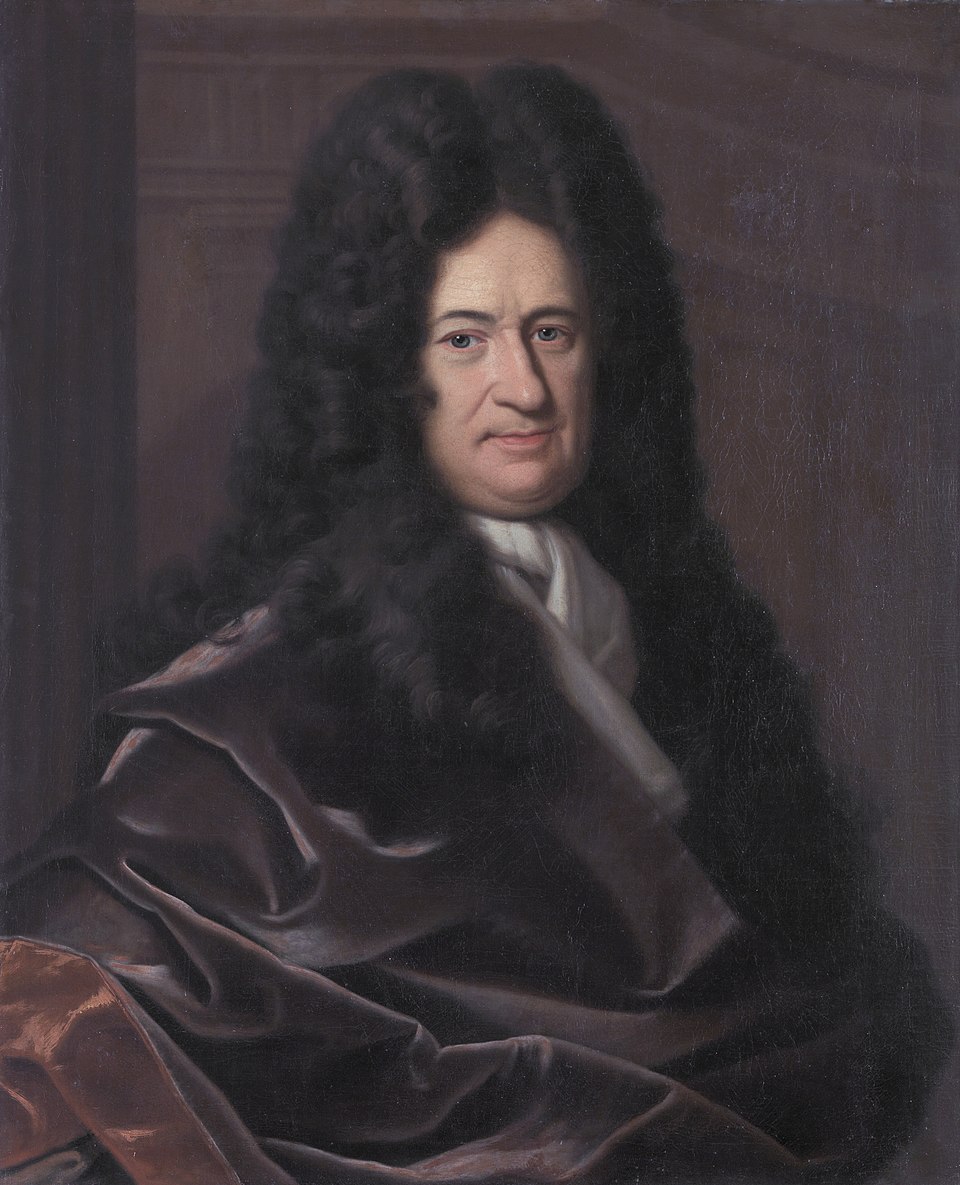
The argument received its most influential modern formulation from Gottfried Wilhelm Leibniz (1646–1716). In his 1697 essay On the Ultimate Origination of Things, Leibniz argued that the existence of the world requires an explanation that cannot be found within the series of contingent things that compose it. Even if the series of states of the world were infinite — even if there were no first moment — the existence of the entire series would remain unexplained unless there were a reason outside the series for why it exists at all. Leibniz grounded this reasoning explicitly in what he called the principle of sufficient reason: "nothing happens without a reason why it should be so rather than otherwise."1 The sufficient reason for the existence of the world, Leibniz concluded, must be found in a substance that carries the reason for its existence within itself — a necessary being, which Leibniz identified with God.1, 4

The formal argument
The Leibnizian argument from contingency can be stated in several ways, but its logical core can be captured in the following deductive formulation:5, 11
P1. Everything that exists has an explanation of its existence, either in the necessity of its own nature or in an external cause.
P2. If the universe has an explanation of its existence, that explanation is a transcendent, necessary being.
P3. The universe exists.
C1. The universe has an explanation of its existence. (From P1 and P3)
C2. The explanation of the universe's existence is a transcendent, necessary being. (From P2 and C1)
The argument is logically valid — that is, if the premises are true, the conclusion follows by deductive logic. The question of soundness — whether the premises are in fact true — is where the philosophical debate occurs. P3 is uncontroversial. The substantive disputes concern P1 (the principle of sufficient reason) and P2 (the claim that the universe's explanation, if it has one, is a necessary being).5
P1 is a version of the principle of sufficient reason. It does not assert that everything has a cause; rather, it asserts that everything has an explanation, and it allows that the explanation may be internal (the thing exists by the necessity of its own nature) or external (the thing is caused by something else). This formulation is designed to accommodate the necessary being itself: a necessary being's existence is explained not by an external cause but by the fact that it could not have failed to exist.2, 11
P2 follows from the observation that the universe is contingent. If the universe does not exist by the necessity of its own nature — if it is the sort of thing that could have failed to exist — then by P1, its explanation must be found in an external cause. That cause must be outside the universe (transcendent) and must itself be necessary, because a contingent cause would in turn require its own explanation, generating a regress that terminates only in a necessary being.1, 5
The principle of sufficient reason
The principle of sufficient reason (PSR) is the philosophical thesis that every fact has an explanation: nothing is true without there being a reason why it is true rather than false, and nothing exists without there being a reason why it exists rather than not. The PSR has a long history in Western philosophy, with versions endorsed by Parmenides, Anaximander, Aquinas, Spinoza, and Leibniz, among others. Leibniz regarded it as one of the two fundamental principles of reasoning, alongside the principle of non-contradiction, and he used it as the foundation for his cosmological argument.1, 2
Several lines of reasoning have been offered in support of the PSR. The first is an appeal to the self-evidence of the principle. When we encounter a fact or entity, we naturally seek an explanation, and the discovery that some fact has no explanation at all — that it is simply a brute fact, with no reason for obtaining — strikes many as deeply unsatisfying and even unintelligible. Pruss argues that the PSR underlies the practice of science and ordinary reasoning: we do not accept brute contingent facts in science or daily life, and the PSR simply generalises this practice into a metaphysical principle.2
A second line of support appeals to the consequences of denying the PSR. If some contingent facts have no explanation, then there is no principled way to distinguish between facts that happen to have explanations and facts that do not. The denial of the PSR introduces an element of arbitrary unintelligibility into the structure of reality. Pruss argues that if we allow some contingent facts to be brute, we lose our justification for expecting that any particular contingent fact has an explanation, which would undermine the epistemic foundations of science and inductive reasoning.2
A third defense proceeds by way of modal logic. Pruss has argued that the PSR can be derived from certain plausible modal principles combined with the thesis that explanatory relations are not merely contingent — that if a fact has an explanation, it could not have lacked one. If it is possible that every contingent fact has an explanation, and if explanatory relations hold necessarily when they hold at all, then the PSR is true in all possible worlds.2
Despite these defenses, the PSR faces significant objections, which are examined in detail below.
Contingent and necessary beings
The argument from contingency depends on a fundamental metaphysical distinction between two categories of being. A contingent being is one whose existence is possible but not necessary: it exists, but there are possible states of affairs in which it does not exist. A necessary being, by contrast, is one whose non-existence is impossible: it exists in every possible state of affairs and could not have failed to exist.5, 2
Ordinary physical objects are paradigmatic examples of contingent beings. A particular mountain, river, or galaxy exists, but it is easy to conceive of circumstances in which it would not have existed — different initial conditions, different physical processes, different configurations of matter. Its existence is not guaranteed by the nature of reality itself but depends on prior causes and conditions that might have been otherwise. The same reasoning, proponents of the argument contend, applies to the universe as a whole. The universe is composed entirely of contingent things — particles, fields, spacetime structures — and the particular laws and initial conditions that characterise it appear to be contingent as well. There is no apparent logical or metaphysical reason why the universe should have these particular laws rather than different ones, or why there should be a universe at all rather than nothing.1, 10
A necessary being, if one exists, would differ fundamentally from contingent beings in its metaphysical status. Its existence would not depend on external causes or conditions. It would exist in every possible world, and its non-existence would be impossible in the same way that a logical contradiction is impossible. Defenders of the contingency argument argue that only a necessary being can provide a terminus for the chain of explanations, because any contingent terminus would itself require further explanation. The necessary being serves as the ultimate explanatory ground — the entity whose existence is self-explanatory, not because it caused itself, but because it exists by the necessity of its own nature.2, 5
The nature of this necessary being is a further philosophical question. Leibniz identified the necessary being with God, understood as a maximally perfect being possessing intellect and will. This identification is not part of the formal argument itself but requires additional argumentation — for instance, that only a personal being with the power of libertarian free will could serve as the cause of a contingent universe, since an impersonal necessary being operating by necessity would produce its effects necessarily rather than contingently.1, 10 Critics, however, have questioned whether the necessary being of the argument can be identified with the God of theism without further premises that are themselves in need of defence.7
Defense of premise 1
The first premise — that everything that exists has an explanation of its existence — is a restricted version of the principle of sufficient reason. Unlike the unrestricted PSR, which asserts that every truth whatsoever has an explanation, P1 limits its scope to existential facts: it claims only that the existence of any entity is either self-explanatory (in the case of necessary beings) or externally explained (in the case of contingent beings). This restriction is deliberate, designed to avoid some of the problematic consequences that have been attributed to the unrestricted PSR.2, 11
The most straightforward defense of P1 appeals to its intuitive plausibility. In ordinary reasoning and scientific practice, the assumption that things have explanations for their existence is nearly universal. When a physicist discovers a new particle, she seeks an explanation for its existence in terms of physical processes and laws. When a detective investigates a death, the possibility that the person simply ceased to exist for no reason at all is not entertained. The contingency argument's defenders argue that P1 simply makes explicit a presupposition that pervades rational inquiry at every level.2
A more sophisticated defense comes from the observation that denying P1 for the universe while accepting it for everything within the universe appears to be a case of special pleading. If every object, event, and state of affairs within the universe has an explanation, what grounds could there be for exempting the universe itself from the same demand? The universe is not a different kind of entity from the things that compose it in the relevant respect — it exists contingently, just as its parts do — and so the demand for explanation applies to it with equal force.10, 11
Against this defense, critics have responded that the universe is not simply another object alongside the objects within it, and that reasoning about the whole based on properties of the parts commits the fallacy of composition. The fact that every brick in a wall is small does not entail that the wall is small. Similarly, the fact that every object within the universe has an explanation does not entail that the universe as a whole has an explanation.9 Defenders of the argument, however, contend that the fallacy of composition charge is misapplied here, because the property in question — contingency — is not the kind of property that is subject to the fallacy. A whole composed entirely of contingent parts is itself contingent; a collection of dependent things does not become independent simply by being aggregated.2, 11
Defense of premise 2
The second premise asserts that if the universe has an explanation of its existence, that explanation is a transcendent, necessary being. This premise depends on two sub-claims: first, that the universe is contingent (it does not exist by the necessity of its own nature), and second, that the explanation of a contingent universe must be a necessary being that transcends the physical order.5
The claim that the universe is contingent has been defended on several grounds. Leibniz argued that the particular configuration of the universe — its specific laws, initial conditions, and physical constants — is not logically necessary. It is conceivable, without contradiction, that the universe should have had different laws of physics, different fundamental constants, or a different initial state. The universe could have been different in any number of ways, and a universe with different properties is a coherent possibility. If the universe could have been otherwise, then it does not exist by the necessity of its own nature, and its existence is contingent.1
Swinburne has reinforced this line of reasoning by observing that the laws of nature are themselves contingent. The laws of physics describe regular patterns in the behaviour of matter and energy, but there is no logically necessary reason why these particular patterns should obtain rather than others. The inverse-square law of gravitation, the value of the speed of light, and the specific form of quantum mechanical equations are all features of the universe that could have been different. If the laws themselves are contingent, then the universe governed by those laws is contingent as well.10
The claim that the explanation of a contingent universe must be a necessary being follows from the logic of the argument. If the universe is contingent, then by P1 its explanation lies in an external cause. That cause is either contingent or necessary. If it is contingent, then it too requires an explanation, and the question of why contingent things exist has simply been pushed back one step. Either the chain of contingent explanations terminates in a necessary being, or it proceeds to infinity without ever providing an ultimate explanation. Proponents of the argument contend that an infinite chain of contingent explanations fails to explain why there are any contingent things at all, because the entire chain is itself contingent and stands in need of explanation just as much as any individual member.1, 2
Leibniz made this point with characteristic clarity. Suppose there exists an infinite series of geometry books, each copied from the one before it. The existence of any individual book is explained by the book it was copied from, but the existence of the entire series of books — why there are geometry books at all, and why they contain this particular geometric content — is not explained by any member of the series. The explanation must lie outside the series altogether, in something that is not itself a copy of a prior book.1 By analogy, the existence of the universe, even if it consists of an infinite series of states each caused by a prior state, is not explained by any member of the series and must be explained by something outside the series — a necessary being.1, 5
Major objections
The argument from contingency has attracted sustained philosophical critique over three centuries. The objections can be grouped into several categories: challenges to the principle of sufficient reason, the brute fact response, the composition objection, and concerns about the identification of the necessary being with God.
The most fundamental challenge to the argument targets the PSR itself. David Hume argued in his Dialogues Concerning Natural Religion (1779) that there is no rational compulsion to accept the PSR. Once we have explained each individual member of a collection, Hume contended, there is nothing left to explain. "Did I show you the particular causes of each individual in a collection of twenty particles of matter, I should think it very unreasonable, should you afterwards ask me, what was the cause of the whole twenty. This is sufficiently explained in explaining the cause of the parts."9 On this view, the demand for an explanation of the universe as a whole, over and above the explanations of its individual parts and states, is simply confused. Each state of the universe is explained by a prior state, and once every state has been explained, the universe has been explained.
Defenders of the contingency argument have responded that Hume's objection confuses internal explanations with ultimate explanations. Even if every state of the universe is explained by a prior state, the existence of the entire series of states remains unexplained. Why does this particular series exist rather than a different one, or rather than no series at all? Leibniz's geometry-book analogy is designed precisely to illustrate this point: explaining each book by reference to its predecessor does not explain why there are any books at all.1, 2
A second major objection holds that the PSR, if accepted in its full generality, leads to modal collapse — the conclusion that everything that is true is necessarily true, and that there are no genuine contingent facts. The reasoning runs as follows: if every truth has a sufficient reason, and if a sufficient reason necessitates what it explains (otherwise it would not be a sufficient reason), then every truth is necessitated by its explanation and is therefore necessary. If everything is necessary, then the very contingency that the argument from contingency invokes to get its argument off the ground does not exist.7 The charge is that the PSR is self-undermining in the context of the contingency argument: it is invoked to explain contingent existence, but if true, it eliminates contingent existence altogether.
The modal collapse objection has generated extensive discussion. Pruss has responded by distinguishing between different senses of "sufficient reason." A sufficient reason for a contingent fact need not be a logically necessitating condition; it may be a contrastive explanation that renders the fact intelligible without entailing it with logical necessity. On a libertarian account of free will, for example, a free agent's choice provides a sufficient reason for an action without necessitating it: the agent could have chosen otherwise. If the necessary being is a free agent, then its decision to create the universe provides a sufficient reason for the universe's existence without making that existence necessary.2 This response preserves the contingency of the universe by locating the explanation in a free act of will rather than in a deterministic process.
A third objection is the brute fact response. This position holds that the existence of the universe may simply be an unexplained fact — a brute fact that has no explanation and does not require one. On this view, the universe exists, and there is no deeper reason why it exists. The demand for an explanation is an expression of a psychological preference for intelligibility, not a genuine metaphysical requirement. Bertrand Russell famously articulated this position in his 1948 BBC debate with Frederick Copleston: "I should say that the universe is just there, and that's all."6
The brute fact response can be developed in a more sophisticated form by arguing that the PSR is epistemically unjustified. We have no way of verifying that every contingent fact has an explanation, and the history of scientific discovery provides examples of phenomena that were initially thought to require explanations but turned out to be fundamental and unexplained (such as the particular values of physical constants, which physics currently treats as brute parameters). If the PSR is not self-evident and cannot be empirically verified, then it lacks the epistemic credentials to serve as a premise in a deductive argument for the existence of God.7
Defenders of the argument have responded that the brute fact position carries its own significant costs. Accepting brute contingent facts means accepting that there are features of reality that have no explanation at all — not merely features for which we have not yet found an explanation, but features that are in principle inexplicable. Pruss argues that this position is difficult to maintain consistently, because in every other domain of inquiry we treat the absence of an explanation as evidence that our understanding is incomplete, not as evidence that no explanation exists. To accept a brute fact about the existence of the universe while refusing to accept brute facts in physics, biology, or everyday life appears to be an ad hoc restriction driven by the desire to avoid the argument's theistic conclusion rather than by any principled epistemological criterion.2
Contemporary versions
The argument from contingency has been reformulated by several contemporary philosophers seeking to address the objections raised against its classical versions. These reformulations typically modify the PSR to avoid the modal collapse objection, employ modal logic to make the argument's structure more precise, or adopt probabilistic rather than strictly deductive reasoning.
Alexander Pruss has developed what he calls a restricted PSR, which asserts that every contingent proposition that can have an explanation does have an explanation. This restriction is designed to avoid certain technical counterexamples to the unrestricted PSR — such as the "Big Conjunctive Contingent Fact" (the conjunction of all contingent truths), which arguably cannot have an explanation because any explanation would either be part of the conjunction (and thus not genuinely explanatory) or necessary (which would collapse the distinction between necessary and contingent). By restricting the PSR to facts that are capable of having explanations, Pruss aims to preserve the principle's explanatory power while blocking the paths to modal collapse.2
Richard Gale and Alexander Pruss jointly developed a cosmological argument that uses a weaker modal version of the PSR. Their Gale-Pruss argument (1999) begins not with the claim that the Big Conjunctive Contingent Fact does have an explanation but with the claim that it possibly has an explanation. The premise is that it is logically possible that there exists a necessary being that explains the existence of all contingent beings. Using the S5 axiom of modal logic (which holds that if something is possibly necessary, then it is necessary), Gale and Pruss argue that if it is possible that a necessary being explains the contingent facts, then a necessary being exists. The advantage of this formulation is that it requires only the weak PSR — the concession that the existence of the universe is the sort of thing that could have an explanation — rather than the strong claim that it must have one.8
Robert Koons has defended a version of the contingency argument that draws on contemporary metaphysics of causation and modality. Koons argues that the causal principle underlying the argument can be supported by inference to the best explanation: the hypothesis that a necessary being exists provides the best explanation for the existence of contingent reality, just as scientific hypotheses provide the best explanations for observed phenomena. Koons also addresses the composition objection by arguing that aggregates of contingent beings are themselves contingent, and that this is not a case of the fallacy of composition but a straightforward consequence of the concept of contingency. If every part of an aggregate depends on something outside itself for its existence, the aggregate as a whole also depends on something outside itself.14
Swinburne has offered a probabilistic version of the argument, which does not claim to demonstrate God's existence with certainty but rather to show that the existence of God raises the probability that a complex, law-governed universe exists. On Swinburne's approach, the existence of the universe is vastly more probable on theism than on naturalism, because theism provides an explanation for the universe's existence (God chose to create it) whereas naturalism treats the universe's existence as an unexplained brute fact. The argument contributes to a cumulative case for theism rather than serving as a standalone deductive proof.10
Responses to objections
The dialectic between defenders and critics of the contingency argument has produced a sophisticated body of responses that merit separate examination. Each major objection has generated a corresponding line of defense, and the state of the debate depends heavily on which version of the PSR is adopted and how key terms are defined.
In response to the modal collapse objection, defenders have pursued two primary strategies. The first, as noted above, is to deny that sufficient reasons must be necessitating reasons. If a sufficient explanation for a contingent fact can be a non-necessitating explanation — for instance, the free choice of a rational agent — then the PSR does not entail that every truth is necessary. The second strategy is to adopt a restricted version of the PSR that applies only to certain classes of facts, thereby preventing the blanket application that generates modal collapse. Pruss has argued that a PSR restricted to contingent propositions that are "normal" — roughly, propositions that do not involve self-referential or infinitely complex constructions — is sufficient to ground the contingency argument while avoiding the technical difficulties of the unrestricted version.2
In response to Hume's objection that explaining each part explains the whole, defenders have pressed the distinction between a series being internally explained and being ultimately explained. An infinite regress of contingent explanations may explain each member of the series in terms of a prior member, but it does not explain the existence of the series itself. This is not a mere intuition pump but a logical point: the conjunction of all contingent facts is itself a contingent fact (assuming the conjunction of contingent facts is contingent), and a contingent fact requires an explanation that is not itself part of the set of facts to be explained.2, 14
In response to the brute fact response, Pruss and others have argued that the willingness to accept brute facts is not a neutral epistemic position but a substantive metaphysical commitment with far-reaching consequences. If the existence of the universe can be a brute fact, then in principle any fact can be brute, and the distinction between facts that have explanations and facts that do not becomes arbitrary. This threatens the epistemic foundations of science, which proceeds on the assumption that natural phenomena have explanations. Defenders of the contingency argument do not claim that this consideration proves the PSR, but they argue that it shifts the burden of proof: the philosopher who accepts brute facts must explain why the universe's existence is a permissible exception to the general demand for explanation, and must do so without special pleading.2, 10
Critics have countered that the brute fact position does not require treating the universe as an arbitrary exception. Rather, it can be grounded in a principled distinction between local explanatory practice and global metaphysical claims. Science explains particular phenomena within the universe by reference to laws and initial conditions, but the demand for an explanation of why there is a universe at all is a different kind of question — a question that may not have a meaningful answer, because the concepts of cause and explanation may not apply to reality as a whole.7 Oppy has argued that the theist faces an analogous problem: if God is a necessary being, the theist must explain what it means for a being to exist necessarily, and the purported explanation of the universe in terms of God's will may be no more illuminating than treating the universe as brute.7
Major formulations of the argument from contingency4, 5
| Philosopher | Period | Key principle | Distinctive feature |
|---|---|---|---|
| Avicenna | 11th c. | Necessary vs. possible existence | Essence-existence distinction; no appeal to temporal beginning |
| Aquinas (Third Way) | 13th c. | Possible beings require a necessary being | Argues from possibility of non-existence to a necessary ground |
| Leibniz | 17th c. | Principle of sufficient reason | Infinite series still requires external explanation |
| Gale & Pruss | 1999 | Weak (modal) PSR | Uses S5 modal logic; requires only possible explanation |
| Pruss | 2006 | Restricted PSR | Limits PSR to "normal" contingent propositions |
| Koons | 2009 | Causal principle & inference to best explanation | Defends composition principle; metaphysics of causation |
| Swinburne | 2004 | Probabilistic reasoning | Cumulative case; universe more probable on theism |
Relationship to other cosmological arguments
The argument from contingency is one of three principal variants within the family of cosmological arguments, and understanding its distinctive features requires comparing it with its relatives. The kalam cosmological argument reasons from the temporal beginning of the universe to a cause: it argues that the universe began to exist, that everything that begins to exist has a cause, and that therefore the universe has a cause. The kalam argument is essentially temporal — it depends on the claim that the universe is finitely old. The contingency argument, by contrast, is not committed to a temporal beginning. Even if the universe were eternal, the contingency argument would apply: an eternal series of contingent states would still be contingent as a whole and would still require an explanation outside itself.4, 5
The Thomistic cosmological argument, associated with Aquinas's Five Ways, reasons not from temporal beginning but from the present-tense dependence of existing things on a sustaining cause. Aquinas argued that things in the world are in a state of actuality that must be sustained at every moment by a cause that is itself in act, and that this chain of sustaining causes cannot proceed to infinity but must terminate in a first cause that is pure actuality. The Thomistic argument shares with the contingency argument the insight that the existence of things requires an ongoing explanation, not merely a historical starting point. However, the Thomistic argument is grounded in Aristotelian metaphysics of act and potency, while the contingency argument is grounded in the Leibnizian distinction between contingent and necessary existence and in the PSR.3, 4
These three variants are complementary rather than competing. A philosopher might endorse the contingency argument on the grounds that the PSR is plausible, the kalam argument on the grounds that the universe began to exist, and the Thomistic argument on the grounds that things require sustaining causes in the present. The arguments share the conclusion that the existence of the natural world is explained by a transcendent cause, but they arrive at that conclusion by different argumentative routes and rest on different foundational premises.4, 11
Philosophical assessment
The argument from contingency occupies a distinctive position in the philosophy of religion. Unlike arguments that depend on specific empirical claims — such as the kalam argument's reliance on the finitude of the past — the contingency argument rests on broad metaphysical principles that can be evaluated through philosophical reasoning alone. Its central premise, the PSR, is a thesis about the intelligibility of reality itself: the claim that existence is not arbitrary, that the world is the kind of place where things exist for reasons rather than for no reason at all.2, 5
The logical structure of the argument is transparent and its validity is not in dispute. The question of soundness turns entirely on whether the PSR (or some restricted version of it) is true and whether the universe is contingent. These are genuine and unresolved philosophical questions. The PSR has powerful intuitive support and appears to underlie the practice of scientific explanation, but it also faces technical challenges, including the modal collapse objection and the difficulty of providing a non-circular justification. The brute fact alternative avoids the PSR's metaphysical commitments but at the cost of accepting that fundamental features of reality have no explanation — a cost that some find acceptable and others find epistemically intolerable.2, 7
The contemporary reformulations of the argument — Pruss's restricted PSR, the Gale-Pruss modal argument, Koons's inference-to-best-explanation approach, and Swinburne's probabilistic version — represent attempts to preserve the argument's core insight while addressing the objections that have accumulated over centuries. These reformulations have made the argument more precise and more resistant to traditional criticisms, though critics maintain that the fundamental problem remains: the PSR is either too strong (leading to modal collapse) or too weak (insufficient to support the argument's conclusion).2, 7, 8
The argument raises a question that is difficult to dismiss regardless of one's stance on the PSR: why does anything exist at all? Even philosophers who reject the contingency argument as a proof of God's existence often acknowledge that the question it poses is genuine and important. The existence of the universe — the fact that there is something rather than nothing — is a fact that calls out for explanation, even if the correct explanation turns out to be that no explanation is available. The argument from contingency gives this ancient question its most rigorous philosophical formulation and remains a central point of engagement in the ongoing dialogue between theism and its alternatives.1, 5, 10