Overview
- A sequence of federal court rulings — from Epperson v. Arkansas (1968) through Kitzmiller v. Dover (2005) — progressively closed every legal avenue for teaching creationism and its successor doctrines in American public schools, consistently finding that such instruction violates the Establishment Clause of the First Amendment.
- Each judicial defeat prompted a strategic rebranding: outright anti-evolution laws gave way to “creation science,” which gave way to “intelligent design,” which gave way to “teach the controversy” — a pattern documented in the text of Of Pandas and People, where the word “creationism” was replaced wholesale with “intelligent design” after the 1987 Edwards ruling, leaving the transitional form “cdesign proponentsists” as a textual fossil.
- The courts have not ruled on the scientific merits of evolution, only on whether government may compel its instruction alongside religious alternatives; every ruling has found that it may not, and that no amount of relabeling transforms a religious claim into a scientific one.
The legal history of creationism in American public schools is, in essence, a chronicle of repeated constitutional failures. Beginning in the 1920s, when several Southern states banned the teaching of evolution by statute, and continuing through the intelligent design movement of the early twenty-first century, advocates of religiously motivated alternatives to evolutionary biology have repeatedly sought the force of law to insert their doctrines into science classrooms. Each attempt has met with judicial rejection, and the cumulative effect of those rulings has been to establish, with increasing precision, the constitutional principle that government may not compel students to receive instruction in religious accounts of origins. Understanding how the courts reached that conclusion requires following the legal battles in chronological order, because each case shaped the terrain on which the next was fought.9, 19
.jpg)
The Establishment Clause and its application to education
The constitutional anchor for all creationism litigation is the First Amendment to the United States Constitution, which provides in its opening clause that “Congress shall make no law respecting an establishment of religion.” The Fourteenth Amendment extended this prohibition to state governments, and the Supreme Court’s incorporation doctrine established that it applies to public school systems as arms of the state.18 In practice, determining whether a government action “respects an establishment of religion” has required the courts to develop interpretive tests. The most durable was articulated in church-state jurisprudence more broadly: in Lemon v. Kurtzman (1971), the Supreme Court held that a law survives Establishment Clause scrutiny only if it has a secular legislative purpose, its principal or primary effect neither advances nor inhibits religion, and it does not foster excessive government entanglement with religion.14 This three-pronged “Lemon test” became the central analytical tool in every subsequent creationism case.
The broader significance of this legal framework extends well beyond science education. Courts ruling on creationism were simultaneously defining what religion is, what science is, and where the boundary between public education and religious instruction must fall. Those definitions have proved remarkably stable across six decades and multiple generations of judges appointed by presidents of both parties.15, 18
The Scopes trial and its legal aftermath
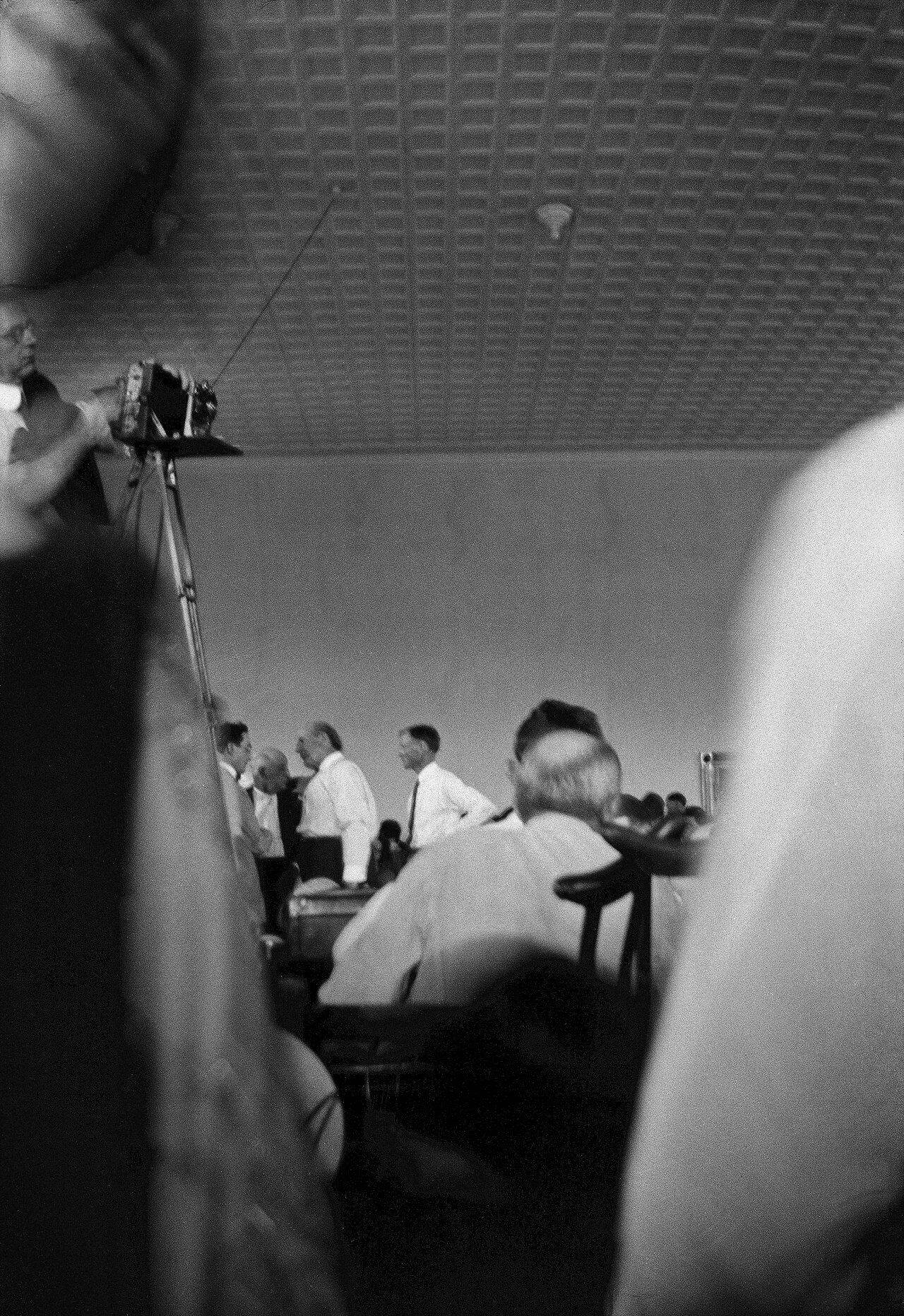
The modern legal history of creationism begins not with a constitutional vindication but with a criminal conviction. In 1925, John T. Scopes, a young substitute teacher in Dayton, Tennessee, was charged with violating the Butler Act — a state law prohibiting the teaching of “any theory that denies the Story of the Divine Creation of man as taught in the Bible, and to teach instead that man has descended from a lower order of animals.” The trial was arranged as a deliberate test case by the American Civil Liberties Union, which had advertised for a willing defendant.2 Scopes was convicted and fined $100, a result that attracted less attention than the theatrical spectacle of Clarence Darrow cross-examining William Jennings Bryan on the literal truth of Genesis.1, 2
The Tennessee Supreme Court overturned the conviction in 1927 on a narrow procedural technicality: the trial judge had assessed the fine himself rather than leaving it to the jury, as Tennessee law required for fines exceeding $50.1 The court avoided ruling on the constitutional question — whether an anti-evolution law violated the First Amendment — and the Butler Act remained on the books. No further prosecution was attempted, but the law’s existence had a chilling effect on science education that historians have documented for decades. Publishers voluntarily diluted or removed evolutionary content from biology textbooks sold in Southern states, a pattern that persisted well into the 1960s.2, 9 The constitutional question the Scopes trial raised would not be answered for another four decades.
Epperson v. Arkansas: the first Supreme Court ruling
The decisive constitutional test came from Arkansas, which had passed its own anti-evolution statute in 1928. In 1965, Susan Epperson, a Little Rock high school biology teacher, challenged the law after her school district adopted a textbook that included a chapter on evolutionary theory, putting her in the impossible position of either violating state law or using a book she was prohibited to teach from.3 The case reached the Supreme Court, which issued a unanimous ruling in 1968.
Justice Abe Fortas, writing for the Court, stated the constitutional principle with unusual directness. The Arkansas law, he wrote, “selects from the body of knowledge a particular segment which it proscribes for the sole reason that it is deemed to conflict with a particular religious doctrine.”3 The First Amendment, the Court held, does not permit a state to require that teaching and learning be tailored to the principles or prohibitions of any religious sect or dogma. The anti-evolution statute thus fell under the Establishment Clause regardless of how it was framed. Epperson made explicit what the Scopes trial had left unresolved: that government may not suppress the teaching of science to protect religious doctrine. It did not, however, address the related question of whether government could affirmatively mandate the teaching of religious alternatives alongside evolution — a distinction the creationist movement immediately began to exploit.3, 9
McLean v. Arkansas: defining science in a courtroom
By the late 1970s, the creationist strategy had shifted from banning evolution to demanding “balanced treatment” — equal time for what proponents now called “creation science.” The rebranding was largely the work of Henry Morris and the Institute for Creation Research, which had promoted a model of young-earth geology and biology since the 1960s as scientific in character, not merely religious.9 In 1981, Arkansas passed Act 590, mandating balanced treatment for “creation-science” and “evolution-science” in public school curricula. The American Civil Liberties Union challenged the law immediately, and the case was tried in federal district court before Judge William R. Overton.4
The McLean decision, issued in January 1982, is one of the most detailed and philosophically sophisticated judicial opinions in American legal history. Judge Overton did not simply apply the Lemon test; he devoted substantial portions of his opinion to the question of what distinguishes science from religion — a question he addressed by hearing testimony from philosophers of science, scientists, and theologians.4 Drawing on the testimony of philosopher of science Michael Ruse, Overton identified five essential characteristics of science: it is guided by natural law; it is explanatory by reference to natural law; it is testable against the empirical world; its conclusions are tentative and revisable; and it is falsifiable. Creation science, he found, failed every criterion. Its conclusions were presented as absolute truth, not tentative hypotheses. Its central claims — a worldwide flood, a young earth, separate ancestry for humans and apes — were not derived from natural law but asserted on the basis of scripture, even when that scriptural basis was not made explicit.4
Overton further found that the legislative history of Act 590 made its religious purpose unmistakable. The bill had been drafted by a minister and introduced by a senator who was a deacon in his church. Testimony revealed that the “creation science” model matched, point for point, the account in Genesis. The law was struck down as a violation of the Establishment Clause on all three Lemon prongs. Though McLean was a district court decision binding only within its jurisdiction, its detailed analysis of the science-religion boundary would prove enormously influential in subsequent litigation and in the design of the intelligent design movement’s legal strategy.4, 12
Edwards v. Aguillard: the Supreme Court strikes down balanced treatment
Louisiana passed its own balanced-treatment statute, the Creationism Act, in 1981. The law required that if evolution was taught in public schools, creation science must be taught alongside it. The stated rationale was “academic freedom” — a framing the creationist movement would return to repeatedly. The case of Edwards v. Aguillard reached the Supreme Court, which struck down the Louisiana law in 1987 by a vote of seven to two.5
Justice William Brennan’s majority opinion applied the Lemon test and found the law defective at the first prong: it lacked a valid secular legislative purpose. The Court scrutinized the legislative record and found that the “academic freedom” justification was pretextual. The law did not expand teachers’ freedom to teach what they chose; it restricted it by compelling the teaching of a specific doctrine. The actual purpose, Brennan concluded, was “to restructure the science curriculum to conform with a particular religious viewpoint.”5 The Court also noted that the term “creation science” as used in the statute embodied the religious belief that a supernatural creator was responsible for the creation of life — a religious belief, not a scientific claim.5
Justice Antonin Scalia, joined by Chief Justice William Rehnquist, dissented. Scalia argued that the majority was too quick to dismiss the secular purpose offered by Louisiana’s legislators and that the Court should have deferred more substantially to the stated legislative intent. His dissent did not dispute the Establishment Clause framework but objected to the majority’s reading of the legislative record.5 Edwards effectively closed the “balanced treatment” avenue. Within months of the ruling, the manuscript of a textbook titled Of Pandas and People — then in preparation — was revised in a way that would later become one of the most striking pieces of evidence in any American courtroom.7, 16
The rise of intelligent design and the “cdesign proponentsists” fossil
The word “creationism” and its variants appeared hundreds of times in early drafts of Of Pandas and People, a textbook promoted as a scientific alternative to evolutionary biology.7 After the Edwards ruling, the text was revised: “creationism” and “creationist” were replaced throughout with “intelligent design” and “design proponent.” The search-and-replace operation was imperfect. In one instance, the substitution produced the phrase “cdesign proponentsists” — the ghost of “creationists” fused with its replacement “design proponents.” This textual artifact, introduced as evidence in the Kitzmiller litigation, became what one scientist called a transitional fossil: direct documentary evidence that intelligent design was creationism under a new name.16
Intelligent design, as elaborated by the Discovery Institute’s Center for the Renewal of Science and Culture (later renamed the Center for Science and Culture), proposed that certain biological structures are too complex to have arisen by natural selection and therefore require an intelligent cause.8 Its chief scientific advocates — biochemist Michael Behe, who developed the concept of irreducible complexity, and philosopher William Dembski, who proposed specified complexity as a criterion for detecting design — argued that their framework was a genuine scientific research program, not a religious doctrine.10 The Discovery Institute’s internal strategy document, the “Wedge Document” of 1998, told a different story: it described the movement’s goal as replacing “materialistic explanations with the theistic understanding that nature and human beings are created by God,” and it explicitly identified the defeat of “scientific materialism” as a religious and cultural objective.8
Through the 1990s and early 2000s, the intelligent design movement concentrated on publishing books, training spokespeople, and building cultural rather than legislative momentum — an approach shaped in part by awareness that overt legislative mandates had consistently failed in court. The strategy shifted when local school boards, rather than state legislatures, became the target. The most consequential of these local battles unfolded in Dover, Pennsylvania.11, 16
Kitzmiller v. Dover: the definitive ruling
In October 2004, the Dover Area School District board voted to require that a statement be read to ninth-grade biology classes informing students that evolution was a theory with gaps and that intelligent design offered an alternative explanation, and directing students to the classroom copies of Of Pandas and People.6 Eleven parents sued, represented by the ACLU and Americans United for Separation of Church and State. The trial — Tammy Kitzmiller et al. v. Dover Area School District — was heard in the federal district court for the Middle District of Pennsylvania by Judge John E. Jones III, a conservative Republican appointed by President George W. Bush.6, 11
The trial lasted forty days, from September through November 2005, and produced a record of testimony and documentary evidence that was unusually rich by the standards of constitutional litigation. Scientists, philosophers of science, theologians, school board members, and the Discovery Institute’s own expert witnesses testified under oath. The expert testimony for the plaintiffs included detailed scientific analysis of intelligent design claims — including extensive refutation of Behe’s irreducible complexity argument, with evidence showing that the bacterial flagellum, Behe’s signature example, shared components with other biological systems in ways that demonstrated evolutionary ancestry.17 Behe himself, under cross-examination, acknowledged that his definition of “theory” was so broad that astrology would qualify as a theory under it.6
Judge Jones issued his opinion on December 20, 2005 — 139 pages long and notable for its directness.6 On the scientific question, Jones found that intelligent design is not science. It invokes and relies upon the supernatural, which places it outside the boundaries of science as understood and practiced by the scientific community. The “cdesign proponentsists” evidence, combined with detailed textual analysis of Of Pandas and People, led Jones to conclude that intelligent design is “essentially religious in nature” and that the Dover policy violated the Establishment Clause under both the Lemon test and the “endorsement test” developed by Justice Sandra Day O’Connor.6
Jones was particularly scathing about the conduct of the Dover school board members, several of whom had testified falsely about their motivations. He wrote that “the citizens of the Dover area were poorly served by the members of the Board who voted for the ID Policy. It is ironic that several of these individuals, who so staunchly and proudly touted their religious convictions in public, would time and again lie to cover the tracks of this highly religious objective.”6 All eight school board members who had voted for the policy had been voted out of office by the time the ruling was issued. The Discovery Institute, which had advised against pursuing the Dover litigation, distanced itself from the outcome and disputed Jones’s characterization of intelligent design, but offered no further legislative initiative.11, 17
The pattern of relabeling and its constitutional significance
Viewed in sequence, the legal history of creationism in American courts reveals a consistent pattern. Each judicial defeat produced a strategic rebranding designed to address the specific constitutional defect identified by the previous ruling. Anti-evolution laws, struck down as straightforwardly suppressing science to protect religion in Epperson, gave way to “balanced treatment” statutes framed in terms of academic freedom. Those were struck down in Edwards when the Court found that “creation science” was transparently religious regardless of its label. The response was to strip explicitly religious language from the curriculum materials — hence the mass replacement of “creationism” with “intelligent design” — and to build an institutional infrastructure, the Discovery Institute, capable of providing academic-seeming credibility.16, 9 That strategy failed in Kitzmiller when the court examined not just the label but the content, the institutional history, and the documentary record.
The “teach the controversy” formulation that emerged after Kitzmiller represented a further iteration: rather than mandating the teaching of any specific alternative, advocates urged that teachers present evolution as disputed or uncertain, and that students be encouraged to examine its “weaknesses.” Louisiana’s Science Education Act of 2008 and similar statutes in other states adopted this language. Legal scholars have noted that such laws are harder to challenge because they do not mandate specific religious content, but they remain constitutionally vulnerable if their application in classrooms can be shown to serve a religious purpose.13, 19 No Supreme Court case has yet resolved the “teach the controversy” formulation, but the lower court record provides substantial precedent for its treatment as a further iteration of the same constitutional violation.19
The courts have throughout these proceedings been careful to distinguish the constitutional question from the scientific one. No federal judge has ruled that evolution is true or that creationism is false in a metaphysical sense. What the courts have held, consistently and with increasing specificity, is that government has no authority to shape science education according to religious commitments — that the First Amendment draws a line between the classroom and the church that no amount of strategic rebranding can erase. The significance of that holding extends far beyond biology: it is one of the clearest articulations in American law of the principle that the state must remain neutral among competing religious views, and between religious and secular understandings of the world, when it exercises its authority over the education of children.15, 18
References
Summer for the Gods: The Scopes Trial and America’s Continuing Debate over Science and Religion