Overview
- The problem of religious language asks whether statements about God — such as 'God is good' or 'God exists' — are meaningful, and if so, in what sense they can be understood, given that God is typically held to transcend the categories of ordinary human experience and empirical investigation.
- Logical positivists argued that religious statements are cognitively meaningless because they are neither analytic truths nor empirically verifiable, while Antony Flew's falsification challenge pressed the related objection that religious claims, by being compatible with any possible state of affairs, assert nothing — prompting responses from R. M. Hare, Basil Mitchell, and others who offered alternative accounts of religious discourse.
- Major constructive theories of religious language include the via negativa (saying only what God is not), Aquinas's doctrine of analogy (predicating terms of God analogically rather than univocally or equivocally), Paul Tillich's symbolic theory (religious language participates in the reality it symbolizes), and Wittgenstein-influenced approaches that treat religious discourse as a distinctive language game with its own internal grammar and criteria of meaning.
Religious language is the branch of philosophy of religion that examines whether statements about God and the divine are meaningful, and if so, what kind of meaning they possess. When a theist says "God is good," "God loves humanity," or "God created the universe," these statements appear to use ordinary words in familiar grammatical arrangements, yet they purport to describe a being that is typically held to be infinite, incorporeal, timeless, and radically unlike anything within ordinary human experience. The question of how finite human language can refer to an infinite, transcendent being — or whether it can do so at all — has occupied philosophers and theologians from antiquity through the present day.9
The problem became particularly acute in the twentieth century, when logical positivism and its successors challenged the cognitive meaningfulness of all metaphysical and theological discourse, arguing that statements incapable of empirical verification or logical demonstration say nothing about the world. This challenge provoked a rich tradition of responses: negative theology, analogy, symbolism, and language-game approaches, each offering a different account of how religious language functions and what, if anything, it asserts.1, 9
Historical background
The roots of the problem of religious language extend to the earliest philosophical reflections on the divine. Plato's dialogues grapple with the difficulty of speaking about the Form of the Good, which transcends ordinary predication. In the Republic (509b), Socrates describes the Good as "beyond being in dignity and power," suggesting that standard descriptive language may be inadequate to capture ultimate reality. The Neoplatonist Plotinus (c. 204–270 CE) pushed this further, arguing in the Enneads that the One is utterly simple and beyond all categories, so that any positive statement about it is necessarily a distortion.9
Within the Christian tradition, the problem crystallized around the question of divine names. The anonymous fifth- or sixth-century author known as Pseudo-Dionysius the Areopagite argued in The Mystical Theology and The Divine Names that God surpasses all human conceptual categories and that the most adequate way of speaking about God is through negation — denying that any created attribute applies to God as it applies to creatures.4 In the twelfth century, the Jewish philosopher Moses Maimonides developed a rigorous negative theology in The Guide of the Perplexed, contending that positive attributes cannot be predicated of God without introducing multiplicity into the divine essence and that statements such as "God is powerful" should be understood as meaning only "God is not powerless."5
Thomas Aquinas (1225–1274) offered the most influential medieval response to the problem, arguing in the Summa Theologiae (I, q.13) that terms can be predicated of God neither univocally (in exactly the same sense as of creatures) nor equivocally (in a completely unrelated sense), but analogically — in a sense that is partly the same and partly different, grounded in the causal relationship between God and creation.3 This doctrine of analogy became the standard framework for much subsequent theological and philosophical discussion of religious language, and its interpretation remains a matter of active scholarly investigation.11
The verification challenge

The most radical twentieth-century challenge to religious language came from logical positivism, the philosophical movement centered on the Vienna Circle of the 1920s and 1930s. The central doctrine of logical positivism was the verification principle, which holds that a synthetic (non-tautological) statement is cognitively meaningful — that is, capable of being true or false — if and only if there is some possible empirical observation that would count as evidence for or against it. Statements that meet this criterion are meaningful; those that do not are dismissed as cognitively meaningless, expressing at most emotional attitudes or linguistic confusions.1
The British philosopher A. J. Ayer (1910–1989) applied this principle to religious discourse with particular force in his 1936 work Language, Truth and Logic. Ayer argued that the statement "God exists" is not an analytic truth (it cannot be established by definition or logic alone), and it is not empirically verifiable (no possible observation could confirm or disconfirm it). It therefore fails the verification criterion and is, on Ayer's view, not merely false but literally meaningless — it does not express a genuine proposition at all. Ayer drew an explicit consequence: the theist and the atheist are equally confused if they take "God exists" to be a factual claim, because the sentence lacks the cognitive content required to be either true or false.1
Ayer was careful to distinguish this position from atheism. The atheist denies a proposition; the logical positivist holds that there is no proposition to deny. On this view, theological sentences belong in the same category as metaphysical sentences generally: they have the grammatical form of assertions but lack assertoric content. Ayer conceded that religious utterances may have emotive or expressive significance — they may convey feelings of awe, dependence, or moral commitment — but held that this significance is not cognitive and does not make them true or false.1, 15
The verification principle itself became the target of sustained criticism. Critics pointed out that the principle appears to be self-undermining: the statement "A synthetic statement is meaningful only if it is empirically verifiable" is itself neither analytic nor empirically verifiable, and so by its own criterion is meaningless. Ayer attempted to address this in the second edition of Language, Truth and Logic (1946) by weakening the criterion to "verifiability in principle" and by characterizing the principle as a methodological recommendation rather than a factual claim, but the revisions were widely regarded as insufficient to resolve the self-referential problem.1, 9 By the 1960s, logical positivism had largely been abandoned as a systematic philosophical program, though its challenge to the meaningfulness of religious language continued to shape debate.
The falsification challenge
A related but distinct challenge was pressed by Antony Flew (1923–2010) in a brief but enormously influential paper, "Theology and Falsification," first published in 1950 in the Oxford journal University and subsequently reprinted in the 1955 anthology New Essays in Philosophical Theology. Flew adapted a parable originally developed by the philosopher John Wisdom in his 1944 essay "Gods."2, 14
In Flew's version of the parable, two explorers come upon a clearing in a jungle that contains both flowers and weeds. One explorer suggests that a gardener tends the clearing. They watch, but no gardener appears. They set up an electric fence and patrol with bloodhounds, but detect nothing. The believing explorer progressively qualifies the claim: the gardener is invisible, intangible, insensible to electric shocks, and has no scent. Flew asked: "What remains of your original assertion? Just how does what you call an invisible, intangible, eternally elusive gardener differ from an imaginary gardener or even from no gardener at all?"2
Flew's challenge was not precisely the verification principle restated. Rather, he argued that an assertion is meaningful only if there is some possible state of affairs that the asserter would accept as counting against it. If a theist claims that "God loves us" but then treats every apparent counterexample — suffering, injustice, unanswered prayer — as compatible with the claim by progressive qualification ("God's love is not like human love," "God has hidden reasons"), the claim "dies the death of a thousand qualifications" and ceases to assert anything. What began as a factual assertion has been emptied of content.2
Flew's paper was published alongside two responses. R. M. Hare replied that religious utterances are not assertions at all but bliks — fundamental, unfalsifiable orientations toward the world that shape how a person interprets all experience. Hare illustrated this with the example of a lunatic who is convinced that all university lecturers want to kill him: no evidence can dissuade him, yet his blik is not meaningless because it determines his entire orientation toward reality. Hare suggested that religious faith functions similarly, as a blik that is immune to falsification but not for that reason meaningless.2
Basil Mitchell offered a different response. He proposed a parable in which a member of a resistance movement meets a stranger who claims to be the leader of the resistance. The stranger's subsequent behavior sometimes supports this claim and sometimes appears to count against it (he is occasionally seen in enemy uniform), but the resistance member retains trust on the basis of the initial encounter. Mitchell argued that the theist does acknowledge that suffering and evil count against the claim that God is good, but maintains the claim on the basis of a prior commitment — treating the counter-evidence as a genuine difficulty to be wrestled with rather than as a refutation.2
The via negativa
The via negativa (the "negative way"), also called apophatic theology, addresses the problem of religious language by holding that human beings can say truly what God is not but cannot say positively what God is. This approach preserves divine transcendence absolutely: if God is utterly unlike anything in creation, then no concept derived from experience can be applied to God in a positive sense, and the most accurate theological language is a series of negations.4, 5
Pseudo-Dionysius developed this approach most systematically within the Christian tradition. In The Mystical Theology, he argued that the soul ascends toward God by progressively denying all attributes: God is not a body, not a soul, not mind, not goodness in any sense that creatures can conceive. The highest knowledge of God is achieved not through affirmation but through unknowing — a "darkness" that is beyond all light and all knowledge. Pseudo-Dionysius did not reject affirmative (cataphatic) theology entirely, but held that it must always be understood as subordinate to the negative way: every positive statement about God must be balanced and ultimately surpassed by its negation.4
Maimonides articulated an even more stringent version of the via negativa. In The Guide of the Perplexed (I.58–60), he argued that every positive attribute apparently predicated of God must be understood as a negation. To say "God is powerful" means only "God is not powerless"; to say "God exists" means only "God's non-existence is impossible." Maimonides held that positive predication inevitably introduces composition into the divine essence — making God a subject with distinct properties — and thereby undermines the absolute unity (tawhid) that is the foundation of monotheism. He concluded that "silence is the best praise," and that the person who says the least about God's nature understands God the most.5
The via negativa faces a persistent objection: if every statement about God is merely a negation, it is not clear that the resulting concept of God has any positive content at all. Critics have argued that a being about which nothing positive can be said is indistinguishable from a being that does not exist, and that the via negativa, taken to its logical conclusion, collapses into agnosticism or even atheism. Defenders respond that the via negativa is not a denial that God has a nature; rather, it is a recognition that God's nature exceeds the capacity of human conceptual categories, and that the progressive stripping away of inadequate concepts can itself be a form of genuine intellectual progress toward the divine reality.9, 13
Aquinas and the doctrine of analogy
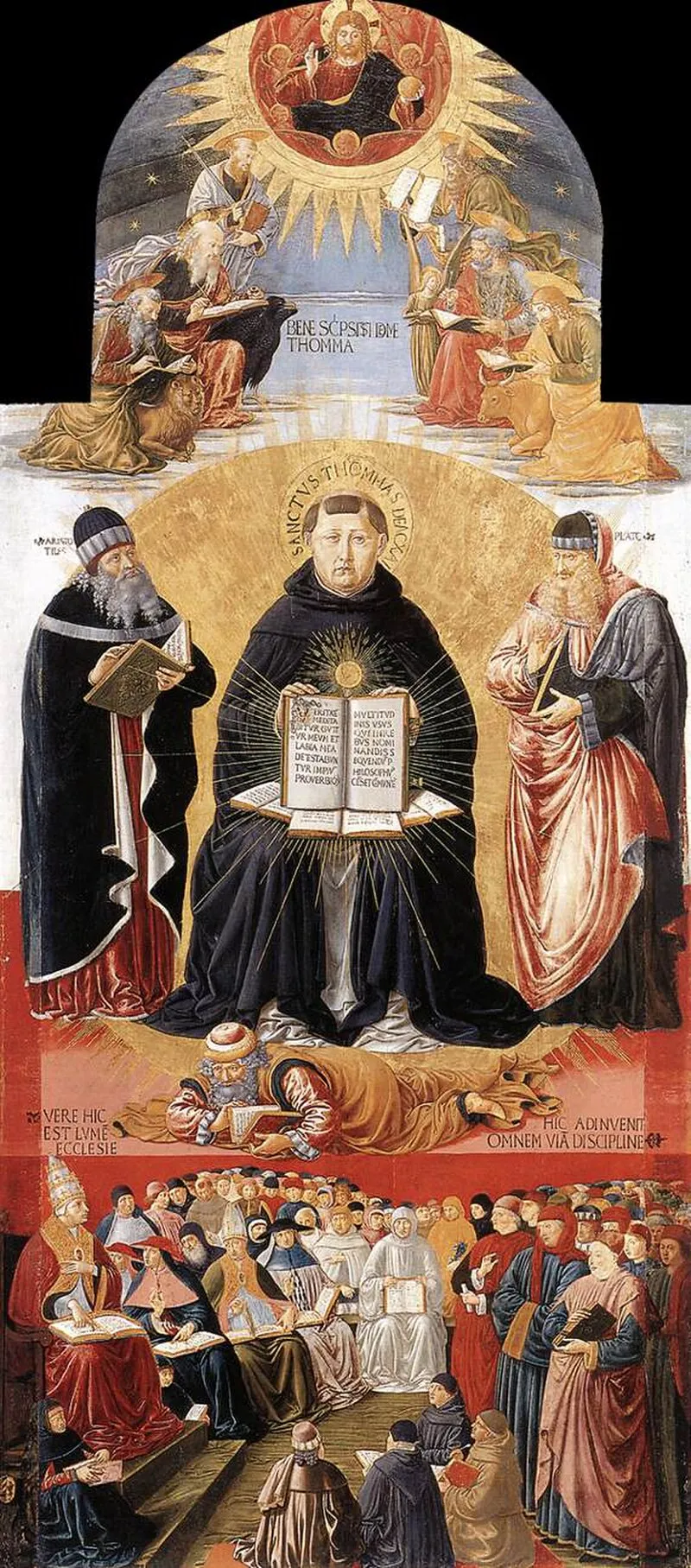
Thomas Aquinas developed the most influential constructive theory of religious language in the Western philosophical tradition. His treatment of the problem appears principally in the Summa Theologiae, Part I, Question 13 ("The Names of God"), and in parallel discussions in the Summa contra Gentiles and De Veritate. Aquinas argued that when we predicate terms such as "good," "wise," or "powerful" of God, we do so neither univocally (in exactly the same sense as we predicate them of creatures) nor equivocally (in a completely unrelated sense), but analogically.3, 11
Univocal predication would make God a member of the same genus as creatures, subject to the same limitations and the same categories — an outcome incompatible with divine transcendence. Equivocal predication, on the other hand, would make religious language meaningless: if "good" when applied to God bears no relation whatsoever to "good" as applied to a human being, then calling God "good" conveys no information to the speaker. Aquinas identified analogy as the middle path between these two extremes.3
The basis of analogical predication, for Aquinas, is the causal relationship between God and creation. Because God is the cause of all goodness in creatures, the goodness found in creatures bears a real, if imperfect, resemblance to the goodness that exists in God. When we say that a human being is good and that God is good, we are using "good" in a sense that is partly the same (both possess goodness) and partly different (the mode of goodness differs radically). The perfection itself — goodness, wisdom, being — exists in God in an unlimited, non-composite manner, while in creatures it exists in a limited, received manner.3, 11
Interpreters of Aquinas have debated whether his mature position relies primarily on the analogy of attribution (in which a term is predicated primarily of one subject, the "primary analogate," and derivatively of others by virtue of a relation to the primary) or the analogy of proportionality (in which relationships are compared: as human goodness is to human nature, so divine goodness is to the divine nature). In the De Veritate (q.2, a.11), Aquinas favors the analogy of proportionality; in the Summa Theologiae, he appears to favor the analogy of attribution, in which God is the primary analogate from whom the perfection flows to creatures.3, 11 The precise reconstruction of Aquinas's position remains a matter of active scholarly discussion, but the core insight — that religious predication is neither identical to nor wholly disconnected from ordinary predication — has been widely influential.
Approaches to religious predication3, 9
| Mode | Definition | Implication for "God is good" | Problem |
|---|---|---|---|
| Univocal | Same meaning when applied to God and creatures | God's goodness is identical in kind to human goodness | Undermines divine transcendence |
| Equivocal | Completely different meaning when applied to God | "Good" conveys no information about God | Renders religious language meaningless |
| Analogical | Partly the same, partly different meaning | God's goodness resembles but infinitely exceeds creaturely goodness | Requires further specification of the "partly" |
| Negative | Only says what God is not | "God is not lacking in goodness" | May leave no positive content |
| Symbolic | Participates in the reality it symbolizes | "Good" points toward and participates in God's nature | Difficult to distinguish from metaphor |
Tillich and symbolic language
The German-American theologian and philosopher Paul Tillich (1886–1965) proposed an alternative theory of religious language centered on the concept of the symbol. In Dynamics of Faith (1957), Tillich distinguished sharply between signs and symbols. A sign, such as a red traffic light, points to something beyond itself but does not participate in the reality to which it points; its connection to its referent is purely conventional. A symbol, by contrast, both points beyond itself and participates in the power and reality of that to which it points.6
Tillich held that all language about God is necessarily symbolic, because God is not a being alongside other beings but the "ground of being" (Sein-selbst, "Being-itself") that underlies and transcends all finite existence. The only literally true statement about God, on Tillich's view, is that God is Being-itself; every other statement — that God is personal, that God is loving, that God is a father — is symbolic. These statements are not false, but they are not literally descriptive either. They point to and participate in the ultimate reality that they cannot capture in finite concepts.6
Tillich argued that symbols cannot be manufactured by deliberate decision; they arise from the "collective unconscious" of a cultural group and die when they can no longer evoke the experience of the sacred. A symbol that has "died" — that no longer mediates the encounter with ultimate concern — becomes a mere conventional sign and loses its power. Religious language, on this account, is living only insofar as the symbols that compose it continue to open dimensions of reality and of the human soul that would otherwise remain closed.6
Several objections have been raised against Tillich's theory. First, the claim that the only literal statement about God is that God is Being-itself is itself a positive metaphysical assertion that requires justification. Second, if all religious language is symbolic, it becomes difficult to specify the criteria by which one symbol can be assessed as more adequate than another, raising the concern that symbolic theology is unfalsifiable in the very way that Flew's challenge targeted. Third, the distinction between symbol and metaphor is not always clear: if a religious statement "participates" in the reality it symbolizes, the nature of that participation requires further philosophical analysis that Tillich left largely undeveloped.9, 15
Wittgenstein and religious language games

A fundamentally different approach to the problem emerged from the later work of Ludwig Wittgenstein (1889–1951). In the Philosophical Investigations (1953), Wittgenstein argued that the meaning of a word is not determined by a private mental image or by correspondence to an object in the world, but by its use in a particular language game — a rule-governed pattern of linguistic and social activity embedded in a broader "form of life."7 Different language games have different criteria of meaningfulness, different standards of evidence, and different internal grammars. The language game of science, for example, operates with different rules from the language game of ethics, aesthetics, or storytelling; demanding that every domain conform to the rules of empirical science is, on this view, a philosophical confusion rather than an insight.
Wittgenstein himself made scattered but suggestive remarks about religious belief, particularly in his Lectures and Conversations on Aesthetics, Psychology and Religious Belief (published posthumously in 1966). He observed that when a religious believer says "There will be a Last Judgment," the believer is not making a scientific prediction that could be confirmed or disconfirmed by empirical evidence. The utterance functions within a different language game entirely, one in which it shapes the believer's attitude toward life, death, and moral responsibility. To assess such a statement by the standards of empirical science is to misunderstand the kind of utterance it is.7
The Welsh philosopher D. Z. Phillips (1934–2006) developed the Wittgensteinian approach into a sustained account of religious language. In works such as The Concept of Prayer (1965) and Religion Without Explanation (1976), Phillips argued that religious concepts such as God, prayer, and immortality must be understood in terms of their use within the religious form of life, not by reference to some external metaphysical reality that religious language allegedly describes. To ask whether God "really exists" as though this were a factual question answerable by evidence is, on Phillips's view, to misunderstand the grammar of religious discourse. The reality of God is constituted by the role that the concept of God plays in the believer's life — in practices of worship, confession, gratitude, and moral transformation — and not by correspondence to a supernatural entity.8
This approach was labeled Wittgensteinian fideism by the philosopher Kai Nielsen, who criticized it as rendering religious claims immune to rational assessment. Nielsen argued that if religious language constitutes a self-contained language game with its own internal criteria of meaning, then it cannot be rationally criticized from outside, and the believer is insulated from all external objections. Phillips rejected the label, contending that his position does not make religious language immune to criticism but rather insists that criticism must engage with the actual grammar of religious discourse rather than imposing foreign criteria.12 The debate between Nielsen and Phillips, conducted over several decades and collected in their 2005 volume Wittgensteinian Fideism?, remains one of the most sustained exchanges on the epistemological status of religious language.
Models, qualifiers, and empirical fit
The British philosopher and Anglican bishop Ian Ramsey (1915–1972) developed an account of religious language that attempted to navigate between the positivist dismissal and the Wittgensteinian insulation of religious discourse. In Religious Language: An Empirical Placing of Theological Phrases (1957), Ramsey argued that religious language employs models drawn from ordinary experience — such as "God is a father," "God is a king," "God is a shepherd" — combined with qualifiers that signal that these models are being extended beyond their ordinary use.10
The qualifier "infinitely" in "infinitely good," for example, does not simply increase the degree of goodness but signals a shift in logical kind: it directs the hearer to follow the model of goodness as far as it will go and then to recognize that the reality being pointed to exceeds the model. Ramsey called the moment of recognition a disclosure — an experience in which the world "comes alive" in a new way and the speaker grasps something that cannot be fully captured in the model alone.10
Ramsey argued that religious statements, while not straightforwardly empirical, are not cognitively empty either. They possess what he called empirical fit: they can be assessed by their capacity to illuminate human experience and to make sense of the full range of situations that confront human beings. A religious claim that fails to "fit" the experienced world — that does not illuminate or make sense of human life — is, on Ramsey's view, a poor religious claim, even though it cannot be tested by laboratory experiment. This notion of empirical fit represents an attempt to preserve some connection between religious language and the experienced world without requiring that religious statements meet the strict criteria of empirical verification.10
Realist and anti-realist interpretations
Much contemporary discussion of religious language is framed by the distinction between realism and anti-realism about theological discourse. A realist holds that religious statements, when they are true, are true because they correctly describe a mind-independent reality — that "God exists" is true because there is, in fact, a being that is God. An anti-realist holds that religious statements do not describe a mind-independent reality but serve some other function: expressing commitments, guiding behavior, articulating a form of life, or pointing symbolically to a reality that transcends literal description.9
Richard Swinburne has been one of the most prominent defenders of a realist account of religious language. In The Coherence of Theism (1977; rev. 1993), Swinburne argued that theological statements are genuinely cognitive — they make truth claims about what exists and what does not. He defended the meaningfulness of theological statements by arguing that the central terms of theistic discourse ("person," "power," "knowledge," "goodness") are used in senses that are logically continuous with their ordinary uses, stretched and extrapolated but not fundamentally altered. On Swinburne's account, "God is a person" does not use "person" in an equivocal sense; it uses the concept of personhood and removes the limitations that accompany personhood in finite beings.13
Anti-realist accounts of religious language have been developed by philosophers working in both the Wittgensteinian tradition and the pragmatist tradition. Don Cupitt, in Taking Leave of God (1980), argued that "God" should be understood not as a referring expression picking out a mind-independent being but as a symbol for the moral and spiritual ideals that constitute the religious life. On this view, religious practice can continue and religious language can retain its function even without any commitment to the objective existence of God.9
The realism-anti-realism debate intersects with the earlier challenges. If the positivist is correct that religious statements are cognitively meaningless, then neither realism nor anti-realism applies, because there is no proposition to be either true or false. If the Wittgensteinian is correct that religious language constitutes a distinctive language game, the question becomes whether the internal criteria of that game include a commitment to the mind-independent reality of God (a form of "internal realism") or whether they function without that commitment (a form of "internal anti-realism"). The resolution of this debate depends in part on how one understands the function of truth within religious practice — a question that connects the philosophy of religious language to broader issues in epistemology and the philosophy of truth.9, 13
Contemporary assessment
The problem of religious language remains an active area of inquiry in analytic philosophy of religion. The strict verificationist challenge has largely receded: the verification principle faces the objection of self-referential incoherence (it cannot satisfy its own criterion), and the broader program of logical positivism has few contemporary proponents in its original form.9, 15
Flew's falsification challenge, however, continues to exert influence. The question of what, if anything, would count against a religious claim remains a live issue, particularly in discussions of the problem of evil, where the theist's response to suffering is scrutinized for the kind of progressive qualification that Flew identified. Philosophers of religion who defend the meaningfulness of theistic claims face the challenge of specifying the conditions under which those claims could, in principle, be shown to be false, or else explaining why the absence of such conditions does not render the claims vacuous.2, 15
The Thomistic tradition of analogy has been renewed by philosophers such as Ralph McInerny and Herbert McCabe, who have offered careful reconstructions of Aquinas's position and argued that analogical predication provides a genuinely informative mode of theological discourse. The Wittgensteinian tradition continues through philosophers who investigate the particular grammar of religious practices — prayer, confession, lament, thanksgiving — and argue that the meaning of religious language is inseparable from the practices in which it is embedded.11, 12
One area of recent development concerns the relationship between religious language and metaphor. Drawing on theories of metaphor developed by Max Black, George Lakoff, and others, some philosophers have argued that much religious language functions as "conceptual metaphor" — a systematic mapping of one domain of experience onto another that generates genuine cognitive content. On this view, to say "God is a fortress" is not merely emotive or decorative but structures thought about God in ways that have real inferential consequences (safety, strength, refuge). Whether metaphorical religious language can bear the cognitive weight that natural theology requires remains an open question.9
The diversity of these approaches — negative theology, analogy, symbolism, language games, models, metaphor, realism, anti-realism — reflects the depth of the underlying problem. Religious language attempts to do something that may be intrinsically difficult: use finite concepts and finite grammar to refer to what is, by definition, beyond finitude. Whether this attempt succeeds, and if so how, depends on questions about the nature of language, the nature of God, and the relationship between human cognition and ultimate reality that remain among the most fundamental in philosophy.9