Overview
- Natural theology is the enterprise of reasoning about the existence and attributes of God using the natural cognitive faculties available to all human beings — sense perception, introspection, and rational inference — without appeal to special revelation, sacred texts, or mystical experience.
- The discipline has a continuous history from Plato and Aristotle through the medieval synthesis of Aquinas, the early modern design arguments of Paley, the Enlightenment critiques of Hume and Kant, the theological rejection by Barth, and the twentieth-century revival led by Swinburne, Plantinga, and Craig.
- Contemporary natural theology employs formal tools including Bayesian probability theory, modal logic, and the philosophy of science, and its relationship to reformed epistemology remains a central question: whether theistic belief requires the support of natural-theological arguments or can be rationally held as a properly basic belief without them.
Natural theology is the enterprise of reasoning about the existence and attributes of God through the use of cognitive faculties available to all human beings — sense perception, introspection, memory, and rational inference — without relying on special revelation, sacred scripture, or mystical experience.1, 2 The term designates not a single argument but a broad intellectual programme whose practitioners ask whether the existence of the natural world, its order and regularity, the deliverances of moral experience, or the very concept of a supreme being can provide rational grounds for theistic belief. In its classical form, natural theology produced the cosmological, teleological, ontological, and moral arguments for God's existence — families of arguments that remain at the centre of philosophical debate. In its contemporary form, the discipline draws on Bayesian probability theory, modal logic, and the philosophy of science to assess whether theism provides a better explanation of the observed world than its rivals.3, 5
The history of natural theology is also the history of its critics. David Hume and Immanuel Kant mounted penetrating Enlightenment-era challenges to the enterprise. Karl Barth rejected it on theological grounds, arguing that human reason is too compromised by sin to reach God apart from divine self-revelation. Alvin Plantinga's reformed epistemology questioned whether natural theology is needed for rational theistic belief, even while granting that its arguments may have value. The tension between natural theology and its alternatives — fideism, presuppositionalism, reformed epistemology — remains one of the defining fault lines in the philosophy of religion.1, 11, 12
Definition and scope
The phrase "natural theology" carries two related but distinct senses. In its narrower sense, it refers specifically to arguments for the existence of God based on features of the natural world: the causal order, the appearance of design, the contingency of finite things. In its broader and more common contemporary usage, natural theology encompasses any attempt to investigate theological questions using the ordinary cognitive faculties shared by all human beings, without appeal to supernatural sources of information such as sacred texts, prophetic utterances, or direct divine communication.1 On this broader definition, the ontological argument — which reasons from the concept of God rather than from any observation of nature — counts as natural theology because it employs nothing beyond rational reflection. Similarly, moral arguments for God's existence, which begin with the experience of moral obligation, fall within natural theology's scope because moral experience is available to all human beings regardless of their religious commitments.2, 3
What natural theology excludes is equally important to its definition. It does not appeal to the authority of any particular religious tradition, creed, or ecclesiastical body. It does not presuppose the truth of any specific revelation. It does not invoke faculties such as telepathy, extrasensory perception, or mystical union, which are not universally shared. The self-imposed constraint of working only with generally available cognitive resources is what gives natural theology its distinctive philosophical character: its conclusions, if sound, should be accessible in principle to any rational inquirer regardless of religious background.1
Natural theology is frequently distinguished from revealed theology, which begins with the contents of a putative divine revelation and reasons about their implications. Thomas Aquinas drew this distinction with particular clarity, dividing theological truths into those accessible to natural reason (that God exists, that God is one) and those known only through revelation (the Trinity, the Incarnation).6, 7 On Aquinas's framework, natural theology and revealed theology are complementary rather than competing enterprises: the former establishes a rational foundation that the latter builds upon. Other thinkers, as discussed below, have been less sanguine about this complementarity.
Ancient roots
The enterprise of reasoning about divine things through natural faculties has roots in the earliest Western philosophy. Plato's Timaeus (c. 360 BCE) presents a sustained argument that the order and beauty of the cosmos point to an intelligent craftsman — the Demiurge — who shaped the material world in accordance with eternal rational forms. In the Laws (Book X), Plato offers what may be the first formal argument against atheism, contending that the self-moving character of the soul demonstrates the priority of mind over matter and therefore the existence of divine intelligence governing the heavens.16
Aristotle's Metaphysics (Book XII) developed the concept of an Unmoved Mover — a being of pure actuality, eternal and unchanging, that serves as the final cause toward which all motion in the cosmos is directed. Aristotle's Unmoved Mover is not a creator in the sense later adopted by monotheistic traditions; it does not act upon the world through will or intention but attracts all things as an object of desire and contemplation. Nevertheless, the Aristotelian argument that the existence of change requires an unchanging source became one of the foundational moves in natural theology, taken up and transformed by medieval thinkers including Thomas Aquinas and Averroes.15, 16
The Stoics developed their own form of natural theology centred on the concept of logos — a rational principle pervading the cosmos that orders all things according to providential design. Marcus Terentius Varro (116–27 BCE), drawing on Stoic sources, introduced a tripartite classification of theology that would prove influential for centuries: theologia mythica (the theology of the poets and popular religion), theologia civilis (the theology of the state and its rituals), and theologia naturalis (the theology of the philosophers, who seek the true nature of the divine through reason). Augustine of Hippo preserved and transmitted this taxonomy in The City of God, and it was through Augustine that the specific term "natural theology" entered the Christian intellectual tradition.1, 3
Cicero's De Natura Deorum (45 BCE) provides the most complete surviving ancient treatment of the subject, staging a dialogue among an Epicurean, a Stoic, and an Academic Sceptic on the existence and nature of the gods. The Stoic interlocutor Balbus presents arguments from cosmic order and providential design; the Sceptic Cotta subjects them to critical examination. The structure of the dialogue — argument, objection, and counter-objection — anticipates the form that natural theology would take in later centuries, and David Hume consciously modelled his own Dialogues Concerning Natural Religion on Cicero's work.9, 14
The medieval synthesis
Natural theology reached its most systematic development in the high medieval period (roughly 1000–1400 CE), when Christian, Jewish, and Islamic philosophers drew on the recovered works of Aristotle to construct elaborate rational frameworks for theological belief. The central question animating medieval natural theology was whether and to what extent human reason, unaided by revelation, could establish truths about God.
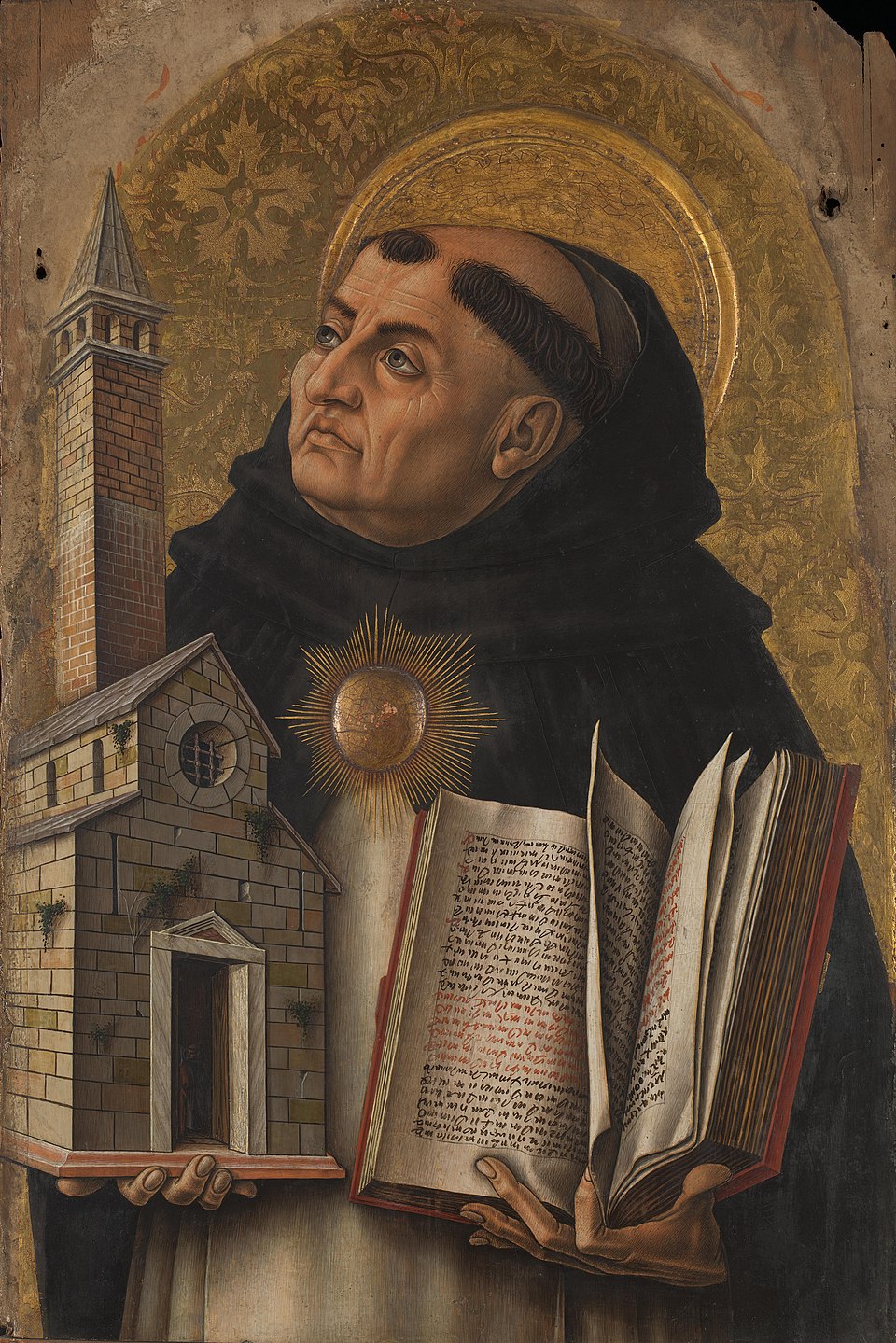

Thomas Aquinas (1225–1274) provided the most influential answer. In the Summa Contra Gentiles (c. 1259–1265), Aquinas explicitly addressed those who do not accept the authority of Christian scripture, arguing that certain truths about God — above all, that God exists — can be demonstrated through natural reason alone, on the basis of premises that any rational person should accept.7 In the Summa Theologiae (I, q. 2, a. 3), he presented the Five Ways — five distinct arguments from motion, efficient causation, contingency, degrees of perfection, and teleology — each intended to show that natural reason, reflecting on features of the observable world, arrives at the conclusion that God exists.6
Aquinas's framework rested on a careful distinction between two domains of theological truth. Truths of the first type — the praeambula fidei (preambles of faith) — are accessible to natural reason and include the existence of God, God's unity, and certain divine attributes such as simplicity, immutability, and perfection. Truths of the second type — the mysteria fidei (mysteries of faith) — exceed the capacity of natural reason and are known only through divine revelation; these include the Trinity, the Incarnation, and the specifics of redemption.6, 7 On this framework, natural theology and revealed theology occupy distinct but complementary epistemic territories: natural reason prepares the ground that revelation builds upon, and the two can never genuinely conflict because both ultimately derive from the same divine source.
Aquinas was not the only medieval practitioner of natural theology. Anselm of Canterbury (1033–1109) had earlier developed the ontological argument, reasoning from the concept of "that than which nothing greater can be thought" to the conclusion that such a being must exist in reality. In the Islamic tradition, al-Kindī (c. 801–873) and Ibn Sīnā (Avicenna, 980–1037) developed cosmological arguments from contingency and efficient causation, while Moses Maimonides (1138–1204) offered parallel arguments within the Jewish tradition. The medieval period thus saw natural theology pursued across multiple religious traditions, each drawing on a common Aristotelian philosophical vocabulary.1, 16
Early modern developments
The early modern period (roughly 1600–1800) transformed natural theology in response to the rise of the new mechanical philosophy and the scientific revolution. As the Aristotelian framework that had sustained medieval natural theology was increasingly displaced by the mechanical worldview of Galileo, Descartes, Boyle, and Newton, the arguments of natural theology were reformulated in terms compatible with the new science.
.jpg)
René Descartes (1596–1650) offered a rationalist version of the ontological argument in the Fifth Meditation, arguing that existence belongs to the essence of a supremely perfect being just as having three angles belongs to the essence of a triangle. He also presented a cosmological argument from the cause of the idea of God: since the idea of an infinite, perfect being cannot have originated from a finite mind, there must exist an actually infinite being that caused the idea.1, 16
Gottfried Wilhelm Leibniz (1646–1716) developed the cosmological argument from contingency in its most rigorous modern form, grounding it in the Principle of Sufficient Reason: for every fact, there must be a sufficient reason why it is so and not otherwise. Since no contingent thing contains the reason for its own existence, the chain of contingent explanations must terminate in a necessary being whose existence is self-explanatory.16
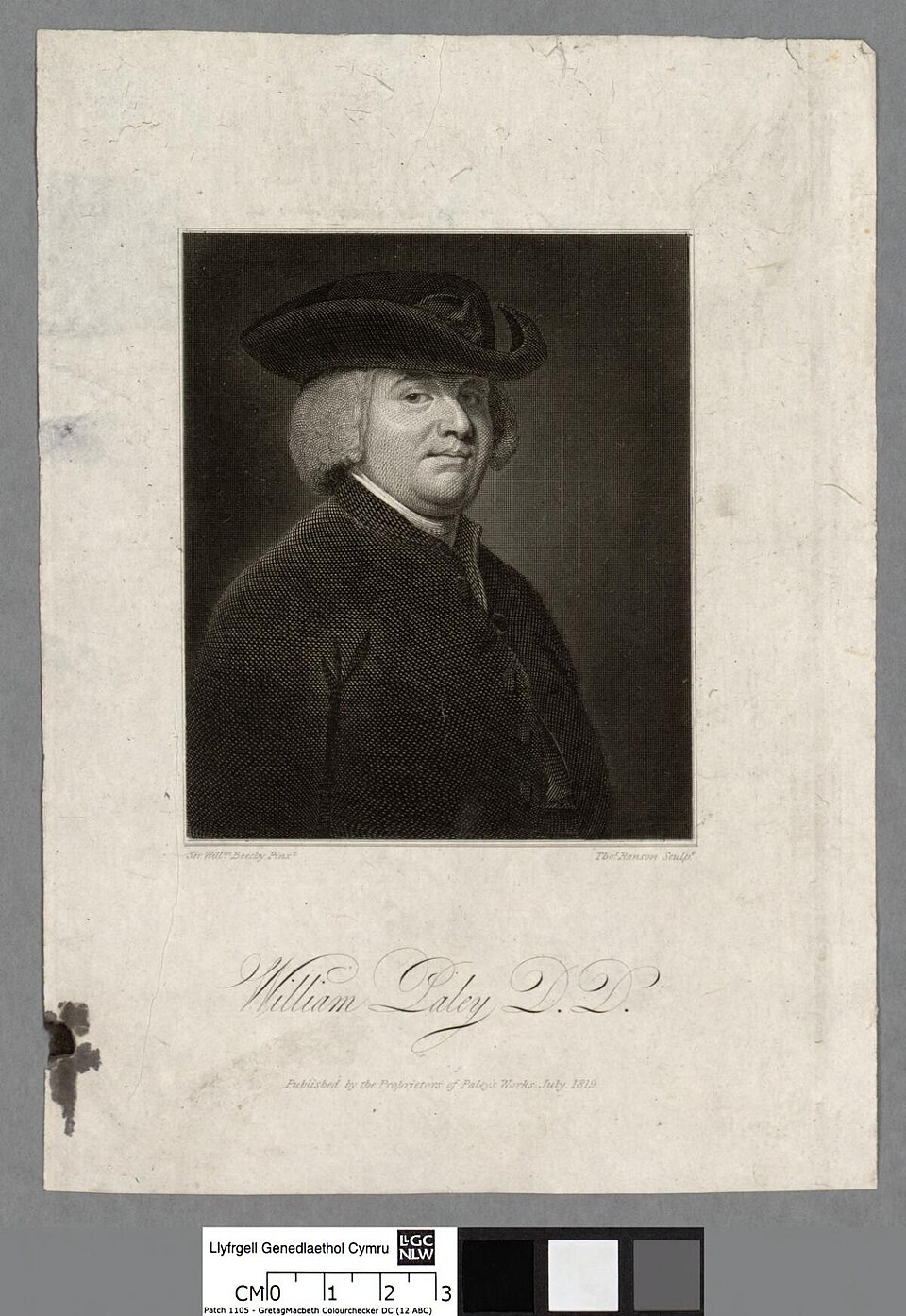
William Paley (1743–1805) produced what became the single most influential work of natural theology in the English-speaking world. His Natural Theology: Or, Evidences of the Existence and Attributes of the Deity, Collected from the Appearances of Nature (1802) opened with the famous watchmaker analogy: just as the intricate mechanism of a watch found on a heath compels the inference of an intelligent designer, so too the far more complex contrivances of the natural world — the eye, the wing, the circulatory system — compel the inference of a divine designer.8 Paley's work was a textbook at Cambridge for much of the nineteenth century and was read closely by the young Charles Darwin, who later recalled admiring "the long line of argumentation" even as his own theory of natural selection would provide an alternative explanation for biological complexity.3
The Enlightenment critique
The Enlightenment produced the two most consequential philosophical challenges to natural theology, both of which continue to shape the discipline's self-understanding.
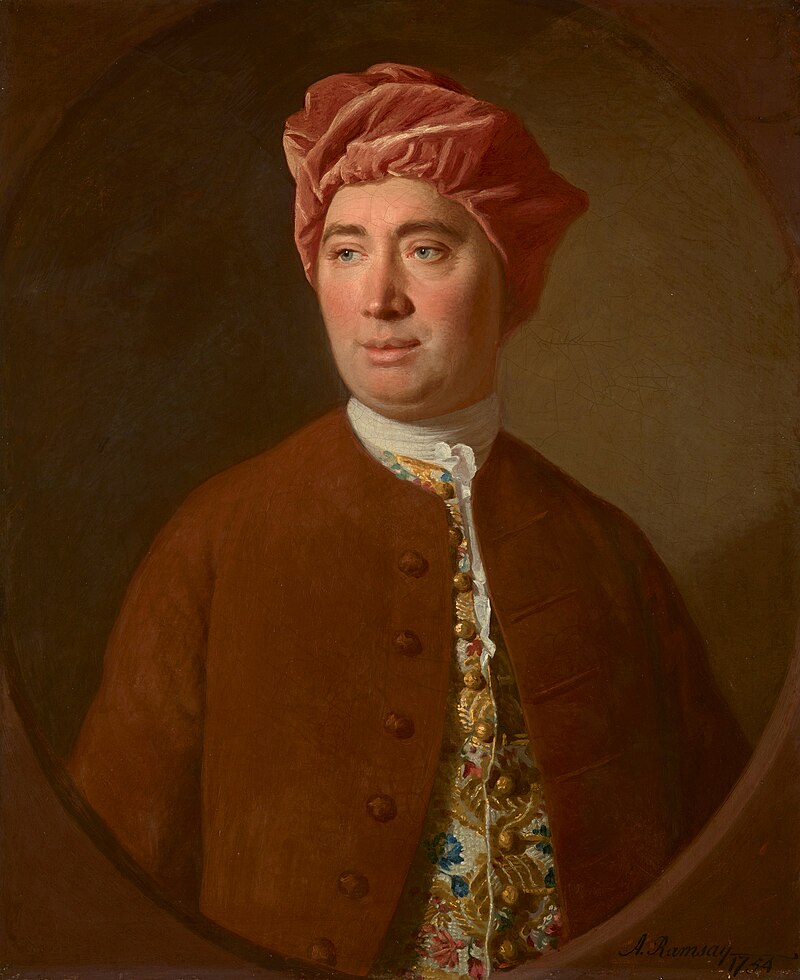

David Hume (1711–1776) mounted his critique primarily in the Dialogues Concerning Natural Religion (published posthumously in 1779). Modelled on Cicero's De Natura Deorum, the work stages a conversation among three characters: Cleanthes, who defends the argument from design; Demea, who favours an a priori cosmological argument; and Philo, a sceptic who subjects both to sustained critical examination. Among Philo's objections are that the analogy between human artefacts and the natural world is too weak to sustain the inference to a divine designer; that the evidence of suffering and disorder in nature counts against the hypothesis of a benevolent, omnipotent creator; that for all the argument shows, the world might have been produced by multiple gods, an imperfect god, or a purely material process; and that the causal principle invoked in cosmological arguments cannot be extrapolated beyond experience to the universe as a whole.9
Hume's critique did not target any single argument in isolation but rather questioned whether the methods of natural theology — causal inference, analogical reasoning, a priori demonstration — are capable in principle of reaching conclusions about transcendent realities. If the tools of natural theology are inadequate to their subject matter, then the entire enterprise, not merely this or that argument, is called into question.9, 13
Immanuel Kant (1724–1804) offered a different and in some respects more fundamental challenge. In the Critique of Pure Reason (1781), Kant argued that the traditional arguments of natural theology rest on an illegitimate extension of concepts beyond the bounds of possible experience. He classified the arguments into three types — physico-theological (from design), cosmological (from contingency), and ontological (from the concept of God) — and argued that each ultimately depends on the ontological argument, which he rejected on the ground that existence is not a "real predicate" that can be included in the concept of a thing. Since the ontological argument fails, the other arguments, which presuppose it at some point, fail with it.10
Kant's critique was not, however, a simple rejection of theism. He argued that while theoretical reason cannot prove the existence of God, practical reason demands the postulation of God as a condition for the possibility of the highest good — the union of virtue and happiness. God thus re-enters Kant's philosophy through the moral argument, not as a demonstrated conclusion of natural theology but as a postulate of practical reason required for the coherence of the moral life.10 The long-term effect of the Humean and Kantian critiques was not to eliminate natural theology but to force its practitioners to refine their methods, clarify their epistemological assumptions, and respond to a set of challenges that remain live in contemporary debate.
The theological rejection
The most forceful opposition to natural theology has come not from secular philosophers but from within the Christian theological tradition itself. Martin Luther (1483–1546) was deeply suspicious of the capacity of fallen human reason to reach genuine knowledge of God, insisting that God is known through the cross of Christ, not through philosophical speculation. John Calvin (1509–1564) acknowledged that the natural world displays evidence of God's existence and attributes — what he called the sensus divinitatis, a natural awareness of the divine implanted in all human beings — but maintained that sin has so corrupted human cognition that natural knowledge of God, while sufficient to render human beings culpable, is insufficient for salvation.1, 12
The most radical theological rejection of natural theology in the twentieth century came from Karl Barth (1886–1968). In 1934, Emil Brunner published Nature and Grace, arguing that there exists a limited "point of contact" between human nature and divine revelation — an innate capacity for God rooted in the image of God in which human beings were created — that makes a modest natural theology possible. Barth's reply was a single word: "Nein!" In his response, Barth denied that any human capacity, no matter how qualified, could serve as a pathway to knowledge of God apart from God's free act of self-revelation in Jesus Christ. Human reason, Barth argued, is not merely limited but actively distorted by sin, and any attempt to construct a theology from below — from nature, reason, or experience — inevitably produces an idol rather than genuine knowledge of God.11
The Barth-Brunner exchange remains a defining moment in twentieth-century theology because it clarified a fundamental divide. For Barth, natural theology was not merely unsuccessful but positively dangerous: by claiming to reach God through human effort, it undermined the radical gratuity of grace and the absolute priority of divine revelation. For Brunner, and for the broader Catholic and much of the Reformed tradition, some form of natural theology was both possible and necessary, if only to establish the conditions under which revelation could be intelligibly received.1, 11
This theological divide has persisted. The Roman Catholic tradition, following the First Vatican Council (1870), formally affirms that the existence of God can be known with certainty from the created world by the natural light of human reason. Many Protestant traditions, by contrast, remain cautious or hostile toward the project, either on Barthian grounds or because they regard natural theology as an unnecessary concession to secular epistemological standards.1, 3
The twentieth-century revival
After a period of relative dormancy in the mid-twentieth century — when logical positivism dismissed theological language as cognitively meaningless and many theologians followed Barth in abandoning the project — natural theology experienced a substantial revival in analytic philosophy of religion beginning in the 1960s and 1970s. This revival was driven by several developments: the collapse of logical positivism as a philosophical movement, the emergence of sophisticated modal logic that could formalise previously informal arguments, and the work of a generation of analytic philosophers who took religious questions seriously as genuine philosophical problems.1, 4
Richard Swinburne (b. 1934) developed the most systematic programme of inductive natural theology in the contemporary period. In The Existence of God (1979; 2nd ed. 2004), Swinburne argued that the existence of God should be assessed using the same canons of reasoning applied to scientific hypotheses. Employing Bayes' theorem, he contended that while no single piece of evidence — the existence of the universe, its conformity to natural laws, the fine-tuning of physical constants, the existence of consciousness, the testimony of religious experience — makes theism more probable than not by itself, the cumulative force of all the evidence together renders the existence of God more probable than not.5 Swinburne's approach marked a fundamental methodological shift: rather than seeking deductive proofs that compel assent, he offered an inductive cumulative case that parallels the way evidence is assessed in the empirical sciences.
Alvin Plantinga (1932–2024) made contributions to natural theology through his formulation of the modal ontological argument and the free will defence against the logical problem of evil, but his relationship to the enterprise was complex. Plantinga's reformed epistemology argued that belief in God can be "properly basic" — rationally held without being inferred from other beliefs or supported by arguments — just as beliefs formed through perception or memory are rationally held without argumentative support.12 On this view, the ordinary believer who trusts in God on the basis of an internal sense of the divine (what Calvin called the sensus divinitatis) is fully rational, even if that believer knows of no argument from natural theology. Plantinga did not claim that natural-theological arguments are unsound, only that they are not epistemically necessary for rational theistic belief.12
William Lane Craig (b. 1949) revived the kalam cosmological argument, drawing on both philosophical reasoning about the impossibility of an actually infinite past and scientific evidence from Big Bang cosmology to argue that the universe began to exist and therefore requires a cause. Craig's formulation generated an enormous secondary literature and became one of the most widely discussed arguments in contemporary philosophy of religion.4, 16
Major figures in the history of natural theology1, 3, 16
| Figure | Period | Key contribution | Primary work |
|---|---|---|---|
| Plato | c. 428–348 BCE | Argument from cosmic order to intelligent craftsman | Timaeus, Laws X |
| Aristotle | 384–322 BCE | Unmoved Mover as final cause of all motion | Metaphysics XII |
| Cicero | 106–43 BCE | Dialogue format for examining theistic arguments | De Natura Deorum |
| Anselm | 1033–1109 | Ontological argument from the concept of God | Proslogion |
| Aquinas | 1225–1274 | Five Ways; distinction of natural and revealed theology | Summa Theologiae, Summa Contra Gentiles |
| Paley | 1743–1805 | Watchmaker analogy and biological design argument | Natural Theology (1802) |
| Hume | 1711–1776 | Sceptical critique of design and cosmological arguments | Dialogues Concerning Natural Religion |
| Kant | 1724–1804 | Critique of speculative theology; moral argument | Critique of Pure Reason |
| Swinburne | b. 1934 | Bayesian cumulative case for theism | The Existence of God (1979, 2004) |
| Plantinga | 1932–2024 | Modal ontological argument; reformed epistemology | God, Freedom, and Evil, Warranted Christian Belief |
| Craig | b. 1949 | Revival of the kalam cosmological argument | The Kalam Cosmological Argument (1979) |
Methods and approaches
Natural theology has employed a wide range of argumentative strategies, which can be classified by their logical form, their starting premises, and the strength of conclusion they claim to establish.
Deductive arguments aim to demonstrate that the existence of God follows necessarily from premises that are claimed to be self-evidently true or established by independent reasoning. The ontological argument is purely deductive: if its premises are granted, the conclusion that God exists is entailed with logical necessity. The argument from contingency, in its Leibnizian form, is likewise deductive, proceeding from the Principle of Sufficient Reason to the existence of a necessary being. The strength of deductive arguments is that their conclusions are as certain as their premises; their vulnerability is that the truth of the premises is typically contested.4, 5
Inductive arguments aim to show that the existence of God is probable given the evidence, without claiming that it follows necessarily. Swinburne distinguishes between C-inductive arguments, in which a piece of evidence raises the probability of God's existence relative to its prior probability, and P-inductive arguments, in which the total evidence makes God's existence more probable than not (probability greater than 0.5). On Swinburne's account, most individual arguments from natural theology are C-inductive: each raises the probability of theism somewhat, and only the cumulative weight of all the evidence together constitutes a P-inductive case.5
Abductive arguments — inferences to the best explanation — reason that theism provides a better explanation of some body of evidence than its competitors. The fine-tuning argument, for instance, contends that the precise values of the fundamental physical constants are better explained by the hypothesis of a designing intelligence than by the hypothesis of chance or physical necessity. The argument from consciousness contends that the existence of subjective experience is better explained by theism than by naturalism. Abductive reasoning is ubiquitous in science and in daily life, and its application to theological questions represents one of the most significant methodological developments in contemporary natural theology.4, 5
Transcendental arguments take a different approach, asking what conditions must obtain for some feature of experience — such as rationality, moral knowledge, or the intelligibility of the natural world — to be possible. The transcendental argument for God contends that the very possibility of rational thought, logical inference, or moral reasoning presupposes the existence of a transcendent ground of intelligibility. These arguments do not appeal to empirical evidence in the ordinary sense but rather to the preconditions of any evidence or reasoning whatever.4
Relationship to revealed theology
The question of how natural theology relates to revealed theology — theology based on the contents of a putative divine revelation — has been answered in strikingly different ways across the history of the discipline.
The complementarity model, exemplified by Aquinas, treats natural theology and revealed theology as addressing different subsets of theological truth. Natural reason can establish that God exists, that God is one, and that God possesses certain attributes such as goodness and power. Revelation discloses further truths — the Trinity, the Incarnation, the specifics of salvation — that natural reason could not have discovered on its own. On this model, natural theology provides the rational preambles (praeambula fidei) that prepare the mind to receive revelation, and the two forms of theology cannot conflict because they derive from the same divine source.6, 7
The opposition model, exemplified by Barth, denies that natural theology can function as a legitimate pathway to knowledge of God. On Barth's view, the attempt to reason about God from below — from nature, experience, or rational analysis — is not merely unsuccessful but positively distorting, because it subjects the infinite God to finite human categories and thereby produces an idol rather than genuine knowledge. The only source of genuine theological knowledge is God's free act of self-revelation in Jesus Christ, which cannot be anticipated, prepared for, or supplemented by human philosophical reasoning.11
The proper basicality model, developed by Plantinga, occupies a middle position. Plantinga does not reject the arguments of natural theology as unsound — indeed, he has contributed to them — but he denies that they are epistemically necessary for rational theistic belief. Belief in God can be properly basic, held rationally on the basis of the sensus divinitatis without inferential support, just as perceptual beliefs are properly basic and rationally held without argumentative support. Natural theology may serve useful subsidiary purposes — as confirmation for those who already believe, as "defeater-defeaters" for those whose faith is challenged by philosophical objections, as evidence for second-order epistemic assessments — but it is not the foundation on which rational theistic belief rests.12
The ramified natural theology approach, developed by Swinburne, extends the programme of natural theology beyond the bare existence of God to specifically Christian doctrines. Having argued that the cumulative evidence makes theism probable, Swinburne proceeds in subsequent works to argue that the evidence of the life, death, and reported resurrection of Jesus makes specifically Christian theism probable, and that doctrines such as the Trinity and the Incarnation are coherent and well-supported. Ramified natural theology thus blurs the boundary between natural and revealed theology, treating the historical evidence for specific revelatory claims as continuous with the philosophical evidence for theism in general.3, 5
Objections and responses
Beyond the specific objections raised against individual arguments (discussed in their respective articles), natural theology as an enterprise faces several overarching challenges.
The gap problem holds that even if the arguments of natural theology succeed, they establish at most the existence of a first cause, a designer, or a necessary being — not the personal, morally perfect, omniscient God of classical theism. Hume pressed this objection forcefully: the design argument, even if successful, shows at most that the world was produced by some intelligent agent or agents, not that it was produced by the infinite, perfect, unique God of monotheism. The gap between the conclusion of the argument and the God of traditional religion remains unbridged.9, 13 Defenders of natural theology respond that the gap can be progressively narrowed: the cosmological argument establishes a necessary, immaterial, enormously powerful cause; the teleological argument adds intelligence and purposiveness; the moral argument adds moral perfection; and the cumulative effect of all the arguments together points toward a being that closely resembles the God of classical theism.5
The epistemic objection questions whether human cognitive faculties are reliable enough to reach conclusions about transcendent realities. If our cognitive apparatus evolved to navigate the immediate physical environment — to find food, avoid predators, and attract mates — there is no guarantee that it is calibrated to track metaphysical truths about the ultimate nature of reality. Plantinga has turned a version of this objection against naturalism through the evolutionary argument against naturalism, contending that if naturalism and evolution are both true, there is no reason to trust that our cognitive faculties produce true beliefs about anything, including naturalism itself.12
The problem of religious diversity poses a different challenge: if natural theology's conclusions are genuinely accessible to all rational inquirers, why have rational inquirers across different cultures and historical periods reached such different conclusions about the divine? The existence of atheism, polytheism, pantheism, and radically divergent monotheisms among thoughtful people who have access to the same evidence and the same cognitive faculties suggests either that the evidence is far more ambiguous than natural theology claims or that non-rational factors — cultural conditioning, psychological needs, existential anxieties — play a larger role in the formation of religious belief than the arguments of natural theology acknowledge.1, 13
The problem of evil is sometimes treated as an argument against the enterprise of natural theology rather than merely against the existence of God. If the evidence of suffering, injustice, and natural catastrophe in the world constitutes strong evidence against the existence of a good and powerful God, then the evidence base that natural theology draws upon is not merely neutral but actively hostile to its conclusion. Natural theology thus faces the task of accounting for the problem of evil within its own framework, and the strength of its overall case depends in part on the strength of available theodicies and defences.5, 13
Natural theology and the natural sciences
The relationship between natural theology and the natural sciences has been both intimate and contentious. In the early modern period, natural theology and natural science were often pursued by the same individuals as parts of a single intellectual programme. Robert Boyle (1627–1691) endowed a lecture series — the Boyle Lectures — explicitly designed to defend Christianity against unbelief through arguments from natural philosophy. Isaac Newton regarded the elegant mathematical structure of the laws of nature as evidence of a divine mathematician. The Bridgewater Treatises (1833–1840), commissioned by the Earl of Bridgewater, enlisted leading scientists of the day to demonstrate "the Power, Wisdom, and Goodness of God, as manifested in the Creation."3
The publication of Darwin's On the Origin of Species (1859) is often regarded as a watershed, particularly for the argument from biological design. By demonstrating that the appearance of design in living organisms can be explained by natural selection acting on random variation, Darwin provided a non-teleological explanation for precisely the phenomena that Paley had cited as evidence of a divine designer. The impact on natural theology was profound but not uniform: some theologians abandoned the design argument entirely, while others reformulated it at a higher level — arguing, for instance, that the existence of natural laws capable of producing complex life through evolution is itself a fact requiring explanation, or that the fine-tuning of the physical constants that make evolution possible constitutes evidence of design at the cosmological rather than the biological level.3, 5
Contemporary natural theology draws on scientific findings in multiple ways. The kalam cosmological argument appeals to Big Bang cosmology as empirical confirmation that the universe began to exist. The fine-tuning argument appeals to physics and cosmology for the data about the values of fundamental constants. The argument from consciousness draws on neuroscience and the philosophy of mind to argue that subjective experience resists reductive explanation. In each case, the argument does not derive a theological conclusion from scientific premises alone but rather uses scientific findings as evidence within a broader philosophical framework.4, 5
The question of whether science and natural theology are complementary, independent, or competing enterprises remains a matter of active debate. Some practitioners of natural theology, following Swinburne, treat theism as a quasi-scientific hypothesis to be assessed by the same standards of evidence and simplicity applied to scientific theories. Others, including those influenced by Wittgenstein or by Barthian theology, reject this assimilation, arguing that religious language operates in a fundamentally different mode from scientific language and that treating God as a hypothesis distorts the character of religious belief.1, 3
Contemporary assessment
Natural theology in the early twenty-first century is a diverse and active field. The publication of comprehensive reference works — including The Blackwell Companion to Natural Theology (2009), edited by Craig and Moreland, and The Oxford Handbook of Natural Theology (2013), edited by Re Manning — testifies to the breadth and vitality of contemporary research.3, 4 The arguments themselves have been formulated with a degree of logical precision that would have been unrecognizable to earlier practitioners, drawing on developments in modal logic, probability theory, and the philosophy of science that were unavailable before the twentieth century.
Several features distinguish the contemporary landscape from earlier periods. First, there is a widespread recognition that no single argument from natural theology is likely to be conclusive on its own. The trend, pioneered by Swinburne and developed by others, is toward cumulative case arguments that assess the total evidence for and against theism rather than resting the entire case on a single line of reasoning.5 Second, the dialogue between natural theology and the natural sciences has become more sophisticated, with practitioners drawing on cutting-edge research in cosmology, physics, biology, and cognitive science rather than relying on outdated scientific models. Third, the discipline has become genuinely global: while the Western tradition from Plato through Swinburne dominates the philosophical literature, there is growing interest in non-Western traditions of natural theology, including Islamic, Hindu, and Buddhist approaches to the question of whether reason can reach conclusions about ultimate reality.1, 3
The assessment of natural theology's success depends in part on what one expects it to achieve. If the standard is deductive proof that compels assent from any rational person, then natural theology has not met it: each of its arguments rests on premises that can be rationally contested, and thoughtful philosophers continue to disagree about their soundness. If the standard is providing rational support for theistic belief — showing that theism is a reasonable position for a reflective person to hold, even if not the only reasonable position — then the enterprise has been considerably more successful. The arguments of natural theology, taken individually and cumulatively, present a substantial body of reasoning that addresses the question of God's existence with the same seriousness and rigour that philosophy brings to any other fundamental question.4, 5
The tension between natural theology and reformed epistemology remains unresolved and perhaps irresolvable, because it reflects a deeper disagreement about the proper relationship between faith and reason. If Plantinga is correct that belief in God can be properly basic, then the believer does not need natural theology to be rational — but natural theology's arguments, if sound, still contribute to the overall evidence for theism and may serve important roles in intellectual engagement with non-believers and in addressing challenges to theistic belief. If Swinburne is correct that theism should be assessed as a hypothesis on the total evidence, then natural theology is not merely useful but central to the epistemic status of religious belief.5, 12 The question of whether belief in God is more like seeing a tree (a basic experience requiring no argument) or more like accepting a scientific theory (a conclusion supported by a cumulative body of evidence) may ultimately be a question about the nature of religious experience itself — a question that natural theology, by its own methods, continues to investigate.
References
Natural Theology: Or, Evidences of the Existence and Attributes of the Deity, Collected from the Appearances of Nature
Natural Theology: Comprising Nature and Grace by Professor Dr. Emil Brunner and the Reply No! by Dr. Karl Barth