Overview
- The problem of divine foreknowledge and free will asks whether God's infallible knowledge of all future events is compatible with the existence of genuinely free human choices, a question that has generated sustained philosophical inquiry from Aristotle's discussion of future contingents through contemporary modal logic and analytic philosophy of religion.
- Five major families of solutions have been developed: the Boethian-Thomistic view that God knows all events from an atemporal eternal present, the Ockhamist view that God's past beliefs about future free acts are 'soft' facts not subject to the necessity of the past, the Molinist view that God possesses middle knowledge of counterfactuals of creaturely freedom, open theism's denial that God possesses exhaustive foreknowledge of future contingents, and theological determinism's denial that libertarian free will exists.
- The debate remains among the most active in philosophy of religion, with each proposed solution facing persistent objections — the Boethian solution must explain how timeless knowledge relates to temporal events, Ockhamism must justify the hard/soft fact distinction, Molinism faces the grounding objection, open theism must reconcile limited omniscience with classical theism, and theological determinism must account for moral responsibility without libertarian freedom.
The problem of divine foreknowledge and free will asks whether an omniscient God's infallible knowledge of all future events is compatible with the existence of genuinely free human choices. If God knew yesterday that a person would perform a particular action tomorrow, and God's knowledge is by definition infallible, then it appears the person cannot do otherwise — for doing otherwise would mean that God held a false belief, which is impossible for an omniscient being. Yet if the person cannot do otherwise, it seems the action is not free in the libertarian sense that requires the genuine ability to choose among alternatives.5, 6 This problem, which sits at the intersection of theology, metaphysics, and the philosophy of action, has generated one of the most sustained and technically sophisticated debates in the history of Western philosophy.
The tension is ancient. Aristotle raised the underlying logical issue in his discussion of future contingents in the fourth century BCE, Boethius proposed a solution grounded in divine timelessness in the sixth century CE, and medieval thinkers including Thomas Aquinas, William of Ockham, and Luis de Molina developed rival frameworks that remain the foundations of contemporary discussion.1, 2, 3, 4 In the twentieth and twenty-first centuries, the debate has been sharpened by the tools of modal logic, possible-worlds semantics, and the philosophy of time, producing a rich landscape of competing positions: Boethian eternalism, Ockhamism, Molinism, open theism, and theological determinism. This article surveys the formal structure of the problem, traces its historical development, and examines each major family of solutions along with the principal objections each faces.
The formal structure of the problem
The core argument for the incompatibility of divine foreknowledge and libertarian free will can be stated in a semiformal way. The argument, often called the basic argument for theological fatalism, proceeds as follows.5, 6
P1. Yesterday, God infallibly believed that Jones would mow his lawn tomorrow.
P2. If an event has occurred in the past, it is now necessary (fixed and unalterable) that it occurred. (The necessity of the past.)
P3. Therefore, it is now necessary that God believed yesterday that Jones would mow his lawn tomorrow. (From P1 and P2.)
P4. Necessarily, if God believed that Jones would mow his lawn tomorrow, then Jones will mow his lawn tomorrow. (From the definition of infallible belief.)
P5. If it is now necessary that God believed that Jones would mow his lawn tomorrow, and necessarily God's belief entails the truth of what is believed, then it is now necessary that Jones will mow his lawn tomorrow. (Transfer of necessity principle.)
C. Therefore, it is now necessary that Jones will mow his lawn tomorrow, and Jones cannot do otherwise.
If the conclusion follows, then no one ever has the power to do otherwise than what God foreknew, and libertarian free will — which requires the genuine ability to have chosen differently — is an illusion. Each of the five major solutions to this problem targets a different premise or inference in the argument. Boethians deny that God's knowledge is temporally located in the past at all, thereby rejecting the applicability of P2. Ockhamists accept that God believed yesterday but deny that this particular past fact is subject to the necessity of the past, challenging the move from P1 and P2 to P3. Molinists accept the argument's structure but contend that God's middle knowledge of counterfactuals of creaturely freedom allows providence without the elimination of freedom. Open theists deny P1 outright: God does not have infallible beliefs about future free actions because such actions are not yet determined and therefore not yet objects of knowledge. Theological determinists accept the conclusion and deny that libertarian free will exists, holding that a compatibilist account of freedom is sufficient for moral responsibility.6, 10
Ancient and medieval origins
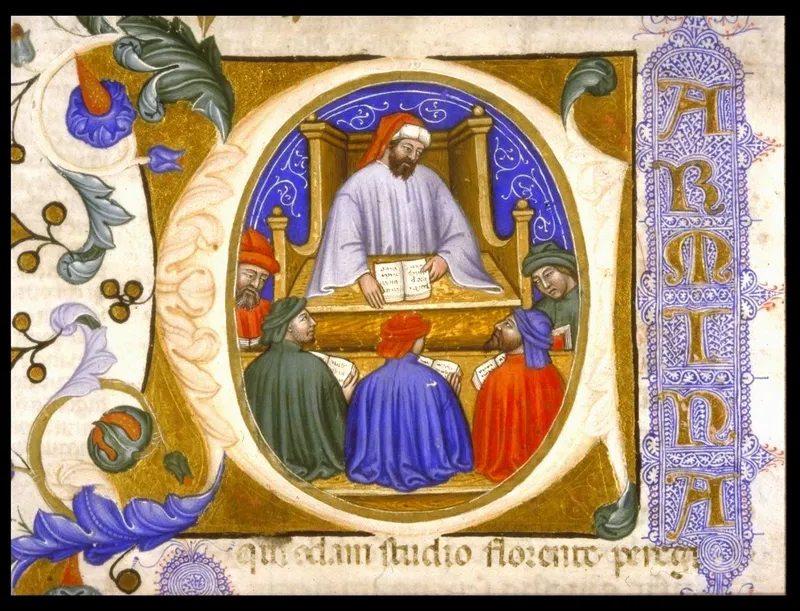

The philosophical roots of the foreknowledge problem extend to Aristotle's De Interpretatione, Chapter 9, composed around 350 BCE. Aristotle considered the proposition "there will be a sea battle tomorrow" and asked whether such statements about future contingent events possess a determinate truth value. If the statement is already true today, Aristotle observed, then the sea battle appears to be necessary; if false, then its non-occurrence appears necessary. Either way, the future seems fixed, and contingency is eliminated.1 Aristotle's own solution is debated, but the majority interpretation holds that he restricted the principle of bivalence for future contingent propositions, holding that while the disjunction "either there will be a sea battle or there will not" is necessarily true, neither disjunct is determinately true or false until the event occurs or fails to occur.1, 6
Aristotle's discussion addressed logical fatalism rather than theological fatalism specifically, since his argument does not depend on the existence of a divine knower. The distinctly theological form of the problem emerged with the rise of monotheistic traditions that attribute exhaustive foreknowledge to God. Boethius, writing his Consolation of Philosophy while awaiting execution around 524 CE, provided the first systematic treatment. He argued that God does not fore-know anything at all, because God exists outside of time entirely. For God, all events — past, present, and future from our temporal perspective — are present simultaneously in an eternal nunc stans ("standing now"). Boethius defined eternity as "the complete, simultaneous, and perfect possession of boundless life," contrasting it with the temporally extended existence of created beings.2 On this view, God's knowledge of what we call "future" events is not foreknowledge but a kind of present perception, and just as a human observer's seeing a person sit down does not cause or necessitate the sitting, God's eternal perception of a free act does not eliminate its freedom.2, 6
Thomas Aquinas developed a similar position in the thirteenth century, arguing in the Summa Theologica (Prima Pars, Question 14, Article 13) that God knows future contingent things not as future but as present to his eternal gaze. Aquinas drew an analogy: just as a person standing on a hilltop can see simultaneously all the travellers on the road below, who are spatially separated, God sees simultaneously all events that are temporally separated from one another.3 The contingency of events is preserved because God knows them as contingent — that is, God knows not only that they occur but also that they occur contingently rather than necessarily. Aquinas distinguished between the necessity of the consequent (the claim that the event itself is necessary) and the necessity of the consequence (the claim that if God knows an event will occur, then it will occur). Only the latter holds, and it does not eliminate the event's contingency.3
Pike's formulation and the modern debate
The contemporary philosophical discussion of divine foreknowledge and free will was catalysed by Nelson Pike's 1965 article "Divine Omniscience and Voluntary Action," published in The Philosophical Review. Pike presented a rigorous version of the incompatibility argument using the tools of analytic philosophy, arguing that if God existed at a time in the past and held a belief about what a person would do in the future, then the fixity of the past and the infallibility of divine belief jointly entail that the person cannot do otherwise.5
Pike's argument introduced several distinctions that have structured subsequent debate. The most important is the necessity of the past (sometimes called the fixity or accidental necessity of the past): the intuition that past events are over and done with, fixed in a way that future events are not, and that no one has the power to bring about a different past. Pike argued that if God believed at time t1 that Jones would do action X at time t2, then at t2 Jones cannot refrain from doing X, because refraining would require either that God held a false belief at t1 (impossible, given divine infallibility) or that God did not exist at t1 (excluded by hypothesis) or that the past be altered (excluded by the necessity of the past).5
The force of Pike's argument depends on the assumption that God is a temporal being who holds beliefs at particular times. If God is atemporal, as the Boethian tradition holds, then the argument's central premise — that God believed something at a time in the past — does not apply. Pike acknowledged this, and the subsequent debate has accordingly divided between those who accept divine temporality and must find another way to resist the argument, and those who invoke divine timelessness to dissolve it.5, 6
The Boethian-Thomistic solution: divine timelessness
The Boethian solution holds that the foreknowledge problem rests on a false assumption: that God's knowledge is temporally ordered. If God is truly eternal — not merely everlasting (existing at every moment of time) but atemporal (existing outside of time altogether) — then God does not hold beliefs at past times, and Pike's argument never gets started. God's knowledge of all events is a single, eternal act of cognition in which all of temporal history is present at once.2, 3
In 1981, Eleonore Stump and Norman Kretzmann revived the Boethian position with a rigorous philosophical analysis in their article "Eternity," published in The Journal of Philosophy. They proposed a new relation they called ET-simultaneity (eternal-temporal simultaneity) to explain how an atemporal God can be genuinely related to temporal events. On their account, each temporal event is ET-simultaneous with God's eternal present, meaning that God perceives it as occurring "now" in the eternal mode, even though the event itself occurs at a particular temporal location. This relation is not symmetric in the way ordinary temporal simultaneity is: two temporal events that are both ET-simultaneous with eternity are not thereby simultaneous with each other.7
The Boethian solution faces several persistent objections. The first concerns the intelligibility of the concept of timeless existence itself: if God acts, responds, and causes effects in time, it is unclear how a genuinely timeless being can stand in real causal relations with a temporal world. The second objection targets ET-simultaneity specifically: the notion of a relation that is simultaneity-like but not transitive has been criticized as ad hoc or incoherent. William Hasker has argued that if God's timeless knowledge is genuinely analogous to perception, then it requires something like a causal relationship with the events perceived, and causal relations are inherently temporal.9 A third objection, raised by several philosophers of time, holds that the Boethian solution is available only to those who adopt a B-theory (or tenseless theory) of time, in which past, present, and future are equally real; on an A-theory (or tensed theory), in which only the present exists or the future is genuinely open, the notion of God perceiving future events as present seems to presuppose the very reality of the future that is in question.6, 9
The Ockhamist solution: hard and soft facts
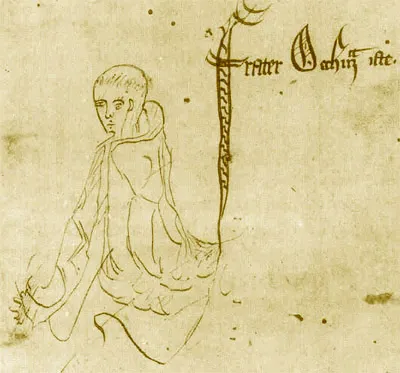

The Ockhamist solution, rooted in the work of William of Ockham in the fourteenth century and revived in contemporary philosophy by Marilyn McCord Adams, Alvin Plantinga, and others, accepts that God holds beliefs at particular past times but denies that all facts about the past are subject to the necessity of the past. The key distinction is between hard facts and soft facts about the past.8, 13
A hard fact about the past is a fact that is entirely and strictly about the past — it is, as it were, over and done with, and no future event can make it otherwise. The fact that Caesar crossed the Rubicon in 49 BCE is a hard fact: nothing that happens now or in the future can change it. A soft fact about the past, by contrast, is a fact that, despite being statable in the past tense, is partly about the future. The fact that "in 1900, the First World War was 14 years in the future" is a soft fact about 1900, because its truth depends on events that had not yet occurred in 1900.8, 6
Ockhamists argue that God's past belief about a future free action is a soft fact about the past. The proposition "God believed at t1 that Jones would mow his lawn at t2" is partly about what happens at t2. If Jones were to refrain from mowing at t2, then God would have held a different belief at t1 — not because Jones changes the past, but because God's past belief tracks the free action and is constitutively connected to it. On this view, the necessity of the past applies only to hard facts, and since God's past foreknowledge of future free acts is a soft fact, the transfer of necessity in Pike's argument fails at the crucial step.8, 13
Plantinga's influential 1986 article "On Ockham's Way Out" gave this position its most rigorous contemporary formulation. Plantinga proposed that Jones has a kind of counterfactual power over the past: it is not that Jones can bring about a change in the past, but that if Jones were to act differently, the past would have been different. This is not backward causation but a counterfactual dependence: God's past belief depends counterfactually on what Jones freely does, because God's beliefs are infallibly responsive to the facts, including future facts about free actions.8
The principal objection to Ockhamism concerns the hard/soft fact distinction itself. Defining precisely which facts about the past are "hard" and which are "soft" has proven difficult. Several proposed criteria have been shown to be either too restrictive (classifying obviously hard facts as soft) or too permissive (classifying obviously soft facts as hard). If the distinction cannot be drawn in a principled, non-question-begging way, the Ockhamist solution lacks a secure foundation. Additionally, some philosophers have argued that even soft facts about the past are fixed and unalterable once they have obtained, making the distinction irrelevant to the necessity of the past.6, 10
The Molinist solution: middle knowledge
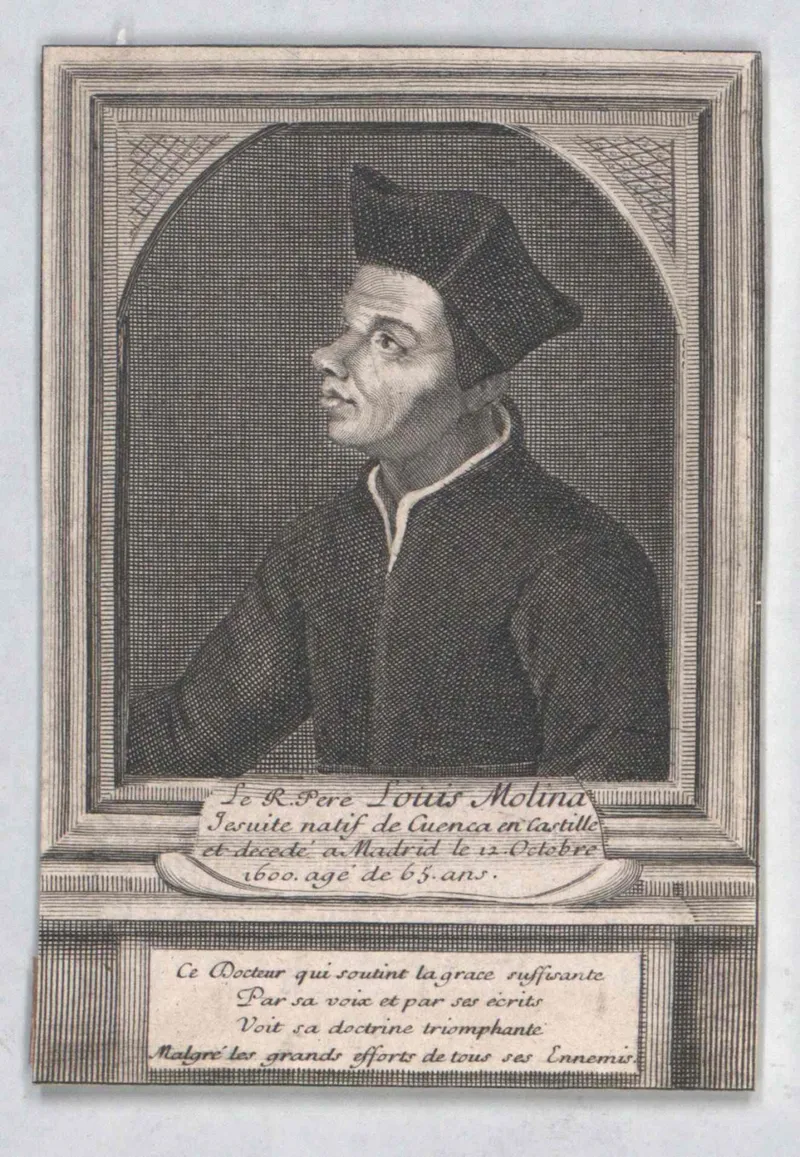

The Molinist solution, developed by the sixteenth-century Jesuit theologian Luis de Molina in his Concordia (1588), proposes that God possesses a special kind of knowledge called scientia media or middle knowledge: prevolitional knowledge of all true counterfactuals of creaturely freedom. These are propositions of the form "If person S were placed in circumstances C, S would freely choose to do A." God knows the truth of all such counterfactuals prior to any decision about which world to create, and uses this knowledge to select a world in which free creatures make the choices that align with God's providential plan.4
Molina situated middle knowledge between two other kinds of divine knowledge. Natural knowledge (scientia naturalis) is God's knowledge of all necessary truths and all metaphysical possibilities — it is prevolitional and could not have been otherwise. Free knowledge (scientia libera) is God's knowledge of everything that will actually occur in the world God has chosen to create — it is postvolitional and depends on God's creative decision. Middle knowledge is prevolitional like natural knowledge (God does not choose which counterfactuals of freedom are true) but contingent like free knowledge (the counterfactuals could have been otherwise, since they depend on what creatures would freely choose).4, 12
The Molinist solution preserves libertarian free will because, on this account, God's knowledge of what a creature will do is grounded in God's knowledge of what the creature would freely do in the relevant circumstances, combined with God's decision to place the creature in those circumstances. The creature's choice is genuinely free — it is the creature's own doing — and God's foreknowledge is derivative rather than determinative. God achieves providential control not by determining the creature's choice but by choosing the circumstances in which the creature freely makes the choice God desires.4
The most persistent objection to Molinism is the grounding objection, which contends that counterfactuals of creaturely freedom lack a metaphysical truthmaker. If a free creature does not yet exist and the relevant circumstances have not yet obtained, what makes it true that the creature would freely choose A rather than B? The creature's nature does not determine the choice (otherwise the choice would not be libertarianly free), and there is no actual world in which the creature is making the choice (since we are in the prevolitional logical moment before God has decided which world to create). Defenders of Molinism have responded by denying that all truths require grounding in ontologically prior entities, by appealing to the primitive truth of counterfactuals, or by invoking possible-worlds semantics as a framework in which counterfactuals of freedom can be true without a causal ground.4, 6
Open theism: denying exhaustive foreknowledge
Open theism, which emerged as a distinct position in the late twentieth century, takes a different approach entirely: it denies that God possesses infallible foreknowledge of future free actions. On this view, omniscience is the knowledge of all truths, but propositions about future free actions do not yet have determinate truth values. If it is not yet true or false that Jones will mow his lawn tomorrow (because Jones has not yet freely decided), then even an omniscient God cannot know whether Jones will mow, because there is nothing yet to know. God's not knowing the future free actions of creatures is not a limitation on divine power or knowledge but a consequence of the metaphysical structure of an open future.9, 11
The philosophical groundwork for open theism was laid by William Hasker's God, Time, and Knowledge (1989), which argued systematically that all attempts to reconcile exhaustive divine foreknowledge with libertarian free will fail. Hasker examined and rejected the Boethian, Ockhamist, and Molinist solutions, concluding that a libertarian about free will must abandon exhaustive foreknowledge.9 The position received its programmatic theological statement in The Openness of God (1994), authored by Clark Pinnock, Richard Rice, John Sanders, Hasker, and David Basinger, which argued that an open view of God — one in which God does not exhaustively foreknow the future — is more faithful to the biblical portrayal of a God who genuinely responds, deliberates, and is affected by creaturely actions than is the classical conception of an impassible, all-determining deity.11 Gregory Boyd's God of the Possible (2000) extended this argument by identifying a "motif of future openness" running through the biblical narrative, pointing to passages in which the text portrays God as changing plans, testing people to discover their character, and expressing surprise or disappointment at human actions.15
Open theism faces several objections. Classical theists argue that it diminishes the divine attribute of omniscience and renders God's providential governance of history uncertain. If God does not know the future free actions of creatures, it is unclear how God can ensure the fulfilment of specific prophecies or guarantee the ultimate outcome of history. Open theists respond that God's perfect knowledge of the past and present, combined with maximal power and wisdom, enables God to respond effectively to whatever choices creatures make, achieving divine purposes through flexible and adaptive providence rather than meticulous predetermination.11, 15 A further philosophical objection holds that if the future is genuinely open and propositions about future free acts lack truth values, then classical logic (specifically, the principle of bivalence) must be restricted, a move that raises difficulties of its own.6
Theological determinism and compatibilism
A fifth approach accepts the conclusion of the incompatibility argument — that divine foreknowledge is incompatible with libertarian free will — but locates the error not in the doctrine of foreknowledge but in the doctrine of libertarian freedom. Theological determinists hold that God's exhaustive foreknowledge is grounded in God's sovereign decree: God foreknows the future because God has ordained it. On this view, every event, including every human action, occurs because God has determined that it will occur, and the apparent freedom of human choice is to be understood in compatibilist terms.6, 14
Compatibilism about free will holds that an action is free if and only if it proceeds from the agent's own desires, intentions, and character, without external coercion, even if the action is determined by prior causes (including, ultimately, God's decree). On this account, the person who mows the lawn freely does so because the action flows from the person's own desires and deliberative processes, not because the person could have done otherwise. The theological determinist thus avoids the foreknowledge problem by denying the premise that free will requires the ability to do otherwise.14
This position has deep roots in the Augustinian and Calvinist theological traditions. Defenders argue that it alone preserves both exhaustive divine sovereignty and the genuineness of divine foreknowledge without recourse to the philosophical complexities of timelessness, soft facts, or counterfactuals of creaturely freedom. The principal objection is that compatibilist freedom does not seem sufficient for moral responsibility: if a person's action is ultimately determined by God's decree, it is God rather than the person who bears ultimate responsibility for the action, and divine punishment for sin appears unjust. Theological determinists have responded with a variety of strategies, including appeals to the mystery of divine sovereignty, analogies between divine and authorial causation, and arguments that compatibilist freedom is the only coherent conception of freedom in the first place.6, 14
The transfer of necessity principle
A technical issue that cuts across all the proposed solutions concerns the transfer of necessity principle (sometimes called the principle of the closure of necessity under entailment), which is essential to the derivation of the fatalist conclusion. The principle states that if p is now-necessary, and necessarily p entails q, then q is also now-necessary. In the foreknowledge argument, this principle is invoked to transfer the necessity of God's past belief (P3) through the entailment relation between God's belief and its object (P4) to the necessity of the future event itself (the conclusion).6, 10
Some philosophers have challenged this principle directly. Linda Zagzebski has examined whether the relevant form of necessity (accidental necessity, or the fixity of the past) is the kind of necessity that transfers across entailment in the way the argument requires. The worry is that accidental necessity is a different modality from logical or metaphysical necessity, and the transfer principle, while valid for logical necessity, may not hold for accidental necessity. If a past fact is accidentally necessary (fixed because it is past) and entails a future fact, it does not obviously follow that the future fact is accidentally necessary (fixed because it is inevitable), since the future fact's fixity, if any, derives from a different source.10
Zagzebski has also introduced a distinct version of the foreknowledge dilemma that does not rely on the transfer principle. Her argument turns on the more basic intuition that the past is temporally asymmetric with respect to the future: we can affect the future but not the past, and this asymmetry alone, combined with the infallibility of divine belief, generates the problem without the need for a contested closure principle. This version of the dilemma is harder to evade, because it does not depend on any particular logical principle that might be challenged but on a deep intuition about the nature of time itself.10
The contemporary landscape
The debate over divine foreknowledge and free will remains one of the most active areas in analytic philosophy of religion. The five major families of solutions — Boethian eternalism, Ockhamism, Molinism, open theism, and theological determinism — each continue to attract defenders and face persistent objections, and the discussion has been enriched by developments in the philosophy of time, modal logic, and the metaphysics of properties.6
Major positions on divine foreknowledge and free will6, 10
| Position | God foreknows free acts? | Libertarian free will? | Key premise denied | Principal objection |
|---|---|---|---|---|
| Boethian eternalism | Knows, but not temporally | Yes | God's knowledge is in the past | Coherence of timelessness |
| Ockhamism | Yes | Yes | God's past belief is a hard fact | Hard/soft fact distinction |
| Molinism | Yes, via middle knowledge | Yes | Foreknowledge eliminates freedom | Grounding objection |
| Open theism | No | Yes | God infallibly believes future free acts | Diminished omniscience |
| Theological determinism | Yes | No (compatibilist) | Free will requires alternatives | Moral responsibility |
One important development in recent decades is the application of insights from the broader free will debate to the theological context. John Martin Fischer's semicompatibilism holds that moral responsibility does not require the ability to do otherwise (the principle of alternative possibilities) but only that the agent acts from the agent's own reasons-responsive mechanism. Applied to the foreknowledge problem, semicompatibilism suggests that even if divine foreknowledge eliminates alternative possibilities, it does not eliminate moral responsibility, provided the agent's action flows from an appropriate deliberative process. This position sidesteps the traditional debate by arguing that the incompatibility of foreknowledge and alternative possibilities, even if granted, does not have the consequences for moral responsibility that are typically assumed.6, 14
Another active area of research concerns the relationship between the foreknowledge problem and the philosophy of time. Philosophers who hold an A-theory of time (on which the passage of time is a real, objective feature of reality and the future is genuinely open) tend to find the foreknowledge problem more pressing, since on their view there is a real sense in which the future does not yet exist and is therefore not available for God to know. Philosophers who hold a B-theory of time (on which past, present, and future are equally real and the passage of time is an illusion) tend to find the problem less pressing, since on their view future events already exist in the relevant metaphysical sense and can serve as objects of knowledge. The Boethian solution is naturally allied with a B-theory, while open theism is naturally allied with an A-theory, though the connections are not strictly entailed.6, 9
Logical relationships among the solutions
The five families of solutions are not mutually exclusive in every respect, and hybrid positions exist. A philosopher might combine elements of the Boethian and Ockhamist approaches, holding both that God is timeless and that some facts about the past are soft. Equally, a philosopher might accept Molinism as an account of divine providence while invoking the Boethian doctrine of timelessness as the explanation of how God's middle knowledge avoids the fatalist argument. The Molinist philosopher William Lane Craig, for instance, has combined Molinism with a personalist (temporal) conception of God, while the philosopher Thomas Flint has developed a Molinist framework that is compatible with either divine temporality or timelessness.6, 10
What the solutions share is a commitment to taking both the foreknowledge problem and the concept of free will seriously. Even those who ultimately reject libertarian freedom (the theological determinists) and those who ultimately restrict divine omniscience (the open theists) do so not out of indifference to the values at stake but because they judge that the remaining options involve unacceptable philosophical costs. The persistence of the debate reflects the depth of the tension between two powerful intuitions: that an omniscient God must know everything, including the future, and that genuine moral responsibility requires the ability to have done otherwise.10, 14
The ongoing philosophical engagement with this problem has also produced broader insights. The analysis of accidental necessity, the development of the hard/soft fact distinction, the exploration of counterfactual power over the past, and the investigation of the metaphysics of time have all advanced not only because of their theological applications but as contributions to metaphysics, philosophy of language, and philosophy of action in their own right. The problem of divine foreknowledge and free will thus remains not merely a theological puzzle but a fruitful source of philosophical inquiry with ramifications well beyond the philosophy of religion.6
Historical development of the debate
The problem of foreknowledge and freedom has a continuous philosophical history spanning more than two millennia. Aristotle's De Interpretatione, Chapter 9 (c. 350 BCE), established the logical framework by raising the question of whether future contingent propositions have determinate truth values, a question that set the terms for all subsequent discussion.1 The Stoics adopted a fatalist position, holding that all events are determined by a causal chain and that every proposition about the future is either true or false. The Epicureans, by contrast, rejected determinism and introduced the notion of the atomic "swerve" to preserve contingency.14
Boethius's Consolation of Philosophy (c. 524) gave the problem its distinctively theological formulation and proposed the eternalist solution that would dominate medieval discussion. Augustine, writing more than a century earlier, had also addressed the problem, arguing that God's foreknowledge does not impose necessity on human actions because the power of the will is included in the order that God foreknows. Anselm of Canterbury engaged the problem in his De Concordia (c. 1108), developing a sophisticated analysis of the different senses in which an event can be said to be necessary.2, 6
Aquinas adopted and refined the Boethian solution in the thirteenth century, while Ockham, writing in the fourteenth century, pioneered the alternative approach based on the contingency of God's past beliefs about the future, introducing the distinction between absolute and conditional necessity that would later be reformulated as the hard/soft fact distinction.3, 13 Molina's Concordia (1588) introduced middle knowledge as a third option, provoking the fierce Congregatio de Auxiliis debate between Jesuits and Dominicans in the late sixteenth and early seventeenth centuries, one of the most intense theological controversies of the Counter-Reformation era.4
The early modern period saw contributions from Leibniz, who engaged with the concept of middle knowledge but recast it within his own deterministic framework, and from Jonathan Edwards, whose Freedom of the Will (1754) argued for theological determinism and compatibilism. The problem received comparatively less attention during the period when logical positivism and ordinary language philosophy dominated analytic philosophy in the mid-twentieth century, but Pike's 1965 article inaugurated the contemporary revival.5 Since then, the volume of philosophical literature on the topic has been enormous, with major book-length treatments by Zagzebski (1991), Hasker (1989), Fischer (1989), and Flint (1998), and the problem continues to generate new articles, monographs, and anthologies in the twenty-first century.9, 10