Overview
- The relationship between science and religion has been framed through several models — most influentially Ian Barbour’s fourfold typology of conflict, independence, dialogue, and integration — and the once-dominant “conflict thesis” of Draper and White is now largely rejected by historians of science as a distortion of the actual historical record.
- Key historical episodes including the Galileo affair, the reception of Darwinism, the Scopes trial, and the intelligent design movement reveal a far more complex relationship than simple warfare, with religious thinkers and institutions often supporting scientific inquiry while opposing specific theories that seemed to threaten theological commitments.
- Ongoing debates center on whether methodological naturalism is merely a working assumption of science or entails metaphysical naturalism, whether Gould’s non-overlapping magisteria (NOMA) model adequately captures the relationship, and whether contemporary evangelical rejection of evolution and climate science represents a specifically American cultural phenomenon rather than an intrinsic feature of religious belief.
The relationship between science and religion is one of the most debated topics in intellectual history. Whether these two domains of human inquiry are inherently at war, address entirely separate questions, or can be brought into constructive conversation depends on how one defines both “science” and “religion” — terms whose meanings have shifted considerably over the centuries. The popular narrative of perpetual conflict between a rational, evidence-based science and a dogmatic, faith-based religion has deep roots in nineteenth-century polemics but has been substantially revised by modern historians and philosophers. In its place, a richer and more complex picture has emerged: one in which religious institutions have at times sponsored, at times resisted, and at times been wholly indifferent to scientific developments, while scientists themselves have held the full range of religious commitments and none.4, 5

This article surveys the historical relationship between science and religion, examines the major philosophical frameworks that have been proposed for understanding it, and considers contemporary flashpoints including the evolution controversy in American evangelicalism. It draws primarily on the work of historians of science such as John Hedley Brooke, Ronald Numbers, David Lindberg, and Gary Ferngren, and on the philosophical typology developed by Ian Barbour.
Barbour’s four models
The most influential modern framework for classifying science-religion relationships was proposed by the physicist and theologian Ian Barbour in his 1990 Gifford Lectures, later published as Religion in an Age of Science and revised as Religion and Science (1997). Barbour identified four basic models: conflict, independence, dialogue, and integration.1
In the conflict model, science and religion are fundamentally incompatible. Each makes claims about the same domain — the natural world and humanity’s place in it — and where those claims diverge, one must be wrong. This model is held both by scientific materialists who argue that science has rendered religion obsolete and by biblical literalists who reject scientific findings that contradict scripture. Barbour noted that despite their opposite conclusions, these two camps share the same underlying assumption: that science and religion are competing for the same epistemic territory.1
In the independence model, science and religion address fundamentally different questions and therefore cannot conflict. Science investigates natural causes and mechanisms; religion addresses questions of meaning, value, and purpose. The most prominent articulation of this view is Stephen Jay Gould’s concept of “non-overlapping magisteria” (NOMA), discussed below. Barbour acknowledged independence as an improvement over conflict but argued that it purchased peace at the cost of intellectual isolation, preventing science and religion from learning anything from each other.1
In the dialogue model, science and religion remain distinct enterprises but engage in mutually beneficial conversation. Dialogue may occur at the level of methodology (both rely on models, paradigms, and interpretive frameworks), at the level of boundary questions (why is the universe intelligible at all?), or through shared concepts (information, emergence, complexity). Barbour saw dialogue as the most promising approach for those who wished to take both science and religion seriously without collapsing one into the other.1
In the integration model, science and religion are brought into a single coherent framework. This may take the form of natural theology (arguing from scientific findings to the existence or nature of God), theology of nature (revising theological doctrines in light of scientific knowledge), or systematic synthesis (as in process theology, which uses Whitehead’s metaphysics to unify scientific and religious insights). Integration is the most ambitious model but also the most contested, as critics argue that it risks distorting both science and theology to force a fit.1, 19
Barbour’s typology has been widely adopted as a pedagogical tool, though scholars have noted its limitations. The four models are ideal types rather than exhaustive descriptions of how actual historical actors have understood the relationship, and many figures in the history of science do not fit neatly into any single category.5, 16
The conflict thesis
The idea that science and religion are locked in perpetual warfare achieved its most influential expression in two nineteenth-century works: John William Draper’s History of the Conflict between Religion and Science (1874) and Andrew Dickson White’s A History of the Warfare of Science with Theology in Christendom (1896).2, 3 Draper, a chemist and historian, argued that the Roman Catholic Church had systematically opposed scientific progress from antiquity through his own day. White, the first president of Cornell University, presented a more nuanced version: he distinguished between theology (which he opposed) and religion (which he valued), but the overall narrative remained one of progressive science battling reactionary dogma.
The Draper-White thesis became enormously popular and shaped public understanding for over a century. It remains the default framework in popular culture, in many science textbooks, and in the rhetoric of the “New Atheism” movement of the 2000s. However, professional historians of science have subjected the conflict thesis to sustained criticism since at least the 1970s, and the scholarly consensus is now firmly against it as a general description of the science-religion relationship.4, 5, 8
The principal objections are historical. Draper and White relied on episodes that, upon closer examination, do not support their narrative. The medieval Church did not suppress science; to the contrary, medieval universities — ecclesiastical institutions — were the primary sites where natural philosophy was preserved and developed in Europe. The story of a “flat earth” myth, in which Columbus supposedly battled Church teachings that the earth was flat, is a nineteenth-century invention; virtually all educated medieval Europeans knew the earth was spherical. The Galileo affair, the centerpiece of the conflict narrative, turns out to be far more complex than a simple story of science versus faith.4, 6
Ronald Numbers, who edited the influential volume Galileo Goes to Jail and Other Myths about Science and Religion (2009), has argued that the conflict thesis “has been rejected by every modern historian of science.” This does not mean that no conflicts have occurred between scientific findings and religious teachings — they clearly have — but rather that conflict is not the defining pattern of the relationship, and that episodes of conflict have been embedded in political, personal, and institutional contexts that resist reduction to a simple science-versus-religion template.4
The Galileo affair
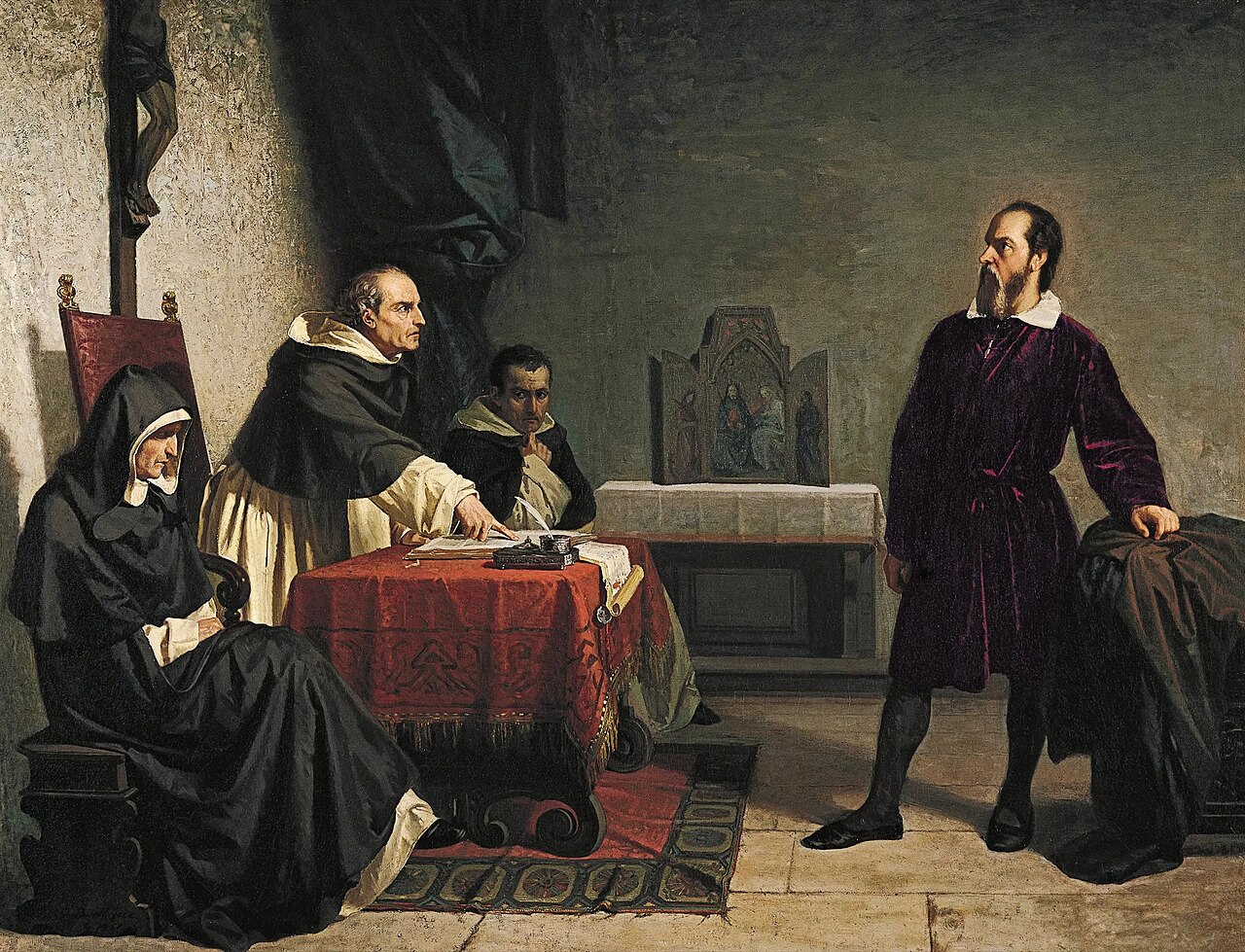
No episode in the history of science and religion has been more frequently invoked than the trial of Galileo Galilei by the Roman Inquisition in 1633. In the popular telling, Galileo was persecuted by the Church for teaching the Copernican heliocentric model of the solar system — a straightforward case of religious dogma suppressing scientific truth. The historical reality, while it does involve genuine conflict between Galileo and Church authorities, is considerably more complex.6
Copernicus’s De revolutionibus (1543) had been published with a preface (added by the Lutheran theologian Andreas Osiander without Copernicus’s permission) describing heliocentrism as a mathematical hypothesis rather than a physical claim. For decades, the model attracted relatively little theological opposition. When Galileo began publicly advocating Copernicanism as physically true in the 1610s, the objections he faced were not purely theological. Many astronomers raised legitimate scientific concerns: the observed absence of stellar parallax (which would not be detected until 1838), the lack of a physical mechanism for Earth’s motion, and apparent inconsistencies with Aristotelian physics that Galileo had not yet resolved.6, 8
Theological concerns did play a role. Cardinal Robert Bellarmine warned Galileo in 1616 that he could discuss Copernicanism as a mathematical hypothesis but not affirm it as physically true until conclusive proof was available — a position that, in the context of seventeenth-century epistemology, was not unreasonable. Galileo’s Dialogue Concerning the Two Chief World Systems (1632) was perceived as violating this injunction and, fatally, as placing the Pope’s preferred arguments in the mouth of the dialogue’s simpleton character, Simplicio. The resulting trial involved elements of personal betrayal, papal politics, Counter-Reformation anxiety, and jurisdictional disputes alongside the scientific and theological questions.6
Historians do not deny that the Galileo affair involved a genuine conflict between a scientific claim and the institutional authority of the Church. What they deny is that this conflict was representative of the general relationship between science and Christianity, or that it can be adequately understood as a simple collision between reason and faith. The Catholic Church itself acknowledged its error in the Galileo case: a commission appointed by Pope John Paul II concluded in 1992 that Galileo’s judges had erred in condemning heliocentrism, though the commission’s statement was criticized by some as insufficiently forthright.4, 6
Darwin and religious responses
Charles Darwin’s On the Origin of Species (1859) provoked a wide range of religious responses, from enthusiastic acceptance to outright rejection. The popular image of an immediate and monolithic religious backlash is inaccurate. Some of the most prominent early supporters of natural selection were deeply religious: the American botanist Asa Gray, who corresponded extensively with Darwin and wrote a series of influential essays arguing that evolution was compatible with theistic design; the Anglican clergyman and novelist Charles Kingsley, who described evolution as God’s way of “making things make themselves”; and the Princeton theologian B. B. Warfield, a staunch defender of biblical inerrancy who nonetheless accepted a form of evolutionary theory.5, 8
The most famous confrontation — the 1860 Oxford debate between Thomas Henry Huxley and Bishop Samuel Wilberforce — has been heavily mythologized. Contemporary accounts suggest a more ambiguous encounter than the decisive Huxley victory later portrayed by supporters of the conflict thesis. Wilberforce, who had been coached by the anatomist Richard Owen, raised substantive scientific objections to Darwin’s theory alongside rhetorical barbs. The incident tells us more about the social politics of Victorian science than about an intrinsic conflict between science and religion.4, 8
Religious responses to Darwin varied by tradition and geography. Conservative Calvinist theologians at Princeton Theological Seminary generally found ways to accommodate evolution, while some liberal Protestant theologians rejected it on grounds unrelated to biblical literalism. The Catholic Church never formally condemned evolution; Pope Pius XII’s encyclical Humani Generis (1950) permitted Catholics to explore evolution as a hypothesis concerning the body, while insisting on the direct creation of the soul, and Pope John Paul II’s 1996 address to the Pontifical Academy of Sciences described evolution as “more than a hypothesis.” In the Islamic world, responses ranged from acceptance by some Ottoman intellectuals to rejection by others, with no single authoritative position emerging.5, 17
The age of the earth posed a separate but related challenge. Lord Kelvin’s thermodynamic calculations initially seemed to allow far too little time for natural selection to produce the observed diversity of life, a problem that troubled Darwin himself. The discovery of radioactivity in the late nineteenth century eventually resolved this difficulty by revealing an energy source Kelvin had not considered, extending the estimated age of the earth to billions of years.14
The Scopes trial and American anti-evolutionism
The 1925 State of Tennessee v. John Thomas Scopes trial — the “Scopes Monkey Trial” — became the defining event in the American conflict over the teaching of evolution. John Scopes, a high school teacher in Dayton, Tennessee, was charged with violating the Butler Act, which prohibited the teaching of human evolution in public schools. The trial attracted national attention largely because of the participation of William Jennings Bryan, a three-time presidential candidate and prominent anti-evolutionist, for the prosecution, and Clarence Darrow, the nation’s most famous defense attorney, for the defense.10
As the historian Edward Larson demonstrated in his Pulitzer Prize-winning Summer for the Gods (1997), the Scopes trial has been widely misunderstood. The popular version, shaped primarily by the 1955 play Inherit the Wind and the subsequent film, portrays a clear victory for science over fundamentalism. In reality, Scopes was convicted (the conviction was later overturned on a technicality), anti-evolution laws remained on the books in several states for decades, and the trial’s long-term effect was to suppress rather than promote the teaching of evolution in American schools. Publishers quietly removed or minimized evolution content from biology textbooks for the next thirty years.10
Bryan’s motivations were more complex than simple anti-intellectualism. He opposed evolution in part because of its association with Social Darwinism and eugenics — movements that, in Bryan’s view, used evolutionary theory to justify economic exploitation and racial hierarchy. Bryan was not a young-earth creationist; he accepted an old earth and an allegorical interpretation of the “days” of Genesis. His primary concern was the moral and social implications of teaching that humans were merely animals in a struggle for survival.10
Scientific creationism and intelligent design
The modern creationist movement emerged in the 1960s, following the publication of John Whitcomb and Henry Morris’s The Genesis Flood (1961), which revived the idea that geological strata could be explained by Noah’s flood and that the earth was only thousands of years old. This “young-earth creationism” differed markedly from the earlier anti-evolution movement, which had often accepted an old earth. Morris founded the Institute for Creation Research in 1972, and the movement developed a body of literature it called “creation science” or “scientific creationism,” which claimed to present a scientifically credible alternative to evolutionary geology and biology.9
The legal history of creationism in American public schools followed a series of court defeats. The Supreme Court struck down Arkansas’s anti-evolution law in Epperson v. Arkansas (1968) and Louisiana’s “balanced treatment” act in Edwards v. Aguillard (1987), ruling that creation science was a religious doctrine that could not be mandated in public school science classes under the Establishment Clause of the First Amendment.9
In the wake of these defeats, intelligent design emerged as a new formulation of the design argument. Proponents such as Michael Behe and William Dembski argued that certain biological structures exhibited “irreducible complexity” or “specified complexity” that could not be explained by unguided natural processes. Unlike young-earth creationism, intelligent design accepted an old universe and did not explicitly identify the designer with the God of any particular religion. However, critics noted that the movement’s principal institutional sponsor, the Discovery Institute, had articulated in its internal “Wedge Document” a strategy to use intelligent design as a wedge to promote theistic worldviews in public life.9, 11
The 2005 federal court ruling in Kitzmiller v. Dover Area School District concluded that intelligent design was not science and that requiring its inclusion in biology classes violated the Establishment Clause. Judge John E. Jones III found that intelligent design had failed to produce peer-reviewed research, relied on a negative argument against evolution rather than positive evidence for design, and was historically continuous with creation science through the textbook Of Pandas and People, in which the word “creationism” had been systematically replaced with “intelligent design” after the Edwards ruling.11
Methodological naturalism and metaphysical naturalism
A central question in the philosophy of science is whether science’s commitment to natural explanations is a methodological convention or a metaphysical claim. Methodological naturalism holds that science, as a matter of method, restricts itself to natural causes and natural explanations. It does not assert that supernatural causes do not exist — only that they fall outside the scope of scientific investigation. Metaphysical naturalism (or ontological naturalism) makes the stronger claim that nature is all there is and that no supernatural reality exists.15
The distinction is crucial for the science-religion relationship. If science is committed only to methodological naturalism, then its findings are in principle compatible with religious belief: science describes how the natural world works, while religion may address questions that lie beyond scientific investigation. If, however, methodological naturalism inevitably leads to metaphysical naturalism — if the consistent success of natural explanations constitutes evidence against the supernatural — then science and theistic religion are in deeper tension.15
Philosophers are divided on this question. Alvin Plantinga has argued that methodological naturalism is an arbitrary restriction on science and that theistic science — science open to supernatural hypotheses — is a coherent possibility. He further contends that evolutionary naturalism is self-defeating, because if human cognitive faculties are the product of unguided natural selection, there is no reason to trust them to produce true beliefs, including the belief in naturalism itself.21 Daniel Dennett and others respond that methodological naturalism is not an arbitrary convention but a hard-won lesson of the scientific revolution: appeals to supernatural intervention have consistently failed as explanatory strategies, while natural explanations have consistently succeeded.21
The National Academy of Sciences has taken the position that science is “limited to explaining the natural world through natural causes” and that “science and religion are based on different aspects of human experience” and are therefore not in conflict. This position reflects a form of methodological naturalism that leaves metaphysical questions open.13 Critics from both sides object: some atheist philosophers argue that the NAS is being diplomatically evasive, while some religious thinkers contend that restricting science to natural causes unfairly privileges naturalistic worldviews.
Non-overlapping magisteria
The paleontologist Stephen Jay Gould proposed his “non-overlapping magisteria” (NOMA) model in Rocks of Ages (1999). Gould defined a magisterium as “a domain of authority in teaching,” and argued that science and religion each possess a legitimate magisterium that does not overlap with the other. Science covers “the empirical realm: what is the universe made of (fact) and why does it work this way (theory),” while religion covers “questions of ultimate meaning and moral value.”7
NOMA has been both praised and criticized. Supporters argue that it provides a principled basis for peace between science and religion without requiring either to surrender its core commitments. Critics have raised several objections. Richard Dawkins argued that NOMA gives religion an undeserved free pass: many religious claims (miracles, the efficacy of prayer, the resurrection of Jesus) are empirical claims about the natural world and therefore fall within science’s magisterium. From the religious side, some theologians have objected that NOMA relegates religion to the realm of subjective values and strips it of any cognitive content — that a God who makes no difference to the empirical world is a God not worth believing in. Barbour classified NOMA under his independence model and noted the same limitation: it prevents any constructive engagement between scientific and theological thinking.1, 7
In practice, NOMA is difficult to maintain consistently. If religion claims that God created the universe, that claim appears to have empirical implications. If science explains the development of moral sentiments through evolutionary psychology, that finding appears to trespass into religion’s magisterium of moral values. The boundaries between fact and value, between empirical description and normative meaning, are more porous than Gould’s model suggests.7, 16
Religious traditions and science
Different religious traditions have engaged with science in markedly different ways, shaped by their respective theological commitments, institutional structures, and cultural contexts.17
Catholic Christianity has a long and complex relationship with science. The medieval Catholic Church was the primary institutional patron of natural philosophy in Europe, founding the university system in which most scientific work took place. Jesuits made significant contributions to astronomy, seismology, and other sciences. After the Galileo affair, the Church became more cautious about scientific pronouncements but never adopted a posture of general opposition to science. In the twentieth century, the Belgian priest and physicist Georges Lemaître proposed the “primeval atom” hypothesis that became the Big Bang theory, and the Pontifical Academy of Sciences has included numerous Nobel laureates among its members. Pope Francis’s encyclical Laudato Si’ (2015) drew extensively on climate science to support an argument for environmental stewardship.5, 17
Protestant Christianity encompasses a vast range of positions. Mainline Protestant denominations have generally accepted evolutionary science and an old earth. Evangelical Protestantism, particularly in the United States, has been the primary locus of anti-evolutionism since the early twentieth century, though the movement is far from monolithic: organizations such as BioLogos, founded by the geneticist Francis Collins, promote the compatibility of evangelical faith with mainstream science. The relationship between Protestantism and science has been shaped by the doctrine of sola scriptura and the varying interpretive traditions that follow from it — a commitment to biblical authority does not entail a single position on how to read Genesis.9, 20
Judaism has generally maintained a positive relationship with science. The Jewish intellectual tradition values education and textual interpretation, and the rabbinic tradition has accommodated scientific knowledge through allegorical reading of scripture. Maimonides, the medieval Jewish philosopher, argued that apparent conflicts between scripture and demonstrated scientific truths should be resolved by reinterpreting scripture. There is no significant Jewish anti-evolution movement.17
Islam presents a varied picture. During the Islamic Golden Age (eighth through fourteenth centuries), Muslim scholars made foundational contributions to mathematics, astronomy, medicine, and optics, often preserving and extending Greek scientific texts. The relationship between science and Islamic theology has been debated throughout this history, with some scholars arguing that the Ash’arite emphasis on divine occasionalism (the idea that God directly causes every event) undermined the development of natural law-based explanations, while others reject this narrative as oversimplified. Contemporary Islamic responses to evolution range from full acceptance to outright rejection, with a common middle position accepting evolution for all species except humans.17
Hinduism and Buddhism have generally not experienced the kind of sharp science-religion conflicts that characterize Western Christianity’s engagement with Darwinism. Hindu cosmology posits vast time cycles that dwarf even scientific estimates of the age of the universe, which some Hindu thinkers have cited as evidence of ancient scientific insight. The Dalai Lama has actively engaged with neuroscientists and physicists, arguing that Buddhism’s emphasis on empirical investigation of the mind makes it a natural partner for science, and has stated that where Buddhist scripture contradicts well-established scientific findings, Buddhism should defer to the evidence.17
Science and American evangelicalism
The most visible contemporary conflict between science and religion occurs within American evangelicalism, where significant portions of the population reject mainstream scientific conclusions on evolution, the age of the earth, and climate change. Surveys consistently find that the United States is an outlier among developed nations in its level of public skepticism toward evolution: a 2006 study found that only Turkey, among the 34 countries surveyed, had a lower rate of public acceptance of evolution than the United States.18
The reasons for this are multiple and debated. Young-earth creationism, which holds that the earth is approximately 6,000–10,000 years old and that the entire fossil record was deposited during Noah’s flood, commands significant support among white evangelical Protestants. According to survey data, roughly 40 percent of American adults consistently agree with the statement that God created humans in their present form within the last 10,000 years, a figure that has remained remarkably stable for decades. Among white evangelical Protestants, the figure is substantially higher.9, 20
Several factors contribute to this pattern. The United States has a highly decentralized religious landscape with no single ecclesiastical authority capable of issuing definitive pronouncements on science. The evangelical emphasis on biblical authority, combined with a populist hermeneutic tradition that resists expert mediation between the individual believer and the text, creates conditions favorable to literalist readings of Genesis. The politicization of science-religion issues — evolution became entangled with the culture wars of the late twentieth century, alongside abortion, school prayer, and sexual morality — has made positions on evolution function as markers of cultural identity rather than assessments of scientific evidence.9, 20
Climate science has followed a similar trajectory. Although the scientific consensus on anthropogenic climate change is overwhelming, significant segments of American evangelicalism remain skeptical, in part because environmentalism is associated with the political left and in part because some theological frameworks emphasize human dominion over nature or interpret environmental concern as a displacement of trust from God to human action. The Cornwall Alliance, an evangelical organization, has described environmentalism as a threat to the poor and to human freedom, while other evangelical groups, such as the Evangelical Environmental Network, have advocated for climate action on the basis of creation care.20
It is important to note that the American pattern is not representative of global Christianity or of religion in general. Surveys of scientists in eight world regions found that the relationship between personal religiosity and scientific practice varied enormously by national and cultural context, and that the United States stood out for the sharpness of its perceived science-religion conflict.12
God of the gaps and explanatory scope
A recurring pattern in science-religion interactions is what critics call the “god of the gaps” argument: appealing to God as an explanation for phenomena that science has not yet explained. The term, originally coined by the evangelical theologian Henry Drummond in the 1890s as a criticism of bad theology, identifies a strategy in which the evidence for God’s action is located precisely in the gaps of current scientific knowledge. As those gaps narrow with scientific progress, the territory assigned to divine action shrinks correspondingly.5, 16
Theologians across traditions have warned against this approach. Dietrich Bonhoeffer wrote from prison in 1944 that Christians should find God “in what we know, not in what we don’t know,” and that a God who exists only at the boundaries of human knowledge becomes progressively marginalized as knowledge advances. Barbour, Polkinghorne, and other scientist-theologians have argued that robust theism should not depend on the failure of scientific explanations but on the deeper question of why there is a natural order susceptible to scientific investigation at all.1, 16
The god-of-the-gaps problem is particularly acute for intelligent design, which locates evidence of design in specific biological systems that, proponents claim, cannot be explained by natural selection. Critics argue that this makes intelligent design structurally vulnerable to scientific progress: if future research demonstrates a natural evolutionary pathway for a supposedly “irreducibly complex” system, the design inference for that system collapses. Proponents respond that their arguments are based on positive evidence for design, not merely on the absence of natural explanations — a claim whose validity remains contested.11, 13
The compatibility question
Whether science and religion are ultimately compatible remains an open philosophical question. The answer depends heavily on what one means by both terms and on the specific religious claims in question. A religion that makes no empirical claims about the natural world is trivially compatible with science; a religion that insists the earth is 6,000 years old is straightforwardly incompatible with geology, physics, and biology. Most religious positions fall somewhere between these extremes.16, 21
Philosophers who argue for compatibility typically emphasize the distinction between methodological and metaphysical naturalism, point to the large number of eminent scientists who have held religious beliefs, and note that science itself rests on assumptions — the intelligibility of nature, the reliability of human cognitive faculties, the existence of mathematical regularities — that science cannot itself justify and that some argue are best explained by theism. Alvin Plantinga has made perhaps the strongest philosophical case for compatibility, arguing not only that science and theism are consistent but that there is a “deep concord” between them: theism provides the metaphysical grounding that makes the scientific enterprise intelligible.21
Philosophers who argue for incompatibility typically point to the track record of natural explanations replacing supernatural ones, the absence of any confirmed supernatural intervention in the history of science, and the epistemological differences between scientific evidence and religious faith. They argue that the compatibility position rests on an artificially constrained definition of religion that strips it of the empirical claims most believers actually hold. Daniel Dennett has argued that the habit of treating religious claims as beyond scientific scrutiny is itself a cultural convention rather than a principled epistemic distinction.21
The sociological data complicate both positions. Surveys of scientists find that they are substantially less religious than the general population in most countries, which could indicate either that science tends to undermine religious belief or that less religious people are more likely to pursue scientific careers. At the same time, a significant minority of scientists — including prominent figures in physics, biology, and other fields — maintain religious commitments, suggesting that compatibility is at least psychologically possible for individuals even if the philosophical question remains unresolved.12
The question is unlikely to be settled in the abstract. Whether science and religion are compatible may depend less on their essential natures — if they have essential natures — than on the specific claims being compared, the interpretive traditions within which those claims are embedded, and the willingness of participants on both sides to revise their positions in light of evidence and argument. What the historical record clearly shows is that the relationship is too complex, too variable across traditions and centuries, and too deeply entangled with politics, culture, and institutional interests to be captured by any single model — whether conflict, independence, dialogue, or integration.4, 5, 16
References
Summer for the Gods: The Scopes Trial and America’s Continuing Debate over Science and Religion
Religion among Scientists in International Context: A New Study of Scientists in Eight Regions