Overview
- Plutarch’s Life of Theseus records that the Athenians preserved the thirty-oared galley in which Theseus had returned from Crete by replacing its decaying timbers one by one, and that this practice generated a standing puzzle among ancient philosophers about whether gradual replacement of parts preserves numerical identity.
- Thomas Hobbes’s De Corpore (1655) sharpened the puzzle by adding a second ship reconstructed from the discarded original planks, producing a dilemma in which two distinct ships at the end of the process each have a serious claim to be identical with the original — a result that, given the transitivity of identity, cannot be accepted at face value.
- Contemporary responses range from the constitution view (Wiggins, Baker), which treats the ship and its matter as distinct coincident objects, through four-dimensionalism (Lewis, Sider), which assigns persisting objects temporal as well as spatial parts, to eliminativist positions (van Inwagen, Unger) that deny the existence of composite artifacts altogether.
The ship of Theseus is a puzzle about identity through change first recorded in Plutarch’s Life of Theseus. According to Plutarch, the Athenians preserved the thirty-oared galley on which the legendary king had returned from Crete by replacing its decaying timbers one by one, until ancient philosophers began to disagree about whether the carefully maintained vessel was still the same ship. The puzzle survived into modern philosophy through Thomas Hobbes’s De Corpore (1655), which added a second ship reconstructed from the discarded original planks and so produced a dilemma in which two distinct ships at the end of the process each have a serious claim to be identical with the original. The puzzle is a central case in the metaphysics of material constitution and identity over time, and contemporary responses span the major positions in those debates: constitution theories, four-dimensionalism, eliminativism about ordinary objects, and revisionary accounts of identity itself.1, 2, 13, 14
The puzzle is generally classed alongside the statue and the lump, the puzzle of Dion and Theon, and the case of Tibbles the cat as one of the standard puzzles of material constitution. What unites these cases is a tension between intuitive judgments about persistence and the formal properties of the identity relation — in particular its transitivity and the requirement, codified by Leibniz’s Law, that identical objects share all their properties. The literature is voluminous, and no proposal has secured general agreement.13, 14

,_Theseus_at_Delos_and_Centauromachy.jpg)
Plutarch’s passage
The earliest surviving statement of the puzzle is in Plutarch’s Life of Theseus, chapter 23. Plutarch reports that the Athenians kept the ship of Theseus as a state monument, dispatching it annually to Delos in commemoration of the legendary voyage, and that the Athenians’ long-running maintenance of the vessel had become a stock example for the philosophical schools of the city. Bernadotte Perrin’s 1914 Loeb Classical Library translation renders the passage as follows.1
Plutarch, Life of Theseus 23.1, trans. Perrin (1914)The ship on which Theseus sailed with the youths and returned in safety, the thirty-oared galley, was preserved by the Athenians down to the time of Demetrius Phalereus. They took away the old timbers from time to time, and put new and sound ones in their places, so that the vessel became a standing illustration for the philosophers in the mooted question of growth, some declaring that it remained the same, others that it was not the same vessel.
Several details of Plutarch’s report are worth attention. First, the dispute is described as belonging to a more general question about growth — the question of how a thing that gains and loses material parts can be considered the same thing — rather than as a stand-alone puzzle about ships. Second, Plutarch identifies the period of preservation as ending in the time of Demetrius of Phalerum, who governed Athens for the Macedonians from 317 to 307 BCE; this places the ship as a publicly maintained monument for several centuries. Third, Plutarch presents the dispute without resolving it and without endorsing either party. The two positions are simply named: “some declaring that it remained the same, others that it was not the same vessel.”1
Plutarch was not the originator of the puzzle; he was reporting an existing tradition of Hellenistic philosophical disputation. The Stoic, Peripatetic, and Academic schools all had occasion to discuss cases of identity through change, and the closely related puzzle of Dion and Theon — in which a complete man and the same man minus one foot appear to come to occupy the same place at the same time — is attributed to the Stoic Chrysippus in the third century BCE. The ship case may already have been a standard example by then.13
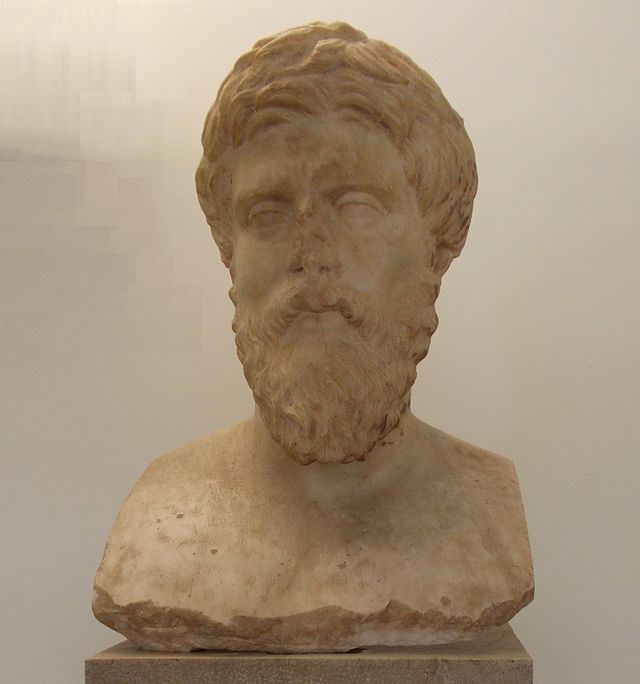

Ancient precursors
The general question to which Plutarch’s ship belongs is older than Hellenistic philosophy. The pre-Socratic Heraclitus of Ephesus, writing around 500 BCE, used the case of a river to express a similar tension. The most secure of the surviving river fragments, fragment B12 in the Diels–Kranz numbering, says that on those who step into the same rivers, different and ever different waters flow. The fragment treats the river as a peculiar kind of existent, one that remains what it is precisely by changing what it contains. If the waters ceased to flow, there would be no river. The continuity of the thing is grounded in the orderly turnover of its matter, not in the persistence of its matter.15
The Platonic and Aristotelian receptions of Heraclitus shifted the river example in the direction of a more radical doctrine of universal flux — the doctrine that one cannot step into the same river twice, and therefore that nothing whatsoever endures. Modern Heraclitus scholarship, beginning with Karl Reinhardt in the early twentieth century, has argued that this stronger reading misrepresents the surviving fragments and that Heraclitus’s actual point was the more subtle one captured in B12. Read in this way, Heraclitus and the ship case make complementary points: the river is the same because its waters change, and the ship may be the same because its planks change. Persistence through change is not always an illusion to be explained away; sometimes it is the very thing that requires explanation.15
Aristotle’s discussions of substance and accidental change in the Categories and Physics provide further conceptual resources used in later treatments. Aristotle distinguishes the substance — what a thing fundamentally is — from its accidents, the properties it has that could change without making it a different thing. He also distinguishes the matter of a thing from its form, allowing the same matter to take different forms and the same form to be realized in different matter. These distinctions allow one to articulate, even if not yet to resolve, the question of which kind of change is destructive of identity and which is not.13
Hobbes and the second ship
Plutarch’s ship had an additional twist added to it by Thomas Hobbes in De Corpore, the first part of his Elementorum Philosophiae, published in Latin in 1655 and in English the following year. In Part II, Chapter 11 (“Of Identity and Difference”), Hobbes considers the question of what makes a body the same body at one time as at another, and offers the ship case as a test of competing answers. He notes the standard ship example and then introduces a hypothetical second ship.2

_(3x4_cropped).jpg)
Hobbes’s addition is straightforward: imagine that, as the old planks are removed from the working ship and replaced with new ones, someone collects the discarded planks and, when enough have accumulated, reassembles them into a ship in their original arrangement. At the end of the process there are two ships. One is the working ship that the Athenians have continuously maintained; it has the same form, location, function, and continuous spatiotemporal career as the original. The other is the reassembled ship; it has all and only the original matter, in its original configuration. Plutarch’s puzzle asked whether the working ship was the same as the original; Hobbes’s addition forces a comparison between the working ship and the reassembled ship as well.2, 13
The structure of the resulting dilemma can be stated in numbered form. Let the original ship be O, the continuously maintained ship be M, and the ship reassembled from the original planks be R.
P1. If continuity of form, function, and spatiotemporal career suffices for identity, then M is identical with O.
P2. If sameness of original matter in its original configuration suffices for identity, then R is identical with O.
P3. M and R are distinct ships at the end of the process: they occupy different locations, have different parts, and can be pointed at separately.
P4. Identity is transitive: if M is identical with O and R is identical with O, then M is identical with R.
C. Therefore not both criteria can be sufficient for identity, and any consistent account must adjudicate between them or reject the framing of the question.
The dilemma is logically valid in the sense that the conclusion follows from the premises; what philosophers have disputed is which premise to give up and what to put in its place. Hobbes himself drew the conclusion that identity must be relativized to a kind of body. Considered as an aggregate of matter, the ship persists only as long as its matter persists in the same configuration; considered as a body of a certain form, it can survive complete replacement of its matter. Considered in still other ways, it might have still other persistence conditions.2, 13
Two criteria of ship identity in the Hobbesian variant2, 13
| Criterion | Identifies original with | What it preserves | What it gives up |
|---|---|---|---|
| Continuity of form and spatiotemporal career | The continuously maintained ship (M) | Functional and structural continuity; the working ship that sailed every plank-replacement | Sameness of constituent matter |
| Sameness of original matter in original configuration | The ship reassembled from the discarded planks (R) | Material composition; every original plank is present in its original place | Spatiotemporal and functional continuity |
| Both criteria together | Both M and R simultaneously | Both intuitions | Transitivity of identity (the formally unacceptable option) |
| Neither criterion | Neither M nor R | The formal properties of identity | The intuitive claim that some ship in the story is the original |
Locke, Hume, and the turn to persons
The early modern reception of the puzzle ran in parallel with the emerging problem of personal identity. In the second edition of his Essay Concerning Human Understanding, published in 1694, John Locke added a new chapter (Book II, Chapter 27, “Of Identity and Diversity”) in which he distinguished sharply between the identity conditions of different kinds of things. A mass of matter persists as long as the same atoms remain united; a plant or animal persists as long as it sustains a single organized life that takes in and gives off matter; and a person — defined as a thinking, intelligent being that can consider itself as itself in different times and places — persists as long as a single consciousness extends over its experiences.3
Locke’s key move is the distinction between the identity of a man (the human animal) and the identity of a person (the thinking, self-conscious subject). The two need not coincide, and on Locke’s account they are governed by different conditions: the identity of the man is the identity of a living human organism, while the identity of the person is the identity of a continuous consciousness joined by memory. Locke’s discussion of the identity of plants and animals applies the same general framework that Plutarch’s puzzle requires — persistence through change of matter is grounded in the persistence of an organizing principle, in the case of organisms a single life. A ship is not a living thing, but the structural analogy is clear: persistence through plank replacement, on a Lockean view, would have to be grounded in the persistence of some principle of organization analogous to the unity of a life.3, 14
David Hume took the discussion in a different direction in Book I, Part IV, Section VI of his Treatise of Human Nature (1739). Hume argued that introspection reveals no impression of an enduring self, but only a succession of perceptions. The mind, Hume wrote, is “nothing but a bundle or collection of different perceptions, which succeed each other with an inconceivable rapidity, and are in a perpetual flux and movement.” What we call personal identity is, on Hume’s account, an intelligible fiction generated by the imagination’s tendency to confuse a closely connected sequence of related items with a single enduring item. The ship’s persistence through plank replacement is, for Hume, the same kind of phenomenon as the self’s persistence through changing perceptions: an imagined unity imposed on a connected series.4
Hume’s diagnosis is significant because it makes the puzzle non-substantive in a particular way. If our talk of an enduring ship reflects a habit of the imagination rather than an objective relation in the world, then the question of whether the working ship or the reassembled ship is “really” the original may have no determinate answer at all. The ship case becomes a case study in the gap between the structure of human concepts and the structure of the world the concepts are supposed to track.4, 14
Constitution without identity
One major contemporary response to the puzzle is the constitution view, developed in different forms by David Wiggins, Lynne Rudder Baker, and others. On the constitution view, the relation between a ship and the planks that compose it at a time is not identity but constitution: the planks make up the ship, but the ship and the planks are distinct objects with different persistence conditions. Wiggins’s Sameness and Substance Renewed (2001) develops a sortal-relative version of the view, on which identity statements are always implicitly relative to a kind term — one and the same ship, one and the same lump of wood — with different sortals fixing different persistence conditions. Two objects of different kinds may coincide spatially without being identical.11, 13
Baker’s Persons and Bodies (2000) defends a similar view in detailed application to persons and the bodies that constitute them, but the framework applies equally to ships and their wood. On Baker’s account, constitution is a non-identity relation that nonetheless explains why we sometimes treat the constituting and the constituted as if they were one. The ship is not identical with the planks, but it has many of its properties only because it is constituted by them, and changes to the constituting matter typically (though not always) carry over to the ship.12, 13
Applied to the Hobbesian variant, the constitution view says that the original ship is constituted at any given time by a particular collection of planks, but is not identical with that collection. As planks are replaced, the ship comes to be constituted by a new collection while remaining the same ship. The reassembled vessel R is constituted by the original collection of planks, but it is a different ship — or possibly the same ship as the original at an earlier time, depending on the details of the account. The transitivity of identity is preserved because the identity claims at issue are identity claims about ships, and only the working ship M is genuinely identical with the original ship O. R is constituted by the original matter without being identical with the original ship.11, 12
Critics of the constitution view have pressed the question of how two distinct objects can occupy the same space at the same time and share so many of their non-modal properties. If the ship and the planks weigh the same, occupy the same volume, are made of the same wood, and respond identically to physical interactions, what does the distinction between them amount to? Defenders reply that the distinction is grounded in differences of modal and historical properties: the ship can survive plank replacement and the collection of planks cannot, and this modal difference is enough to make them numerically distinct.13
Four-dimensionalism and temporal parts
A second major response treats the puzzle as an artifact of a flawed three-dimensional picture of objects. Four-dimensionalism, defended in different forms by David Lewis in On the Plurality of Worlds (1986) and Theodore Sider in Four-Dimensionalism (2001), holds that material objects are four-dimensional entities extended through time as well as space, and that they persist by having distinct temporal parts at distinct times. On this view, an enduring ship is not a single three-dimensional object that is wholly present at every moment of its career; it is a four-dimensional “spacetime worm” whose stages at different times are themselves objects.7, 8
Applied to the Hobbesian variant, four-dimensionalism makes available a clean diagnosis. There are two four-dimensional ships in the story. The first consists of the original ship-stages followed by the continuously maintained ship-stages; this is the ship M. The second consists of the original ship-stages followed by a temporal gap (during which the planks are dispersed) and then the reassembled ship-stages; this is the ship R. Crucially, M and R share their early temporal parts — the stages prior to any plank replacement — without being identical. Two distinct four-dimensional objects can have a common initial segment in the same way that two distinct lines can pass through a common point. Both M and R have an equally good claim to be continuous with the original stages, but neither is identical with the other, and the question of which is “really” the original ship is a question about which spacetime worm to single out for that label.7, 14
Sider distinguishes a strong perdurantism on which persisting objects are sums of distinct temporal parts from a stage-theoretic version on which the things we ordinarily refer to are themselves momentary stages, with persistence claims analyzed via temporal counterpart relations. Both versions agree that the apparent paradox in the ship case dissolves once one admits temporal parts: there is no contradiction in saying that two distinct four-dimensional ships share a portion of their careers, just as there is no contradiction in saying that two distinct roads share a stretch of pavement.7
Critics of four-dimensionalism object that the view multiplies entities beyond necessity, replacing the single ship with which we started with two overlapping spacetime worms (and on some versions, with infinitely many overlapping worms corresponding to every possible way of carving up the spatiotemporal region). They also argue that the view conflicts with the apparent fact that we, and ships, are wholly present at any given moment rather than spread out across time.14
Eliminativism about ordinary objects
A third major response denies the existence of the disputed objects altogether. On eliminativist or near-eliminativist views, there is no such object as a ship. There are only the planks, or the smaller particles that compose the planks, arranged in various configurations. Talk of ships is a useful approximation that does not track any genuine composite object in the world.9, 10
Peter Unger’s “There Are No Ordinary Things” (1979) defends a strong version of this position, arguing that the existence of composite ordinary objects leads to incoherence (in particular through sorites-style arguments) and that the most consistent response is to deny the existence of tables, chairs, ships, and other artifacts. Peter van Inwagen’s Material Beings (1990) defends a more restricted version on which the only composite material objects are living organisms; tables and ships do not exist, but human beings, dogs, and oak trees do, because in these cases the activities of the parts compose a single life. On either view, the ship of Theseus puzzle is dissolved by denying that there is any ship at all whose identity through time is at stake. There are some planks, the planks change over time, some of the planks get reassembled, and that is the whole story. The puzzle arises only if one mistakenly reifies the ordinary noun “ship” into a genuine object.9, 10
Eliminativists owe an account of why ordinary talk of ships is so useful and so apparently truth-evaluable if there are no ships. Van Inwagen offers a paraphrase strategy on which sentences about tables and ships are reinterpreted as quantifying over particles arranged tablewise or shipwise; sentences about the ship of Theseus become sentences about successive arrangements of planks. The paraphrase preserves the truth-conditions of ordinary discourse while denying its apparent ontological commitments.9
Critics argue that the paraphrase strategy faces problems of generality and adequacy: it is not obvious that every ordinary sentence about composite objects can be paraphrased in particle terms without loss of content, and the eliminativist must in any case appeal to predicates like “arranged shipwise” whose meaning seems to depend on prior understanding of what a ship is.13
Chisholm’s strict identity and successive entities
Roderick Chisholm, in Person and Object (1976), defended a different kind of revisionary response. Chisholm argued that strict philosophical identity requires sameness of all parts: in the strict sense, no ordinary object can survive the loss or replacement of any part whatsoever. The objects we ordinarily refer to as ships, tables, and rivers are not strict-identical persisting entities but entia successiva — successions of strictly distinct momentary objects bound together by causal and functional relations. Talk of an enduring ship is talk in the “loose and popular” sense; in the strict and philosophical sense, there is a different ship at every moment.6, 14
Chisholm’s strict-loose distinction handles the Hobbesian variant naturally. In the strict sense, there is no single ship that persists through plank replacement; there is a succession of distinct momentary ships, each strictly identical only with itself. In the loose sense, both the working ship and the reassembled ship can be called “the ship of Theseus,” but the choice between them is a matter of conventional bookkeeping rather than a discovery about which is “really” identical with the original.6
Chisholm denied that this analysis applies to persons. Persons, on his view, are strict-identical persisting entities — entia per se rather than entia per alio. The reason Chisholm gave is that the identity of a person across time has a kind of self-presenting reality that the identity of an artifact does not: when one anticipates one’s own future suffering, one is not anticipating the suffering of a strictly distinct momentary successor that happens to be causally related to one’s present self. Chisholm took this asymmetry to be evidence that the strict-loose distinction tracks a real metaphysical difference between persons and ordinary material objects.6
Distribution of major contemporary responses to the puzzle by what they preserve13, 14
Parfit, persons, and what matters
Derek Parfit’s Reasons and Persons (1984) brought the structure of the ship case into the centre of debates about personal identity. Parfit considered a series of thought experiments — the teletransporter, fission cases in which the two hemispheres of a single brain are transplanted into two different bodies, and gradual replacement of brain matter — that have the same logical shape as the Hobbesian ship dilemma. In a fission case, two future persons each have an equally good claim to be continuous with a single earlier person, and the transitivity of identity rules out the claim that both are identical with the original.5
Parfit’s characteristic move was to argue that, in the personal case, this shows that identity is not what matters in survival. What matters is psychological continuity and connectedness — what Parfit called Relation R — which can hold one-many as well as one-one. In a fission case, the original person stands in Relation R to each of the two later persons, even though the original person cannot be strictly identical with both. Parfit concluded that one should care about Relation R rather than about identity, and that the question “will I survive?” can come apart from the question “will there be someone in the future who is psychologically continuous with me?”5
The same move can be made in the ship case. What matters about the persistence of the ship of Theseus is not strict numerical identity but a relation of historical, functional, and structural continuity that can hold to varying degrees and can in principle be borne to more than one later object. The Hobbesian dilemma stops being a dilemma about an all-or-nothing identity relation and becomes a question about how to assign one or more labels to a structure of continuities. Parfit’s reductionist position about persons generalizes naturally to a reductionist position about artifacts: both are nothing over and above the obtaining of certain causal, structural, and functional relations among more basic items.5, 14
Related puzzles and significance
The ship of Theseus is one of a family of puzzles that arise wherever the same matter can be configured in different ways or different matter can realize the same configuration. The statue and the lump pose the question of whether a statue is identical with the lump of clay that constitutes it, given that the lump existed before the statue was sculpted and can survive being squashed while the statue cannot. The puzzle of Dion and Theon, attributed to Chrysippus, asks how a complete human being and the same human being minus one foot can fail to be two persons coincident in the same body before the amputation. The case of Tibbles the cat and the part of Tibbles that excludes one hair raises the same question for the relationship between an organism and its arbitrary undetached parts. In each case, the underlying tension is between intuitive judgments about persistence or constitution and the logical features of the identity relation, particularly its transitivity and Leibniz’s Law.13, 14
The significance of the puzzle for contemporary metaphysics lies in the way it forces a choice among large theoretical commitments. To preserve the natural-language judgment that the working ship is the original, one must adopt a view of objects on which they can survive complete material replacement; to preserve the natural-language judgment that the reassembled ship has equal standing, one must explain how two distinct objects can share their early careers; to deny that there are any ships at all, one must explain the apparent success and indispensability of artifact talk. None of these positions is cost-free. The same structural choices recur in debates about the persistence of organisms, of persons, and of social entities like nations and corporations, where the ship case serves as a controlled, low-stakes proving ground for views that have much more consequential applications.13, 14
The puzzle also bears on debates in functionalism in the philosophy of mind, where the question of whether a thinking thing can survive complete replacement of its physical substrate by functionally equivalent parts has the same logical shape as the question of whether the ship can survive complete replacement of its planks. A functionalist who is willing to say that the gradually rebuilt ship is the same ship is under pressure to say that a gradually rebuilt mind is the same mind. The connections among the metaphysics of artifacts, the metaphysics of organisms, and the metaphysics of persons mean that what looks like a small puzzle about a galley in a Plutarch biography turns out to be entangled with some of the largest questions in contemporary philosophy.5, 13