Overview
- Edmund Gettier’s 1963 paper demonstrated with two brief counterexamples that justified true belief is not sufficient for knowledge — a person can have a belief that is both true and well-justified yet does not constitute knowledge because the justification connects to the truth only by luck.
- Responses to the Gettier problem have generated much of contemporary epistemology: the no-false-lemmas condition, defeasibility theories, reliabilism, virtue epistemology, and causal theories of knowledge each attempt to specify the missing fourth condition (or replace the JTB framework entirely) that would distinguish genuine knowledge from Gettier cases.
- Despite six decades of sustained effort, no proposed solution has achieved consensus — leading some philosophers to conclude that knowledge is an unanalyzable primitive concept, while others take the problem as evidence that the project of conceptual analysis faces fundamental limits.
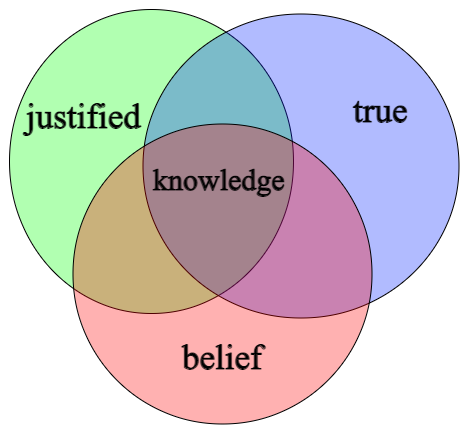
The Gettier problem is the challenge posed to the classical analysis of knowledge by Edmund Gettier’s 1963 paper “Is Justified True Belief Knowledge?” For more than two millennia, epistemologists had widely accepted that knowledge is justified true belief — that a person knows a proposition if and only if the proposition is true, the person believes it, and the person is justified in believing it. This tripartite analysis, with roots traceable to Plato’s Theaetetus, seemed to capture the necessary and sufficient conditions for knowledge.2 In a paper of barely two and a half pages, Gettier produced two counterexamples showing that justified true belief is not sufficient for knowledge: cases in which a person has a justified, true belief that nonetheless falls short of knowledge because the connection between the justification and the truth is accidental. The paper transformed epistemology, generating an enormous literature of proposed solutions, further counterexamples, and fundamental reassessments of the project of analyzing knowledge.1, 10

The classical analysis and Gettier’s counterexamples
The justified true belief (JTB) analysis holds that a subject S knows a proposition P if and only if three conditions are met: P is true, S believes that P, and S is justified in believing that P. Each condition seems independently necessary. A true belief held without justification — a lucky guess — is not knowledge. A justified belief that happens to be false is not knowledge either. And justification without belief is not the right kind of mental state. The conjunction of all three conditions was taken to be sufficient: if your belief is true and you have good reasons for holding it, you know it.10, 2
Gettier’s counterexamples showed that all three conditions can be met while the resulting state is clearly not knowledge. In his first case, Smith and Jones have applied for a job. Smith has strong evidence that Jones will get the job (the company president told him so), and Smith has counted the coins in Jones’s pocket and knows Jones has ten coins. Smith therefore forms the justified belief that “the man who will get the job has ten coins in his pocket.” As it turns out, Smith himself gets the job, and Smith himself, unknown to him, also has ten coins in his pocket. Smith’s belief is true (the man who got the job does have ten coins in his pocket — it is just that the man is Smith, not Jones). His belief is justified (he had strong evidence for it). But Smith does not know the proposition, because his belief is true for the wrong reasons: the justification pointed toward Jones, while the truth was secured by a coincidence involving Smith.1
The structure of Gettier cases can be stated in general terms. The subject forms a justified belief on the basis of evidence. Through a step of valid reasoning (such as existential generalization or disjunction introduction), the subject derives a further belief that is also justified. By bad luck, the original evidence is misleading — the state of affairs it points to does not obtain. But by compensating good luck, the derived belief happens to be true anyway, made true by a different state of affairs than the one the subject’s evidence indicated. The result is a justified true belief that is not knowledge, because the justification and the truth are connected only by epistemic luck.1, 14
Early responses
The immediate reaction to Gettier’s paper was an effort to supplement the JTB analysis with a fourth condition that would exclude Gettier cases. The no-false-lemmas condition, proposed in various forms by several epistemologists, requires that the subject’s justification not depend essentially on any false belief. In Smith’s case, his reasoning depended on the false belief that Jones would get the job; remove this false lemma and the justified true belief collapses. The no-false-lemmas approach handles Gettier’s original cases but fails against more sophisticated counterexamples in which the subject’s reasoning does not pass through any identifiable false belief. If Smith sees what appears to be a barn in the countryside and forms the belief “there is a barn in that field,” and it happens to be a real barn though the surrounding countryside is filled with barn facades (the “fake barn” case devised by Goldman), Smith’s belief is justified, true, and does not depend on any false lemma — yet most epistemologists judge that he does not know.6, 10
The defeasibility theory, advanced by Keith Lehrer and Thomas Paxson (1969), proposes that knowledge requires that the subject’s justification be undefeated: there must be no true proposition such that, if the subject became aware of it, the justification would be undermined. In the original Gettier case, the true proposition “Jones will not get the job” would defeat Smith’s justification. Defeasibility captures a wide range of Gettier cases, but faces the problem of misleading defeaters — true propositions that would undermine justification but that are themselves misleading, and whose misleadingness means the subject actually does have knowledge. Constructing the right account of non-misleading defeaters has proved difficult.5, 10
Alvin Goldman’s causal theory of knowledge (1967) took a different approach. Goldman proposed that knowledge requires an appropriate causal connection between the fact that makes the belief true and the subject’s belief. Smith’s belief that “the man who will get the job has ten coins in his pocket” is not knowledge because the fact that makes it true (Smith’s own ten coins and his getting the job) is not causally connected to Smith’s belief in the right way. The causal theory handles many Gettier cases naturally but has difficulty with knowledge of abstract entities (mathematical and logical truths), which do not stand in causal relations to believers.3
Reliabilism and virtue epistemology
Goldman later developed his approach into process reliabilism, which replaces the traditional concept of justification with the requirement that the belief be produced by a reliable cognitive process — one that tends to produce true beliefs in the relevant range of circumstances. On this account, the problem with Gettier cases is that the process connecting the evidence to the truth is not reliable in the right way: it produces a true belief in this instance, but only by luck, and it would produce false beliefs in relevantly similar cases. Reliabilism shifts the epistemological focus from the subject’s reasons to the causal and statistical properties of the belief-forming process, and it has become one of the dominant frameworks in contemporary epistemology.7
Linda Zagzebski’s virtue epistemology (1996) approaches the Gettier problem by modeling knowledge on the concept of a virtuous act. An act of knowledge, like a virtuous act, must succeed because of the relevant excellence of the agent. A belief constitutes knowledge when it is true and when its truth is attributable to the intellectual virtues of the believer — her careful observation, sound reasoning, intellectual honesty, or cognitive skill. In Gettier cases, the belief is true, but its truth is not attributable to the subject’s intellectual virtues; it is attributable to luck. Knowledge, on this view, is not justified true belief plus a fourth condition but a fundamentally different kind of cognitive achievement — an achievement that essentially involves the agent’s intellectual character.8
Alvin Plantinga’s account of warrant offers a related but distinct response. Plantinga argues that the property that turns true belief into knowledge is not justification but warrant — the property a belief has when it is produced by cognitive faculties that are functioning properly, in an appropriate epistemic environment, according to a design plan successfully aimed at truth. Gettier cases fail to produce knowledge because, even though the subject’s faculties are functioning properly, the environment is abnormal in a way that breaks the connection between proper function and truth. Plantinga’s account connects directly to his broader project in reformed epistemology, where he argues that belief in God can have warrant without requiring propositional evidence.12, 13
Knowledge as primitive
The persistent failure to find an adequate analysis of knowledge has led some philosophers to a more radical conclusion. Timothy Williamson, in Knowledge and Its Limits (2000), argues that knowledge is a primitive, unanalyzable mental state — not a composite of belief, truth, and some further condition, but a basic factive mental state that resists decomposition. On Williamson’s view, the Gettier problem is insoluble because the project it presupposes — analyzing knowledge into necessary and sufficient conditions — is misconceived. Knowledge is more fundamental than belief: belief is best understood as a state that aims at knowledge, rather than knowledge being understood as a species of belief. This “knowledge-first” approach reverses the traditional explanatory priority and dissolves the Gettier problem by rejecting the framework that generated it.9
Duncan Pritchard has developed an anti-luck epistemology that focuses directly on the element that unifies all Gettier cases: epistemic luck. A belief constitutes knowledge, on Pritchard’s account, only if it is not true by luck — more precisely, only if, in nearby possible worlds where the subject forms the belief in the same way, the belief is still true. This “safety” condition is designed to capture what goes wrong in Gettier cases: the subject’s belief, though true in the actual world, would easily have been false given slightly different circumstances. The safety condition avoids some of the problems facing other proposals, though counterexamples to safety-based accounts have also been constructed.14, 11
Broader significance
The Gettier problem has significance well beyond the narrow question of defining knowledge. It has served as a test case for the methodology of conceptual analysis itself. If a concept as seemingly basic as knowledge resists analysis into necessary and sufficient conditions after sixty years of concentrated philosophical effort, this may tell us something about the limits of the analytic method. Some epistemologists have drawn the lesson that conceptual analysis is less productive than empirical approaches to epistemology, including experimental philosophy (which tests intuitions about Gettier cases across cultures) and naturalized epistemology (which studies knowledge as a natural phenomenon using the methods of cognitive science).10, 15
The problem also connects to religious epistemology in several ways. If knowledge requires more than justified true belief, then the epistemological status of religious belief depends on what the correct account of knowledge is. Reliabilist accounts may vindicate religious belief if religious experience is a reliable belief-forming process; virtue-theoretic accounts may vindicate it if religious belief arises from intellectual virtues exercised in appropriate circumstances; Plantinga’s warrant account was designed in part to show that theistic belief can be warranted even without propositional evidence. The Gettier problem thus serves as a gateway to the broader epistemological questions that shape the philosophy of religion: what counts as knowledge, what justification requires, and whether the standards that govern ordinary empirical knowledge apply to beliefs about God.12, 13
References
Virtues of the Mind: An Inquiry into the Nature of Virtue and the Ethical Foundations of Knowledge