Overview
- The hard problem of consciousness, formulated by David Chalmers in 1995, asks why and how physical processes in the brain give rise to subjective experience — the felt quality of seeing red, tasting chocolate, or hearing a melody — as distinguished from the “easy problems” of explaining cognitive functions such as discrimination, integration, attention, and behavioral control.
- The hard problem builds on Joseph Levine’s concept of the explanatory gap (1983), Thomas Nagel’s argument that physical science omits what it is like to be a conscious organism (1974), and Frank Jackson’s knowledge argument (1982), which contends that a complete physical account of color vision leaves out the subjective experience of seeing color.
- Responses range from dualist and panpsychist positions that accept the hard problem as genuine and propose non-physicalist ontologies, to functionalist and illusionist positions that deny the problem is well-posed, arguing that subjective experience is either identical with functional states or a cognitive illusion — a debate with direct implications for the argument from consciousness in the philosophy of religion.
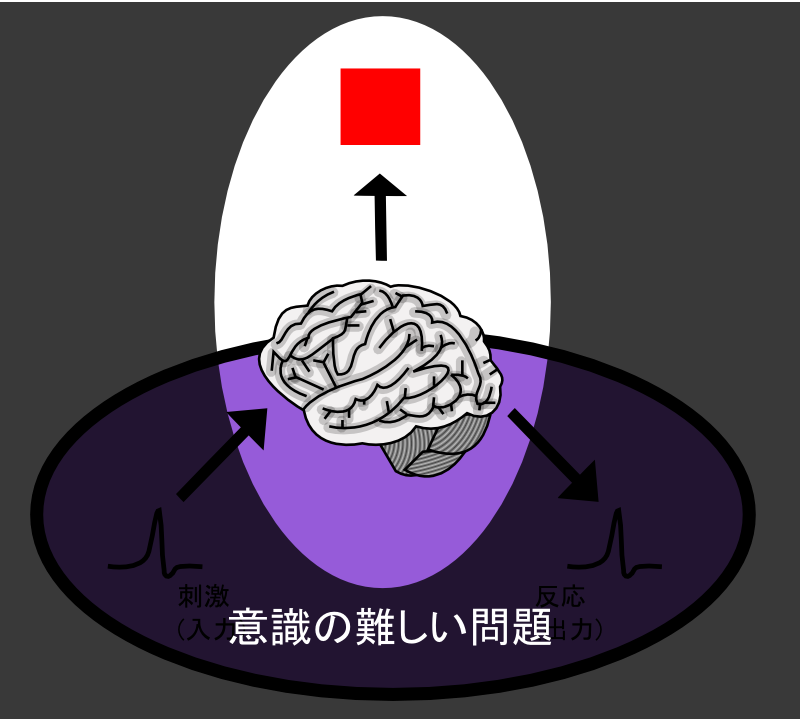
The hard problem of consciousness is the problem of explaining why and how physical processes in the brain give rise to subjective experience — why there is “something it is like” to see a color, feel a pain, or taste a flavor, rather than these processes occurring without any accompanying inner life. The term was introduced by David Chalmers in his 1995 paper “Facing Up to the Problem of Consciousness,” though the underlying puzzle has roots extending at least to Descartes and Leibniz. Chalmers distinguished the hard problem from what he called the “easy problems” of consciousness — explaining how the brain discriminates stimuli, integrates information, controls behavior, reports on internal states, and focuses attention. These are “easy” not because they have been solved but because they are the kind of functional problems that standard neuroscientific and computational methods are, in principle, equipped to address. The hard problem is different in kind: even a complete functional explanation of every cognitive capacity associated with consciousness would leave untouched the question of why these functions are accompanied by subjective experience at all.1, 2
.png)
Philosophical antecedents
Chalmers did not introduce the problem from nowhere. Thomas Nagel’s 1974 paper “What Is It Like to Be a Bat?” argued that consciousness has an essentially subjective character — there is something it is like to be a particular conscious organism — and that this subjective character is not captured by any objective, third-person account of the organism’s physical constitution. No amount of neurological information about echolocation could tell us what it is like for a bat to perceive the world through sonar. Nagel concluded that the mind–body problem is genuinely intractable given our current conceptual resources, and that physicalist reductions of consciousness may be impossible in principle.5
Frank Jackson’s knowledge argument (1982) sharpened the point with a celebrated thought experiment. Mary is a brilliant neuroscientist who has spent her entire life in a black-and-white room. She knows every physical fact about color vision — the wavelengths of light, the neural pathways, the brain states associated with color perception. When Mary is released from her room and sees red for the first time, Jackson argued, she learns something new: what red looks like. If she learns something new despite already possessing all physical knowledge, then physical knowledge is not all knowledge — there exist facts about the qualitative character of experience that are not physical facts. Jackson originally drew a dualist conclusion from this argument, though he later reversed his position.4
Joseph Levine introduced the concept of the explanatory gap in 1983. Levine observed that even if pain is identical to C-fiber firing (as identity theorists maintain), the identity statement “pain = C-fiber firing” leaves a felt sense of incompleteness that is absent from other identity statements, such as “water = H2O.” With water, understanding the molecular structure explains why the substance has the macro-properties it does — its boiling point, its transparency, its solvent behavior. With pain, understanding the neural firing pattern does not explain why it feels like pain rather than like nothing at all. Levine was careful to distinguish the explanatory gap from an ontological gap: the gap in our understanding does not necessarily entail that pain is not identical to a brain state, but it does mean that physicalism has an explanatory deficit that other reductions do not.3
Chalmers’s formulation
Chalmers organized the problem with a clarity and systematicness that made it a central topic in the philosophy of mind. He began by listing the easy problems: the ability to discriminate and categorize environmental stimuli, the integration of information by a cognitive system, the reportability of mental states, the ability to access one’s own internal states, the control of behavior by attention, the distinction between wakefulness and sleep. For each of these, Chalmers argued, a functional explanation — an account of how the system performs the relevant function — would constitute a satisfying solution. Neuroscience and cognitive science are making steady progress on all of them.1
The hard problem is what remains after all the easy problems have been solved. Even if every functional, behavioral, and neural correlate of consciousness were fully explained, there would still be the question: why is all this processing accompanied by subjective experience? Why does the neural processing of 700-nanometer light not occur “in the dark,” with the same functional and behavioral outputs but no inner experience of redness? Chalmers argued that the hard problem is hard precisely because it cannot be solved by the standard methods of cognitive science, which explain functions. Consciousness is not a function but a phenomenon — something that is there in addition to all the functions.1, 2
To support the claim that consciousness is not entailed by physical and functional facts, Chalmers introduced the zombie argument. A philosophical zombie is a being that is physically and functionally identical to a conscious human being in every respect — same neurons, same behavior, same functional organization — but that has no subjective experience whatsoever. Chalmers argued that zombies are conceivable (we can coherently imagine such a being without contradiction) and that conceivability is a guide to metaphysical possibility. If a zombie world is metaphysically possible, then consciousness is not logically supervenient on the physical: there is a further fact about whether a physical system is conscious that goes beyond its physical and functional properties. This conclusion, if sound, refutes all forms of physicalism about consciousness.2, 12
Dualist and panpsychist responses
Those who accept the hard problem as genuine have developed a range of non-physicalist positions. Property dualism, which Chalmers himself favors, holds that conscious experience is a fundamental feature of the world that is not reducible to physical properties, even though it is lawfully correlated with them. On this view, there are psychophysical laws — fundamental laws of nature connecting physical states to conscious states — that are not derivable from the laws of physics. These laws have the same status as other fundamental laws: they are basic features of reality that do not require further explanation. Chalmers has argued that a complete science would include both physical and psychophysical laws, expanding the ontology of fundamental science to include experience as a basic category alongside mass, charge, and spacetime.2, 13
Panpsychism takes a more radical step by proposing that consciousness or proto-consciousness is a fundamental property of all matter, not something that emerges only in brains. If every physical entity has some rudimentary experiential aspect, then the emergence of complex consciousness in biological organisms is a matter of combination and integration rather than a radical discontinuity. Chalmers has explored panpsychism and a related view, panprotopsychism (which holds that fundamental entities have proto-conscious properties that are not themselves experiences but that constitute or give rise to experience when combined in the right way), as among the most promising approaches to the hard problem. The principal objection to panpsychism is the combination problem: how do the micro-experiences of billions of particles combine into the unified, structured experience of a human mind? This problem has proved at least as difficult as the original hard problem, and some philosophers argue that it shows panpsychism merely relocates the explanatory gap rather than closing it.16, 2
The hard problem has been taken up in the philosophy of religion as a premise in the argument from consciousness. Richard Swinburne and J. P. Moreland have argued that the existence of subjective experience is more probable on the hypothesis that ultimate reality is itself conscious (theism) than on the hypothesis that ultimate reality is fundamentally physical (naturalism). If psychophysical laws are brute, unexplained features of nature under naturalism, but expected consequences of a conscious creator under theism, then the existence of consciousness constitutes evidence for God. Whether this argument succeeds depends in part on whether the hard problem is genuine or whether physicalist and functionalist accounts can eventually dissolve it.15
Functionalist and identity theory responses
Physicalist responses to the hard problem deny that there is a genuine explanatory gap that physicalism cannot close. Type identity theory, in the tradition of U. T. Place and J. J. C. Smart, holds that conscious states are straightforwardly identical to brain states: pain is C-fiber firing, the experience of red is a particular pattern of neural activation in the visual cortex. Saul Kripke challenged this approach in Naming and Necessity (1980), arguing that if pain is identical to C-fiber firing, the identity should hold necessarily (in all possible worlds), but it seems conceivable that C-fiber firing could occur without pain, which should be impossible for a necessary identity. Kripke’s argument remains one of the most influential objections to identity theory.8
David Papineau defends a version of identity theory that addresses the conceivability objection through the phenomenal concept strategy. Papineau argues that the apparent gap between physical and phenomenal descriptions arises not from a gap in nature but from a gap in our concepts. We have two fundamentally different ways of representing the same brain state: a physical/functional concept (C-fiber firing) and a phenomenal concept (the feeling of pain). These concepts pick out the same property but do so via different cognitive mechanisms, creating the illusion that they must refer to different properties. The explanatory gap is conceptual, not ontological: the experience of pain just is C-fiber firing, even though our concept of the experience does not reveal this identity transparently.10
Functionalism, the dominant physicalist position in the philosophy of mind since the 1960s, identifies mental states with functional roles: pain is whatever plays the functional role of being caused by tissue damage, causing withdrawal behavior, and producing the desire for the state to cease. Functionalism avoids the species-chauvinism of type identity theory (which ties mental states to specific neural substrates) but faces the objection that functional organization alone cannot account for qualitative experience. Two systems could play identical functional roles while differing in their qualitative experience (the “inverted spectrum” scenario) or while one lacks experience entirely (the zombie scenario). If these scenarios are genuinely possible, functionalism fails to capture what is distinctive about consciousness.11, 9
Illusionism and eliminativism
The most radical physicalist response to the hard problem denies that phenomenal consciousness — in the philosophically loaded sense of intrinsic, ineffable qualia that stand over against functional properties — exists at all. Daniel Dennett, in Consciousness Explained (1991), argued that the intuition of an explanatory gap is generated by confused philosophical theorizing about qualia. There are no qualia in the dualist’s sense — no intrinsic, private, directly apprehended properties of experience. What we call “consciousness” is a collection of cognitive functions: discrimination, categorization, attention, self-monitoring, and reportability. Once these functions are fully explained, nothing remains to be explained. The hard problem dissolves because its presupposition — that there is something beyond the functions — is false.6
Keith Frankish has developed a more nuanced version of this position under the label illusionism. Frankish agrees with Dennett that phenomenal consciousness, in the strong sense of intrinsic qualia, does not exist. But he takes the subjective impression that it exists seriously as a datum requiring explanation. We are under a powerful introspective illusion: we seem to ourselves to have experiences with intrinsic qualitative properties, but introspection is not a transparent window onto the nature of our mental states. What introspection actually detects are “quasi-phenomenal properties” — functional and representational properties that create the illusion of phenomenality. The hard problem, on this view, is replaced by the “illusion problem”: explaining why we are under the illusion that we have phenomenal consciousness, even though we do not.7
Patricia Churchland and the eliminative materialist tradition take a related approach from the direction of neuroscience. Our folk-psychological concepts of consciousness — qualia, the unity of experience, the subjective perspective — are artifacts of a prescientific framework that may not correspond to the actual structure of the brain. Just as “phlogiston” and “vital spirit” were eliminated when chemistry and biology matured, the concepts that generate the hard problem may be eliminated by a mature neuroscience that describes brain processes in terms that do not map onto our intuitive categories of conscious experience.14
The current state of the debate
The hard problem of consciousness remains one of the deepest unresolved questions in philosophy. The PhilPapers survey of professional philosophers (2020, published 2021) found that approximately 52% accept or lean toward physicalism about the mind, while roughly 32% accept or lean toward non-physicalism, with the remainder undecided. These numbers reflect an ongoing, roughly balanced dispute rather than an emerging consensus. Among philosophers of mind specifically, the debate is if anything more intense, with proponents of each position producing increasingly sophisticated arguments.12
Empirical developments in neuroscience have influenced but not resolved the debate. The search for the neural correlates of consciousness (NCCs) — the minimal neural mechanisms sufficient for a specific conscious experience — has identified candidate structures and processes, including recurrent processing in the visual cortex, global workspace dynamics, and integrated information in thalamocortical networks. Proponents of the hard problem argue that NCCs, however precisely specified, are correlations rather than explanations: they tell us which brain states are associated with which experiences but not why those brain states are accompanied by experience at all. Physicalists respond that as the correlations become more precise and more explanatory, the felt sense of an explanatory gap will diminish, just as the gap between thermodynamics and statistical mechanics closed with deeper understanding.2, 9
The debate has direct implications for several areas beyond philosophy of mind. In artificial intelligence, the question of whether a sufficiently complex computational system could be conscious turns on whether consciousness is a functional property (as functionalists maintain) or something that requires a specific physical or metaphysical substrate (as dualists and biological naturalists like Searle maintain). In the philosophy of religion, the hard problem provides the premise for the argument from consciousness and connects to the argument from reason, both of which reason from features of the mental to conclusions about the ultimate nature of reality. Whether the hard problem is a genuine, permanent feature of the mind–body problem or a puzzle that will eventually yield to scientific and philosophical progress remains, after thirty years of concentrated debate, an open question.1, 12, 15