Overview
- Several passages found in modern Bibles are absent from the earliest and most reliable Greek manuscripts, including the longer ending of Mark (16:9–20), the story of the woman caught in adultery (John 7:53–8:11), and the Trinitarian formula in 1 John 5:7–8.
- The manuscript evidence for these additions is extensive and unambiguous: each passage is missing from the oldest surviving witnesses, appears first in later copies, and in some cases is marked with scribal annotations indicating doubt about its authenticity.
- These textual additions reveal how the New Testament text was shaped during centuries of hand-copying, as scribes incorporated marginal notes, liturgical readings, and theological clarifications into the running text of their manuscripts.
The text of the New Testament as it appears in modern printed Bibles is the product of centuries of hand-copying, during which scribes introduced changes both deliberate and accidental into the manuscripts they produced. Most of these changes are minor — spelling variations, word-order differences, and copying errors that affect no point of meaning. A small number, however, are substantial: entire passages comprising multiple verses that are present in later manuscripts but absent from the earliest surviving witnesses.1 These later additions are not hidden or obscure. They include some of the most familiar passages in the New Testament: the resurrection appearances at the end of the Gospel of Mark, the story of Jesus and the woman caught in adultery in the Gospel of John, and the explicit Trinitarian formula in the First Epistle of John. In each case, the manuscript evidence documenting their absence from early copies is extensive and has been known to textual critics since at least the early modern period.1, 2
This article examines the major later additions to the New Testament text, presenting the manuscript evidence for each passage — which manuscripts include it, which omit it, when and where it first appears in the surviving record — and quoting the passages in full so that the reader can see exactly what was added and where it was inserted into the text.10
The longer ending of Mark (16:9–20)
The Gospel of Mark as it appears in most modern Bibles ends with twelve verses (16:9–20) that describe Jesus' post-resurrection appearances, his commission to the disciples, and his ascension. These verses are absent from the two oldest complete Greek manuscripts of the New Testament: Codex Sinaiticus (fourth century, British Library) and Codex Vaticanus (fourth century, Vatican Library).1, 3 In both manuscripts, the Gospel of Mark ends at 16:8 with the words "for they were afraid" (ephobounto gar, ἐφοβοῦντο γάρ).2
The text of Mark 16:1–8, the last passage present in the earliest manuscripts, reads as follows:
When the sabbath was over, Mary Magdalene, and Mary the mother of James, and Salome bought spices, so that they might go and anoint him. And very early on the first day of the week, when the sun had risen, they went to the tomb. They had been saying to one another, "Who will roll away the stone for us from the entrance to the tomb?" When they looked up, they saw that the stone, which was very large, had already been rolled back. As they entered the tomb, they saw a young man, dressed in a white robe, sitting on the right side; and they were alarmed. But he said to them, "Do not be alarmed; you are looking for Jesus of Nazareth, who was crucified. He has been raised; he is not here. Look, there is the place they laid him. But go, tell his disciples and Peter that he is going ahead of you to Galilee; there you will see him, just as he told you." So they went out and fled from the tomb, for terror and amazement had seized them; and they said nothing to anyone, for they were afraid. (NRSV)
In the earliest manuscripts, this is where Mark ends. The women flee the empty tomb in fear, tell no one, and the narrative simply stops. There is no account of anyone seeing the risen Jesus, no commission to preach, no ascension.6
The twelve verses that follow in later manuscripts read:
Now after he rose early on the first day of the week, he appeared first to Mary Magdalene, from whom he had cast out seven demons. She went out and told those who had been with him, while they were mourning and weeping. But when they heard that he was alive and had been seen by her, they would not believe it. After this he appeared in another form to two of them, as they were walking into the country. And they went back and told the rest, but they did not believe them. Later he appeared to the eleven themselves as they were sitting at the table; and he upbraided them for their lack of faith and stubbornness, because they had not believed those who saw him after he had risen. And he said to them, "Go into all the world and proclaim the good news to the whole creation. The one who believes and is baptized will be saved; but the one who does not believe will be condemned. And these signs will accompany those who believe: by using my name they will cast out demons; they will speak in new tongues; they will pick up snakes in their hands, and if they drink any deadly thing, it will not hurt them; they will lay their hands on the sick, and they will recover." So then the Lord Jesus, after he had spoken to them, was taken up into heaven and sat down at the right hand of God. And they went out and proclaimed the good news everywhere, while the Lord worked with them and confirmed the message by the signs that accompanied it. (NRSV)
The shift between 16:8 and 16:9 is abrupt even at the level of Greek style. The subject changes without transition — 16:8 ends with the women as subject, while 16:9 introduces Jesus as a new subject without the kind of connective clause that characterizes Mark's style elsewhere. Mary Magdalene is reintroduced in 16:9 as though she has not already appeared in 16:1, with the parenthetical note "from whom he had cast out seven demons," a description that echoes Luke 8:2 rather than anything in Mark's preceding narrative. The vocabulary of 16:9–20 also differs from the rest of Mark: the passage uses seventeen words that appear nowhere else in the Gospel, and its literary style — compressed summaries rather than vivid narrative detail — does not match the pattern of Mark's writing in chapters 1 through 16:8.5, 18
Manuscript evidence for Mark's ending
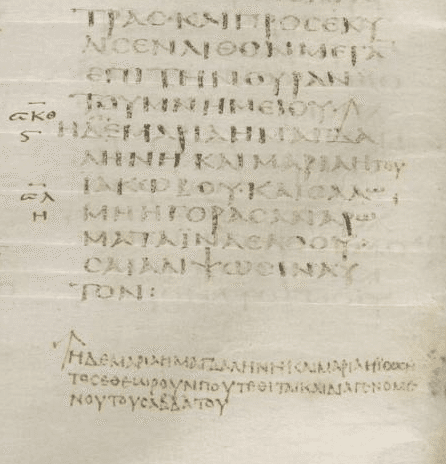

The manuscript evidence for the ending of Mark is more complex than a simple presence-or-absence question. The surviving witnesses attest not two but at least four different endings for the Gospel.1, 2
The abrupt ending at 16:8 is found in Codex Sinaiticus (ℵ, fourth century) and Codex Vaticanus (B, fourth century), the two oldest complete Greek manuscripts of the New Testament. It is also attested by the Sinaitic Syriac manuscript (late fourth or early fifth century), approximately one hundred Armenian manuscripts, and the two oldest Georgian manuscripts.1, 3 Eusebius of Caesarea, writing in the early fourth century, stated that the "accurate copies" of Mark ended at 16:8, and Jerome repeated this observation in the early fifth century.2
The longer ending (16:9–20) first appears in Codex Alexandrinus (A, fifth century), Codex Ephraemi Rescriptus (C, fifth century), and Codex Bezae (D, fifth century), and is present in the vast majority of later Greek manuscripts, including the medieval minuscules that formed the basis for the Textus Receptus and the King James Version. It is also attested by Irenaeus of Lyon, who around 180 CE quoted Mark 16:19 in Against Heresies 3.10.6, providing the earliest known reference to the passage. This means the longer ending was in circulation by the late second century, even though it is absent from the oldest surviving Greek manuscripts.2, 4
A shorter ending, sometimes called the "intermediate ending," appears in a small number of manuscripts. It reads: "And all that had been commanded them they told briefly to those around Peter. And afterward Jesus himself sent out through them, from east to west, the sacred and imperishable proclamation of eternal salvation. Amen." (NRSV) This shorter ending appears in some manuscripts alone after 16:8, and in others it appears before the longer ending, producing a text that contains both.2
A longer ending with the Freer Logion appears in Codex Washingtonianus (W, late fourth or early fifth century, Smithsonian Institution). This manuscript contains 16:9–20 but inserts an additional passage after 16:14 in which the disciples offer an excuse for their unbelief and Jesus responds. Jerome referenced this insertion, which is not found in any other surviving Greek manuscript.1, 2
Several manuscripts that do include 16:9–20 mark the passage with scribal notations indicating uncertainty about its status. Codex Vaticanus, which ends at 16:8, has an unusual blank column after the verse — the only such blank space in the entire New Testament portion of the manuscript — which has been interpreted as an indication that the scribe was aware of additional material but chose not to include it.7 Many later minuscule manuscripts that include the longer ending add marginal notes (scholia) stating that the passage is absent from older copies, or include asterisks and obeli — critical marks used by ancient scribes to signal doubtful text.2
The woman caught in adultery (John 7:53–8:11)
The passage known as the Pericope Adulterae — the story of Jesus and a woman accused of adultery, in which he responds to her accusers by saying "Let anyone among you who is without sin be the first to throw a stone at her" — is among the most widely known passages in the New Testament. It is absent from the earliest and most reliable Greek manuscripts of the Gospel of John.1, 8
The passage reads:
Then each of them went home, while Jesus went to the Mount of Olives. Early in the morning he came again to the temple. All the people came to him and he sat down and began to teach them. The scribes and the Pharisees brought a woman who had been caught in adultery; and making her stand before all of them, they said to him, "Teacher, this woman was caught in the very act of committing adultery. Now in the law Moses commanded us to stone such women. Now what do you say?" They said this to test him, so that they might have some charge to bring against him. Jesus bent down and wrote with his finger on the ground. When they kept on questioning him, he straightened up and said to them, "Let anyone among you who is without sin be the first to throw a stone at her." And once again he bent down and wrote on the ground. When they heard it, they went away, one by one, beginning with the elders; and Jesus was left alone with the woman standing before him. Jesus straightened up and said to her, "Woman, where are they? Has no one condemned you?" She said, "No one, sir." And Jesus said, "Neither do I condemn you. Go your way, and from now on do not sin again." (NRSV)
The passage is absent from the earliest papyrus witnesses to John's Gospel, including P66 (circa 200 CE) and P75 (early third century), both of which preserve the relevant portion of the text and move directly from John 7:52 to John 8:12 with no gap.16, 19 It is also absent from Codex Sinaiticus and Codex Vaticanus, from Codex Washingtonianus, from Codex Ephraemi Rescriptus, and from the earliest Syriac, Coptic, and some Old Latin manuscripts. No Greek church father before the twelfth century comments on the passage in the course of a systematic exposition of John's Gospel — the earliest Greek commentary on the passage comes from Euthymius Zigabenus in the twelfth century, though the passage was known to Latin writers including Jerome and Augustine by the late fourth and early fifth centuries.1, 8
The passage first appears in the Greek manuscript tradition in Codex Bezae (D, fifth century), an unusual bilingual Greek-Latin manuscript known for its many distinctive readings and expansions.12 It subsequently appears in the majority of medieval Greek minuscule manuscripts and became the standard text in the Byzantine tradition that underlies the Textus Receptus.
What makes the manuscript evidence particularly revealing is that the passage does not appear in a fixed location. In the manuscripts that include it, the Pericope Adulterae is found in at least four different places: after John 7:52 (the most common location), after John 7:36, after John 21:25 (at the very end of the Gospel), and in one manuscript family, after Luke 21:38. The fact that scribes placed it in different locations suggests that it circulated as an independent story that was inserted into the Gospel text at various points, rather than being an original part of the narrative at any single location.8, 9
The literary style of the passage also differs from the surrounding text of John's Gospel. The vocabulary includes several words and constructions that are characteristic of Luke-Acts but not found elsewhere in John. The narrative flow of John's Gospel is interrupted by the passage: John 7:52 ends with the Pharisees dismissing Jesus' claims, and John 8:12 opens with Jesus speaking again in the temple — a continuation that reads naturally without the intervening story. The passage introduced at 7:53 ("Then each of them went home") abruptly disperses the crowd that has been the focus of the preceding narrative, and the scene shifts without explanation to the Mount of Olives, a location associated with Jesus in the Synoptic Gospels but not in John.8, 9
The Johannine Comma (1 John 5:7–8)
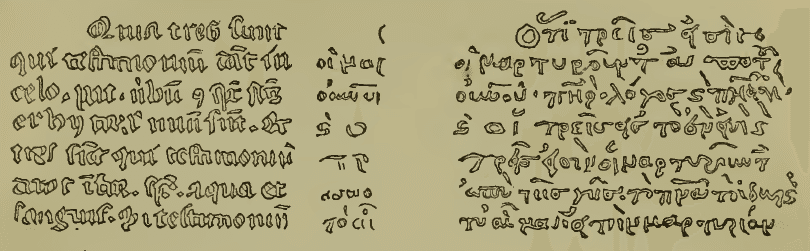
The passage known as the Comma Johanneum is a clause in the First Epistle of John that provides the most explicit statement of Trinitarian theology in the New Testament. In the form found in the Textus Receptus and the King James Version, the passage reads:
.PNG)
For there are three that bear record in heaven, the Father, the Word, and the Holy Ghost: and these three are one. And there are three that bear witness in earth, the Spirit, and the water, and the blood: and these three agree in one. (KJV)
The words "in heaven, the Father, the Word, and the Holy Ghost: and these three are one. And there are three that bear witness in earth" constitute the Comma — the addition. Without these words, the passage reads simply:
There are three that testify: the Spirit and the water and the blood, and these three agree. (NRSV)
The Comma is absent from every known Greek manuscript of 1 John written before the sixteenth century.1, 15 It is not found in Codex Sinaiticus, Codex Vaticanus, Codex Alexandrinus, Codex Ephraemi Rescriptus, or any of the hundreds of other Greek manuscripts that preserve this portion of 1 John. It does not appear in the earliest Syriac versions, the earliest Coptic versions, the earliest Ethiopic versions, or the earliest Armenian versions. No Greek church father — including those involved in the extensive Trinitarian controversies of the fourth century, who had every doctrinal reason to cite such a passage had they known it — ever quotes the Comma as scripture.1, 11
The Comma first appears in Latin manuscripts. It is found in certain Old Latin manuscripts beginning around the fifth or sixth century and was incorporated into some copies of the Latin Vulgate, though it is absent from the earliest Vulgate manuscripts, including the Codex Fuldensis (546 CE), which has a prologue mentioning the passage but does not include it in the text of 1 John itself. The earliest clear citation of the Comma as scripture appears in the work of Priscillian, a fourth-century Latin theologian, or in a text attributed to him, though even this attribution is disputed.11, 13
The Comma entered the Greek manuscript tradition through a circuitous route. When Desiderius Erasmus prepared his first printed edition of the Greek New Testament in 1516, he did not include the Comma because he could not find it in any Greek manuscript available to him. When challenged, he reportedly stated that he would include it if a Greek manuscript containing it could be produced. A manuscript was subsequently presented — now known as Codex Montfortianus (Gregory-Aland 61), a Greek manuscript produced in the early sixteenth century, likely in Oxford — and Erasmus included the Comma in his third edition of 1522, from which it passed into the Textus Receptus and eventually into the King James Version of 1611.15 The manuscript that Erasmus was shown appears to have been produced specifically to provide Greek attestation for the Comma, as it is not found in any independent Greek manuscript of earlier date.1, 15
Other significant additions
Beyond the three major additions discussed above, the New Testament manuscript tradition contains several other passages that are absent from the earliest witnesses and appear to have been added during the process of transmission.
Luke 22:43–44 describes Jesus in the Garden of Gethsemane in intense agony, sweating drops "like great drops of blood," and being strengthened by an angel. The passage is absent from P75 (early third century), Codex Vaticanus, Codex Alexandrinus (in Luke), and several other early witnesses, though it is present in Codex Sinaiticus, Codex Bezae, and the majority of later manuscripts. The passage appears in the first corrector's hand in Sinaiticus, not in the original scribe's work, adding a layer of complexity to its attestation. The text reads:
Then an angel from heaven appeared to him and gave him strength. In his anguish he prayed more earnestly, and his sweat became like great drops of blood falling down on the ground. (NRSV)
The manuscript evidence is divided, and the passage's status has been debated more extensively than any of the three major additions above, with its presence in Sinaiticus (a corrector's addition) and its absence from Vaticanus pointing in different directions.2, 13
Luke 23:34a contains the words attributed to Jesus on the cross: "Father, forgive them; for they do not know what they are doing." This saying is absent from P75, Codex Vaticanus (original hand), Codex Bezae, and several early versions. It is present in Codex Sinaiticus, Codex Alexandrinus, and the majority of later manuscripts. The passage reads:
Then Jesus said, "Father, forgive them; for they do not know what they are doing." (NRSV)
The distribution of manuscripts both including and omitting this verse does not follow the usual pattern in which early manuscripts omit and later ones include. Some early witnesses have it and some do not, making the textual situation here genuinely ambiguous in a way that the three major additions above are not.2, 13
John 5:3b–4 provides an explanation for why the sick gathered at the pool of Bethesda: an angel would periodically stir the water, and the first person into the pool afterward would be healed. The passage is absent from P66, P75, Codex Sinaiticus, Codex Vaticanus, and Codex Bezae, and appears first in later manuscripts. The text reads:
[They were] waiting for the stirring of the water; for an angel of the Lord went down at certain seasons into the pool, and stirred up the water; whoever stepped in first after the stirring of the water was made well from whatever disease that person had. (NRSV footnote)
Without this explanatory addition, the narrative in John 5 simply states that a multitude of invalids lay beside the pool, and the man Jesus encounters explains that he has no one to put him into the water when it is "stirred up" — a reference that presupposes some tradition about the water's healing properties without explaining it. The addition supplies the explanation that the original narrative apparently assumed the reader would know.2, 14
Acts 8:37 contains a confession of faith by the Ethiopian eunuch before his baptism by Philip. In the text without this verse, Philip and the eunuch arrive at water, the eunuch asks "What is to prevent me from being baptized?" and Philip baptizes him. The added verse supplies an exchange:
And Philip said, "If you believe with all your heart, you may." And he replied, "I believe that Jesus Christ is the Son of God." (KJV)
This verse is absent from P45, Codex Sinaiticus, Codex Vaticanus, Codex Alexandrinus, and essentially all early Greek manuscripts. It appears in some Old Latin manuscripts and in Codex Laudianus (E, sixth century). The verse appears to reflect an early baptismal liturgy that was inserted into the narrative to make explicit the confession of faith that the surrounding text implies.2, 14
Summary of manuscript evidence
Manuscript attestation for major later additions1, 2, 10
| Passage | Earliest manuscripts omitting | First appears in | Approximate date of first attestation |
|---|---|---|---|
| Mark 16:9–20 | ℵ (Sinaiticus), B (Vaticanus), Sinaitic Syriac, ~100 Armenian MSS | Irenaeus (quotation, c. 180 CE); Codex Alexandrinus (5th c.) | Late 2nd century (citation); 5th century (manuscript) |
| John 7:53–8:11 | P66, P75, ℵ, B, W, C, earliest Syriac and Coptic | Codex Bezae (D, 5th c.); Didascalia Apostolorum (3rd c., allusion) | 3rd century (possible allusion); 5th century (manuscript) |
| 1 John 5:7–8 (Comma) | Every Greek MS before 16th c.; ℵ, B, A, C; all early versions | Old Latin MSS (5th–6th c.); Priscillian (c. 380 CE, Latin citation) | Late 4th century (Latin citation); no Greek MS before 16th c. |
| Luke 22:43–44 | P75, B, A (in Luke), T, W | ℵ (corrector), D, Justin Martyr (c. 160 CE, allusion) | Mid-2nd century (allusion); 4th century (manuscript) |
| Luke 23:34a | P75, B (original hand), D, W | ℵ, A, C, L | 4th century (manuscript) |
| John 5:3b–4 | P66, P75, ℵ, B, D, C | Codex Alexandrinus (A, 5th c.); later Byzantine MSS | 5th century (manuscript) |
| Acts 8:37 | P45, ℵ, B, A; nearly all early Greek MSS | Codex Laudianus (E, 6th c.); some Old Latin MSS | 5th–6th century (manuscript) |
The table reveals a consistent pattern: in every case, the earliest surviving witnesses lack the passage in question, and the passage first appears either in a later manuscript or in a patristic citation from a period after the composition of the original text. The pattern is most striking for the Johannine Comma, which has no Greek manuscript attestation at all before the sixteenth century — a gap of nearly 1,500 years between the composition of 1 John and the first Greek copy containing the Trinitarian clause.1, 15
How additions entered the text
The process by which later additions became part of the received text of the New Testament reflects the conditions under which ancient and medieval manuscripts were produced. Before the invention of the printing press in the fifteenth century, every copy of every biblical text was produced by hand, and each act of copying introduced the possibility of change.1, 20
One well-documented mechanism is the incorporation of marginal glosses. Scribes and readers frequently wrote explanatory notes in the margins of their manuscripts. A subsequent scribe, copying from a manuscript with marginal annotations, might mistake a marginal note for text that had been accidentally omitted and incorporate it into the running text of the new copy. Once the note entered the text of one manuscript, it would be transmitted to all subsequent copies made from that manuscript. The explanatory addition at John 5:3b–4, which supplies a rationale for the healing properties of the pool of Bethesda, has the character of exactly this kind of marginal gloss: it explains a detail that the narrative assumes the reader will understand, and its absence from early manuscripts suggests it was not part of the original composition.2, 14
A second mechanism is the insertion of independent traditions — stories or sayings that circulated orally or in writing outside the canonical texts and were eventually incorporated into a Gospel manuscript by a scribe who considered them authentic. The Pericope Adulterae appears to be an example of this process. The story bears marks of antiquity — its literary style is consistent with first- or second-century narrative conventions — and it may preserve a genuine early Christian tradition about Jesus, but its placement in different locations in different manuscripts indicates that it was not originally composed as part of any single Gospel. Scribes who encountered the story as an independent unit inserted it where they thought it fit best, most commonly after John 7:52 but sometimes after John 21:25 or even in the Gospel of Luke.8, 9
A third mechanism is liturgical influence. The New Testament texts were read aloud in church services from an early date, and the liturgical use of the text created pressure toward certain kinds of expansions — adding confessions of faith where the narrative implied them (as in Acts 8:37), supplying resurrection appearances where the original text ended without them (as in the longer ending of Mark), and harmonizing passages across Gospels so that liturgical readings would be consistent. The longer ending of Mark, with its comprehensive summary of post-resurrection appearances that echo material found in Luke, John, and Acts, reads less like a continuation of Mark's distinctive narrative style and more like a liturgical summary composed to provide the Gospel with a conclusion suitable for public reading.5, 6
A fourth mechanism, operative primarily in the case of the Johannine Comma, is theological elaboration. The Comma provides an explicit Trinitarian proof-text in a letter that, in its original form, contains no such statement. The addition appears first in Latin sources during a period of intense doctrinal controversy over the Trinity, and its incorporation into the Latin Vulgate tradition gave it the authority of scripture in the Western church for over a thousand years. The passage's absence from all Greek manuscripts before the sixteenth century — and from all early versions in every other language — indicates that it originated as a Latin theological gloss that was treated as scripture and eventually back-translated into Greek to supply the manuscript evidence that Erasmus required.11, 13, 15
Treatment in modern editions and translations
Modern critical editions of the Greek New Testament, including the Nestle-Aland Novum Testamentum Graece (28th edition, 2012) and the United Bible Societies Greek New Testament (5th edition, 2014), treat the major later additions differently depending on the strength of the evidence.10
Mark 16:9–20 is printed in the Nestle-Aland 28th edition but enclosed in double square brackets — a notation indicating that the editors consider the passage to be a later addition that was not part of the original text of Mark. The critical apparatus documents the full range of manuscript evidence for and against the passage. The shorter ending is also printed, likewise in brackets.10
John 7:53–8:11 receives the same treatment: it is printed in double square brackets in the Nestle-Aland text, signaling its secondary status. The apparatus notes the passage's absence from the earliest witnesses and its appearance in varying locations across the manuscript tradition.10
The Johannine Comma (1 John 5:7–8) is not printed in the main text of the Nestle-Aland edition at all. It is referenced only in the critical apparatus, reflecting the fact that it has no Greek manuscript support before the sixteenth century and is considered a Latin interpolation. The main text prints only the short form: "There are three that testify: the Spirit and the water and the blood, and these three agree."10
Modern English translations handle these passages in several ways. The New Revised Standard Version (1989, updated 2021) includes Mark 16:9–20 and John 7:53–8:11 in the text but introduces each with a note stating that the passage is absent from the earliest manuscripts. The Comma Johanneum is placed in a footnote rather than the main text. The English Standard Version (2001, updated 2016) similarly includes the longer ending of Mark and the Pericope Adulterae in the text with bracketed notes, and omits the Comma from the main text. The New International Version (2011) sets off both passages with horizontal lines and explanatory notes. The New American Standard Bible (1995, updated 2020) brackets Mark 16:9–20, brackets John 7:53–8:11, and omits the Comma from the text.1, 14
Translations based on the Textus Receptus, including the King James Version (1611), include all three passages without any notation, because the Textus Receptus was compiled primarily from late medieval Greek manuscripts that contain the additions. The New King James Version (1982) includes the passages in the text but adds footnotes acknowledging the manuscript evidence. The distinction between translations based on critical Greek texts and those based on the Textus Receptus thus directly determines which passages appear as unquestioned scripture and which are marked as later additions.1, 17
Significance for understanding the text
The later additions to the New Testament illustrate a fundamental feature of ancient textual transmission: the text of a manuscript was not fixed at the moment of its initial composition but continued to develop as it was copied, read, annotated, and used in worship over centuries. Each manuscript is not simply a copy of the previous one but a product of its scribe's knowledge, judgment, and theological commitments.1, 20
The additions examined in this article are not minor variations. The longer ending of Mark supplies the Gospel's only account of post-resurrection appearances and contains Jesus' Great Commission — a passage that has been central to Christian missionary theology. The Pericope Adulterae contains one of the most frequently cited sayings attributed to Jesus in the Gospel tradition. The Johannine Comma provides the New Testament's most explicit statement of Trinitarian doctrine. In each case, the passage has shaped Christian theology, liturgy, and practice for centuries, and in each case, the manuscript evidence indicates that the passage was not present in the earliest form of the text in which it now appears.1, 2, 13
The evidence for these additions is not new. Eusebius noted the absence of Mark's longer ending in the fourth century. Erasmus noted the absence of the Johannine Comma from Greek manuscripts in the sixteenth century. The absence of the Pericope Adulterae from early manuscripts has been known since the publication of Codex Vaticanus in facsimile in the nineteenth century.2, 7, 15 What the last two centuries of manuscript discovery have added is not the basic observation that these passages are absent from early witnesses — that observation is centuries old — but the sheer scale and consistency of the evidence. With the discovery of early papyri such as P66 and P75, the publication of comprehensive manuscript catalogues, and the development of systematic textual criticism as a discipline, the evidence has grown from a handful of observations about individual codices to a comprehensive picture of the entire manuscript tradition, in which the pattern is consistent: the earliest witnesses lack these passages, and the passages appear in later copies.16, 19, 20
The manuscript tradition of the New Testament thus preserves not a single fixed text but a record of how the text was read, used, and shaped by the communities that transmitted it. The later additions are part of that record — evidence of the processes by which the text was not merely copied but actively engaged with, supplemented, and developed over the first millennium and a half of its transmission.1, 14
References
The Text of the New Testament in Contemporary Research: Essays on the Status Quaestionis