Overview
- No original manuscript of any biblical book survives; the text is preserved in thousands of handwritten copies — over 5,800 Greek manuscripts for the New Testament alone, and hundreds of Hebrew manuscripts for the Old Testament — spanning from the third century BCE to the medieval period.
- The earliest substantial witnesses to the Hebrew Bible are the Dead Sea Scrolls (circa 250 BCE to 68 CE), which preserve copies of every book except Esther and reveal that multiple textual traditions circulated simultaneously before standardization.
- Where manuscripts disagree, the differences range from single-letter spelling variations to the presence or absence of entire passages, and these variants provide a physical record of how the biblical text was copied, edited, and transmitted across centuries.
No original manuscript of any biblical book is known to survive. The texts that constitute the Bible are preserved entirely in copies — handwritten manuscripts produced over a span of more than fifteen centuries, from the third century BCE to the age of the printing press. For the Hebrew Bible (Old Testament), the manuscript tradition includes the Dead Sea Scrolls, the medieval Masoretic codices, and the ancient Greek translation known as the Septuagint. For the New Testament, more than 5,800 Greek manuscripts have been catalogued, along with thousands of copies in Latin, Syriac, Coptic, and other ancient languages.1, 2 These manuscripts do not all say the same thing. They differ from one another in ways that range from single-letter spelling variations to the presence or absence of entire passages, and these differences — called textual variants — provide the raw material for reconstructing what the earliest recoverable form of each text may have said.
This article surveys the physical evidence for the biblical text: what manuscripts exist, how old they are, how the text was transmitted from copy to copy, and where the surviving witnesses agree and disagree. It serves as an introduction to the more detailed articles on the Dead Sea Scrolls, New Testament manuscripts, the Septuagint and Masoretic text, textual variants, and later additions.
No originals survive
The autographs — the original documents as first composed or dictated — of every biblical book have been lost. This is not a peculiarity of the Bible; it is the normal situation for texts from the ancient world. No original manuscript of Homer's Iliad, Plato's Republic, or Thucydides' History survives either. What survives are copies, and copies of copies, separated from the originals by decades, centuries, or in some cases more than a millennium.1, 10
For the New Testament, the gap between the estimated date of composition and the earliest surviving manuscript fragment is relatively small by the standards of ancient literature. The Gospel of John, for example, is typically dated to the late first century CE. The earliest known manuscript fragment of John's Gospel is Papyrus 52 (P52), a small scrap measuring approximately 8.9 by 6.4 centimetres, preserving parts of John 18:31–33 on the front and John 18:37–38 on the back. P52 is housed in the John Rylands Library in Manchester, England, and has been dated paleographically to approximately 125–175 CE.21, 17 For the Hebrew Bible, the gap is considerably larger. The books of the Pentateuch are set in the second millennium BCE and were composed at some point during the first millennium BCE. The earliest substantial manuscripts of these books — the Dead Sea Scrolls — date to the third through first centuries BCE.3, 18
The absence of autographs means that every printed Bible is the product of a reconstruction. Editors compare the available manuscripts, weigh the evidence of their readings, and produce a critical text that represents their best judgment of what the earliest recoverable form of the text contained. The standard critical edition of the Hebrew Bible is the Biblia Hebraica Stuttgartensia, based on the Leningrad Codex (circa 1009 CE).9 The standard critical edition of the Greek New Testament is the Nestle-Aland Novum Testamentum Graece, now in its 28th edition (2012), which draws on the full range of Greek manuscripts, ancient translations, and patristic quotations.5
Old Testament manuscripts
_-_Google_Art_Project.jpg)
_-_Google_Art_Project.jpg)
The manuscript tradition for the Hebrew Bible can be divided into three broad streams: the Hebrew manuscripts, the Greek Septuagint, and the Aramaic Targums. Each preserves a form of the text, and where these streams diverge, the differences reveal that the biblical text existed in multiple editions during the Second Temple period (roughly 515 BCE to 70 CE).18, 10
The oldest complete manuscript of the Hebrew Bible is the Leningrad Codex (Codex Leningradensis, designated L), a Masoretic manuscript copied in Cairo in 1008–1009 CE and now held in the National Library of Russia in Saint Petersburg. It is the base text of the Biblia Hebraica Stuttgartensia and the Biblia Hebraica Quinta.9 The Aleppo Codex, produced around 930 CE, is slightly older and was considered the most authoritative Masoretic manuscript, but approximately 40 percent of it was damaged or lost during riots in 1947. The surviving portions are housed in the Israel Museum in Jerusalem.10
Before the discovery of the Dead Sea Scrolls in 1947, the oldest known Hebrew manuscripts of the Bible dated to approximately the ninth and tenth centuries CE. The scrolls pushed the manuscript evidence back by more than a thousand years, providing Hebrew texts dating from the third century BCE to the first century CE. The approximately 950 manuscripts recovered from the Qumran caves and other sites in the Judean Desert include some 235 biblical texts — copies of every book of the Hebrew Bible except Esther.3, 4 These manuscripts are examined in detail in the article on the Dead Sea Scrolls.
The Greek Septuagint (abbreviated LXX), produced beginning in the third century BCE in Alexandria, preserves a translation of the Hebrew scriptures that in many places reflects a Hebrew source text different from the one preserved in the later Masoretic tradition. The Septuagint's text of Jeremiah, for example, is approximately one-eighth shorter than the Masoretic text and arranges the oracles against the nations in a different order. The Septuagint's text of 1 Samuel 17–18 (the David and Goliath narrative) lacks approximately 40 percent of the material found in the Masoretic version.16, 18 Dead Sea Scroll fragments have confirmed that these differences are not artifacts of Greek translation but reflect genuine Hebrew textual traditions that diverged from the tradition that later became standard. A Hebrew Jeremiah scroll from Qumran (4QJerb) preserves a shorter text whose order aligns with the Septuagint rather than the Masoretic text.15, 20 These divergences are examined in the article on the Septuagint and Masoretic text.
New Testament manuscripts
The New Testament is preserved in a substantially larger body of manuscript evidence than the Hebrew Bible. As of recent cataloguing, more than 5,800 Greek manuscripts of part or all of the New Testament have been identified, along with more than 10,000 Latin manuscripts, and thousands of additional copies in Syriac, Coptic, Armenian, Ethiopic, Georgian, Gothic, and other languages.1, 2
Greek New Testament manuscripts are conventionally classified into four categories based on their writing material and script. Papyri are manuscripts written on papyrus, the writing surface made from the processed pith of the Cyperus papyrus plant. Approximately 140 New Testament papyri have been catalogued, designated by the letter P followed by a number (P1, P2, etc.). The oldest among them date to the second and third centuries CE and are therefore the earliest direct witnesses to the New Testament text. P52 (John 18, circa 125–175 CE), P66 (much of John's Gospel, circa 200 CE), and P75 (portions of Luke and John, early third century) are among the most significant early papyri.17, 8
Uncials (also called majuscules) are manuscripts written on parchment in a formal script using capital letters, dating primarily from the fourth through ninth centuries CE. Approximately 320 uncials are catalogued, and they include the most important complete or near-complete witnesses to the New Testament: Codex Sinaiticus (designated by the Hebrew letter aleph, ℵ, fourth century, British Library), which contains the oldest surviving complete New Testament; Codex Vaticanus (B, fourth century, Vatican Library), which preserves most of the New Testament; and Codex Alexandrinus (A, fifth century, British Library), which contains nearly the entire Bible in Greek.6, 7, 2
Minuscules are manuscripts written in a smaller, cursive script that became dominant after the ninth century. They constitute the largest group, with approximately 2,900 catalogued manuscripts. While individually later than the papyri and uncials, some minuscules preserve very early textual traditions copied faithfully from ancient exemplars.2, 12 Lectionaries are manuscripts containing biblical texts arranged for reading in church services, numbering approximately 2,500. Together, these four categories produce the total count of more than 5,800 Greek witnesses.1 The full manuscript tradition is examined in the article on New Testament manuscripts.
The great uncial codices
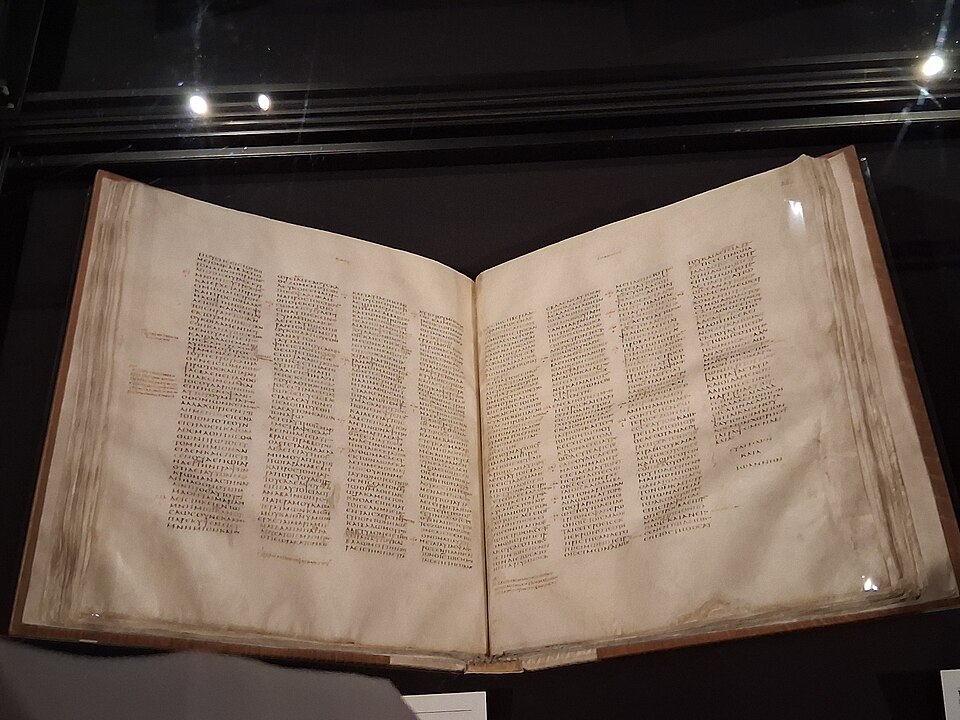

Four parchment codices from the fourth and fifth centuries occupy a central position in biblical textual study because they are the oldest surviving manuscripts containing large continuous portions of the Bible in Greek. Their readings carry particular weight in establishing the text, and their agreements and disagreements form the backbone of modern critical editions.1, 5
Codex Sinaiticus (ℵ), discovered by Constantin von Tischendorf at the Monastery of Saint Catherine on the Sinai Peninsula in the 1840s and 1850s, is dated to the mid-fourth century CE. It originally contained the entire Greek Bible — Old and New Testaments — along with the Epistle of Barnabas and the Shepherd of Hermas. It is the oldest manuscript to contain a complete New Testament. The codex is now divided among four institutions: the British Library (the largest portion), the Leipzig University Library, the National Library of Russia in Saint Petersburg, and the Monastery of Saint Catherine. A collaborative digitization project has made the entire manuscript available online.6
Codex Vaticanus (B), held in the Vatican Library since at least the fifteenth century, is dated to the early-to-mid fourth century and may be slightly older than Sinaiticus. It originally contained the entire Greek Bible, though portions are now missing: most of Genesis, a section of 2 Samuel, about thirty Psalms, and the end of the New Testament from Hebrews 9:14 onward (including 1 and 2 Timothy, Titus, Philemon, and Revelation). The manuscript's New Testament text is closely related to that of the early papyrus P75, placing it within the oldest recoverable strand of the textual tradition.7, 8
Codex Alexandrinus (A), dating to the fifth century, was brought to England in 1627 as a gift from the Patriarch of Constantinople to King Charles I. It contains most of the Old Testament and nearly all of the New Testament, with some pages lost from Matthew, John, and 2 Corinthians. It also includes 1 and 2 Clement, early Christian writings not found in most later manuscripts. It is housed in the British Library.2
Codex Ephraemi Rescriptus (C), a fifth-century palimpsest in the Bibliothèque nationale de France in Paris, is a manuscript that was erased in the twelfth century and overwritten with the Greek text of sermons by Ephrem the Syrian. The original biblical text, partially recoverable through chemical treatment and ultraviolet photography, preserves portions of every New Testament book except 2 Thessalonians and 2 John.1, 2
The four great uncial codices1, 6, 7
| Codex | Designation | Date | Contents | Current location |
|---|---|---|---|---|
| Sinaiticus | ℵ | Mid-4th century CE | Complete NT; most of OT; Barnabas; Shepherd of Hermas | British Library (primary); also Leipzig, St. Petersburg, Sinai |
| Vaticanus | B | Early-to-mid 4th century CE | Most of OT and NT (missing end of Hebrews through Revelation) | Vatican Library, Rome |
| Alexandrinus | A | 5th century CE | Nearly complete OT and NT; 1–2 Clement | British Library, London |
| Ephraemi Rescriptus | C | 5th century CE | Portions of OT and NT (palimpsest, partially recoverable) | Bibliothèque nationale de France, Paris |
How the text was transmitted
Before the invention of the printing press in the fifteenth century, every copy of every biblical book was produced by hand. A scribe would work from an exemplar — an existing manuscript — and copy its text onto a fresh writing surface, whether papyrus, parchment, or (in rare cases) pottery or metal. Each act of copying introduced the possibility of change. Some changes were unintentional: the scribe's eye might skip from one line to a similar line below (homoeoteleuton, meaning "same ending"), omitting the intervening text; a scribe might accidentally repeat a word or line (dittography); or a scribe listening to a text being read aloud might confuse similar-sounding words (itacism, common in Greek where several vowels came to be pronounced alike).1, 12
Other changes were deliberate. A scribe might correct what appeared to be an error in the exemplar, smooth out a grammatically awkward phrase, harmonize one Gospel passage with the parallel account in another Gospel, or add a marginal note that a later copyist would incorporate into the body of the text. In some cases, scribes made changes that reflect theological concerns — adjusting a passage to align more clearly with doctrinal positions that had developed after the text was originally composed.11
The process of Hebrew Bible transmission followed a somewhat different trajectory. After the destruction of the Second Temple in 70 CE, the rabbinic movement gradually standardized the Hebrew text, and by the second century CE a consonantal text very close to the later Masoretic text had become dominant. Between the sixth and tenth centuries CE, a group of Jewish scribes and scholars known as the Masoretes added vowel points, cantillation marks, and marginal notes (Masorah) to the consonantal text, producing the Masoretic text that serves as the basis for printed Hebrew Bibles and most modern Old Testament translations.10, 18 The Dead Sea Scrolls, which predate this standardization by centuries, preserve evidence of the earlier textual diversity that the Masoretic process eventually supplanted.15, 19
For the New Testament, no comparable standardization occurred in the early centuries. Different regions of the Roman Empire and its successor states developed their own textual traditions as manuscripts were copied locally. The manuscripts circulating in Alexandria tended to share certain readings, as did manuscripts from Constantinople, from the Latin West, and from the Syriac-speaking East. These regional groupings, sometimes called text-types, are an imperfect but useful framework for understanding the diversity of the manuscript tradition.1, 14
Scribal practices and manuscript production
The physical characteristics of surviving manuscripts reveal a great deal about how they were produced and by whom. Early New Testament manuscripts were written on papyrus in a single-column format with minimal punctuation and no spaces between words — a convention known as scriptio continua. The reader was expected to parse the text into words and sentences during the act of reading. This practice occasionally led to ambiguities that different scribes resolved differently, producing variant readings.12, 17
The shift from papyrus scrolls to parchment codices (bound books) occurred during the second through fourth centuries CE. Christian communities adopted the codex format earlier and more thoroughly than their pagan contemporaries. The overwhelming majority of early Christian manuscripts, including the earliest New Testament papyri, are in codex form rather than scroll form — a distinction that has been noted as a marker of Christian book production practices in the Roman world.8, 12
The Masoretic scribes who transmitted the Hebrew Bible developed elaborate quality-control measures. They counted the letters, words, and verses of each book, identified the middle letter and middle word, and recorded these statistics in marginal and final notes. They also noted where the written text (Ketiv) differed from the reading tradition (Qere) — places where the consonantal text was preserved unchanged but a different word was to be read aloud during synagogue recitation. These Ketiv-Qere notations preserve evidence of variant readings and scribal traditions that might otherwise have been lost.10, 9
The Dead Sea Scrolls reveal a more varied picture of scribal practice in the Second Temple period. Some scrolls follow careful scribal conventions with consistent spelling and formatting, while others show evidence of informal or private copying — inconsistent spelling, corrections made by different hands, and textual features that suggest the scribe was working from memory rather than from an exemplar.19
Textual plurality before standardization
One of the most significant findings from the Dead Sea Scrolls is that the Hebrew Bible existed in multiple textual forms during the Second Temple period. Before the discoveries at Qumran, the dominant assumption was that a single authoritative Hebrew text had been transmitted with high fidelity from an early date. The scrolls revealed instead that scribes in the last centuries BCE and the first century CE were copying texts that differed from one another in ways that cannot be explained by ordinary copying error alone. Different manuscripts of the same book sometimes reflect genuinely different editions of the text.4, 15
The evidence is clearest in the book of Jeremiah. The Masoretic text of Jeremiah contains approximately 3,100 more words than the Septuagint translation, and the order of the chapters differs substantially: the oracles against the nations, which appear at the end of the book in the Masoretic text (chapters 46–51), are placed after 25:13 in the Septuagint. A Hebrew Jeremiah manuscript from Qumran cave 4 (4QJerb) preserves a text whose length and arrangement match the shorter Septuagint form, confirming that the Septuagint translators were working from a genuinely different Hebrew text, not abbreviating or rearranging the text that later became standard.15, 20
The book of Samuel presents a similar picture. At Qumran, a large Samuel scroll (4QSama) preserves readings that agree with the Septuagint against the Masoretic text in numerous places. In the Masoretic text, Goliath's height is given as "six cubits and a span" (approximately 2.9 metres or 9 feet 6 inches); the Septuagint gives "four cubits and a span" (approximately 2.0 metres or 6 feet 6 inches); and 4QSama agrees with the Septuagint reading.4, 18 The Masoretic text of 1 Samuel 17–18 also contains approximately 40 percent more material than the Septuagint version of the same chapters, including 1 Samuel 17:12–31 and 17:55–18:5, passages that introduce David to Saul as though for the first time despite an earlier introduction in 16:14–23. The Septuagint text, which lacks these passages, presents a narrative without this duplication.18, 16
This textual plurality was not limited to a few books. The Qumran scrolls preserve texts of Isaiah, Psalms, Exodus, Numbers, and other books that show varying degrees of agreement and disagreement with the Masoretic text. Some scrolls are virtually identical to the Masoretic text; others reflect a text closer to the Septuagint's Hebrew source; and still others appear to represent a third textual tradition that matches neither. The picture that emerges is one of genuine diversity — multiple forms of the text circulating simultaneously in Jewish communities before the process of standardization that produced the Masoretic text.4, 15, 19
Where manuscripts disagree
Textual variants — places where manuscripts differ from one another — number in the hundreds of thousands across the full manuscript tradition. The vast majority are trivial: differences in spelling (such as the movable nu in Greek), word order (which is relatively free in Greek), and the presence or absence of the definite article. These variants affect no point of meaning and are of interest primarily to paleographers and linguists.1, 14
A smaller but significant number of variants affect the meaning of the text. These include the omission or addition of entire verses and passages; the substitution of one word or phrase for another in ways that change the theological or narrative content; and differences between parallel accounts in different manuscripts that either increase or decrease the harmonization between the accounts.13, 11
Among the most substantial New Testament variants are the longer ending of the Gospel of Mark (16:9–20), absent from Codex Sinaiticus and Codex Vaticanus; the story of the woman caught in adultery (John 7:53–8:11), absent from the earliest papyri and great uncials; and the Johannine Comma (1 John 5:7–8), an explicit Trinitarian formula absent from every known Greek manuscript before the sixteenth century. Each of these passages is found in many later manuscripts and in some modern translations, but is absent from the oldest surviving witnesses. These cases are examined in detail in the article on later additions.13, 1
Other variants are smaller in scale but significant in content. In Luke 2:33, some manuscripts read "his father and his mother marveled at what was said about him," while others read "Joseph and his mother marveled" — a change that appears to protect the doctrine of the virgin birth by avoiding the implication that Joseph was Jesus' father. In Luke 3:22, some manuscripts record the voice at Jesus' baptism saying "You are my Son, the Beloved; with you I am well pleased" (echoing Psalm 2:7 and Isaiah 42:1), while the Western text represented by Codex Bezae reads "You are my Son; today I have begotten you" (quoting Psalm 2:7 alone) — a reading that could be understood as an adoptionist Christology, the view that Jesus became God's Son at his baptism rather than being so from birth.11, 13 These and other variants are examined in the article on textual variants.
The practice of textual criticism
Textual criticism is the discipline concerned with identifying and evaluating variants across the manuscript tradition in order to reconstruct the earliest recoverable form of a text. For the Bible, this discipline draws on two types of evidence: external evidence (which manuscripts attest which reading, how old those manuscripts are, and how geographically diverse the attestation is) and internal evidence (which reading best explains the origin of the other readings, given what is known about scribal habits, theological motivations, and the author's style).1, 14
A basic principle of textual criticism is that the reading that best explains the origin of the other readings is likely the earliest. If a passage exists in two forms — one theologically difficult and one that resolves the difficulty — the more difficult reading (lectio difficilior) is often considered earlier, on the principle that scribes were more likely to smooth over difficulties than to create them. Similarly, the shorter reading (lectio brevior) is often preferred in the New Testament, because scribes were more likely to add clarifying material than to delete existing text — though this principle has exceptions and is applied with caution.13, 1
For the Hebrew Bible, textual criticism must contend with a more complex situation. The Masoretic text represents a single standardized tradition, but the Dead Sea Scrolls and the Septuagint preserve evidence of earlier textual forms that sometimes differ not just in wording but in the scope and arrangement of the content. In cases like Jeremiah, where the Septuagint and Masoretic text represent genuinely different editions, textual criticism cannot simply choose between readings — it must account for the coexistence of two legitimate literary editions of the same book.18, 15
The results of textual criticism are recorded in critical apparatuses — the footnotes printed beneath the text in scholarly editions. The apparatus of the Nestle-Aland 28th edition, for example, records significant variants at each point of disagreement, listing the manuscripts that support each reading. The apparatus of the Biblia Hebraica Stuttgartensia does the same for the Hebrew Bible, noting where the Dead Sea Scrolls, Septuagint, and other witnesses differ from the Masoretic text.5, 9
Timeline of the manuscript evidence
The physical evidence for the biblical text spans approximately two millennia. The following timeline presents the major categories of witnesses in chronological order, illustrating the distribution of evidence across time and the gap between the estimated composition dates of the biblical books and their earliest surviving manuscript witnesses.1, 10, 18
Major witnesses to the biblical text by date1, 3, 10
| Witness | Date range | Content | Writing material |
|---|---|---|---|
| Dead Sea Scrolls (biblical) | c. 250 BCE – 68 CE | All OT books except Esther; multiple copies of many books | Parchment and papyrus scrolls |
| Septuagint fragments (Ry 458, etc.) | 2nd century BCE | Fragments of Deuteronomy and other books in Greek translation | Papyrus |
| New Testament papyri (P52, P66, P75, etc.) | c. 125 – 300 CE | Fragments and partial copies of NT books (primarily Gospels, Paul) | Papyrus codices |
| Great uncial codices (ℵ, B, A, C) | 4th – 5th century CE | Complete or near-complete Greek Bibles | Parchment codices |
| Early translations (Old Latin, Syriac Peshitta, Coptic) | 2nd – 5th century CE | Complete or partial Bibles in translation | Parchment and papyrus |
| Latin Vulgate manuscripts | 5th century CE onward | Jerome’s Latin translation; became the standard Western Bible | Parchment codices |
| Greek minuscules and lectionaries | 9th – 16th century CE | NT in cursive Greek script; liturgical excerpts | Parchment and paper |
| Masoretic codices (Aleppo, Leningrad) | 10th – 11th century CE | Complete Hebrew Bible with vowels and cantillation | Parchment codices |
The table illustrates two features of the manuscript evidence. First, the earliest witnesses are fragmentary — scraps of papyrus preserving a few verses or chapters — while the earliest complete or near-complete Bibles date to the fourth century CE for the New Testament and the tenth century CE for the Hebrew Bible. Second, the evidence is not evenly distributed across the biblical books. Some books, such as the Psalms and Isaiah, are attested by numerous Dead Sea Scroll fragments and multiple early papyri. Others, such as Esther and some of the Minor Prophets, have sparse early attestation.3, 4
What the manuscript evidence preserves
The manuscript tradition of the Bible is not a single chain of copying from a single original to a single received text. It is a branching, converging, and sometimes cross-contaminating tradition in which different communities, in different times and places, transmitted the text according to their own conventions, correcting it against other copies when available and occasionally introducing changes — both intentional and accidental — that were then transmitted to subsequent generations of copies.12, 14
For the Hebrew Bible, the Dead Sea Scrolls demonstrate that the text existed in multiple literary editions during the Second Temple period. The process by which one of these editions — the proto-Masoretic text — became the standard is not fully documented in the surviving evidence, but the result is clear: by the second century CE, the consonantal text that would become the Masoretic text had achieved a dominant position in Jewish communities, and the Masoretes of the sixth through tenth centuries preserved and annotated it with extraordinary care.18, 10
For the New Testament, the picture is one of greater ongoing diversity. No single standardizing authority governed the text in the early centuries, and the manuscript tradition continued to develop — with new variants arising and old ones being corrected, harmonized, or replaced — until the invention of printing fixed the text in a particular form. The Textus Receptus, the printed Greek text that dominated from the sixteenth through the nineteenth centuries, was based primarily on a handful of late medieval minuscule manuscripts. Modern critical editions, drawing on the full range of papyri, uncials, and early versions, frequently differ from the Textus Receptus in readings both large and small.1, 5
The physical manuscripts are themselves historical artifacts — evidence not only of what the text said but of how it was used, who copied it, and what they considered important enough to preserve, correct, or supplement. The corrections visible in many manuscripts (including multiple correcting hands in Codex Sinaiticus, each from a different period) record a history of scribal engagement with the text that spans centuries within a single physical object.6 The manuscripts do not transmit a single static text. They preserve a record of a living textual tradition — its stability, its variation, and its development across more than two thousand years of continuous copying and use.
References
The Dead Sea Scrolls Bible: The Oldest Known Bible Translated for the First Time into English
The Text of the New Testament in Contemporary Research: Essays on the Status Quaestionis