Overview
- The New Testament is preserved in approximately 5,900 Greek manuscripts ranging from small papyrus fragments dated as early as the second century to complete parchment codices of the fourth century and later, making it the most extensively attested text from the ancient Mediterranean world.
- These manuscripts are classified into three principal categories by writing material and script: papyri (written on papyrus, mostly fragmentary, dating from the second through eighth centuries), uncials or majuscules (written in capital letters on parchment, dating from the third through tenth centuries), and minuscules (written in cursive lowercase script on parchment, dating from the ninth through sixteenth centuries).
- No two manuscripts are identical in their text; the surviving witnesses contain an estimated 300,000 to 400,000 individual textual variations, ranging from single-letter spelling differences to entire passages present in some manuscripts and absent from others.
The text of the New Testament has reached the modern world through a vast manuscript tradition. Approximately 5,900 Greek manuscripts containing portions of the New Testament have been catalogued by the Institut für Neutestamentliche Textforschung in Münster, Germany, which maintains the official registry of all known witnesses.17 These manuscripts range from small papyrus fragments preserving a few verses of a single book to massive parchment codices containing the entire New Testament alongside other texts. The earliest fragments date to the second century CE; the latest manuscripts predate the invention of movable-type printing in the mid-fifteenth century. In addition to the Greek witnesses, the New Testament survives in approximately 10,000 Latin manuscripts, as well as manuscripts in Syriac, Coptic, Armenian, Georgian, Ethiopic, and other ancient languages, bringing the total number of manuscript witnesses into the tens of thousands.1
No two of these manuscripts contain exactly the same text. The surviving witnesses preserve an estimated 300,000 to 400,000 individual points of variation, a figure that exceeds the total number of words in the New Testament itself (approximately 138,000 in Greek).1, 14 The vast majority of these variants involve spelling differences, word-order transpositions, and other minor discrepancies that do not affect meaning. A smaller but significant subset involves wording differences that alter the sense of individual passages, and a handful involve entire passages present in some manuscripts and absent from others. This article examines the categories, dates, and characteristics of the Greek manuscript witnesses that form the basis for modern critical editions of the New Testament.
The classification system
New Testament manuscripts are catalogued using a system maintained by the Münster institute. Each manuscript receives a unique identifier based on its type. Papyri are designated with a Gothic P followed by a superscript number (e.g., P52, P66, P75). Uncial manuscripts — those written in capital letters — are designated either by a number preceded by zero (e.g., 01, 02, 03) or by a traditional letter symbol (e.g., the Hebrew letter aleph for Codex Sinaiticus, B for Codex Vaticanus). Minuscule manuscripts, written in cursive lowercase script, are designated by plain Arabic numerals (e.g., 33, 1739, 2427). Lectionaries — manuscripts arranged not by biblical book but by the liturgical reading schedule — receive a lowercase ell followed by a number.3, 17
As of the most recent catalogue totals, the Greek New Testament manuscript tradition comprises approximately 140 papyri, 323 uncials, 2,951 minuscules, and approximately 2,500 lectionaries.17 The distribution of these manuscripts across time is heavily weighted toward the later centuries: the overwhelming majority of surviving witnesses date to after the ninth century. Manuscripts from the first four centuries of the Christian era number in the dozens rather than the thousands, and the number of witnesses to any individual New Testament book before the year 300 CE can often be counted on one hand.
The papyri
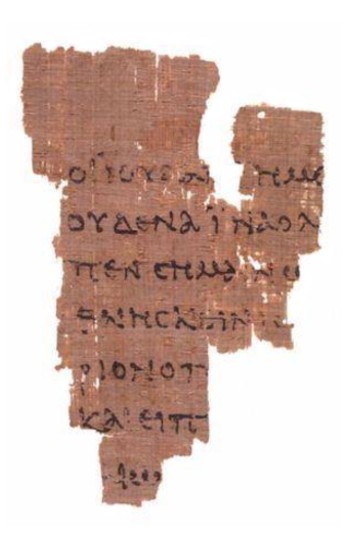

The earliest surviving New Testament manuscripts are written on papyrus, the plant-based writing material of the ancient Mediterranean. Papyrus is fragile and degrades in moist environments; nearly all surviving New Testament papyri come from the dry climate of Egypt, where conditions permitted preservation over millennia.1, 24 The papyri are the most important witnesses for reconstructing the earliest recoverable form of the New Testament text, because they predate the great parchment codices by one to two centuries.
The manuscript designated P52 (Papyrus Rylands Greek 457), housed at the John Rylands Library in Manchester, England, is a small fragment measuring approximately 6 by 9 centimetres. It contains portions of the Gospel of John 18:31–33 on the recto and 18:37–38 on the verso. When C. H. Roberts first published the fragment in 1936, he assigned it a date in the first half of the second century on the basis of its handwriting, making it the oldest known manuscript of any New Testament text.5 Subsequent paleographic analysis has proposed a broader range, and Brent Nongbri has argued that the handwriting is consistent with dates anywhere from the late first century to the early or mid-third century, since paleographic dating of literary papyri to within fifty years is rarely possible on the basis of script alone.6 The fragment's small size means it preserves too little text to reveal much about the character of the larger manuscript from which it came, but it does confirm that the Gospel of John was circulating in Egypt by at least the second or early third century.
Among the most substantial early papyri are the Chester Beatty Papyri and the Bodmer Papyri, two collections that transformed understanding of the early New Testament text when they became available for study in the twentieth century. P45 (Chester Beatty I), dated to the early to mid-third century, preserves portions of all four Gospels and the Acts of the Apostles in a single codex — the earliest known manuscript to contain multiple Gospels together.13 P46 (Chester Beatty II), dated to approximately 200 CE, is the earliest substantial witness to the Pauline epistles, preserving large portions of Romans, Hebrews, 1 and 2 Corinthians, Ephesians, Galatians, Philippians, Colossians, and 1 Thessalonians. The order of books in P46 differs from the order found in later manuscripts: Hebrews is placed immediately after Romans rather than at the end of the Pauline corpus, and the Pastoral Epistles (1 Timothy, 2 Timothy, Titus) are absent entirely, though whether this is because they were not included or because the final pages of the codex are lost remains debated.13
P66 (Papyrus Bodmer II), dated to approximately 200 CE, preserves much of the Gospel of John and is one of the most extensively studied early papyri.23 P75 (Papyrus Bodmer XIV–XV), dated to the early third century, preserves substantial portions of Luke and John and is significant because its text aligns closely with that of Codex Vaticanus (B), a fourth-century manuscript, demonstrating that the text type represented by Vaticanus extends back at least to the early third century.12, 7
Study of the scribal habits visible in the early papyri has revealed systematic patterns of copying error. An analysis of the major early papyri found that scribes tended to omit text more often than they added it — a pattern that runs counter to the general trend visible in the later manuscript tradition, where texts tend to grow longer over time through the accumulation of additions, harmonizations, and glosses.22
The great uncial codices
.jpg)
.jpg)
The most important complete or near-complete manuscripts of the New Testament are the great uncial codices of the fourth and fifth centuries. These are large parchment books written in majuscule (capital letter) script, and they provide the earliest continuous witnesses to the full New Testament text.
Codex Sinaiticus (designated by the Hebrew letter aleph, or 01) dates to the mid-fourth century and originally contained the entire Christian Bible in Greek, including the Old Testament in the Septuagint version and the full New Testament. It also includes two early Christian texts not part of the later canon: the Epistle of Barnabas and the Shepherd of Hermas. The manuscript was discovered at the Monastery of Saint Catherine on the Sinai Peninsula in stages during the nineteenth century. The bulk of it is now housed at the British Library in London, with portions at the University of Leipzig, the National Library of Russia in Saint Petersburg, and the Sinai monastery itself.8 In the New Testament, Codex Sinaiticus lacks certain passages found in later manuscripts. The Gospel of Mark ends at 16:8, without verses 9–20. The passage known as the Pericope Adulterae (John 7:53–8:11) is absent. The text of 1 John 5:7–8 does not contain the Trinitarian formula (the Comma Johanneum).8, 16
Codex Vaticanus (B, or 03) also dates to the mid-fourth century and has been in the Vatican Library since at least 1475. It originally contained the entire Greek Bible, though portions have been lost: in the New Testament, everything after Hebrews 9:14 is missing, including the Pastoral Epistles, Philemon, and Revelation. Like Sinaiticus, Vaticanus lacks Mark 16:9–20 and John 7:53–8:11. The scribe of Vaticanus left a curious space between the end of Mark 16:8 and the beginning of Luke — a blank column unusual in the manuscript — which has been interpreted as evidence that the scribe was aware of additional material attributed to Mark but chose not to include it.9 Vaticanus and Sinaiticus frequently agree against later manuscripts, and together they form the foundation of modern critical texts of the New Testament.15
Codex Alexandrinus (A, or 02), dating to the fifth century, is housed at the British Library. It contains most of the Greek Bible including nearly the complete New Testament. Unlike Sinaiticus and Vaticanus, Alexandrinus includes Mark 16:9–20. Its text of the Gospels represents a different text type from Sinaiticus and Vaticanus, aligning more closely with the form of text that later became dominant in the Byzantine manuscript tradition.11, 1
Codex Bezae (D, or 05), a fifth-century bilingual Greek-Latin manuscript housed at Cambridge University Library, presents a text that diverges substantially from both the Sinaiticus-Vaticanus text and the later Byzantine text. In the Gospels and Acts, Codex Bezae frequently contains material absent from other witnesses, omits material present in them, and paraphrases where they copy verbatim. The text of Acts in Bezae is approximately 8.5 percent longer than in the other major manuscripts, containing additional narrative details, speeches, and geographical references not found elsewhere.10
Codex Washingtonianus (W, or 032), a late fourth- or early fifth-century manuscript held at the Smithsonian Institution, contains the four Gospels in the Western order (Matthew, John, Luke, Mark). Its text displays a remarkable feature: it shifts between text types from one section to another, suggesting it was copied from multiple exemplars. In the Gospel of Mark, between 16:14 and 16:15, it contains an interpolation known as the Freer Logion — a passage found in no other surviving Greek manuscript — in which the disciples respond to the risen Jesus by blaming "this age of lawlessness and unbelief" and Jesus replies with a prophecy about Satan's power being ended.19
The minuscule manuscripts
Beginning in the ninth century, Greek scribes transitioned from the uncial (majuscule) script used in the great codices to a cursive lowercase hand known as minuscule. This shift was driven by practical considerations: minuscule script is faster to write, more compact, and uses less expensive parchment per page. The vast majority of surviving New Testament manuscripts — approximately 2,951 of the catalogued total — are written in minuscule script, and most date from the tenth through fifteenth centuries.3, 17
Because the minuscule manuscripts were copied during centuries when the Byzantine Empire was the primary custodian of Greek literary culture, most of them reflect the text type that had become standard in the Byzantine church by the medieval period. This Byzantine or Majority Text is characterized by smooth, full readings that appear to harmonize parallel passages, fill out abbreviated expressions, and resolve ambiguities present in earlier witnesses.20 The Byzantine text formed the basis of the first printed Greek New Testaments, including the editions of Erasmus (1516) and the later Textus Receptus that underlies the King James Version of 1611.1
A small number of minuscule manuscripts preserve texts that diverge from the Byzantine standard and align instead with the older text represented by the papyri and great uncials. Minuscule 33, a ninth-century manuscript, carries a text so close to Vaticanus in the Gospels that it has been called "the queen of the cursives." Minuscule 1739, a tenth-century manuscript of the Pauline epistles and Catholic epistles, was copied from an exemplar whose text dates to the fourth century or earlier, based on annotations in its margins referencing early church writers including Origen and Clement of Alexandria. These manuscripts demonstrate that older text forms continued to be transmitted alongside the increasingly dominant Byzantine text throughout the medieval period.1, 3
Text types and manuscript groupings
Since the late nineteenth century, manuscripts have been grouped by shared patterns of readings into families or text types. The classification system that emerged from the work of B. F. Westcott and F. J. A. Hort in 1881, subsequently refined by later generations of editors, recognizes several principal groupings.15
The Alexandrian text (also called the "Neutral" text by Westcott and Hort) is represented by the great fourth-century codices Sinaiticus and Vaticanus, by early papyri such as P75 and P66, and by the Coptic versions. It tends to present shorter, more austere readings and is widely regarded in modern textual criticism as preserving the earliest recoverable form of the text for most New Testament books.15, 1
The Western text is represented primarily by Codex Bezae (D), certain Old Latin manuscripts, and the quotations of early Latin church fathers. Its defining characteristics are paraphrase, expansion, and rearrangement. In the Acts of the Apostles, the Western text is approximately 8.5 percent longer than the Alexandrian text, with additions that include names, topographical details, and narrative amplifications absent from the other tradition. Whether the Western text represents an early, uncontrolled form of transmission or a deliberate editorial revision remains a subject of ongoing analysis.10
The Byzantine text (also called the Majority Text or Koine text) is the form of the New Testament found in the overwhelming majority of surviving manuscripts. It is characterized by conflation of readings (combining elements from two variant readings into a single longer reading), harmonization of parallel passages, and grammatical smoothing. No papyrus manuscript and no uncial manuscript earlier than the fifth century presents a purely Byzantine text, a pattern that Westcott and Hort cited as evidence that the Byzantine text is a later development rather than the original form.15, 20 Defenders of the Byzantine text have countered that the absence of early Byzantine witnesses may reflect the accidents of survival rather than the lateness of the text type, since the humid climates of Constantinople and the broader Byzantine world were unfavorable to manuscript preservation compared with the dry climate of Egypt.20
The Caesarean text, identified in certain manuscripts of the Gospels (including minuscule family 1, family 13, and portions of Codex Washingtonianus), was proposed as an intermediate type between the Alexandrian and Western texts. Its existence as a distinct, coherent text type has been questioned, and recent analyses have treated the relevant manuscripts as witnesses to mixed or transitional texts rather than to a unified Caesarean archetype.1, 2
Distribution and survival patterns
The distribution of surviving manuscripts across time is sharply asymmetric. The following table presents approximate counts of Greek New Testament manuscripts by century of origin, drawn from the Münster institute's catalogue data.
Greek New Testament manuscripts by approximate date17, 1
| Century | Papyri | Uncials | Minuscules | Approximate total |
|---|---|---|---|---|
| 2nd | 2–4 | 0 | 0 | 2–4 |
| 3rd | ~30 | 1 | 0 | ~31 |
| 4th | ~14 | ~15 | 0 | ~29 |
| 5th | ~8 | ~30 | 0 | ~38 |
| 6th | ~7 | ~35 | 0 | ~42 |
| 7th | ~8 | ~20 | 0 | ~28 |
| 8th | ~5 | ~30 | 0 | ~35 |
| 9th | 0 | ~60 | ~100 | ~160 |
| 10th–15th | 0 | ~130 | ~2,850 | ~2,980 |
Several factors account for this distribution. Papyrus is perishable outside arid environments, meaning that papyrus manuscripts could survive only where they were buried in dry sand or stored in the desert climate of Upper Egypt. Parchment is more durable but still subject to deterioration over centuries, and manuscripts that were in continuous liturgical use were eventually worn out and replaced. The shift from scroll to codex format in the early Christian centuries, the transition from papyrus to parchment beginning in the fourth century, and the later transition from uncial to minuscule script each created a context in which older manuscripts were superseded by newer copies and allowed to deteriorate.1, 24 The geographic concentration of early witnesses in Egypt reflects not necessarily the importance of Egypt in early Christianity but the unique suitability of its climate for manuscript preservation.
Relative proportion of manuscript types17
Scribal practices and sources of variation
Every manuscript of the New Testament was produced by hand, and every act of hand-copying introduced the possibility of error. The types of variation that accumulated during the centuries of manual transmission fall into two broad categories: unintentional errors and deliberate changes.1, 22
Unintentional errors include visual mistakes, in which a scribe misread a letter or word in the exemplar (the manuscript being copied), and aural mistakes, in which a scribe writing from dictation misheard a word. A common visual error was homoioteleuton (similar ending), in which a scribe's eye skipped from one line to another line ending with the same word or letter sequence, omitting everything in between. The reverse error, dittography, occurred when a scribe inadvertently copied the same passage twice. In Greek, where many grammatical endings sound alike (a phenomenon called itacism), aural confusion between vowels such as eta (η) and iota (ι), or omicron-iota (οι) and upsilon (υ), produced frequent spelling variants that are trivial in meaning but pervasive in the manuscript record.22
Deliberate changes by scribes include harmonization, in which a passage in one Gospel was modified to match the parallel passage in another Gospel; clarification, in which a scribe added a word or phrase to resolve a perceived ambiguity; and theological correction, in which a scribe altered a passage to bring it into conformity with developing doctrinal positions. An analysis of theologically motivated scribal changes has documented instances in which scribes modified texts touching on Christology (the nature of Christ), the role of women, anti-Jewish polemic, and the relationship between the divine and human in Jesus.14 For example, in Luke 2:33, early manuscripts read "his father and his mother marveled" (ho patēr autou kai hē mētēr), while later manuscripts change "his father" to "Joseph," apparently to avoid any implication that Joseph was the biological father of Jesus.14, 16
The study of individual scribal habits in the early papyri has shown that different scribes exhibited different tendencies. Some scribes were careful and produced relatively few errors; others were prone to frequent omissions, transpositions, or harmonizations. P66, for instance, contains numerous corrections in the hand of the original scribe, suggesting that the copyist reviewed and attempted to correct the manuscript after the initial transcription, yet the manuscript still contains a high density of singular readings (readings found in no other surviving manuscript).22, 23
Critical editions and the reconstructed text
A critical edition of the New Testament is a printed Greek text that attempts to reconstruct the earliest recoverable wording by evaluating the manuscript evidence at each point of variation. The two standard critical editions in use are the Nestle-Aland Novum Testamentum Graece (now in its 28th edition, abbreviated NA28) and the United Bible Societies Greek New Testament (5th edition, abbreviated UBS5). These two editions present the same Greek text but differ in their critical apparatus: NA28 records a larger number of variants, while UBS5 focuses on variants judged to be significant for translators.4, 18
The method used to reconstruct the text is known as reasoned eclecticism, which weighs both external evidence (the age, quality, and geographic distribution of the manuscripts supporting a reading) and internal evidence (which reading best explains the origin of the others, based on scribal tendencies and the author's known style). When manuscripts disagree, the editors evaluate the variant readings and select the one judged most likely to be original. The rejected readings are recorded in the critical apparatus at the bottom of the page, along with the manuscript witnesses supporting each variant.1, 4
The Editio Critica Maior (ECM), an ongoing project of the Münster institute, represents the most comprehensive critical edition ever attempted, presenting a fuller range of manuscript evidence than either NA28 or UBS5. Volumes covering the Catholic Epistles (James, 1–2 Peter, 1–3 John, Jude), Acts, and Mark have been published or are in preparation, and the project employs the Coherence-Based Genealogical Method (CBGM), a computational approach that analyzes the genealogical relationships among manuscripts on a passage-by-passage basis rather than assigning each manuscript to a single text type.21
The reconstructed text produced by critical editions is not identical to any single surviving manuscript. It is a composite, drawing readings from different manuscripts at different points in the text. At some points in the New Testament, the editors of NA28 and UBS5 have judged the evidence to be so evenly balanced that they print the favored reading in the text but enclose it in single or double brackets to indicate uncertainty. The double-bracketed passages include the longer ending of Mark (16:9–20) and the Pericope Adulterae (John 7:53–8:11), which are printed in the text of NA28 within double brackets to indicate that they are regarded as secondary additions to the text even though they have been part of the received text for centuries.4, 16
Major manuscripts compared
The following table summarizes the key features of the principal Greek manuscripts discussed in this article. Where a manuscript lacks a passage that appears in the majority of later manuscripts, the absence is noted.
Principal Greek New Testament manuscripts8, 9, 10, 11, 13
| Manuscript | Date | Material | Contents (NT) | Mark 16:9–20 | John 7:53–8:11 |
|---|---|---|---|---|---|
| P52 | c. 125–250 CE | Papyrus | John 18 (fragment) | N/A | N/A |
| P46 | c. 175–225 CE | Papyrus | Pauline epistles (partial) | N/A | N/A |
| P66 | c. 200 CE | Papyrus | Gospel of John (most) | N/A | Absent |
| P75 | c. 200–225 CE | Papyrus | Luke & John (partial) | N/A | Absent |
| P45 | c. 200–250 CE | Papyrus | Gospels & Acts (partial) | N/A (Mark portion fragmentary) | N/A |
| Sinaiticus (01) | c. 340–360 CE | Parchment | Complete NT + Barnabas, Hermas | Absent | Absent |
| Vaticanus (03) | c. 325–350 CE | Parchment | NT to Hebrews 9:14 | Absent | Absent |
| Alexandrinus (02) | c. 400–440 CE | Parchment | Nearly complete NT | Present | Absent |
| Bezae (05) | c. 400–450 CE | Parchment | Gospels & Acts (Greek-Latin) | Present | Absent |
| Washingtonianus (032) | c. 375–450 CE | Parchment | Four Gospels | Present (with Freer Logion) | Absent |
The table illustrates a consistent pattern: the earliest substantial manuscripts of the Gospels and Acts (P66, P75, Sinaiticus, Vaticanus) lack the longer ending of Mark and the Pericope Adulterae. Both passages first appear in manuscripts dating to the late fourth and fifth centuries. The textual evidence bearing on these and other later additions is examined in a separate article.
The versional and patristic evidence
The Greek manuscripts do not exist in isolation. The New Testament was translated into other languages from a very early date, and these translations — called "versions" — provide indirect evidence for the Greek text that underlies them. The earliest translations include the Old Latin (second century), the Old Syriac (second to third century), and the Coptic versions in the Sahidic and Bohairic dialects (third to fourth century).1, 2 Later translations include the Vulgate (Jerome's Latin translation, completed c. 405 CE), the Peshitta (the standard Syriac version), the Armenian, the Georgian, and the Ethiopic. Each translation reflects the Greek manuscript or manuscripts from which it was made, and where a version agrees with a particular Greek reading, it provides a witness to that reading's existence at the time and place of translation.
The quotations of the New Testament found in the writings of early church fathers provide a further line of evidence. Authors such as Clement of Alexandria (c. 150–215 CE), Origen (c. 185–254 CE), Eusebius of Caesarea (c. 260–339 CE), and Jerome (c. 347–420 CE) quoted New Testament passages extensively in their theological works. These quotations can be compared with the surviving manuscripts to determine what form of the text each author was using. Origen, for instance, is known to have worked with manuscripts containing different readings and sometimes commented explicitly on the variation he observed, making his writings a valuable witness to the state of the text in the early third century.1, 7
Patristic evidence must be used with caution, however. Church fathers often quoted from memory rather than from a manuscript open before them, and their quotations may reflect their own paraphrasing, conflation of parallel passages, or adaptation to the rhetorical context. The text of patristic writings is itself subject to manuscript transmission, meaning that the quotations preserved in later copies of a church father's work may have been altered by scribes to match the form of the biblical text current at the time of copying.2
Comparison with other ancient texts
The manuscript tradition of the New Testament is often compared with that of other texts from the ancient Mediterranean to contextualize its scale. The works of classical authors survive in far fewer manuscripts, and the gap between the date of composition and the oldest surviving manuscript is typically measured in centuries. The following table presents selected comparisons.
Manuscript traditions of selected ancient texts1, 7
| Text | Date of composition | Oldest surviving manuscript | Gap | Total Greek manuscripts |
|---|---|---|---|---|
| New Testament | c. 50–120 CE | c. 125–250 CE (P52) | ~25–200 years | ~5,900 |
| Homer, Iliad | c. 750 BCE | 3rd century BCE (papyri) | ~400–500 years | ~1,900 |
| Thucydides, History | c. 431–404 BCE | c. 1st century CE | ~400 years | ~100 |
| Tacitus, Annals | c. 116 CE | c. 9th century CE | ~750 years | ~2 (Latin) |
| Plato, collected works | c. 380–348 BCE | c. 895 CE (oldest complete) | ~1,200 years | ~250 |
The scale of the New Testament manuscript tradition means that the text is attested by more witnesses, and earlier witnesses, than any other work from the ancient Mediterranean. This abundance of evidence makes it possible to identify textual variations with a precision that is unavailable for most ancient texts. It also means that the sheer number of variants is correspondingly larger, since more manuscripts copying the same text over more centuries produces more opportunities for divergence. The quantity of manuscripts is a resource for reconstruction, not a guarantee that reconstruction will produce certainty at every point in the text.1, 2
Ongoing discoveries and digitization
New manuscripts continue to be identified and catalogued. The total number of registered Greek New Testament manuscripts has grown from approximately 5,000 in the mid-twentieth century to approximately 5,900 as of the most recent tallies, as previously uncatalogued manuscripts in monastic libraries, private collections, and museum storerooms are examined and assigned official numbers.17 Most newly registered manuscripts are minuscules and lectionaries that contribute to understanding the medieval transmission history but do not substantially alter the evidence for the earliest text.
The digitization of major manuscript collections has transformed access to the primary evidence. The Codex Sinaiticus Project, a collaboration among the British Library, the University of Leipzig, the National Library of Russia, and the Monastery of Saint Catherine, has produced high-resolution digital images of the entire manuscript, freely available online.8 The New Testament Virtual Manuscript Room (NTVMR), maintained by the Münster institute, provides digital images and transcriptions of thousands of manuscripts in a searchable online database.17 These digital resources have made it possible for any researcher with internet access to examine the manuscript evidence directly, rather than relying on printed descriptions and collations. The implications for the transparency and reproducibility of textual criticism are substantial: the evidence on which critical editions are based is increasingly open to public inspection.
The physical manuscripts themselves remain vulnerable. The 2003 invasion of Iraq resulted in damage to manuscript collections in Baghdad and Mosul. Manuscripts in Syrian monasteries have been at risk during the civil war. The fire that damaged the National Library of Turin in 1904 destroyed or injured several biblical manuscripts. The history of New Testament manuscript survival is a history of both preservation and loss, and the surviving 5,900 Greek witnesses represent a fraction of the manuscripts that once existed.24
References
The Text of the New Testament in Contemporary Research: Essays on the Status Quaestionis
The Text of the New Testament: An Introduction to the Critical Editions and to the Theory and Practice of Modern Textual Criticism
The Chester Beatty Biblical Papyri: Descriptions and Texts of Twelve Manuscripts on Papyrus of the Greek Bible
Liste der griechischen Handschriften des Neuen Testaments (Institute for New Testament Textual Research)