Overview
- The four Gospels narrate the trial, crucifixion, and death of Jesus with different sequences, different participants, and different dialogue — Mark and Matthew present a single trial before the Sanhedrin at night, Luke places a hearing in the morning with no verdict of blasphemy, and John omits a Sanhedrin trial entirely
- The accounts diverge on what Jesus says from the cross: Mark and Matthew report only one cry of abandonment, Luke records three sayings including a promise to a co-crucified criminal, and John reports three different sayings including the committal of his mother to the beloved disciple
- The events surrounding Jesus' death differ across the Gospels — Matthew alone reports an earthquake, the splitting of rocks, and the raising of dead saints from their tombs; Luke alone reports the dialogue with the criminals; John alone reports the piercing of Jesus' side with a spear
The passion narratives — the accounts of the arrest, trial, crucifixion, and death of Jesus — form the longest continuous narrative shared by all four canonical Gospels. Each Gospel devotes substantial space to these final hours: Mark 14:43–15:47, Matthew 26:47–27:66, Luke 22:47–23:56, and John 18:1–19:42. While all four texts narrate the same basic sequence — arrest, Jewish hearing, Roman trial, crucifixion, death, burial — they differ in specific details, dialogue, sequence, participants, and theological emphasis. The following article presents the four accounts side by side, quoting the texts at length and identifying where they agree and where they diverge.
All quotations are from the New Revised Standard Version (NRSV) unless otherwise noted. Where the Greek text is relevant to a particular point, the original language is provided from the Nestle-Aland 28th edition critical text.1
The arrest
All four Gospels report that Jesus is arrested at night by a group that includes or is led by Judas Iscariot. The details of the arrest differ across accounts (Mark 14:43–52; Matthew 26:47–56; Luke 22:47–53; John 18:1–12).
The Gospel of Mark reports the arrest as follows:
Mark 14:43–52, NRSVImmediately, while he was still speaking, Judas, one of the twelve, arrived; and with him there was a crowd with swords and clubs, from the chief priests, the scribes, and the elders. Now the betrayer had given them a sign, saying, "The one I will kiss is the man; arrest him and lead him away under guard." So when he came, he went up to him at once and said, "Rabbi!" and kissed him. Then they laid hands on him and arrested him. But one of those who stood near drew his sword and struck the slave of the high priest, cutting off his ear. Then Jesus said to them, "Have you come out with swords and clubs to arrest me as though I were a bandit? Day after day I was with you in the temple teaching, and you did not arrest me. But let the scriptures be fulfilled." All of them deserted him and fled. A certain young man was following him, wearing nothing but a linen cloth. They caught hold of him, but he left the linen cloth and ran off naked.
The Gospel of Matthew follows Mark closely but adds that Jesus rebukes the use of the sword (Matthew 26:47–56):
Matthew 26:52–54, NRSVThen Jesus said to him, "Put your sword back into its place; for all who take the sword will perish by the sword. Do you think that I cannot appeal to my Father, and he will at once send me more than twelve legions of angels? But how then would the scriptures be fulfilled, which say it must happen in this way?"
The Gospel of Luke includes a detail absent from the other Synoptic accounts — Jesus heals the severed ear (Luke 22:49–51):
Luke 22:49–51, NRSVWhen those who were around him saw what was coming, they asked, "Lord, should we strike with the sword?" Then one of them struck the slave of the high priest and cut off his right ear. But Jesus said, "No more of this!" And he touched his ear and healed him.
The Gospel of John diverges from the Synoptic Gospels in several ways. It identifies the swordsman as Simon Peter and the slave as Malchus by name. It omits Judas's kiss entirely, replacing it with a scene in which Jesus steps forward and identifies himself, causing the arresting party to fall to the ground:
John 18:4–6, NRSVThen Jesus, knowing all that was to happen to him, came forward and asked them, "Whom are you looking for?" They answered, "Jesus of Nazareth." Jesus replied, "I am he." Judas, who betrayed him, was standing with them. When Jesus said to them, "I am he," they stepped back and fell to the ground.
The phrase "I am he" translates the Greek egō eimi (ἐγώ εἰμι), which in John's Gospel carries theological weight as a divine self-identification formula, used repeatedly in the Fourth Gospel (John 8:58, John 6:35, John 8:12, John 10:11).10 John also reports that a detachment of Roman soldiers (speira, σπεῖρα) participates in the arrest alongside officers from the chief priests and Pharisees — a detail absent from the Synoptic accounts, which describe only a Jewish crowd. Mark alone includes the episode of the young man who flees naked, a detail absent from Matthew, Luke, and John.
The Jewish proceedings
The four Gospels present the Jewish proceedings against Jesus with significant structural differences. Mark and Matthew describe a formal night trial before the Sanhedrin, with testimony, a direct question from the high priest, and a verdict of blasphemy. Luke describes a morning hearing with no formal verdict of blasphemy. John omits a Sanhedrin trial entirely, replacing it with an informal interrogation before Annas (Mark 14:53–65; Matthew 26:57–68; Luke 22:66–71; John 18:13–24).7
The Gospel of Mark reports:
Mark 14:53, 55–64, NRSVThey took Jesus to the high priest; and all the chief priests, the elders, and the scribes were assembled. ... Now the chief priests and the whole council were looking for testimony against Jesus to put him to death; but they found none. For many gave false testimony against him, and their testimony did not agree. Some stood up and gave false testimony against him, saying, "We heard him say, 'I will destroy this temple that is made with hands, and in three days I will build another, not made with hands.'" But even on this point their testimony did not agree. Then the high priest stood up before them and asked Jesus, "Have you no answer? What is it that they testify against you?" But he was silent and did not answer. Again the high priest asked him, "Are you the Messiah, the Son of the Blessed One?" Jesus said, "I am; and 'you will see the Son of Man seated at the right hand of the Power,' and 'coming with the clouds of heaven.'" Then the high priest tore his clothes and said, "Why do we still need witnesses? You have heard his blasphemy! What is your decision?" All of them condemned him as deserving death.
Matthew's account is closely parallel to Mark's, with one difference in Jesus' response to the high priest. Where Mark reports Jesus saying "I am" (egō eimi), Matthew reports a more ambiguous reply (Matthew 26:63–64):7
Matthew 26:64, NRSVJesus said to him, "You have said so. But I tell you, From now on you will see the Son of Man seated at the right hand of Power and coming on the clouds of heaven."
The phrase "You have said so" (sy eipas, σὺ εἶπας) in Matthew can be read as affirmation, deflection, or qualified agreement — the Greek is syntactically ambiguous.1, 7 The question of whether the Jewish proceedings as described in Mark and Matthew constitute a formal trial under the procedural rules recorded in the Mishnah (tractate Sanhedrin) or an informal hearing has been extensively examined. The Mishnah prohibits capital trials at night, on the eve of a Sabbath, and on the eve of a festival — conditions that the Markan account appears to describe.11
The Gospel of Luke restructures the proceedings. There is no night trial. Instead, Jesus is held overnight and brought before the council in the morning:
Luke 22:66–71, NRSVWhen day came, the assembly of the elders of the people, both chief priests and scribes, gathered together, and they brought him to their council. They said, "If you are the Messiah, tell us." He replied, "If I tell you, you will not believe; and if I question you, you will not answer. But from now on the Son of Man will be seated at the right hand of the power of God." All of them asked, "Are you, then, the Son of God?" He said to them, "You say that I am." Then they said, "What further testimony do we need? We have heard it ourselves from his own lips!"
In Luke's account, the council does not pronounce a formal verdict of blasphemy, does not tear garments, and does not condemn Jesus as "deserving death." The response "You say that I am" (hymeis legete hoti egō eimi, ὑμεῖς λέγετε ὅτι ἐγώ εἰμι) is again ambiguous in its force.1 Luke also omits the false testimony about destroying the temple, which appears in both Mark and Matthew (Mark 14:57–59; Matthew 26:60–61).7
The Gospel of John presents an entirely different sequence. There is no Sanhedrin trial at all. Instead, Jesus is taken first to Annas, identified as the father-in-law of the high priest Caiaphas:
John 18:13, 24, NRSVFirst they took him to Annas, who was the father-in-law of Caiaphas, the high priest that year. ... Then Annas sent him bound to Caiaphas the high priest.
The interrogation before Annas concerns Jesus' teaching and disciples, not his messianic identity. There is no question about whether Jesus is the Messiah, no charge of blasphemy, and no council verdict. What Caiaphas does with Jesus after receiving him from Annas is not described; John moves directly to the Roman trial (John 18:19–24).10
Luke alone among the four Gospels includes a separate hearing before Herod Antipas, tetrarch of Galilee. Pilate sends Jesus to Herod upon learning that Jesus is a Galilean, and Herod questions Jesus, mocks him, and sends him back to Pilate (Luke 23:6–12):7
Luke 23:8–12, NRSVWhen Herod saw Jesus, he was very glad, for he had been wanting to see him for a long time, because he had heard about him and was hoping to see him perform some sign. He questioned him at some length, but Jesus gave him no answer. The chief priests and the scribes stood by, vehemently accusing him. Even Herod with his soldiers treated him with contempt and mocked him; then he put an elegant robe on him, and sent him back to Pilate. That same day Herod and Pilate became friends with each other; before this they had been enemies.
This episode appears in no other Gospel.9
The trial before Pilate
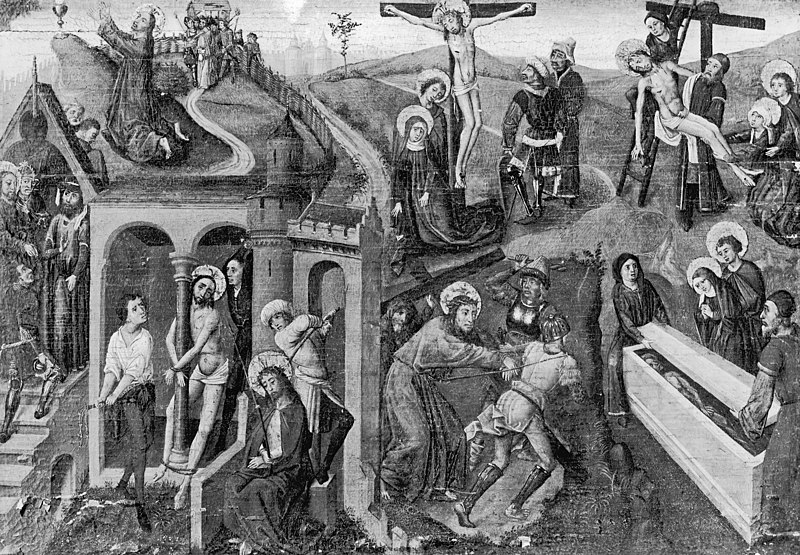

All four Gospels report a trial before Pontius Pilate and include the exchange in which Pilate asks Jesus if he is "the King of the Jews." In all four, the reply is some form of "You say so" or "You have said it." Beyond this shared core, the accounts diverge (Mark 15:1–15; Matthew 27:11–26; Luke 23:1–25; John 18:28–19:16).7
In Mark's account, Pilate offers to release one prisoner at Passover. The crowd chooses Barabbas, and Pilate hands Jesus over to be crucified. Pilate's interaction with Jesus is brief — a single question and a single ambiguous answer (Mark 15:2–15):
Mark 15:2–5, NRSVPilate asked him, "Are you the King of the Jews?" He answered him, "You say so." Then the chief priests accused him of many things. Pilate asked him again, "Have you no answer? See how many charges they bring against you." But Jesus made no further reply, so that Pilate was amazed.
Matthew follows Mark but adds two episodes unique to his Gospel.7 First, Pilate's wife sends a message warning her husband:
Matthew 27:19, NRSVWhile he was sitting on the judgment seat, his wife sent word to him, "Have nothing to do with that innocent man, for today I have suffered a great deal because of a dream about him."
Second, Matthew includes the scene in which Pilate washes his hands and the crowd accepts responsibility (Matthew 27:24–25):9
Matthew 27:24–25, NRSVSo when Pilate saw that he could do nothing, but rather that a riot was beginning, he took some water and washed his hands before the crowd, saying, "I am innocent of this man's blood; see to it yourselves." Then the people as a whole answered, "His blood be on us and on our children!"
This passage appears only in Matthew. The hand-washing and the crowd's response have no parallel in Mark, Luke, or John.9
John's account of the Roman trial is the most expansive of the four, extending over nearly two full chapters and structured as a series of scenes in which Pilate moves back and forth between Jesus inside the praetorium and the Jewish authorities outside (John 18:28–19:16). John's Pilate engages in extended theological dialogue with Jesus:10
John 18:37–38, NRSVPilate asked him, "So you are a king?" Jesus answered, "You say that I am a king. For this I was born, and for this I came into the world, to testify to the truth. Everyone who belongs to the truth listens to my voice." Pilate asked him, "What is truth?"
John also includes the Ecce Homo scene, in which Pilate presents the flogged Jesus to the crowd saying "Here is the man!" (John 19:5), and a confrontation in which the crowd invokes Roman political loyalty: "If you release this man, you are no friend of the emperor. Everyone who claims to be a king sets himself against the emperor" (John 19:12, NRSV).
The crucifixion and the question of time
All four Gospels report that Jesus is crucified at a place called Golgotha (Aramaic) or Kranion (Greek), meaning "the skull." All four report that an inscription is placed on the cross identifying Jesus as "King of the Jews," though the exact wording varies across accounts (Mark 15:22–26; Matthew 27:33–37; Luke 23:33–38; John 19:17–22).7
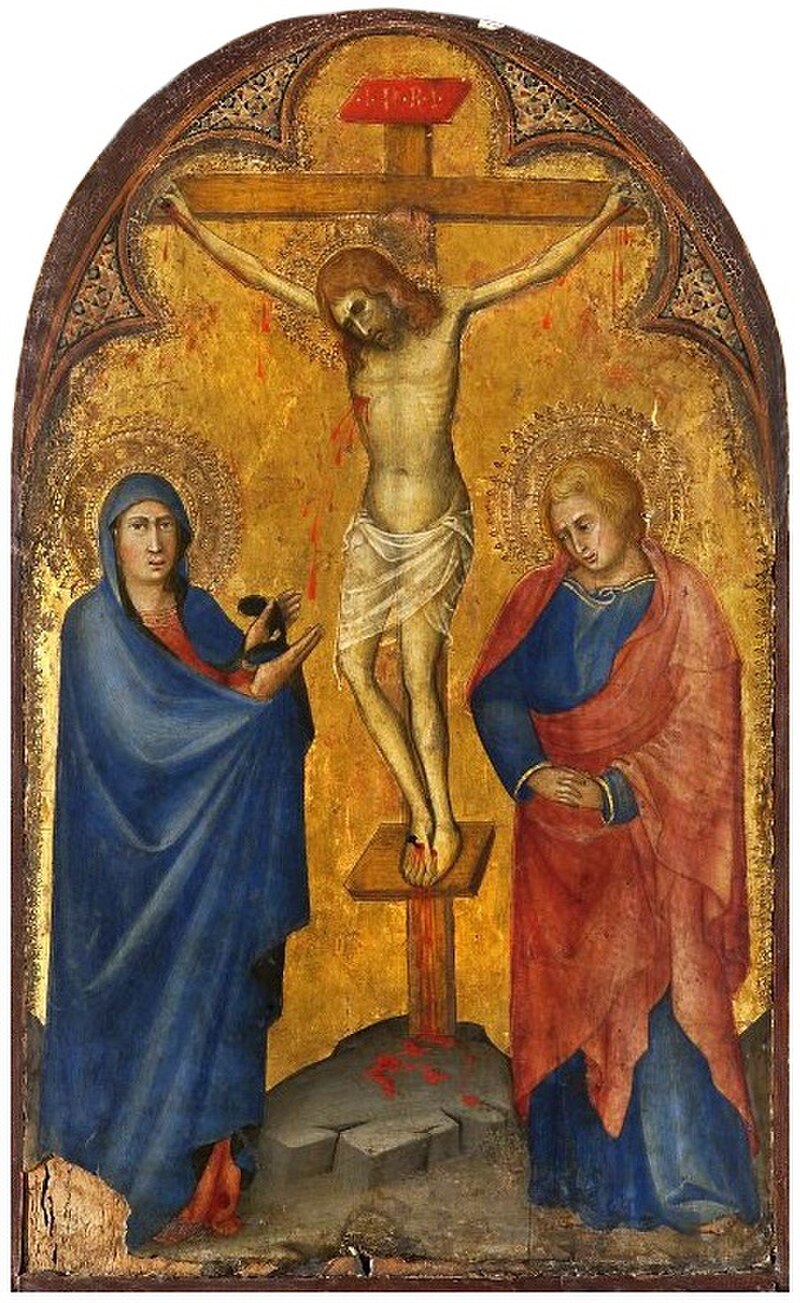

The Gospels provide different information about the time of the crucifixion. Mark states:
Mark 15:25, NRSVIt was nine o'clock in the morning when they crucified him.
The Greek reads hōra tritē (ὥρα τρίτη), "the third hour," which in the Jewish reckoning of time corresponds to approximately 9:00 a.m.1
John presents a different timeline. In John's account, Jesus is still before Pilate at a later point in the morning:
John 19:14, NRSVNow it was the day of Preparation for the Passover; and it was about noon. He said to the Jews, "Here is your King!"
The Greek reads hōra hektē (ὥρα ἕκτη), "the sixth hour," which corresponds to approximately noon. In Mark, Jesus has already been on the cross for three hours by noon. In John, Jesus is still standing before Pilate at noon. The two time notices are not easily reconciled without positing that one of the Gospels uses a different system of time-reckoning, though the text of each Gospel gives no indication that it is using a non-standard system.7
The day of Jesus' death in relation to Passover also differs between the Synoptic Gospels and John. Mark, Matthew, and Luke present the Last Supper as a Passover meal, placing the crucifixion on the day after Passover begins (15 Nisan). John places the crucifixion on the day of Preparation for the Passover (14 Nisan), before the Passover meal is eaten. In John's chronology, Jesus dies at the time the Passover lambs are being slaughtered in the temple.10
The words from the cross
The four Gospels collectively attribute seven distinct sayings to Jesus on the cross. No single Gospel contains all seven, and no saying appears in more than two Gospels. Mark and Matthew share one saying. Luke records three sayings found nowhere else. John records three sayings found nowhere else.7
The Gospel of Mark reports a single cry:
Mark 15:34, NRSVAt three o'clock Jesus cried out with a loud voice, "Eloi, Eloi, lema sabachthani?" which means, "My God, my God, why have you forsaken me?"
This is a quotation of Psalm 22:1, rendered in Aramaic. The Markan text uses the Aramaic form Eloi (Ἐλωι).1
The Gospel of Matthew reports the same saying with a Hebrew form of the divine address:
Matthew 27:46, NRSVAnd about three o'clock Jesus cried with a loud voice, "Eli, Eli, lema sabachthani?" that is, "My God, my God, why have you forsaken me?"
Matthew uses the Hebrew form Eli (Ἡλι) rather than Mark's Aramaic Eloi. In both Gospels, bystanders misunderstand the cry as a call to Elijah (Elias) (Mark 15:35; Matthew 27:47).1
The Gospel of Luke omits the cry of abandonment entirely. Instead, Luke attributes three different sayings to Jesus on the cross, none of which appear in Mark, Matthew, or John:7
Luke 23:34a, NRSVThen Jesus said, "Father, forgive them; for they do not know what they are doing."
Luke 23:43, NRSVHe replied, "Truly I tell you, today you will be with me in Paradise."
Luke 23:46, NRSVThen Jesus, crying with a loud voice, said, "Father, into your hands I commend my spirit." Having said this, he breathed his last.
The final saying in Luke echoes Psalm 31:5: "Into your hand I commit my spirit." Where Mark's and Matthew's Jesus dies with a cry of abandonment from Psalm 22, Luke's Jesus dies with a prayer of trust from Psalm 31.7
The Gospel of John likewise omits the cry of abandonment and reports three sayings unique to its account:10
John 19:26–27, NRSVWhen Jesus saw his mother and the disciple whom he loved standing beside her, he said to his mother, "Woman, here is your son." Then he said to the disciple, "Here is your mother."
John 19:28, NRSVAfter this, when Jesus knew that all was now finished, he said (in order to fulfill the scripture), "I am thirsty."
John 19:30, NRSVWhen Jesus had received the wine, he said, "It is finished." Then he bowed his head and gave up his spirit.
The Greek word translated "It is finished" is tetelestai (τετέλεσται), a perfect passive form of teleō, meaning "to complete" or "to bring to an end."1, 10
Words from the cross across the four Gospels
| Saying | Mark | Matthew | Luke | John |
|---|---|---|---|---|
| "Father, forgive them; for they do not know what they are doing" | — | — | 23:34 | — |
| "Today you will be with me in Paradise" | — | — | 23:43 | — |
| "Woman, here is your son" / "Here is your mother" | — | — | — | 19:26–27 |
| "My God, my God, why have you forsaken me?" | 15:34 | 27:46 | — | — |
| "I am thirsty" | — | — | — | 19:28 |
| "Father, into your hands I commend my spirit" | — | — | 23:46 | — |
| "It is finished" | — | — | — | 19:30 |
Events surrounding the death
The Gospels report different phenomena occurring at the moment of Jesus' death. All four agree that Jesus dies, but the accompanying events vary.7
Mark's account is the sparest:
Mark 15:37–39, NRSVThen Jesus gave a loud cry and breathed his last. And the curtain of the temple was torn in two, from top to bottom. Now when the centurion, who stood facing him, saw that in this way he breathed his last, he said, "Truly this man was God's Son!"
Mark reports two events: the tearing of the temple curtain and the centurion's declaration (Mark 15:37–39). Matthew reports both of these and adds several more:
Matthew 27:50–54, NRSVThen Jesus cried again with a loud voice and breathed his last. At that moment the curtain of the temple was torn in two, from top to bottom. The earth shook, and the rocks were split. The tombs also were opened, and many bodies of the saints who had fallen asleep were raised. After his resurrection they came out of the tombs and entered the holy city and appeared to many. Now when the centurion and those with him, who were keeping watch over Jesus, saw the earthquake and what took place, they were terrified and said, "Truly this man was God's Son!"
The events unique to Matthew — the earthquake, the splitting of rocks, the opening of tombs, and the resurrection of dead saints who appear in Jerusalem — are absent from Mark, Luke, and John. No other New Testament text refers to this mass resurrection of saints at the time of Jesus' death (Matthew 27:51–53).7
Luke reports the tearing of the curtain but places it before Jesus' death rather than after. Luke's centurion makes a different declaration from the one in Mark and Matthew (Luke 23:44–47):7
Luke 23:44–47, NRSVIt was now about noon, and darkness came over the whole land until three in the afternoon, while the sun's light failed; and the curtain of the temple was torn in two. Then Jesus, crying with a loud voice, said, "Father, into your hands I commend my spirit." Having said this, he breathed his last. When the centurion saw what had taken place, he praised God and said, "Certainly this man was innocent."
In Mark and Matthew, the centurion calls Jesus "God's Son" (Greek: theou huios, θεοῦ υἱός). In Luke, the centurion calls Jesus "innocent" or "righteous" (Greek: dikaios, δίκαιος). These are different declarations.1
John does not report the tearing of the temple curtain at all. Instead, John includes a scene unique to his Gospel in which a soldier pierces Jesus' side with a spear:
John 19:33–37, NRSVBut when they came to Jesus and saw that he was already dead, they did not break his legs. Instead, one of the soldiers pierced his side with a spear, and at once blood and water came out. (He who saw this has testified so that you also may believe. His testimony is true, and he knows that he tells the truth.) These things occurred so that the scripture might be fulfilled, "None of his bones shall be broken." And again another passage of scripture says, "They will look on the one whom they have pierced."
The scripture references cited by the Gospel of John are Exodus 12:46 and Numbers 9:12 (regarding the Passover lamb whose bones must not be broken) and Zechariah 12:10 ("they will look on the one whom they have pierced"). This episode — the piercing, the blood and water, the unbroken bones — appears only in John.
The two criminals
All four Gospels mention that Jesus is crucified alongside two others. The accounts describe the interaction with these two figures differently (Mark 15:27–32; Matthew 27:38–44; Luke 23:32–43; John 19:18).
Mark states simply:
Mark 15:27, 32b, NRSVAnd with him they crucified two bandits, one on his right and one on his left. ... Those who were crucified with him also taunted him.
Matthew follows Mark: "The bandits who were crucified with him also taunted him in the same way" (Matthew 27:44, NRSV). In both Mark and Matthew, both criminals mock Jesus.
Luke presents a different scene. One criminal mocks Jesus, but the other rebukes the first and asks Jesus to remember him:
Luke 23:39–43, NRSVOne of the criminals who were hanged there kept deriding him and saying, "Are you not the Messiah? Save yourself and us!" But the other rebuked him, saying, "Do you not fear God, since you are under the same sentence of condemnation? And we indeed have been condemned justly, for we are getting what we deserve for our deeds, but this man has done nothing wrong." Then he said, "Jesus, remember me when you come into your kingdom." He replied, "Truly I tell you, today you will be with me in Paradise."
Mark and Matthew present both criminals mocking Jesus. Luke presents one criminal mocking and the other defending Jesus and receiving a promise of paradise. John mentions two others crucified alongside Jesus but records no interaction between them and Jesus (John 19:18).7
Parallel comparison of key elements
The following table presents a side-by-side comparison of major elements in the passion narratives across all four Gospels. Each cell reflects what the text of that Gospel states. A dash indicates the element is absent from that Gospel's account.
Passion narrative elements across the four Gospels
| Element | Mark | Matthew | Luke | John |
|---|---|---|---|---|
| Judas's kiss | Yes (14:45) | Yes (26:49) | Yes (22:47–48) | No — Jesus steps forward |
| Swordsman identified | No — "one of those who stood near" | No — "one of those with Jesus" | No — "one of them" | Yes — Simon Peter; slave named Malchus |
| Ear healed | No | No | Yes (22:51) | No |
| Roman soldiers at arrest | No | No | No | Yes (18:3) |
| Night trial before Sanhedrin | Yes (14:53–65) | Yes (26:57–68) | No — morning hearing (22:66–71) | No — interrogation by Annas (18:13–24) |
| Formal verdict of blasphemy | Yes (14:64) | Yes (26:65–66) | No | No |
| Hearing before Herod Antipas | No | No | Yes (23:6–12) | No |
| Pilate's wife's dream | No | Yes (27:19) | No | No |
| Pilate washes hands | No | Yes (27:24) | No | No |
| "His blood be on us and on our children" | No | Yes (27:25) | No | No |
| Time of crucifixion | Third hour / 9 a.m. (15:25) | Not specified | Not specified | Still before Pilate at sixth hour / noon (19:14) |
| Both criminals mock Jesus | Yes (15:32) | Yes (27:44) | No — one defends Jesus (23:40–43) | No interaction recorded |
| Cry of abandonment (Psalm 22:1) | Yes (15:34) | Yes (27:46) | No | No |
| "It is finished" | No | No | No | Yes (19:30) |
| Temple curtain torn | Yes — after death (15:38) | Yes — after death (27:51) | Yes — before death (23:45) | No |
| Earthquake and raised saints | No | Yes (27:51–53) | No | No |
| Centurion's words | "God's Son" (15:39) | "God's Son" (27:54) | "Innocent" / "righteous" (23:47) | No centurion declaration |
| Side pierced with spear | No | No | No | Yes (19:34) |
| Legs not broken | No mention | No mention | No mention | Yes (19:33) |
The inscription on the cross
All four Gospels report that an inscription was placed on or above the cross stating the charge against Jesus. The wording differs in each Gospel:
Mark: "The King of the Jews" (ho basileus tōn Ioudaiōn, ὁ βασιλεὺς τῶν Ἰουδαίων) (Mark 15:26, NRSV).
Matthew: "This is Jesus, the King of the Jews" (Matthew 27:37, NRSV).
Luke: "This is the King of the Jews" (Luke 23:38, NRSV).
John: "Jesus of Nazareth, the King of the Jews" (John 19:19, NRSV). John alone adds that the inscription was written in Hebrew, Latin, and Greek, and that the chief priests asked Pilate to change the wording from "The King of the Jews" to "This man said, I am King of the Jews," a request Pilate refused with the words "What I have written I have written" (John 19:20–22, NRSV).
The four formulations share the phrase "the King of the Jews" but differ in every other element. The Greek text of each Gospel preserves a distinct wording.1
Textual variants in the passion narratives
Several passages within the passion narratives have significant manuscript variants — places where the earliest surviving manuscripts disagree about what the text contained.2, 3
Luke 22:43–44 describes an angel strengthening Jesus in Gethsemane and Jesus sweating drops like blood:
Luke 22:43–44, NRSVThen an angel from heaven appeared to him and gave him strength. In his anguish he prayed more earnestly, and his sweat became like great drops of blood falling down on the ground.
These two verses are absent from Papyrus Bodmer XIV–XV (P75, dated to approximately 175–225 CE) and from the original hand of Codex Vaticanus (4th century CE). They are present in Codex Sinaiticus (4th century CE), though a later corrector marks them with critical signs, and they appear in Codex Bezae (5th century CE).4, 5, 6, 13, 14 The verses are included in the Nestle-Aland 28th edition within double brackets, indicating that the editors considered the passage to be of uncertain authenticity.1
Luke 23:34a — "Father, forgive them; for they do not know what they are doing" — is likewise absent from significant early manuscripts. It is omitted by P75 and by the original hand of Codex Vaticanus, and it is absent from Codex Bezae. It is present in Codex Sinaiticus and in many later manuscripts.4, 5, 6, 13, 15 The Nestle-Aland 28th edition includes this saying in double brackets as well.1
The cry from the cross in Mark 15:34 and Matthew 27:46 presents a different kind of variant. The divine address varies between manuscripts: some manuscripts of Mark read Eloi (Aramaic), while others read Eli (Hebrew), harmonizing Mark with Matthew's text. Similarly, the second word varies between lema and lama across manuscripts of both Gospels. Codex Bezae renders Mark's version as Eli, Eli, lama zaphthani, a reading that differs from the standard text in both the address and the verb.3, 6
In John 19:14, the time reference "the sixth hour" is read as "the third hour" in a few manuscripts, apparently an attempt to harmonize John's timeline with Mark 15:25. The earliest and best-attested manuscripts, including P66 (Papyrus Bodmer II, ca. 200 CE), Codex Sinaiticus, and Codex Vaticanus, read "the sixth hour."1, 2, 3, 12
Old Testament allusions
The passion narratives contain numerous allusions to and quotations from the Hebrew Bible. Several of these allusions shape the structure and detail of the accounts.7, 8
Psalm 22 provides the most extensively echoed text. Beyond the cry of abandonment in Mark 15:34 and Matthew 27:46 (quoting Psalm 22:1), additional details in the passion narratives correspond to elements of the psalm. Psalm 22:7–8 reads: "All who see me mock at me; they make mouths at me, they shake their heads; 'Commit your cause to the Lord; let him deliver — let him rescue the one in whom he delights!'" (NRSV). The Gospels report passers-by shaking their heads and mocking Jesus (Mark 15:29, Matthew 27:39), and chief priests saying "He saved others; he cannot save himself ... let God deliver him now" (Matthew 27:42–43, NRSV).
Psalm 22:18 reads: "they divide my clothes among themselves, and for my clothing they cast lots" (NRSV). All four Gospels report the soldiers dividing Jesus' garments and casting lots for them (Mark 15:24, Matthew 27:35, Luke 23:34b, John 19:23–24). John quotes Psalm 22:18 explicitly and adds the detail that Jesus' tunic was seamless and woven in one piece, prompting the soldiers to cast lots rather than tear it.
Psalm 69:21 reads: "for my thirst they gave me vinegar to drink" (NRSV). All four Gospels report that Jesus is offered sour wine or vinegar while on the cross (Mark 15:36, Matthew 27:48, Luke 23:36, John 19:29).
Isaiah 53 — the passage describing a suffering figure who is "wounded for our transgressions" and "like a lamb that is led to the slaughter" — does not receive direct quotation in the passion narratives themselves, though the Gospel of John alludes to the imagery when noting that none of Jesus' bones were broken, echoing the Passover lamb regulations in Exodus 12:46. John's identification of Jesus with the Passover lamb is reinforced by the chronological placement of the crucifixion on the day of Preparation, when the lambs were slaughtered.10
The extent to which these correspondences reflect historical memory, literary shaping based on scriptural texts, or some combination of both is a question the texts themselves do not resolve. The Gospels present the events as fulfillments of scripture; the Hebrew Bible passages predate the Gospel compositions by centuries. Both the passion narratives and the Hebrew Bible texts they echo are available for the reader's examination.7, 8
The burial
All four Gospels report that Jesus is buried by Joseph of Arimathea, a member of the Jewish council. The details of the burial differ (Mark 15:42–47; Matthew 27:57–61; Luke 23:50–56; John 19:38–42).7
Mark's account is brief:
Mark 15:42–46, NRSVWhen evening had come, and since it was the day of Preparation, that is, the day before the sabbath, Joseph of Arimathea, a respected member of the council, who was also himself waiting expectantly for the kingdom of God, went boldly to Pilate and asked for the body of Jesus. Then Pilate wondered if he were already dead; and summoning the centurion, he asked him whether he had been dead for some time. When he learned from the centurion that he was dead, he granted the body to Joseph. Then Joseph bought a linen cloth, and taking down the body, wrapped it in the linen cloth, and laid it in a tomb that had been hewn out of the rock. He then rolled a stone against the door of the tomb.
Matthew follows Mark closely but adds two details absent from Mark: the tomb is described as Joseph's own new tomb (Matthew 27:60), and after the burial, the chief priests and Pharisees ask Pilate to secure the tomb with a guard, fearing that the disciples will steal the body and claim a resurrection (Matthew 27:62–66). This guard-at-the-tomb narrative is unique to Matthew.
Luke describes Joseph as "a good and righteous man" who "had not agreed to their plan and action" — implying that Joseph dissented from the council's decision regarding Jesus (Luke 23:50–51, NRSV).
John expands the burial scene by adding a second participant. In John, Joseph of Arimathea is joined by Nicodemus, who brings "a mixture of myrrh and aloes, weighing about a hundred pounds" (John 19:39, NRSV). Nicodemus appears only in John's Gospel, having been introduced earlier in a night conversation with Jesus (John 3:1–21). John also notes that the tomb was in a garden near the place of crucifixion, a detail not found in the Synoptic accounts.
In Mark, Joseph's motivation is described as "waiting expectantly for the kingdom of God." In Matthew, Joseph is identified as "a rich man" and "a disciple of Jesus." In Luke, Joseph is "a good and righteous man" who did not consent to the council's action. In John, Joseph is "a disciple of Jesus, though a secret one because of his fear of the Jews." The characterizations are different: Mark does not call Joseph a disciple; Matthew and John do (Mark 15:43; Matthew 27:57; Luke 23:50–51; John 19:38).7
Narrative and theological emphasis
Each Gospel's passion narrative operates within the broader theological framework of that Gospel. These frameworks are visible in the selection and arrangement of material.
The Gospel of Mark presents a Jesus who is increasingly isolated. His disciples fall asleep in Gethsemane (Mark 14:37–41), Judas betrays him, Peter denies him three times, and all the disciples flee at the arrest. On the cross, Jesus speaks only the cry of abandonment. The centurion's declaration — "Truly this man was God's Son!" — comes from a Roman outsider, not from any follower. Mark's passion narrative is structured around abandonment and paradox: the moment of greatest desolation is the moment the narrative identifies Jesus' divine sonship.8
The Gospel of Matthew retains Mark's structure but adds material that emphasizes Jewish responsibility and scriptural fulfillment. The additions include Judas's remorse and suicide (Matthew 27:3–10), Pilate's wife's dream (Matthew 27:19), Pilate's hand-washing (Matthew 27:24), the crowd's cry "His blood be on us and on our children" (Matthew 27:25), and the earthquake and resurrection of saints (Matthew 27:51–53). Matthew frames the passion as a drama in which Gentile figures (Pilate's wife, Pilate himself, the centurion) recognize Jesus' innocence or divinity, while Jewish authorities press for his execution.7
The Gospel of Luke presents a Jesus who remains composed and compassionate throughout. Luke omits the cry of abandonment and replaces it with a prayer of forgiveness for the executioners (Luke 23:34) and a prayer of trust at the moment of death (Luke 23:46). Jesus engages pastorally with the criminal on the cross, promising paradise (Luke 23:43). Jesus addresses the women of Jerusalem on the way to crucifixion, telling them to weep for themselves and their children (Luke 23:28–31). Luke's Jesus does not express abandonment or anguish on the cross; he extends mercy and dies with a prayer.7
The Gospel of John presents a Jesus who exercises sovereign control throughout the passion. At the arrest, the arresting party falls to the ground before him (John 18:6). Before Pilate, Jesus declares that Pilate has no power except what has been "given from above" (John 19:11). On the cross, Jesus speaks not a cry of abandonment but a declaration of completion: "It is finished" (John 19:30). John's Jesus arranges his mother's care from the cross (John 19:26–27), fulfills scripture deliberately — "I am thirsty" is spoken "in order to fulfill the scripture" (John 19:28) — and gives up his spirit voluntarily. The language of John 19:30, "he bowed his head and gave up his spirit" (paredoken to pneuma, παρέδωκεν τὸ πνεῦμα), uses a verb of deliberate handing over rather than simply breathing one's last.1, 10
The result is four passion narratives that share a common skeleton — arrest, Jewish proceeding, Roman trial, crucifixion, death, burial — but construct different scenes around it, attribute different words to the same figure, include different participants, report different accompanying phenomena, and present different characterizations of Jesus in his final hours. The texts are presented above. The reader can examine each account and the specific points at which they agree and diverge.
References
Who Killed Jesus? Exposing the Roots of Anti-Semitism in the Gospel Story of the Death of Jesus