Overview
- The Septuagint (LXX) is the Greek translation of the Hebrew scriptures, produced in Alexandria between the third and first centuries BCE, making it the oldest translation of the Bible and the primary form in which the Old Testament was known in the early Christian church.
- The Septuagint differs from the Masoretic Text in numerous passages — some reflecting a different Hebrew source text (Vorlage), others reflecting the translators' interpretive choices — and these differences have consequences for the New Testament, whose authors frequently quoted the Old Testament in forms that follow the Septuagint rather than the Hebrew.
- The Septuagint contains books not found in the Hebrew Bible (Wisdom, Sirach, Tobit, Judith, 1–2 Maccabees, and others), which became part of the Roman Catholic and Eastern Orthodox canons as deuterocanonical books while being excluded from the Protestant Old Testament.
The Septuagint (commonly abbreviated LXX, from the Latin for "seventy") is the Greek translation of the Jewish scriptures, produced in Alexandria, Egypt, between the third and first centuries BCE. It is the oldest translation of the Hebrew Bible into any language. The Septuagint served as the primary form of the Old Testament for Greek-speaking Jews in the Hellenistic and Roman periods and became the Old Testament of the early Christian church. The majority of Old Testament quotations in the New Testament follow the Septuagint text rather than the Hebrew, and several New Testament arguments depend on the Greek wording of the LXX rather than the corresponding Hebrew.1, 7
The Septuagint is not a single translation produced at one time. The Pentateuch was translated first, probably in the third century BCE, and the remaining books were translated over the following two centuries by different translators with different approaches. Some books were translated with close fidelity to the Hebrew; others were rendered freely, with additions, omissions, and rearrangements. The Greek text of some books (particularly Jeremiah, Daniel, and Esther) differs so substantially from the Masoretic Text that the two represent what are effectively different editions of the same work.2, 9

Origin and the Letter of Aristeas
The origins of the Septuagint are described in the Letter of Aristeas, a pseudonymous Greek work usually dated to the second century BCE. According to the Letter, Ptolemy II Philadelphus (reigned 285–247 BCE), king of Egypt, wished to include the Jewish law in the Library of Alexandria. He sent envoys to the high priest Eleazar in Jerusalem, who selected seventy-two elders — six from each of the twelve tribes of Israel — and sent them to Alexandria with a copy of the Torah written in gold letters. The elders completed their translation in seventy-two days, working on the island of Pharos, and the finished translation was read aloud to the Jewish community of Alexandria, who approved it and pronounced a curse on anyone who would alter it.4
The Letter of Aristeas is not a historical account of the translation's origins. It is a literary work designed to enhance the authority of the Greek Torah by associating it with royal patronage, priestly authorization, and communal approval. The number seventy-two (rounded to seventy, hence "Septuagint") and the narrative of independent agreement served to establish the translation as inspired and authoritative. Later writers, including Philo of Alexandria (first century CE) and several early church fathers, expanded the legend: in Philo's version, the translators worked independently in separate cells and produced identical translations, demonstrating divine guidance.1, 2
What can be established historically is that the Pentateuch was translated into Greek in Alexandria in the third century BCE, during the reign of Ptolemy II or shortly after. Alexandria had the largest Jewish community in the Diaspora, and the translation was produced to serve a community whose primary language was Greek. The translation of the remaining books followed over the next two centuries, with each book or group of books translated independently by different translators.1, 8
Manuscripts of the Septuagint
No manuscripts survive from the original translation. The earliest direct evidence for the Septuagint text consists of papyrus fragments from the second and first centuries BCE found in Egypt. The most important of these are Papyrus Rylands 458 (mid-second century BCE), containing fragments of Deuteronomy, and Papyrus Fouad 266 (first century BCE), containing fragments of Deuteronomy with the divine name written in Hebrew characters (YHWH) within the Greek text.1, 8
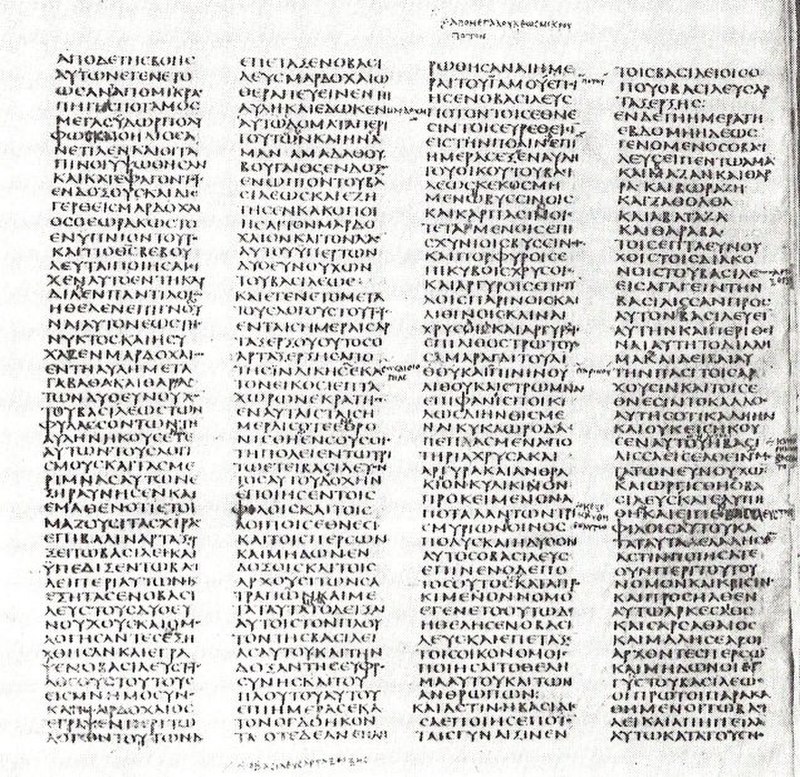
The three principal complete (or nearly complete) manuscripts of the Septuagint are the great uncial codices of the fourth and fifth centuries CE. Codex Vaticanus (B, fourth century), held in the Vatican Library, is generally regarded as preserving the best text of the LXX for most books. Codex Sinaiticus (aleph, fourth century), discovered by Tischendorf at Saint Catherine's Monastery in 1844, contains the complete New Testament and most of the Old Testament in Greek. Codex Alexandrinus (A, fifth century), held in the British Library, contains nearly the complete Septuagint and is the primary witness for the Lucianic recension of the text in the historical books.12, 13, 14
The critical edition of the Septuagint is the Gottingen Septuagint (Septuaginta: Vetus Testamentum Graecum), published by the Gottingen Academy of Sciences since 1931. This edition presents a reconstructed text based on the full range of manuscript evidence, with a comprehensive apparatus of variant readings. Not all books have yet appeared in the Gottingen series; for books not yet covered, the Rahlfs edition (1935, revised 2006) remains the standard reference text. A modern English translation of the full Septuagint, the New English Translation of the Septuagint (NETS), was published in 2007.3, 5
Translation technique
The Septuagint is not a uniform translation. Each book (or section of a book) was translated by a different translator or group of translators, and the translation techniques range from strictly literal to freely paraphrastic. The Greek Pentateuch occupies a middle position: it follows the Hebrew closely enough that the Hebrew text can be reconstructed from it in most cases, but it also adapts the text for Greek readers, clarifying ambiguities, smoothing grammar, and occasionally inserting explanatory phrases.1, 2, 6
The translation of the Psalms is relatively literal, preserving the word order of the Hebrew in most cases. The translations of Proverbs and Job, by contrast, are markedly free: the Greek Proverbs contains material not found in the Hebrew, rearranges the order of chapters, and renders many proverbs with different imagery. The Greek Job is approximately one-sixth shorter than the Hebrew, omitting passages throughout the book. Origen, in his Hexapla (third century CE), marked the passages present in the Hebrew but absent from the Greek with an asterisk, and the passages present in the Greek but absent from the Hebrew with an obelus, making the scale of the differences visible at a glance.2, 15
The following table illustrates the range of translation approaches across representative books:
Translation technique in selected Septuagint books1, 2
| Book | Approach | Relationship to MT |
|---|---|---|
| Pentateuch | Moderate literalism | Close to MT with minor expansions |
| Psalms | Literal | Very close to MT |
| Isaiah | Free, interpretive | Numerous divergences in wording |
| Jeremiah | Literal to different Vorlage | One-eighth shorter than MT; different order |
| Job | Free, abridged | One-sixth shorter than MT |
| Proverbs | Free, rearranged | Different order; added material |
| Daniel | Two translations (OG + Theodotion) | Substantial additions (Prayer of Azariah, Susanna, Bel and the Dragon) |
| Esther | Expanded | 107 additional verses not in MT |
Divergences from the Hebrew text
The differences between the Septuagint and the Masoretic Text fall into several categories. Some reflect a different Hebrew source text (Vorlage) underlying the Greek translation. Others reflect the translator's interpretive choices, theological concerns, or attempts to clarify the text for a Greek-speaking audience. In many cases, the discovery of the Dead Sea Scrolls has made it possible to distinguish between these two explanations: where a Qumran manuscript agrees with the LXX against the MT, the difference is more likely to reflect a variant Hebrew source than a translator's invention.9, 10
The book of Jeremiah provides the most dramatic example. The Septuagint text of Jeremiah is approximately one-eighth shorter than the Masoretic Text (approximately 2,700 words shorter), and the oracles against the nations, which appear at the end of the book in the MT (chapters 46–51), appear in the middle of the book in the LXX (after 25:13). The discovery at Qumran of Hebrew manuscripts of Jeremiah in both the shorter (LXX-type) and longer (MT-type) forms confirmed that the LXX translators were working from a genuinely different Hebrew text, not abbreviating the text that became the MT.9, 10
In the Pentateuch, the differences are less dramatic but cumulatively significant. The chronology of the patriarchs in Genesis 5 and 11 differs between the MT and the LXX: the Septuagint consistently gives higher ages for the patriarchs at the birth of their first son, adding approximately 1,500 years to the span from Adam to Abraham. In Exodus 1:5, the MT states that seventy persons descended from Jacob entered Egypt; the LXX gives the number as seventy-five. The New Testament follows the LXX figure: in Acts 7:14, Stephen states that Joseph sent for his father and "all his relatives, seventy-five in all."1, 9
The Septuagint and the New Testament
The New Testament authors wrote in Greek and, when citing the Old Testament, most often followed the Septuagint text. Of approximately 350 direct Old Testament quotations in the New Testament, the majority agree with the LXX against the MT where the two differ. In some cases, the New Testament argument depends on the Greek wording of the LXX and would not work with the Hebrew text.7, 11
The most frequently cited example is Isaiah 7:14. The Hebrew text reads: "Therefore the Lord himself will give you a sign. Look, the young woman ('almah, עַלְמָה) is with child and shall bear a son, and shall name him Immanuel" (NRSV). The Hebrew word 'almah means "young woman" without specifying virginity; the Hebrew word for "virgin" is betulah (בְּתוּלָה). The Septuagint translates 'almah with the Greek word parthenos (παρθένος), which specifically means "virgin." The Gospel of Matthew quotes this verse in its account of Jesus' birth: "All this took place to fulfill what had been spoken by the Lord through the prophet: 'Look, the virgin (parthenos) shall conceive and bear a son'" (Matthew 1:22–23). The argument from fulfilled prophecy depends on the LXX's parthenos rather than the Hebrew 'almah.1, 7, 11
Another example appears in Hebrews 10:5–6, which quotes Psalm 40:6. The Hebrew text of Psalm 40:6 reads: "Sacrifice and offering you do not desire, but you have given me an open ear" (NRSV). The phrase "you have given me an open ear" translates the Hebrew literally as "ears you have dug for me." The Septuagint renders this as "a body you have prepared for me" (soma de katertiso moi). The author of Hebrews quotes the LXX reading and uses it to argue that Christ's incarnation — God preparing a body for the Son — was prophesied in the Psalms. This christological argument depends on the Septuagint's rendering; the Hebrew text, with its reference to "open ears," does not yield the same interpretation.7, 11
In Acts 15:16–17, James quotes Amos 9:11–12 at the Jerusalem council to argue that Gentiles should be admitted to the church without circumcision. The Hebrew text of Amos 9:12 reads: "in order that they may possess the remnant of Edom." The LXX reads: "so that the rest of humanity may seek the Lord." The Hebrew yirshu ("they may possess") became ekzetesousin ("they may seek"), and 'edom ("Edom") became adam ("humanity") — likely because the Hebrew consonants are identical and the LXX translators vocalized them differently. James's argument that the prophets foretold the inclusion of the Gentiles depends entirely on the Septuagint reading.7, 11
Revisions and recensions
As the Septuagint gained authority in the early church, Jewish communities that had originally used the Greek translation began to distance themselves from it, in part because Christians used the LXX in theological arguments and in part because the Greek text diverged from the Hebrew text that was becoming standardized in rabbinic circles. Beginning in the late first century CE, Jewish scholars produced revised Greek translations that brought the text into closer alignment with the proto-Masoretic Hebrew.2, 8
Three major revisions are attested. Aquila of Sinope (early second century CE) produced an extremely literal translation that followed the Hebrew word for word, sometimes at the cost of intelligibility in Greek. Symmachus (late second century CE) produced a translation that combined fidelity to the Hebrew with good Greek style. Theodotion (late second century CE, or possibly earlier) produced a revision of the existing LXX that corrected it toward the Hebrew in many passages. In the book of Daniel, Theodotion's version displaced the original Septuagint translation (known as the Old Greek or OG) so completely that the OG survived in only a single Greek manuscript (Codex Chisianus, from the ninth century) until Papyrus 967 (late second or early third century CE) was identified in the twentieth century.2, 15
Origen of Alexandria (c. 185–254 CE) compiled the Hexapla, a monumental work that placed the Hebrew text, the Hebrew in Greek transliteration, the Septuagint, and the versions of Aquila, Symmachus, and Theodotion in six parallel columns. Origen marked passages where the LXX differed from the Hebrew: an asterisk (*) indicated words present in the Hebrew but absent from the LXX (which Origen supplied from Theodotion), and an obelus (÷) indicated words present in the LXX but absent from the Hebrew. The original Hexapla, filling an estimated 6,500 pages, was kept in the library at Caesarea and is believed to have been destroyed in the seventh century. It survives only in fragments and in the Syro-Hexaplar, a Syriac translation of Origen's fifth column (the LXX with his critical marks).15, 16
Additional books in the Septuagint
The Septuagint manuscripts contain books that are not found in the Hebrew Bible. These include Wisdom of Solomon, Sirach (Ecclesiasticus), Tobit, Judith, 1–4 Maccabees, Baruch, the Letter of Jeremiah, and additions to the books of Esther and Daniel. Some of these were originally composed in Greek (Wisdom of Solomon, 2 Maccabees); others were composed in Hebrew or Aramaic and survive only in Greek translation (Sirach, Tobit, 1 Maccabees).1, 2
The status of these books has been debated since antiquity. Jerome distinguished between books found in the Hebrew canon and those found only in the Greek, coining the distinction between "canonical" and "ecclesiastical" books. The Roman Catholic Church affirmed the deuterocanonical books as fully canonical at the Council of Trent (1546). Protestant traditions, following Luther, excluded them from the canon. The Eastern Orthodox churches accept a slightly broader selection. The question of these books' status is examined in detail in Canon formation.1, 7
Significance for biblical studies
The Septuagint occupies a central position in the study of the Bible. For the textual critic, it provides the earliest evidence for the text of the Hebrew Bible, predating the Masoretic manuscripts by over a millennium. Where the LXX differs from the MT, the difference may reflect a variant Hebrew reading that has otherwise been lost. The Dead Sea Scrolls have confirmed this in numerous cases, preserving Hebrew manuscripts that agree with the LXX against the MT.9, 10
For the historian of religion, the Septuagint documents how Jewish interpreters in the Hellenistic period understood their own scriptures. Translation choices reveal theological commitments: the consistent use of kyrios (Lord) for the divine name YHWH, the avoidance of anthropomorphisms that the Hebrew text preserves, and the introduction of Greek philosophical terminology into the description of God all reflect the concerns of Hellenistic Jewish theology.2, 7
For the student of the New Testament, the Septuagint is indispensable. The New Testament authors thought and wrote in categories shaped by the Greek Old Testament. Their vocabulary, their theological concepts, and their quotation of scripture all depend on the Septuagint. The LXX's rendering of key terms — diatheke ("covenant"), nomos ("law"), ekklesia ("assembly," later "church"), christos ("anointed one") — provided the conceptual framework within which the New Testament was composed.1, 7