Overview
- The synoptic problem is the question of how to explain the extensive literary relationships among the Gospels of Matthew, Mark, and Luke, which share large blocks of material in verbatim or near-verbatim Greek wording, follow the same general narrative sequence, yet also contain systematic patterns of divergence.
- The dominant solution since the late nineteenth century is the Two-Source Hypothesis, which posits that Mark was written first and that Matthew and Luke each independently used Mark and a lost sayings source designated Q; competing hypotheses include the Farrer Hypothesis (Luke used both Mark and Matthew, eliminating Q), the Griesbach Hypothesis (Matthew was first, Luke used Matthew, and Mark condensed both), and the Augustinian Hypothesis (Matthew first, Mark second, Luke third).
- The principal categories of evidence brought to bear on the problem include the argument from order (the pattern of agreement and disagreement in pericope sequence), the argument from wording (verbatim Greek correspondence and editorial improvements), the minor agreements of Matthew and Luke against Mark, editorial fatigue, and the distribution and character of the double tradition material shared by Matthew and Luke but absent from Mark.
The synoptic problem is the scholarly designation for the question of how to account for the literary relationships among the Gospels of Matthew, Mark, and Luke. These three texts — called "synoptic" because they can be "seen together" (from the Greek synoptikos, συνοπτικός) — share extensive passages in verbatim or near-verbatim Greek wording, follow the same general narrative sequence, and yet also diverge from one another in systematic and patterned ways. Of Mark's approximately 661 verses, roughly 600 appear in some form in Matthew and 350 in Luke, often reproducing not merely the same events but the same Greek vocabulary, the same grammatical constructions, and even the same parenthetical narrator comments.3, 1 At the same time, approximately 235 verses of material appear in both Matthew and Luke but not in Mark — consisting primarily of sayings attributed to Jesus — while each Gospel also contains substantial blocks of material found nowhere else.5, 11
The extent and character of these agreements and disagreements require explanation. If the three authors composed their texts independently, the degree of verbatim Greek correspondence is difficult to account for. If one or more of the authors used one or more of the others as a written source, the specific patterns of agreement and divergence become evidence for determining who used whom. The synoptic problem is the attempt to identify that pattern of literary dependence, and it has generated a range of competing hypotheses since the late eighteenth century. This article presents the principal solutions that have been proposed, the categories of evidence on which they rest, and the strengths and difficulties of each.1, 14
Historical development of the problem
The recognition that the synoptic Gospels bear a close literary relationship to one another is ancient. Augustine of Hippo, writing around 400 CE in De Consensu Evangelistarum ("On the Harmony of the Evangelists"), addressed the agreements and disagreements among the Gospels and proposed that the canonical order reflected the order of composition: Matthew wrote first, Mark followed as an abbreviator of Matthew, and Luke wrote third, drawing on both.19 This Augustinian sequence — Matthew, Mark, Luke — remained the default assumption in Western Christianity for over a millennium, as the question of literary relationships among the Gospels attracted relatively little critical attention during the medieval period.
The modern study of the synoptic problem began in the late eighteenth century. Johann Jakob Griesbach published a Synopsis of the Gospels in 1776 that arranged Matthew, Mark, and Luke in parallel columns, making the patterns of agreement and disagreement visually accessible for systematic comparison. Griesbach proposed that Matthew was composed first, that Luke drew on Matthew, and that Mark subsequently produced a conflation of both — a hypothesis that reversed the Augustinian view of Mark as an abbreviator and instead cast Mark as a secondary compiler.6
In 1835, Karl Lachmann published a comparison of the sequence of pericopes (self-contained narrative units) in the three synoptic Gospels, observing that while Matthew and Mark frequently agree in pericope order, and Luke and Mark frequently agree, Matthew and Luke rarely agree in order against Mark. Lachmann inferred that Mark's order best preserved a fixed early tradition, an observation that came to be regarded as foundational evidence for Markan priority — the thesis that the Gospel of Mark was the first of the three to be composed.1, 13
Christian Hermann Weisse, writing in 1838, combined the emerging case for Markan priority with Friedrich Schleiermacher's earlier suggestion that Papias of Hierapolis's reference to Matthew having compiled "the oracles" (ta logia) in Hebrew pointed to a sayings source distinct from the narrative Gospel of Matthew.18 Weisse proposed that both Matthew and Luke drew on two written sources: the Gospel of Mark and a collection of sayings. This two-source model was then developed and systematized by Heinrich Julius Holtzmann in 1863, whose influential treatment established it as the dominant framework for synoptic research in Germany.17, 14 The second source, initially called the Logienquelle ("logia-source"), was eventually designated simply as Q, from the German Quelle ("source").
B. H. Streeter's 1924 monograph The Four Gospels: A Study of Origins provided the most comprehensive English-language statement of the Two-Source Hypothesis, adding the proposal that Matthew and Luke each also drew on additional sources unique to them — designated "M" and "L" respectively — to produce a four-source model. Streeter's formulation became the standard account in English-speaking scholarship and remained largely unchallenged until the mid-twentieth century.2
The data requiring explanation
The synoptic problem arises from a set of observable features of the three texts. Before any hypothesis can be evaluated, the data themselves must be specified. These data fall into several categories, each of which any adequate solution must account for.
The first category is the triple tradition: material that appears in all three synoptic Gospels. This constitutes the largest body of shared material. Approximately 90 percent of Mark's content appears in Matthew, and approximately 53 percent appears in Luke. The correspondence extends to the level of individual Greek words. In the healing of the paralytic, for instance, Mark 2:10–11 and Matthew 9:6 reproduce the same sentence almost word for word in Greek, including the parenthetical "he said to the paralytic" embedded within a speech attributed to Jesus — an editorial insertion by the narrator that both texts share (Mark 2:10–11; Matthew 9:6).3, 15
The second category is the double tradition: material that appears in both Matthew and Luke but not in Mark. This consists of approximately 235 verses, primarily sayings and teachings attributed to Jesus, including the Beatitudes, the Lord's Prayer, and extended discourses on discipleship and judgment. Matthew and Luke rarely agree in placing this material at the same point in their narratives; Matthew tends to collect it into large discourse blocks (the Sermon on the Mount in chapters 5–7, the Mission Discourse in chapter 10), while Luke distributes much of the same material across the Travel Narrative (9:51–18:14).5, 10
The third category is the special material unique to each Gospel. Mark contains a small amount of material found in neither Matthew nor Luke, including the healing of the deaf man (Mark 7:31–37) and the healing of the blind man at Bethsaida (Mark 8:22–26). Matthew contains substantial unique material (designated "M"), including the visit of the Magi, several parables (the wheat and the weeds, the ten virgins, the sheep and the goats), and much of the Sermon on the Mount. Luke's unique material (designated "L") includes the parables of the Good Samaritan and the Prodigal Son, the Magnificat, the Emmaus road narrative, and much of the infancy narrative.2, 14
The fourth category is the agreement in order. When the pericope sequence of the three Gospels is compared, a distinctive pattern emerges: Matthew and Mark frequently agree in order, and Luke and Mark frequently agree in order, but Matthew and Luke rarely agree in order against Mark. This pattern — sometimes called the "Lachmann observation" after its initial formulator — suggests that Mark's order occupies an intermediate position between the other two.1, 13
The fifth category is the minor agreements: points at which Matthew and Luke agree with each other against Mark in passages where all three are narrating the same event. These include shared additions of words or phrases absent from Mark, shared omissions of Markan material, and shared alterations of Markan wording. The mocking question "Who is it that struck you?" (Matthew 26:68; Luke 22:64), directed at the blindfolded Jesus during his beating, appears in both Matthew and Luke but not in Mark's parallel account (Mark 14:65). The number and significance of the minor agreements have been a matter of sustained debate.8, 1
The Two-Source Hypothesis
The Two-Source Hypothesis (often abbreviated 2SH) posits that the Gospel of Mark was composed first, and that the authors of Matthew and Luke each independently used Mark as a written source, supplementing it with material from a second source — the hypothetical sayings collection Q — as well as material unique to their respective Gospels. The hypothesis thus proposes two principal sources behind the synoptic tradition: a narrative source (Mark) accounting for the triple tradition, and a sayings source (Q) accounting for the double tradition.2, 14
The case for Markan priority within this framework rests on several converging lines of evidence. The argument from content observes that nearly all of Mark's material reappears in Matthew, in Luke, or in both. If Mark were a later abridgment of Matthew, the author would have omitted the Sermon on the Mount, the Lord's Prayer, the birth narrative, the resurrection appearances, and virtually all of the material that distinguishes Matthew as a longer and more developed text — an editorial strategy that would be difficult to explain.1, 2
The argument from order, as described above, observes that Matthew and Luke rarely agree in pericope sequence against Mark. This is what one would expect if each author independently followed Mark's order, occasionally rearranging material for their own purposes; it would be difficult to explain if Mark were a later conflation of two prior texts whose order he sometimes followed and sometimes departed from.1, 11
The argument from wording observes that where Matthew and Luke reproduce Markan material, they frequently improve Mark's rougher Greek. Mark uses the historical present tense extensively ("he says," "they come"); Matthew and Luke systematically convert these to past tenses. Mark's syntax occasionally contains awkward constructions that both Matthew and Luke smooth independently. This pattern of editorial refinement is consistent with later writers improving an earlier source, not with an earlier writer degrading the polished prose of later texts.1, 16
The argument from harder readings observes that Mark occasionally contains material that appears theologically problematic from the perspective of the later Gospel writers. In Mark 6:5, Jesus "could do no deed of power" in his hometown; Matthew's parallel (Matthew 13:58) changes this to "he did not do many deeds of power there." In Mark 10:18, Jesus says "Why do you call me good? No one is good but God alone"; Matthew 19:17 rewrites this as "Why do you ask me about what is good?" These modifications suggest writers altering a source they found theologically difficult, not a later writer introducing difficulties into smoother texts (Mark 6:5; Matthew 13:58; Mark 10:18; Matthew 19:17).1, 14
The Q component of the hypothesis accounts for the approximately 235 verses shared by Matthew and Luke but absent from Mark. On the Two-Source Hypothesis, these shared sayings derive from a written source that both authors incorporated independently. John S. Kloppenborg's reconstruction proposed that Q was composed in stages: an earliest layer of wisdom sayings concerning poverty and discipleship, a second layer of prophetic and judgmental sayings directed against "this generation," and a final redactional layer including the temptation narrative.5 The Critical Edition of Q, published in 2000 by James M. Robinson, Paul Hoffmann, and Kloppenborg, represents the most detailed scholarly reconstruction of the hypothetical document, reconstructing a Greek text verse by verse on the basis of the agreements between Matthew and Luke.10
Principal source hypotheses for the synoptic Gospels1, 17
| Hypothesis | Order of composition | Source relationships | Q required? |
|---|---|---|---|
| Two-Source (2SH) | Mark → Matthew, Luke | Matthew and Luke each use Mark + Q independently | Yes |
| Farrer (FH) | Mark → Matthew → Luke | Matthew uses Mark; Luke uses both Mark and Matthew | No |
| Griesbach (2GH) | Matthew → Luke → Mark | Luke uses Matthew; Mark conflates both | No |
| Augustinian | Matthew → Mark → Luke | Mark abbreviates Matthew; Luke uses both | No |
Challenges to the Two-Source Hypothesis
The Two-Source Hypothesis, while widely adopted, faces several categories of objection that have been raised with increasing force since the mid-twentieth century.
The most persistent challenge concerns the minor agreements of Matthew and Luke against Mark. If Matthew and Luke each used Mark independently and did not know each other's work, they should not agree with each other in points where they both depart from Mark — or at least such agreements should be rare and attributable to coincidence. In practice, however, Frans Neirynck catalogued several hundred points at which Matthew and Luke agree against Mark, ranging from trivial coincidences (both replacing a Markan word with a more common synonym) to substantive shared additions or omissions.8
The mocking question at the beating of Jesus provides a representative example. Mark 14:65 reports that some of the bystanders covered Jesus' face, struck him, and said "Prophesy!" Matthew 26:67–68 and Luke 22:63–64 both add the question "Who is it that struck you?" — words absent from Mark's account. The addition makes the taunting more pointed: Jesus, blindfolded, is challenged to identify his assailant, turning "Prophesy!" from a general taunt into a specific test. The question is whether two writers working independently from Mark would both make the same expansion at the same point, or whether this shared addition indicates that one had access to the other's text or that both drew on a version of Mark that has not survived (Mark 14:65; Matthew 26:68; Luke 22:64).8, 1
Streeter addressed the minor agreements by attributing them variously to coincidental independent editorial improvement, to overlaps between Mark and Q (where Q contained a version of a Markan pericope), to oral tradition influencing both authors, and to textual corruption in the manuscript transmission of Mark.2 These explanations have been critiqued as ad hoc: each minor agreement receives its own individualized explanation rather than being accounted for by a single systemic principle.4, 1
A second challenge concerns the existence of Q itself. No manuscript of Q has ever been found. No early Christian writer quotes Q or refers to it by name. The entire document is reconstructed inferentially from the agreements between Matthew and Luke in non-Markan material. Proponents of Q respond that many ancient texts are known to have existed but have not survived, and that the consistency and coherence of the reconstructed Q material support the inference that it derives from a single written source rather than scattered oral traditions.5, 4
A third challenge concerns the order of double tradition material. If Matthew and Luke independently used Q, one might expect them to preserve Q's order to roughly the same degree. In practice, Luke's order is generally regarded as closer to the original Q sequence, while Matthew reorganizes the material into large topical blocks. Proponents of Q explain this by arguing that Matthew had a stronger editorial tendency to group material thematically. Those who find this explanation insufficient note that it amounts to a differential treatment of the evidence: Matthew's departures from Q's order are attributed to his editorial method, while Luke's fidelity to Q's order is taken as evidence for Q's original sequence.5, 4
The Farrer Hypothesis
In 1955, the Oxford scholar Austin Farrer published an essay titled "On Dispensing with Q" in a festschrift for R. H. Lightfoot. Farrer argued that the Q hypothesis was formed to answer a specific question: where did Matthew and Luke obtain the double tradition material if they did not know each other's Gospels? But if Luke had read Matthew, the question that Q was invented to answer does not arise, and the hypothetical source becomes unnecessary.7
The Farrer Hypothesis (FH) proposes that Mark was composed first, that Matthew used Mark as a source, and that Luke used both Mark and Matthew. On this model, the double tradition material that Matthew and Luke share is explained not by a hypothetical source Q but by Luke's direct use of Matthew. The hypothesis accepts Markan priority — it agrees with the Two-Source Hypothesis that Mark was the earliest synoptic Gospel — but eliminates the need for Q by positing a direct literary relationship between Matthew and Luke.7, 4
Michael Goulder developed the Farrer Hypothesis in substantial detail through a series of publications from the 1970s onward, culminating in his 1989 monograph Luke: A New Paradigm. Goulder argued that Luke's composition could be understood as a systematic reworking of both Mark and Matthew, with Luke redistributing Matthean material, recasting Matthean discourses into new literary settings, and supplementing both sources with traditions and compositions of his own.12 Mark Goodacre has further developed the case for the Farrer Hypothesis, providing detailed arguments against Q and identifying new categories of evidence — particularly editorial fatigue — that bear on the direction of literary dependence.4, 9
The Farrer Hypothesis accounts for the minor agreements straightforwardly: if Luke knew Matthew's text, the points at which they agree against Mark are simply cases where Luke followed Matthew's wording rather than Mark's, or where Luke independently made the same editorial decision as Matthew when both were working from the same Markan passage. No appeal to coincidence, oral tradition, or textual corruption is needed.4
The principal objection to the Farrer Hypothesis has been the question of why Luke, if he had Matthew's Gospel before him, would have dismantled Matthew's carefully constructed discourses. The Sermon on the Mount (Matthew 5–7) is among the most artfully structured passages in the New Testament; if Luke knew it, he scattered its contents across multiple chapters and different literary contexts. Proponents of the Farrer Hypothesis respond that Luke had his own compositional strategy. Luke's Travel Narrative (9:51–18:14) creates a different literary framework for much of the teaching material, and Luke's redistribution of Matthean discourse material is no more radical than Matthew's own reorganization of Markan material, which is well attested and uncontroversial.7, 12, 4
The Griesbach Hypothesis
The Griesbach Hypothesis, also called the Two-Gospel Hypothesis (2GH), proposes that Matthew was the first Gospel composed, that Luke used Matthew as a source, and that Mark was the last of the three, producing a condensed conflation of both Matthew and Luke. This model reverses the priority of Mark and eliminates Q: the double tradition is explained by Luke's use of Matthew, and the triple tradition is explained by Mark's use of both.6
The hypothesis takes its name from Johann Jakob Griesbach, who articulated it in the late eighteenth century, though the basic framework had precursors. It was the dominant Protestant solution to the synoptic problem before the rise of Markan priority in the mid-nineteenth century. William R. Farmer revived the Griesbach Hypothesis in 1964 with The Synoptic Problem: A Critical Analysis, arguing that the case for Markan priority rested on weaker foundations than was generally assumed and that the Griesbach framework could account for the data at least as well.6
Farmer and subsequent proponents of the hypothesis argued that Mark's Gospel can be understood as a deliberate selection and conflation of Matthean and Lukan material. Where Matthew and Luke agree, Mark follows their shared wording. Where they diverge, Mark chooses one version or the other, or combines elements of both. Mark's shorter length is explained not as the product of an early, unsophisticated author but as the result of a later editor condensing two longer texts into a single streamlined narrative.6, 20
The principal difficulty for the Griesbach Hypothesis is explaining Mark's content. If Mark had access to both Matthew and Luke, the material he chose to omit is striking: the birth narratives, the Sermon on the Mount, the Lord's Prayer, the Beatitudes, the parables of the Good Samaritan and the Prodigal Son, and virtually all of the resurrection appearances. At the same time, Mark retains passages that appear to present theological difficulties for later writers (Jesus' inability to perform miracles in Mark 6:5, Jesus' rebuke "Why do you call me good?" in Mark 10:18), passages that Matthew and Luke independently modify. The Griesbach model must explain why a later conflator would preserve theologically difficult material while omitting the most memorable and distinctive content of his two sources.1, 20
Christopher Tuckett's 1983 study The Griesbach Hypothesis and Redaction Criticism examined whether Mark's text, read as a conflation of Matthew and Luke, displays coherent redactional tendencies — that is, whether a consistent editorial intelligence is visible behind the choices of what to include, modify, and omit. Tuckett argued that the redactional profile of Mark on the Griesbach model is incoherent: the supposed conflator shows no consistent theological program and no discernible editorial rationale for his selections and omissions.20
The Augustinian Hypothesis
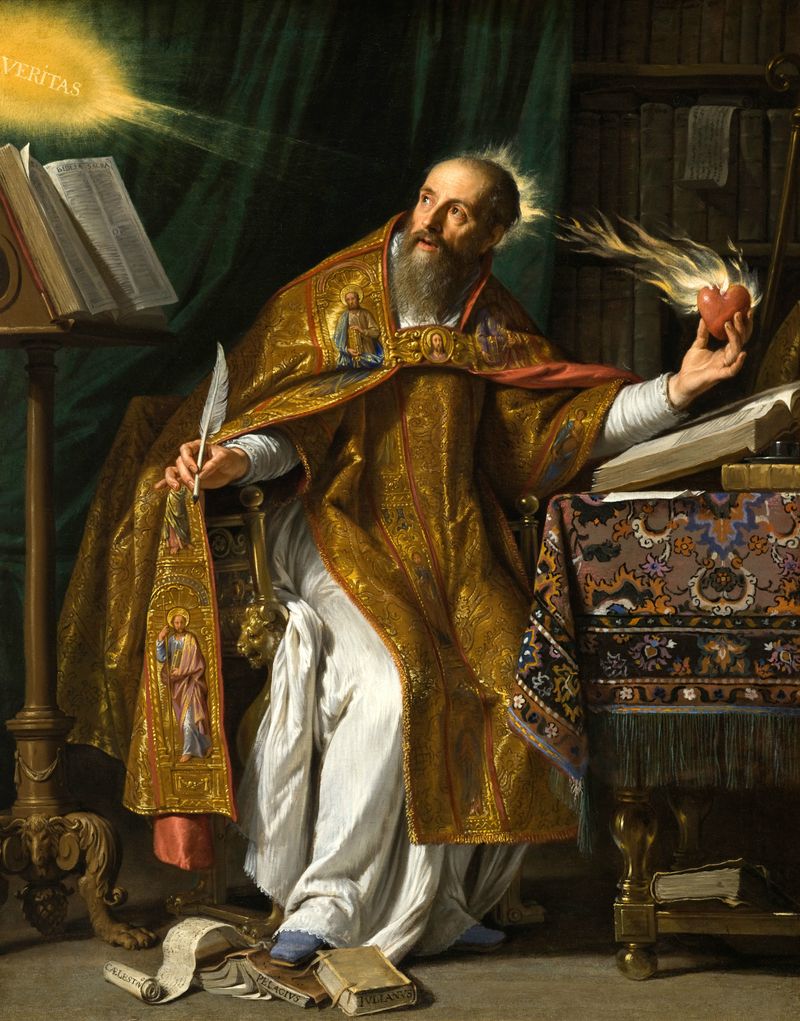

The Augustinian Hypothesis, the oldest proposed solution to the synoptic problem, follows the canonical order: Matthew was composed first, Mark second (as an abridgment or "follower" of Matthew, in Augustine's phrase), and Luke third, using both earlier Gospels. Augustine articulated this sequence around 400 CE in De Consensu Evangelistarum, describing Mark as a follower and abbreviator (pedissequus et breviator) of Matthew.19
The hypothesis was the default assumption in Western Christianity for over a thousand years. In the twentieth century, B. C. Butler mounted a renewed critical defense in The Originality of St Matthew (1951), arguing that the case for Markan priority relied in part on a logical fallacy. Butler observed that the "argument from order" — the fact that Mark occupies an intermediate position in pericope sequence between Matthew and Luke — does not by itself establish that Mark was the source. The same pattern of agreement would emerge if Matthew were the source and both Mark and Luke independently followed Matthew's order, departing from it at different points. The observation that Matthew and Luke rarely agree in order against Mark is equally consistent with Matthean priority as with Markan priority, because on either model, the middle term (whether Mark or Matthew) would be the one with which the other two most frequently agree.13
Butler's identification of this "Lachmann fallacy" — the incorrect inference that the middle term in a pattern of agreement must be the source rather than the dependent text — is widely acknowledged as a valid logical point, even by those who maintain Markan priority on other grounds. The argument from order, considered in isolation, cannot distinguish between Markan priority and Matthean priority; it can only establish that one of the three Gospels occupies an intermediate position. The case for Markan priority must therefore rest on the additional arguments from content, wording, and harder readings rather than on the argument from order alone.1, 13
The principal difficulty for the Augustinian Hypothesis is the same as for other models of Matthean priority: explaining why Mark, as an abbreviator of Matthew, would have omitted the Sermon on the Mount, the Lord's Prayer, the birth narrative, and the resurrection appearances while retaining passages that present Jesus in a less exalted light. The hypothesis must also account for the double tradition: if Luke used Matthew directly, the Q hypothesis is unnecessary, but the Augustinian model must then explain Luke's treatment of Matthean material — a challenge it shares with the Farrer Hypothesis.1, 14
Editorial fatigue as evidence
In a 1998 article in New Testament Studies, Mark Goodacre introduced the concept of "editorial fatigue" as a category of evidence bearing on the synoptic problem. Editorial fatigue is the phenomenon that occurs when a writer copying from a source makes changes at the beginning of an episode but fails to sustain those changes throughout, reverting to the wording or details of the source as the passage continues. The result is an internal inconsistency in the dependent text that is absent from the source — a telltale sign of the direction of literary dependence.9
Goodacre identified multiple examples of fatigue in Matthew and Luke that point to their dependence on Mark. In the parable of the sower, Matthew 13:4 changes Mark's "some seed fell on the path" to "some seeds fell on the path" (singular "seed" to plural "seeds"). But by Matthew 13:20, the text reverts to Mark's singular: "As for what was sown on rocky ground, this is the one who hears the word..." The initial editorial change (singular to plural) is not sustained; the author lapses back into the source's formulation (Mark 4:4; Matthew 13:4; Matthew 13:20).9
In the feeding of the five thousand, Mark 6:39–40 specifies that the crowd sat down in groups of hundreds and fifties. Matthew 14:19 simplifies the scene: the crowd simply sits down on the grass, with no mention of organized groups. Yet in the subsequent feeding of the four thousand, Matthew 15:35 states that the crowd sat down "on the ground," reverting to language closer to Mark's account. The simplification introduced at the beginning of the first feeding is not consistently maintained through the parallel narrative.9
In Luke, a prominent example occurs in the healing of the paralytic. Luke 5:18 introduces the man as being carried on a bed (klinē, κλίνη), a change from Mark's krabattos (κράβαττος), a more colloquial term for a pallet or mat. But by Luke 5:24, the Lukan Jesus tells the healed man to take up his klinidion (κλινίδιον, a diminutive related to klinē), whereas the earlier change from krabattos to klinē is partially sustained. More revealingly, Luke 5:19 describes the paralytic being let down "through the tiles" (dia tōn keramōn), reflecting a Greco-Roman architectural setting, whereas Mark 2:4 describes digging through a mud-brick roof — a detail more consistent with Palestinian construction. Luke's architectural change at the outset is not fully integrated with the rest of the narrative, suggesting editorial modification of a source rather than independent composition (Mark 2:1–12; Luke 5:17–26).9, 1
The evidential value of editorial fatigue lies in its directionality. The inconsistencies in Matthew and Luke are explicable as the products of writers who modified a source (Mark) at the beginning of an episode but lapsed back into the source's wording as they continued. The reverse — finding comparable patterns of fatigue in Mark pointing to Matthean or Lukan priority — has proven difficult. This asymmetry supports the thesis that Mark is the source and Matthew and Luke are the dependent texts.9
The Q debate
Whether the double tradition material shared by Matthew and Luke derives from a single written source (Q) or from Luke's direct use of Matthew is perhaps the most contested question in contemporary synoptic studies. The debate cuts across the boundaries of the major hypotheses: the Two-Source Hypothesis requires Q; the Farrer, Griesbach, and Augustinian hypotheses do not. The question of Q is thus partly independent of the question of Markan priority, since one can accept Markan priority with Q (the Two-Source Hypothesis) or without it (the Farrer Hypothesis).4, 5
The principal argument for Q's existence is the difficulty of explaining Luke's treatment of Matthean material if Luke had Matthew before him. The Sermon on the Mount (Matthew 5–7) is a unified literary composition; if Luke knew it, he broke it apart and dispersed its components across multiple chapters and distinct narrative settings. The Lord's Prayer appears in a longer form in Matthew 6:9–13 and a shorter form in Luke 11:2–4; proponents of Q argue that both versions derive from Q, with Matthew expanding and Luke preserving a form closer to the original. If Luke had Matthew's longer version, his decision to shorten it while clearly knowing the material would require explanation (Matthew 6:9–13; Luke 11:2–4).5, 11
The principal argument against Q is the principle of parsimony: Q is an entirely hypothetical document for which no independent evidence exists. No manuscript has been found, no early writer quotes it, and its existence is inferred entirely from the pattern of agreements between Matthew and Luke. If Luke's use of Matthew can account for the double tradition, the hypothesis of a lost source becomes unnecessary. Goodacre has argued that the case for Q rests on the assumption that Luke would not have dismantled Matthew's discourses — but this assumption itself requires justification, and Luke's editorial freedom in treating Markan material suggests that he was capable of substantial reorganization of his sources.4, 7
An additional argument against Q concerns Luke's apparent knowledge of distinctively Matthean material. Several passages in Luke appear to reflect not generic sayings tradition but specific Matthean redactional additions to Markan material — that is, changes that Matthew made to Mark that also appear in Luke. If Luke knew only Q and Mark, these Matthean fingerprints in Luke would be difficult to explain; if Luke knew Matthew directly, they follow naturally.4, 12
The Q debate remains unresolved. Proponents of Q continue to develop and refine their reconstruction of the document, pointing to the internal coherence of the reconstructed text, its distinctive theology, and its parallels with other ancient sayings collections such as the Gospel of Thomas. Opponents continue to argue that the double tradition is better explained by Luke's direct use of Matthew, and that the coherence of the reconstructed Q reflects the coherence of the traditions Matthew drew upon rather than the existence of a single prior document.5, 4, 10
The argument from order reconsidered
The argument from order — the observation that Mark's pericope sequence occupies an intermediate position between Matthew and Luke — has been central to the synoptic problem since Lachmann's 1835 study. Its interpretation, however, is more contested than its use in introductory textbooks might suggest.
The raw data are not in dispute. When the sequence of pericopes in the three Gospels is compared, three observations hold: (1) Matthew and Mark frequently agree in order; (2) Luke and Mark frequently agree in order; (3) Matthew and Luke rarely agree in order against Mark. The question is what inference can be drawn from these observations.1, 11
On the Two-Source Hypothesis, the explanation is straightforward: Matthew and Luke each independently followed Mark's order, departing from it at different points. Their independent departures from Mark naturally produce a pattern in which they rarely agree against Mark, because their rearrangements are independent of each other.2
Butler's 1951 critique demonstrated that this explanation, while consistent with the data, is not uniquely implied by the data. The same pattern would emerge on the Augustinian Hypothesis if Mark and Luke independently followed Matthew's order, departing at different points. The "middle term" in the three-way comparison — the Gospel that both others tend to agree with — need not be the source; it could equally be a dependent text that two independent authors happen to follow closely. The argument from order alone cannot distinguish between these possibilities.13
The argument from order can, however, be combined with the argument from content to narrow the range of viable hypotheses. If Mark is the middle term and if Mark also contains the least content (shortest Gospel, no birth narrative, no extended resurrection appearances, no Sermon on the Mount), then the hypothesis that the middle-term Gospel was the source from which the other two independently drew becomes more plausible than the hypothesis that the middle-term Gospel was a later abridgment — because the supposed abridger would have removed the most distinctive and memorable material while preserving the basic narrative framework. The convergence of the argument from order with the argument from content makes Markan priority more compelling than either argument alone.1, 14
Current state of the debate
The synoptic problem remains an open question in New Testament studies. The Two-Source Hypothesis continues to be the most widely adopted framework, functioning as the working assumption in the majority of introductory textbooks, commentaries, and scholarly publications on the synoptic Gospels.14, 11 The Farrer Hypothesis has gained substantial ground since the late twentieth century, particularly in British scholarship, and its proponents have produced detailed treatments of the double tradition material, the minor agreements, and editorial fatigue that challenge the necessity of Q.4, 9 The Griesbach Hypothesis retains a smaller but committed group of proponents, and the Augustinian Hypothesis has seen some renewed interest.
What unites all four major hypotheses is the acceptance that the synoptic Gospels stand in a literary relationship — that is, that one or more of the authors had access to one or more of the other texts (or to a shared written source) and used it in composing their own work. The degree of verbatim Greek correspondence, the shared parenthetical narrator comments, and the patterns of editorial modification visible across the three texts are not compatible with fully independent composition. The synoptic Gospels are literarily interdependent; the dispute concerns the direction and structure of that interdependence.1, 14
Each hypothesis accounts well for some features of the data while facing difficulties with others. The Two-Source Hypothesis explains the triple tradition and the double tradition with elegant simplicity but struggles with the minor agreements and the non-existence of any physical evidence for Q. The Farrer Hypothesis handles the minor agreements and eliminates the need for a hypothetical source but must explain Luke's dismantling of Matthew's discourses. The Griesbach Hypothesis eliminates Q and explains the double tradition through Luke's use of Matthew but faces the problem of Mark's omissions and the absence of a coherent redactional profile for Mark as a conflator. The Augustinian Hypothesis preserves the traditional order but shares the Griesbach Hypothesis's difficulty in explaining why Mark omitted the most distinctive material from his source.1, 6, 4
The synoptic problem is not merely an abstract literary puzzle. The hypothesis one adopts shapes how every passage in the synoptic Gospels is interpreted. If Mark wrote first, Matthew's additions to Mark represent Matthean theology; if Matthew wrote first, Mark's omissions represent Markan editorial choices. If Q existed, the double tradition preserves an independent witness to the sayings of Jesus that is older than any extant Gospel; if Q did not exist, the double tradition reflects Matthew's editorial work filtered through Luke's reinterpretation. The synoptic problem thus sits at the foundation of all historical and literary study of the Gospels, and its resolution — if resolution is achievable — would reconfigure the landscape of New Testament research.14, 1