Overview
- The Neo-Assyrian Empire (c. 911–609 BCE), beginning with the accession of Adad-nirari II and culminating under Ashurbanipal, became the largest political entity the ancient Near East had yet seen, stretching from the Iranian plateau to Egypt at its greatest extent.
- Neo-Assyrian kings pioneered military and administrative innovations — a professional standing army under Tiglath-pileser III, a province-and-governor system, an imperial road and relay-courier network, and large-scale population deportations — that became templates for later empires.
- The empire's material legacy survives in the palace reliefs of Nimrud, Khorsabad, and Nineveh, in the colossal lamassu gate guardians, and in the cuneiform library of Ashurbanipal, whose roughly 30,000 tablets in the British Museum preserve much of what is known about Mesopotamian literature, science, and religion.
The Neo-Assyrian Empire, conventionally dated from the accession of Adad-nirari II in 911 BCE to the destruction of the last Assyrian field army at Harran in 609 BCE, was the dominant political and military power of the ancient Near East for almost three centuries and the largest territorial state the world had yet produced.1, 16 At its greatest extent under Esarhaddon and Ashurbanipal in the seventh century BCE, the empire stretched from the western foothills of the Zagros Mountains in Iran to the Nile Delta and from the Persian Gulf to the southeastern coast of Anatolia, encompassing most of the urban centres of the ancient Near East and bringing the cuneiform-writing heartland of Mesopotamia into a single imperial polity for the first time on this scale.16, 21
What set the Neo-Assyrian state apart from earlier Mesopotamian polities was the systematic character of its imperialism. Rather than collecting tribute from nominally independent vassals, successive kings annexed conquered regions as provinces under royally appointed governors, deported large populations to integrate them into a multi-ethnic imperial economy, maintained a professional standing army garrisoned across the empire, and operated a state communication network that allowed orders to reach distant provinces within days.6, 7, 8 These institutions, together with the empire's monumental art and the great cuneiform library assembled at Nineveh under Ashurbanipal, constitute the most fully documented imperial system of the pre-classical Near East.13, 14
Historical framework and chronology
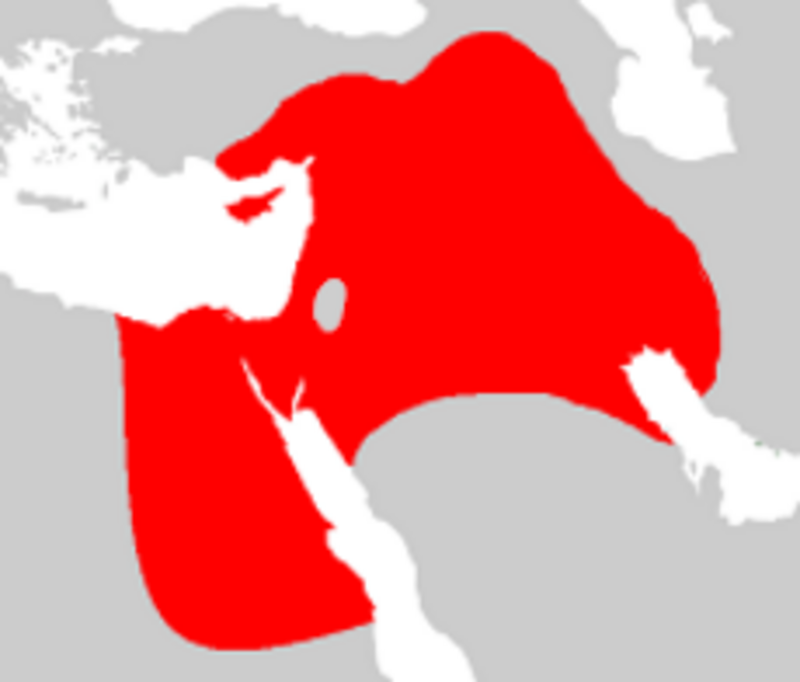

The Neo-Assyrian period is the third great phase of Assyrian history, preceded by the Old Assyrian merchant colonies of the early second millennium BCE and the Middle Assyrian kingdom that flourished and then contracted between roughly 1365 and 1050 BCE.1, 2 Following the Late Bronze Age collapse and waves of Aramean migration into upper Mesopotamia, Assyria entered a period of territorial retreat from which it began to recover under Ashur-dan II (934–912 BCE). His son Adad-nirari II is conventionally treated as the founder of the Neo-Assyrian Empire because his reign is the first for which a continuous and securely datable sequence of eponym lists, royal annals, and chronicle entries survives, allowing year-by-year reconstruction of events.2, 16
Three sub-phases are usually distinguished. The early phase (911–824 BCE), running through the reigns of Adad-nirari II, Tukulti-Ninurta II, Ashurnasirpal II, and Shalmaneser III, recovered the territorial limits of the old Middle Assyrian state and pushed Assyrian arms westward to the Mediterranean coast.2, 3 A long interval of internal weakness from the late ninth century into the mid eighth (often called the “period of the magnates”) saw effective power shift from the throne to provincial officials. The empire’s mature phase began with the seizure of power by Tiglath-pileser III in 745 BCE and continued through Shalmaneser V, Sargon II, Sennacherib, Esarhaddon, and Ashurbanipal — the era of greatest expansion, deportation, and palace building.4, 16 The empire collapsed with surprising speed after Ashurbanipal’s death (c. 631 BCE), falling to a Medo-Babylonian coalition between 614 and 609 BCE.15
Major Neo-Assyrian kings, reigns, and signature events2, 3, 4, 16
| King | Reign (BCE) | Signature event |
|---|---|---|
| Adad-nirari II | 911–891 | Recovery of the Khabur and Tigris frontier; conventional start of the empire |
| Ashurnasirpal II | 883–859 | Founded new capital at Kalhu (Nimrud); Banquet Stele records ten-day inaugural feast |
| Shalmaneser III | 859–824 | Battle of Qarqar (853) against an eleven-king Levantine coalition |
| Tiglath-pileser III | 745–727 | Created the standing army (kisir sharri); annexed Damascus and Babylon |
| Sargon II | 722–705 | Built the new capital Dur-Sharrukin (Khorsabad); destroyed Israel’s capital Samaria |
| Sennacherib | 704–681 | Sacked Babylon (689); besieged Lachish and Jerusalem (701); built the Southwest Palace at Nineveh |
| Esarhaddon | 681–669 | Conquered Egypt (671); rebuilt Babylon |
| Ashurbanipal | 669–c. 631 | Sacked Thebes (663); assembled the royal library at Nineveh |
| Sin-shar-ishkun | c. 627–612 | Lost Ashur (614) and Nineveh (612) to the Medo-Babylonian coalition |
| Ashur-uballit II | 612–609 | Last Assyrian king; defeated at Harran, ending the empire |
Early recovery and territorial reconstruction
Adad-nirari II inherited a kingdom whose effective control extended only over the Assyrian heartland between the Tigris and the Lower Zab. His annals, preserved in the inscriptions edited by Grayson in the Royal Inscriptions of Mesopotamia series, record campaigns against Aramean polities along the Khabur and middle Euphrates that re-established Assyrian garrisons at strategic crossings and reintroduced systematic tribute collection from the surrounding peoples.2 Because eponym lists survive continuously from his reign forward, year one of Adad-nirari II in 911 BCE is among the earliest events in ancient Near Eastern history that can be assigned to an exact calendar year, anchoring the chronology of the entire first millennium BCE.16
The decisive consolidation of the heartland fell to Ashurnasirpal II (883–859 BCE), whose campaigns are recorded in some of the most extensive royal annals of the period. He moved the political capital from Ashur to Kalhu (modern Nimrud) on the east bank of the Tigris, building a new royal city centred on the Northwest Palace, whose alabaster wall reliefs of war, hunting, and ritual established the iconographic vocabulary of Neo-Assyrian palace art for the next two centuries.2, 20 The Banquet Stele recovered from Kalhu records that the inauguration of the new capital in 879 BCE was marked by a ten-day feast for 69,574 guests — including envoys from across the empire and tens of thousands of local townspeople — that consumed thousands of cattle and sheep, along with thousands of jars of wine and beer. Whether the figures are literal or rhetorical, the stele documents the scale of royal display the new imperial centre was meant to project.20
Ashurnasirpal’s son Shalmaneser III (859–824 BCE) carried Assyrian arms further west than any predecessor, fighting repeated campaigns in northern Syria and the Levant. His sixth regnal year culminated in the Battle of Qarqar in 853 BCE on the Orontes River, where the Assyrian army faced an unprecedented coalition of eleven kings led by Hadadezer of Damascus and including Ahab of Israel, Irhuleni of Hamath, and Arab cameleers under a chieftain named Gindibu.3, 22 The Kurkh Monolith, Shalmaneser’s own commemorative stele, claims a great victory and lists the contingents of the coalition in detail — Ahab is credited with 2,000 chariots and 10,000 infantry — but the absence of any annexation of Syrian territory in the immediate aftermath, and the king’s repeated returns to the same region in subsequent campaigns, suggest that Qarqar was at best a tactical draw.22 The battle is significant less for its military outcome than for being the earliest mention of an Israelite king in an external source and one of the first appearances of the Arabs in recorded history.
The reforms of Tiglath-pileser III
Following the death of Shalmaneser III, Assyria entered nearly a century of weakened royal authority during which provincial governors — the so-called magnates — ran much of the empire as quasi-independent fiefs. The seizure of power in 745 BCE by Tiglath-pileser III, who took the throne under unclear circumstances during a revolt at Kalhu, inaugurated a sweeping restructuring of the Assyrian state that many historians regard as the moment Assyria became an empire in the strict institutional sense.4, 16
Tiglath-pileser’s most consequential innovation was the conversion of the Assyrian army from a seasonal levy of conscripts into a permanent professional force. The new core of the army, known as the kisir sharri or “king’s unit,” was a standing body of trained infantry, cavalry, and chariotry maintained year-round at royal expense and supplemented during major campaigns by provincial levies and allied contingents.4, 7 Karen Radner’s work on Neo-Assyrian governance has shown that this army was complemented by a corresponding reform of the provincial system: large semi-autonomous territories were broken into smaller provinces, each placed under a governor who served at the king’s pleasure rather than by hereditary right, and an expanded body of royal officials was inserted between the governors and the throne.7, 16
The political effect of these reforms was immediate and dramatic. Within his first decade, Tiglath-pileser had subjugated Urartu, suppressed Aramean and Chaldean polities in Babylonia, annexed Damascus after a two-year siege ending in 732 BCE, and reduced Israel and Judah to tributary status.4 In 729 BCE he had himself crowned king of Babylon under the throne name Pulu, establishing a personal union between the two oldest cuneiform monarchies. The combination of a standing army, a centralised provincial system, and direct control over the religious and economic capital of southern Mesopotamia provided the institutional basis on which his successors would push the empire to its greatest extent.16
Provincial administration and the state correspondence
By the late eighth century BCE, the Neo-Assyrian Empire was organised into roughly seventy provinces, each headed by a governor (Akkadian bel pahete or simply pahutu, “proxy”) responsible for collecting tribute, maintaining order, conscripting labour for state projects, and reporting regularly to the king.7, 16 The governors were drawn increasingly from a class of professional administrators rather than from the old hereditary aristocracy, a deliberate policy designed to ensure that the holders of imperial office owed their position to the crown alone. Many of the highest officials — the chief eunuch, the palace herald, the chief cupbearer — were eunuchs, a status that prevented the emergence of dynastic rivals to the royal house.7
Holding the empire together at this scale required reliable communication. The state correspondence of the Neo-Assyrian Empire, recovered from the royal archives at Nineveh and edited in the State Archives of Assyria series under Simo Parpola and others, preserves thousands of letters between the king and his governors, generals, and scholars.8, 9 Karen Radner’s reconstruction of the imperial communication system shows that messages were carried along a network of royal roads by relay couriers using fresh horses stationed at intervals; one well-known dispatch from the western province of Que (Cilicia) is calculated to have reached the Assyrian heartland, a distance of roughly 700 kilometres across rivers without bridges, in under five days.8 The same road network was used to move troops, deportees, and tribute, and the postal system was the institutional ancestor of the more famous Persian Royal Road of the Achaemenid Empire that succeeded Assyria.
Radner has argued that the imperial communication network “may well constitute Assyria’s most important contribution to the art of government,” because it allowed a king sitting in Nineveh or Khorsabad to issue orders to a governor on the Egyptian frontier and receive a reply within weeks rather than months — a degree of central control that no earlier Mesopotamian polity had achieved over comparable distances.8 The same archives reveal a parallel network of scholarly correspondence: letters from astrologers, exorcists, physicians, and diviners advising the king on celestial omens, ritual purifications, and the auspicious timing of military campaigns, an unparalleled record of the intellectual life of an ancient royal court.9, 10
Mass deportation as imperial policy
Among the most distinctive instruments of Neo-Assyrian rule was the systematic transfer of conquered populations from one part of the empire to another. The classic study by Bustenay Oded, Mass Deportations and Deportees in the Neo-Assyrian Empire (1979), catalogued 157 separate deportation events recorded in the royal inscriptions and chronicles between Ashur-dan II in the early ninth century and the fall of the empire, with a cumulative total of approximately 4.4 million deportees over roughly three centuries.6 Sennacherib’s inscriptions alone account for more than 469,000 deportees in twenty separate operations, while Tiglath-pileser III claims around 393,000 and Sargon II about 239,000, figures that even allowing for royal exaggeration imply a regular and large-scale movement of populations.6, 4
Oded distinguished several functions for the policy. Deportation served as a punitive measure that broke the social cohesion of rebellious populations without resorting to mass execution; as a means of supplying labour for royal building projects in the Assyrian heartland and for agricultural expansion in newly developed provinces; as a mechanism for transferring skilled craftsmen, scribes, and scholars from conquered cities to the royal capitals; and as a tool of imperial integration, since deportees relocated far from their homelands lost their local political networks and became dependent on the imperial state.6 The biblical accounts of the deportations of the northern kingdom of Israel after the fall of Samaria in 722 BCE, described in 2 Kings 17, and of the Judahites after the siege of Lachish in 701 BCE, are among the best-known cases attested in both Assyrian and external sources.11, 21
Major Neo-Assyrian deportations recorded in royal inscriptions, by king6
One important consequence of the deportation system was the spread of Aramaic across the empire. As Aramean populations from Syria and upper Mesopotamia were resettled throughout the imperial territory and as Aramean groups already in Babylonia were drawn into the imperial workforce, the Aramaic language and its 22-letter alphabetic script gradually displaced Akkadian as the everyday language of administration. By the seventh century BCE, scribes attached to provincial offices were producing parallel records in Akkadian cuneiform on clay tablets and in Aramaic on parchment or wax-coated boards, and Tiglath-pileser III had effectively recognised Aramaic as a second official language of the empire.19 The fact that Aramaic was eventually inherited as the administrative lingua franca by the Neo-Babylonian and Achaemenid Persian empires that followed Assyria is a direct consequence of Neo-Assyrian deportation and resettlement policy.19, 8
Siege warfare and military technology
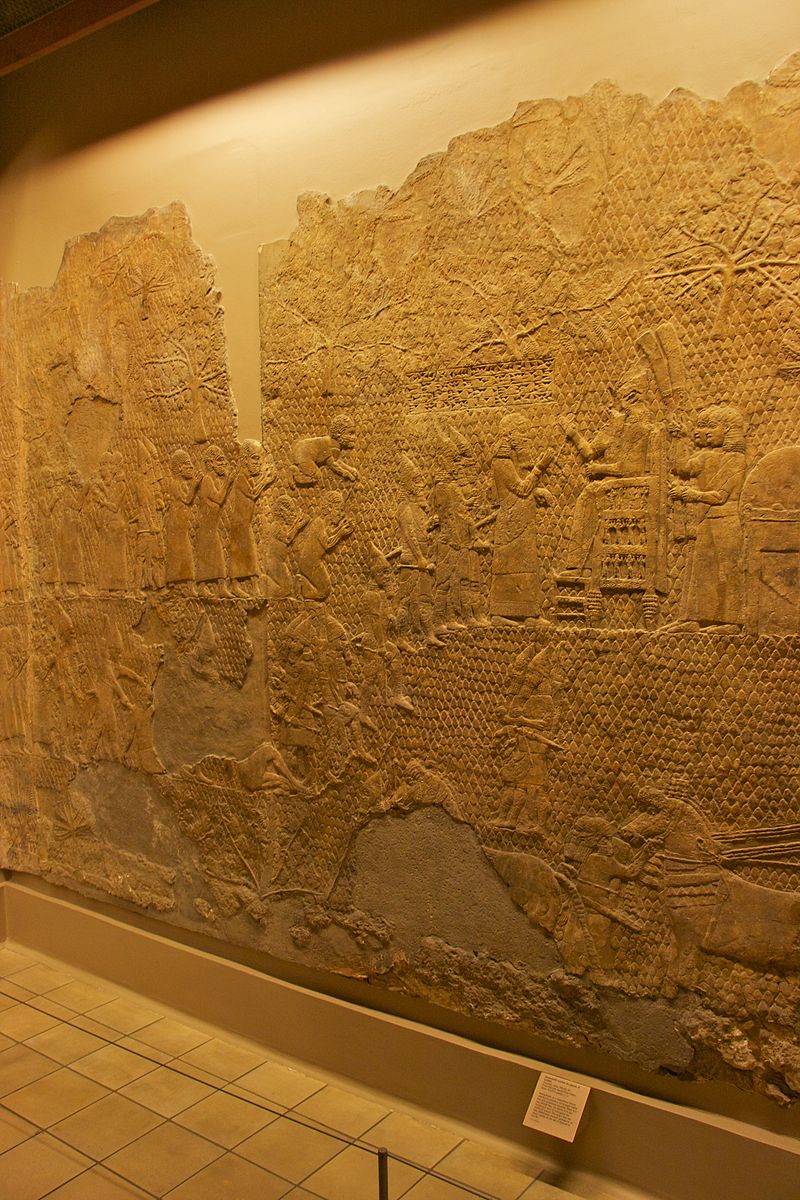
The Neo-Assyrian army was the most formidable military instrument of its day, and its capacity to take fortified cities was perhaps its most distinctive technical achievement. Palace reliefs from Nimrud, Khorsabad, and Nineveh depict virtually every element of an Assyrian siege: archers and slingers providing covering fire from behind large wicker shields, sappers undermining walls, engineers building earthen ramps to bring battering rams up to the parapets, and prisoners being led away in chains while officials count the spoils.12, 23

The Assyrian battering ram, refined under Ashurnasirpal II, was a wheeled wooden frame protected by a roof and turret, inside which a heavy timber beam tipped with a metal blade was suspended on ropes so that it could swing freely against masonry walls.23 By the reign of Sennacherib (704–681 BCE), the Assyrians were deploying lighter, prefabricated rams that could be assembled on site and operated in groups against the same gate or section of wall. Aaron Burke’s technical analysis of the surviving depictions argues that the Assyrian rams were not in fact powerful enough to breach intact mudbrick or stone curtain walls; rather, they were used in concert with siege ramps to attack the relatively thin parapets at the top of fortifications, where defenders were exposed and where a localised collapse could create a foothold for assault troops.23
The most fully documented Assyrian siege is Sennacherib’s capture of the Judahite fortress of Lachish in 701 BCE, recorded simultaneously in the Hebrew Bible (2 Kings 18–19; 2 Chronicles 32), in Sennacherib’s own annals on the Taylor Prism, in the Lachish Reliefs from his Southwest Palace at Nineveh, and in the archaeological excavations of the site itself, where the Assyrian siege ramp survives as one of the oldest siege works yet identified anywhere in the world.5, 11 David Ussishkin’s study of the Lachish reliefs reconstructed the siege from the carved panels: the Assyrian army builds an earth ramp against the southwest corner of the city, archers and slingers cover the advance, battering rams are pushed up the ramp under hide-covered roofs, defenders on the walls hurl down stones and torches, and after the wall is breached the population is led out in long files of deportees while captured rebel leaders are flayed alive in front of Sennacherib’s throne.11 The convergence of an Assyrian artistic record, an Assyrian textual record, a biblical narrative, and a stratified archaeological excavation makes Lachish the best-attested ancient siege before the Roman period.
Palaces, lamassu, and royal art
The Neo-Assyrian kings expressed their political ideology through monumental architecture and sculpture on a scale unprecedented in the ancient Near East. Each major king built a new palace or new capital city: Ashurnasirpal II at Kalhu, Sargon II at Dur-Sharrukin, Sennacherib at Nineveh, Esarhaddon at Nineveh and Babylon, Ashurbanipal at Nineveh again. The palaces shared a common architectural vocabulary — vast courtyards, throne rooms reached by long ceremonial passages, gateways flanked by colossal stone gate-figures — and a common decorative programme of carved stone reliefs lining the walls of the principal rooms.17, 18
The most recognisable elements of this programme are the lamassu (Akkadian aladlammû or kuribu), colossal hybrid creatures with the body of a bull or lion, the wings of an eagle, and a bearded human head wearing a horned crown. Two pairs of lamassu, each carved from a single alabaster block weighing approximately 28 tonnes, flanked the main gates of Sargon II’s palace at Dur-Sharrukin (modern Khorsabad).17, 18 Designed to be read from both the front and the side, the figures were given five legs so that a viewer approaching the gate would see two legs in a static frontal pose, while a viewer walking past the side would see four legs in a striding posture. The lamassu functioned as protective spirits guarding the threshold between the outside world and the king’s sacred space, and their faces — resembling depictions of the king himself — identified the royal person with the divine guardians.18
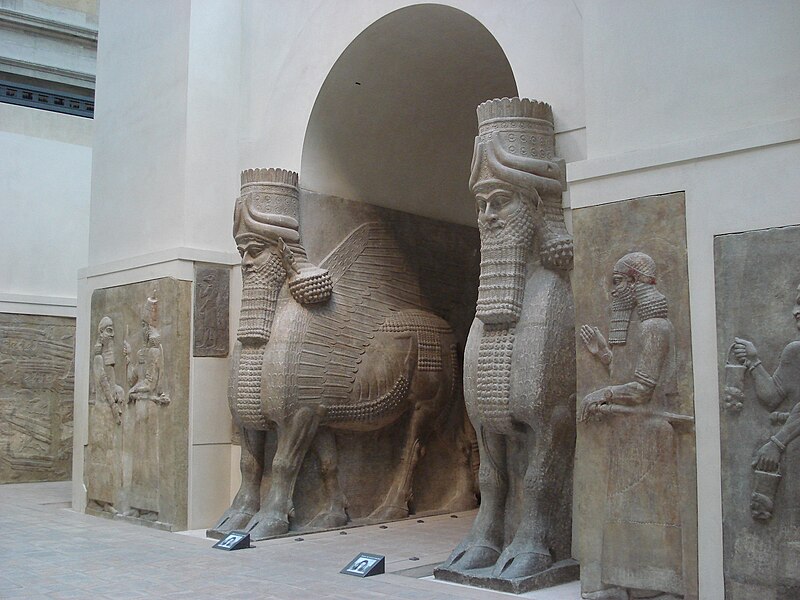

The wall reliefs that lined the palace rooms behind the lamassu told two great stories: the king at war and the king at the hunt. The war reliefs depicted Assyrian campaigns in narrative sequence, often labelled in cuneiform with the names of the cities under attack and the foreign kings being executed or led away. The hunting reliefs from Ashurbanipal’s North Palace at Nineveh, now in the British Museum, depict the king killing lions in a ritual hunt that figured the king’s suppression of chaos and his protection of the cultivated land from wild predators.18, 13 Together with the lamassu, these reliefs constitute one of the most extensive surviving programmes of state propaganda from the ancient world and a primary source for the appearance, dress, weapons, and ritual life of the empire.
The library of Ashurbanipal
Ashurbanipal (669–c. 631 BCE) is the only Assyrian king known to have been literate in cuneiform; he claims in several inscriptions to have been trained as a scholar in his youth and to have been able to read difficult Sumerian and Akkadian texts.13, 14 Whatever the literal truth of this boast, his reign is associated with the most ambitious attempt to assemble a comprehensive cuneiform library ever undertaken in antiquity. From his palace at Nineveh, Ashurbanipal sent agents to Babylonia and other centres of cuneiform learning with instructions to seek out and copy — or, when necessary, simply to confiscate — tablets in every genre of Mesopotamian scholarship.13
The library was excavated by Austen Henry Layard and Hormuzd Rassam between 1849 and 1854 in the rooms of the Southwest and North Palaces at Nineveh, and the surviving tablets and fragments — numbering more than 30,000 by the British Museum’s current count — were shipped to London, where they remain the core of the museum’s cuneiform collection.13, 14 The Ashurbanipal Library Project, a long-running collaboration between the British Museum and the University of Pennsylvania, has produced high-resolution digital images and transliterated editions of much of the corpus.14
The contents are extraordinarily wide-ranging. Literary works include the most complete surviving copy of the Standard Babylonian version of the Epic of Gilgamesh, the Enuma Elish creation epic, the myth of Atra-hasis with its account of a great flood, and a substantial collection of Sumerian and Akkadian poetry, hymns, and proverbs.13 Scholarly and technical works include omen series for divination from celestial events, sacrificial livers, and abnormal births; lexical lists matching Sumerian and Akkadian words; medical texts cataloguing symptoms and prescriptions; mathematical and astronomical tables; and ritual handbooks for exorcists. State documents include royal correspondence, treaties, administrative records, and the scholarly letters Parpola edited as part of the State Archives of Assyria.9, 13 The discovery in 1872 of a flood narrative on one of the Gilgamesh tablets — the “Flood Tablet” identified by George Smith — was the beginning of the modern realisation that the Hebrew biblical traditions had deep roots in earlier Mesopotamian literature.14
The conquest of Egypt
The southwestern frontier of the empire reached Egypt during the reign of Esarhaddon (681–669 BCE). After an initial campaign in 674 BCE that was repulsed by the Kushite pharaoh Taharqa of the Twenty-fifth Dynasty, Esarhaddon mounted a much larger expedition in 671 BCE that succeeded in storming Memphis. Taharqa fled south into Nubia, but his wife, his crown prince Ushankhuru, and much of the royal household were captured and deported to Assyria.21 Esarhaddon installed local governors and tributary kings throughout Lower Egypt, including Necho I of Sais, an arrangement intended to convert Egypt into an Assyrian satellite without the expense of permanent occupation. The campaign is commemorated on the Victory Stele of Esarhaddon erected at Zincirli in southeastern Anatolia, which depicts the Assyrian king holding ropes attached to lip-rings through the mouths of the kneeling Taharqa and the king of Sidon — one of the most striking visual statements of imperial domination to survive from the ancient Near East.21
The Assyrian hold on Egypt proved difficult to maintain. Taharqa returned from the south within a year and recovered Memphis, and his successor Tantamani temporarily reoccupied Lower Egypt after Esarhaddon’s death. Ashurbanipal responded with a punitive campaign that culminated in the sack of Thebes (Egyptian Waset, biblical No-Amon) in 663 BCE, the first time the religious capital of Upper Egypt had ever been taken by a foreign army. The booty from Thebes — including, according to Ashurbanipal’s annals, two great obelisks and a vast quantity of gold and silver — was carried back to Nineveh, and the sack of Thebes was remembered in the Hebrew prophetic tradition (Nahum 3:8) as the paradigm of total urban destruction.21, 15 Within a generation, however, the Saite Twenty-sixth Dynasty under Psamtik I had quietly reasserted Egyptian independence, and Assyrian power south of the Levant gradually evaporated.
The collapse of the empire
The collapse of the Neo-Assyrian Empire after Ashurbanipal’s death is one of the most rapid imperial disintegrations in ancient history. The exact date of Ashurbanipal’s death is uncertain, falling somewhere between 631 and 627 BCE, and the succession was contested between rival sons. By 626 BCE, the Babylonian general Nabopolassar had seized the throne of Babylon and begun a war of liberation against Assyrian rule in the south.15, 16 Within fifteen years, the empire that had dominated the Near East for almost three centuries had ceased to exist.
The principal narrative source for the collapse is the cuneiform tablet known as the Fall of Nineveh Chronicle (ABC 3 in Grayson’s standard numbering), a Babylonian chronicle preserved on a single tablet now in the British Museum that records year by year the campaigns of Nabopolassar from 616 to 609 BCE.15 According to the chronicle, Nabopolassar fought inconclusive campaigns against Assyrian forces along the middle Euphrates for several years before being joined by a much more dangerous enemy: the Medes, an Iranian people from the Zagros highlands ruled by Cyaxares (Akkadian Umakishtar). In 614 BCE the Medes captured the ancient religious capital of Ashur, after which Nabopolassar arrived too late to participate in the sack but met Cyaxares outside the ruined city and concluded a formal alliance, sealed (according to later Greek tradition) by a marriage between Nabopolassar’s son Nebuchadnezzar and a Median princess.15
In May of 612 BCE the combined Medo-Babylonian army laid siege to Nineveh itself. The Fall of Nineveh Chronicle records that the siege lasted three months; in the month of Ab (July–August) 612 BCE the city was stormed and sacked, the Assyrian king Sin-shar-ishkun apparently dying in the destruction.15 Archaeological excavations at Nineveh have confirmed a destruction layer dating to this period, with burnt debris, slaughtered defenders, and signs of looting in the palaces of Sennacherib and Ashurbanipal. A remnant of the Assyrian army withdrew westward to Harran under a new king, Ashur-uballit II, and held out for three more years with Egyptian military support; their final defeat at Harran in 609 BCE, also recorded in the Fall of Nineveh Chronicle, marks the conventional end of the Neo-Assyrian Empire.15 The biblical Book of Nahum, almost certainly composed shortly before or during these events, celebrates the impending destruction of Nineveh in language that captures the shock of contemporaries at the sudden fall of so terrifying a power (Nahum 2–3).
Legacy and the recovery of the empire
The political institutions of the Neo-Assyrian Empire did not vanish with its destruction. Its provincial system, royal road network, professional army, and bureaucratic correspondence were inherited almost entire by the Neo-Babylonian successor state under Nabopolassar and Nebuchadnezzar II, and from the Babylonians by the Achaemenid Empire that followed in the late sixth century BCE. The Persian satrapy system, the Royal Road, the relay courier service, and the practice of governing a multi-ethnic empire from a series of monumental palace complexes are all clearly modelled on the Assyrian template, and through the Achaemenids these institutional patterns passed in turn to the Hellenistic kingdoms and the early Roman provincial system.8, 16
For more than two millennia after 609 BCE, however, the Neo-Assyrian Empire was known almost entirely through hostile external sources — the Hebrew Bible, the brief notices of Herodotus, and the romanticised accounts of Ctesias and the Greek historians — and Assyria existed in the Western imagination chiefly as a byword for cruelty and overweening power. The recovery of the empire as a historical reality began with the excavations of Paul-Émile Botta at Khorsabad in 1843 and Austen Henry Layard at Nimrud and Nineveh from 1845 onwards, which produced the first lamassu, the first palace reliefs, and the first cuneiform tablets to reach European museums in large numbers.17, 13 The decipherment of cuneiform by Henry Rawlinson and others in the 1850s, building on Rawlinson’s work on the Behistun inscription of Darius the Great, opened the inscriptions and tablets to systematic reading.14
Modern Assyriology has continued to expand the source base in three main directions. The Royal Inscriptions of Mesopotamia (RIM) and Royal Inscriptions of the Neo-Assyrian Period (RINAP) projects, initiated by A. Kirk Grayson at Toronto and continued at the University of Pennsylvania under Grant Frame and Jamie Novotny, have produced authoritative critical editions of the royal annals from Adad-nirari II down to Ashur-uballit II.2, 3, 4, 5 The State Archives of Assyria series, founded by Simo Parpola at Helsinki in the 1980s, has edited the surviving administrative and scholarly correspondence from the Nineveh archives.9, 10 And the Ashurbanipal Library Project at the British Museum has continued the long task of cataloguing, photographing, and editing the tens of thousands of tablets recovered from the royal library.13, 14 Together with archaeological work at sites across Iraq, Syria, and Turkey, this scholarship has transformed the Neo-Assyrian Empire from the caricature of biblical and Greek tradition into the most fully documented imperial system of the pre-classical world — a state whose institutions, texts, and material culture remain the foundational reference for the study of ancient empires.1, 16
References
The Royal Inscriptions of Tiglath-pileser III (744–727 BC) and Shalmaneser V (726–722 BC), Kings of Assyria, RINAP 1
The Royal Inscriptions of Sennacherib, King of Assyria (704–681 BC), Part 1, RINAP 3/1
Assyrian empire builders: Governors, diplomats and soldiers in the service of Sargon II and Tiglath-pileser III
An imperial communication network: the state correspondence of the Neo-Assyrian Empire
The Conquest of Lachish by Sennacherib (Publications of the Institute of Archaeology 6)
The Construction of the Assyrian Empire: A Historical Study of the Inscriptions of Shalmaneser III (859–824 BC) Relating to His Campaigns to the West (CHANE 3)
Ancient Near Eastern battering rams: questioning their penetrative power and target location