Overview
- The Aztec Empire, formally the Triple Alliance of Tenochtitlan, Tetzcoco, and Tlacopan formed in 1428, controlled much of central Mexico by 1519 and governed an estimated 5 to 6 million people across 400–500 tributary polities spanning from the Gulf Coast to the Pacific.
- Tenochtitlan, founded in 1325 on an island in Lake Texcoco, grew into one of the largest cities in the world by the early sixteenth century, with a population of 200,000 to 300,000 sustained by intensive chinampa agriculture, elaborate hydraulic infrastructure, and a vast tribute economy.
- The empire fell in August 1521 after a 75-day siege led by Hernán Cortés and an estimated 200,000 Indigenous allies, but Aztec contributions to agriculture, urbanism, mathematics, and the arts represent one of the most remarkable cultural achievements of the pre-Columbian Americas.
The Aztec Empire was the dominant political and cultural force in Mesoamerica during the century preceding the Spanish arrival in 1519, controlling a territory that extended across much of central Mexico from the Gulf Coast to the Pacific lowlands.1, 2 The empire was formally constituted as the Triple Alliance (Excan Tlatoloyan), a confederation of three city-states — Tenochtitlan, Tetzcoco, and Tlacopan — formed in 1428 after their joint defeat of the Tepanec kingdom of Azcapotzalco.1, 4 Although Tetzcoco initially served as an equal partner and Tlacopan held a junior share of tribute, Tenochtitlan rapidly emerged as the senior power, and by the late fifteenth century the Mexica of Tenochtitlan exercised effective hegemony over an estimated 400 to 500 tributary polities encompassing perhaps 5 to 6 million people.1, 14 The island capital of Tenochtitlan, with a population of 200,000 to 300,000 at the time of European contact, ranked among the largest cities in the world, rivalling contemporary Paris, Constantinople, and Beijing in scale and sophistication.1, 7 The empire's abrupt destruction by a small Spanish force and its vastly more numerous Indigenous allies in 1521 brought an end to one of the most remarkable state-building projects in the pre-Columbian Americas.5, 21
Origins and the Mexica migration
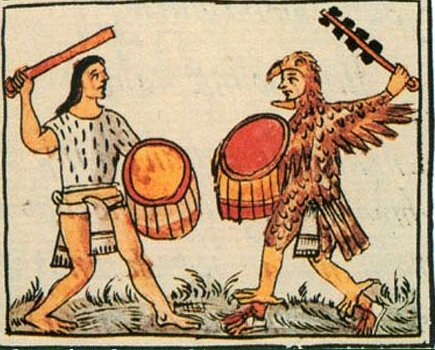

The people who built the Aztec Empire called themselves the Mexica, and their origin narrative describes a long migration from a mythical homeland called Aztlan — meaning "place of the herons" — somewhere in northwestern Mexico or the arid north.1, 3 According to this tradition, the Mexica's patron deity Huitzilopochtli commanded them to leave Aztlan and seek a new home, which they would recognise when they found an eagle perched on a prickly pear cactus growing from a rock — an image that appears on the modern Mexican national flag.1, 16 Archaeological and linguistic evidence suggests that the Mexica were one of several Nahuatl-speaking groups that migrated southward into the Basin of Mexico during the twelfth and thirteenth centuries CE, entering a region already densely populated and politically fragmented following the collapse of the Toltec state around 1150 CE.1, 2
Arriving in the Basin of Mexico as impoverished newcomers, the Mexica initially served as mercenaries and clients of established powers, particularly the Tepanec kingdom centred at Azcapotzalco.1, 4 In approximately 1325, they founded their capital of Tenochtitlan on a marshy island in Lake Texcoco, a location that offered both defensive advantages and access to the lake's abundant aquatic resources.1, 7 A sister settlement, Tlatelolco, was established on an adjacent island and would become one of the largest marketplaces in Mesoamerica.1 For approximately a century, the Mexica remained subordinate to the Tepanecs, paying tribute and providing military service, but this period of subjugation ended dramatically in 1428 when a coalition led by the Mexica ruler Itzcoatl and his nephew Tlacaelel overthrew Azcapotzalco and established the Triple Alliance that would become the Aztec Empire.4, 3
Imperial expansion and the tributary system
The Aztec Empire expanded with extraordinary rapidity between 1428 and 1519, growing from a regional alliance in the Basin of Mexico to a polity that extracted tribute from communities as distant as the Soconusco region on the Guatemalan border, over 1,000 kilometres from the capital.4, 14 Expansion was driven by a combination of military conquest, diplomatic pressure, and strategic alliance-building, with Aztec armies numbering up to 200,000 warriors in major campaigns.4 The great conquering rulers — Moctezuma I (r. 1440–1469), Axayacatl (r. 1469–1481), Ahuitzotl (r. 1486–1502), and Moctezuma II (r. 1502–1520) — progressively extended imperial reach through campaigns that combined military force with ritual warfare known as flower wars (xochiyaoyotl), formalised conflicts with unconquered enemies such as Tlaxcala that provided a steady supply of sacrificial captives.4, 1
The Aztec Empire was not a centralised territorial state in the European sense but rather a hegemonic empire that exercised control primarily through the extraction of tribute rather than through direct provincial administration.14, 10 Conquered rulers were typically left in power provided they paid regular tribute to the alliance and supplied soldiers when required.14 The Codex Mendoza, a pictorial manuscript compiled shortly after the conquest on Spanish orders, records the tribute obligations of 38 imperial provinces, listing the quantities of textiles, foodstuffs, warrior costumes, precious feathers, gold, jade, cacao, rubber, and other goods that flowed into the capital on a semi-annual or annual schedule.13, 10 This system generated enormous wealth for the imperial core but left conquered communities with considerable local autonomy, a structural feature that would prove a critical vulnerability when many tributary and unconquered polities chose to ally with the Spanish invaders in 1519–1521.14, 5
Estimated extent of Aztec tributary provinces by reign4, 14
Tenochtitlan: the imperial capital
By the early sixteenth century, Tenochtitlan had grown from a modest island settlement into a monumental city that astonished the Spanish conquistadors who first beheld it in November 1519.1, 21 The soldier-chronicler Bernal Díaz del Castillo described the sight of the city rising from Lake Texcoco as resembling "the enchantments they tell of in the legend of Amadis," with its white-plastered temples and pyramids, carefully ordered streets and canals, and bustling markets visible from the surrounding mountains.21 The city covered approximately 13.5 square kilometres and housed between 200,000 and 300,000 inhabitants, making it one of the five or six largest cities in the world at the time.1, 7, 8
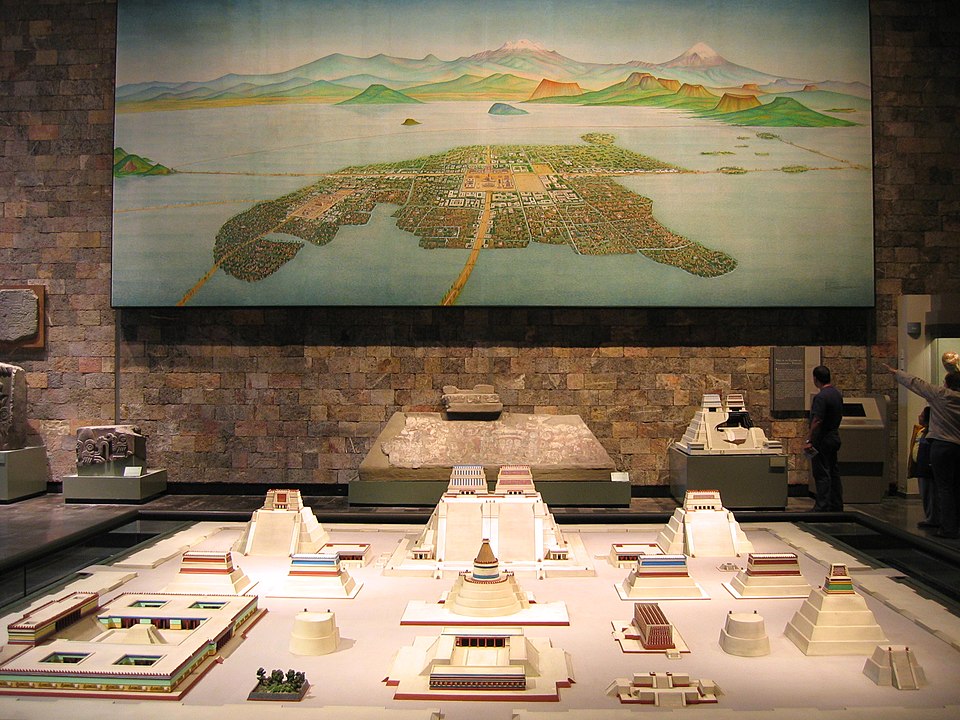

Tenochtitlan's urban plan reflected both practical engineering and cosmological symbolism.1, 17 The city was divided into four great quarters (campan) oriented to the cardinal directions, with the ceremonial precinct — dominated by the Templo Mayor, a twin-pyramid temple approximately 45 metres tall dedicated to Huitzilopochtli and the rain god Tlaloc — at the centre.1, 7 Three massive causeways, each wide enough for eight horsemen to ride abreast according to Spanish accounts, connected the island to the mainland at Iztapalapa (south), Tlacopan (west), and Tepeyac (north), while a fourth led east to Tetzcoco by canoe.1 An aqueduct carrying fresh water from the springs at Chapultepec supplemented the lake's brackish water, and a massive dike constructed under Nezahualcoyotl of Tetzcoco separated the saline eastern lake from the fresher western waters surrounding the city, controlling flooding and maintaining the chinampa agricultural zone.7, 8
The great market at Tlatelolco, Tenochtitlan's twin city absorbed in 1473, attracted an estimated 60,000 traders daily and offered goods from across Mesoamerica and beyond, including obsidian tools, cacao, cotton textiles, featherwork, pottery, gold ornaments, rubber, tropical bird plumage, and enslaved persons.1, 16 Market exchange operated alongside a redistributive tribute economy, and professional long-distance merchants known as pochteca travelled far beyond imperial borders, serving simultaneously as traders, intelligence gatherers, and sometimes as agents provocateurs whose mistreatment provided a pretext for military intervention.10, 12
Agriculture and economy
The economic foundation of the Aztec Empire rested on one of the most intensive and productive agricultural systems in the pre-industrial world.1, 9 The centrepiece of this system was chinampa agriculture, an ingenious technique in which long, narrow raised fields were constructed in the shallow lake beds by alternating layers of aquatic vegetation, mud, and soil, anchored by willow trees planted along the edges.8, 9 Chinampas were extraordinarily productive, yielding up to seven harvests per year for some crops, and the chinampa zones ringing Tenochtitlan and the freshwater lakes of Xochimilco and Chalco covered an estimated 9,000 to 12,000 hectares, producing a significant portion of the capital's food supply.8, 1
Beyond chinampas, Aztec farmers employed terracing on hillsides, canal irrigation in the lowlands, and flood-recession farming along river margins to maximise output from the Basin of Mexico's diverse ecological zones.1, 7 Maize (Zea mays) was the staple crop and the centre of Mexica cosmological thought, supplemented by beans, squash, amaranth, chia, chilli peppers, and the protein-rich lake algae spirulina (tecuitlatl), which was harvested from the surface of Lake Texcoco.1, 16 Cacao, consumed as a frothy, spiced drink by the elite, also functioned as a medium of exchange alongside cotton mantles (quachtli) and small copper axe-blades, since the Aztecs lacked a metallic coinage system.10, 1
The tribute economy channelled vast quantities of goods from the provinces to the imperial centre.13, 14 According to the Codex Mendoza, annual tribute payments included approximately 7,000 tonnes of maize, 4,000 tonnes of beans, 4,000 tonnes of chia, 4,000 tonnes of amaranth, and 2 million cotton mantles, alongside luxury items such as jade, turquoise, gold dust, eagle feathers, jaguar skins, live birds, and cacao.13 Provincial communities that failed to pay tribute faced military retaliation, while compliant polities benefited from access to the empire's trade networks and the relative stability that imperial oversight provided.14, 15
Society and social structure
Aztec society was hierarchically organised around a fundamental distinction between nobles (pipiltin) and commoners (macehualtin), though the boundaries between these classes were somewhat permeable through military achievement.1, 16 At the apex stood the huey tlatoani ("great speaker"), the ruler of Tenochtitlan and effective head of the Triple Alliance, who was chosen from the royal lineage by a council of senior nobles and military leaders rather than through strict primogeniture.1, 3 Below the tlatoani, a complex bureaucracy of tribute collectors, judges, provincial governors, and military commanders administered the empire, while a priestly caste managed an elaborate ceremonial calendar and the education of elite youth in temple schools called calmecac.1, 10
Commoners were organised into calpulli, territorial kin-based units that functioned as the fundamental building blocks of Aztec social and political organisation.1, 16 Each calpulli collectively held agricultural land, maintained its own temple, and was responsible for labour service and military obligations to the state.1 Children of commoners attended neighbourhood schools called telpochcalli, where boys received military training and girls learned domestic arts, weaving, and religious observances.16 A warrior who captured four enemies in battle could rise to the prestigious rank of jaguar knight (ocelotl) or eagle knight (cuauhtli), gaining access to privileges normally reserved for the nobility, including the right to wear cotton garments, drink pulque in public, and own land privately.4, 1 At the bottom of the social hierarchy were slaves (tlacotin), a status typically resulting from debt, criminal punishment, or voluntary self-sale during famine, though Aztec slavery was notably different from chattel slavery in that the children of slaves were born free.1, 16
Religion and human sacrifice
Aztec religion was a complex polytheistic system centred on the maintenance of cosmic order through ritual practice, particularly the offering of human blood and hearts to sustain the gods and ensure the continuation of the current world age, or Fifth Sun.1, 2 The Mexica believed that the present world was the fifth in a series of creations, each of which had ended in catastrophe, and that the current sun would be destroyed by earthquakes unless the gods — especially Huitzilopochtli, the solar and war deity, and Tlaloc, the rain god — received regular sustenance in the form of human sacrifice.1, 18 This theological framework provided both a religious justification for imperial warfare and a powerful mechanism of political terror directed at subject and enemy populations.4, 18
The scale of Aztec human sacrifice has been a subject of intense scholarly debate, but both archaeological and ethnohistorical evidence confirm that it was practised on a significant scale.18, 19 The Hueyi Tzompantli (great skull rack) adjacent to the Templo Mayor, excavated by archaeologists beginning in 2015, has yielded at least 603 human skulls arranged in a massive rack and two flanking towers, corroborating sixteenth-century descriptions of vast skull displays.19 Isotopic analyses of sacrificial remains from the Templo Mayor and from Tlatelolco indicate that many victims originated from distant regions outside the Basin of Mexico, consistent with ethnohistorical accounts that war captives formed the primary source of sacrificial victims.11 The most elaborate ceremonies occurred during major festivals such as the dedication of the expanded Templo Mayor in 1487 under Ahuitzotl, for which some sources claim thousands of captives were sacrificed over four days, though the precise numbers remain disputed.1, 4
Beyond sacrifice, Aztec religious life encompassed an elaborate 260-day ritual calendar (tonalpohualli) interlocking with a 365-day solar calendar (xiuhpohualli) to produce a 52-year cycle, at the end of which the New Fire Ceremony (xiuhmolpilli) was performed to prevent the world's destruction.1, 2 The Aztec pantheon included hundreds of deities associated with natural forces, agriculture, fertility, death, and the arts, and ritual observance permeated daily life at every social level, from household offerings of incense and food to state-sponsored ceremonies involving thousands of participants.1, 16
Intellectual and artistic achievements
The Aztecs inherited and extended the rich intellectual traditions of earlier Mesoamerican civilisations, producing notable achievements in mathematics, astronomy, engineering, medicine, and the arts.1, 17 They employed a vigesimal (base-20) number system and used pictographic and ideographic writing to record historical narratives, tribute lists, calendrical calculations, and religious texts in folding-screen books (amoxtli) made from amate bark paper or deerskin.1, 13 Although the Aztec writing system was less phonetically developed than the Maya script, it effectively conveyed complex administrative and historical information, and many of the surviving codices — including the Codex Mendoza, Codex Borbonicus, and the Florentine Codex compiled by Fray Bernardino de Sahagún — rank among the most important ethnographic documents in the Americas.13, 2
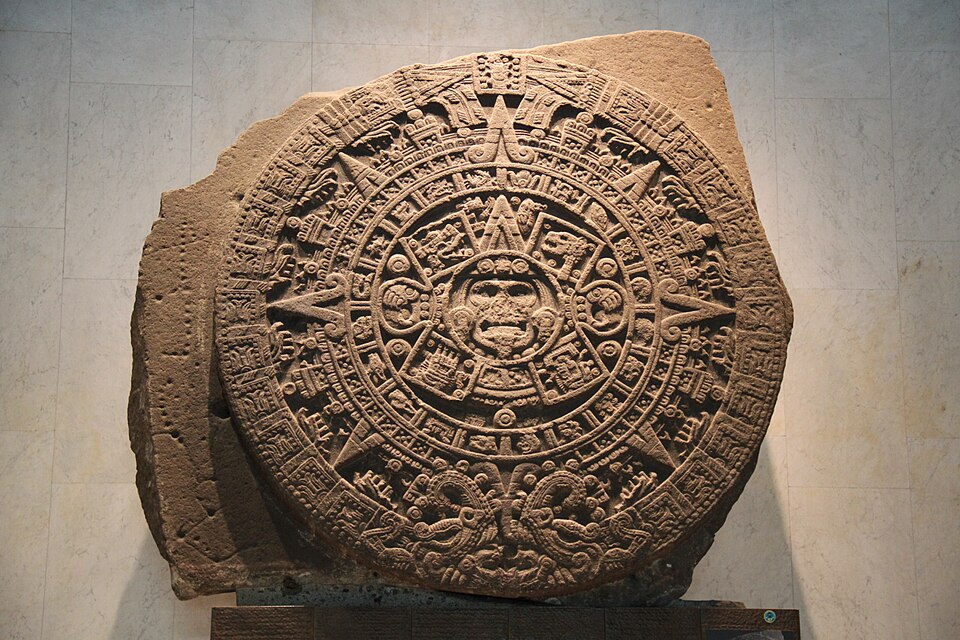

Aztec monumental sculpture achieved a power and naturalism without parallel in Mesoamerica.2, 17 The colossal Sun Stone (Piedra del Sol), a 3.6-metre basalt disc weighing approximately 24 tonnes and carved with the image of the sun god Tonatiuh surrounded by calendrical and cosmological symbols, is one of the most recognisable artefacts of the pre-Columbian world.1 Featherwork (amantecayotl) was considered the most prestigious of the visual arts, with master craftsmen creating elaborate mosaics, headdresses, and shields from the iridescent plumage of quetzals, cotingas, and other tropical birds.16, 2 Poetry and oratory occupied a central place in Aztec elite culture, and the tradition of flower and song (in xochitl, in cuicatl) — a Nahuatl metaphor for artistic expression — produced sophisticated philosophical verse exploring themes of beauty, transience, and the nature of truth, much of it attributed to the poet-king Nezahualcoyotl of Tetzcoco (r. 1431–1472).1, 3
The Spanish conquest and the fall of Tenochtitlan
The Aztec Empire's destruction began with the arrival of Hernán Cortés and approximately 500 Spanish soldiers on the Gulf Coast in April 1519.5, 21 Cortés quickly recognised and exploited the resentment that many tributary and unconquered polities felt toward Mexica imperial rule, forging a decisive alliance with the independent republic of Tlaxcala, which contributed tens of thousands of warriors to the anti-Aztec campaign.5, 4 The Spanish entered Tenochtitlan peacefully in November 1519 as guests of Moctezuma II, but relations deteriorated rapidly after the massacre of Aztec nobles during the festival of Toxcatl in May 1520, carried out by Pedro de Alvarado during Cortés's temporary absence.5, 21
The Mexica rose in revolt, Moctezuma II died under disputed circumstances, and the Spanish were driven from the city with heavy losses on the night of 30 June 1520, an event the conquistadors called La Noche Triste ("The Sad Night").5, 21 Cortés regrouped at Tlaxcala, built thirteen brigantines for lake warfare, and returned to lay siege to Tenochtitlan in May 1521 with a force that included approximately 900 Spanish soldiers, 80 horses, 15 cannon, and an estimated 200,000 Indigenous allies drawn from Tlaxcala, Texcoco, and other polities.5 The siege lasted 75 days. The Spanish and their allies cut the causeways, controlled the lake with their brigantines, and destroyed the aqueduct from Chapultepec, depriving the city of fresh water.5, 21 A devastating smallpox epidemic, introduced to the Americas by the Spanish expedition and for which the Indigenous population had no immunity, killed a significant portion of the city's defenders, including Moctezuma II's successor Cuitláhuac.5, 20
Tenochtitlan fell on 13 August 1521, when the last Aztec ruler, Cuauhtémoc, was captured while attempting to escape by canoe.5, 21 The city was largely destroyed during the fighting, and the Spanish built their colonial capital of Mexico City directly on its ruins.6, 20 The conquest was not solely a European achievement: it was made possible by the empire's own structural vulnerabilities, the willingness of subjugated peoples to rebel against Mexica hegemony, the catastrophic impact of Old World diseases, and the technological advantages of Spanish steel weaponry, firearms, and cavalry, all operating in combination.5, 4, 20
Legacy
The destruction of the Aztec Empire in 1521 did not erase Mexica cultural influence, which persisted throughout the colonial period and remains deeply embedded in modern Mexican national identity.6, 20 The Nahuatl language, spoken by the Mexica and widely used as a lingua franca in central Mexico, continued to be the most widely spoken Indigenous language in the Americas, with an estimated 1.7 million speakers in Mexico today.3, 6 Aztec agricultural innovations, particularly chinampa cultivation, survived the conquest and continue in modified form in the Xochimilco district of modern Mexico City, where they were designated a UNESCO World Heritage Site in 1987.9, 7 The eagle on the cactus from the Mexica foundation myth adorns the Mexican flag and coat of arms, and the name "Mexico" itself derives from "Mexica."1, 3
Scholarly understanding of the Aztec Empire has deepened considerably since the mid-twentieth century, driven by major archaeological projects — most notably the excavation of the Templo Mayor in the heart of Mexico City beginning in 1978 — and by advances in the interpretation of Nahuatl-language documents and pictorial codices.7, 2 Modern research has moved beyond the colonial-era emphasis on human sacrifice and military violence to reveal a complex, intellectually vibrant civilisation that achieved remarkable feats of urban planning, hydraulic engineering, ecological management, artistic expression, and political organisation in one of the most challenging environments in the Americas.1, 2, 17
References
Residential Patterns of Mexica Human Sacrifices at Mexico-Tenochtitlan and Mexico-Tlatelolco: Evidence from Phosphate Oxygen Isotopes
Feeding the Gods: Hundreds of Skulls Reveal Massive Scale of Human Sacrifice in Aztec Capital
The Conquest of Mexico: The Incorporation of Indian Societies into the Western World, 16th–18th Centuries