Overview
- The megalithic tradition of Atlantic Europe, spanning from approximately 4800 to 2000 BCE, produced thousands of monuments including dolmens, passage graves, stone circles, and standing stones (menhirs) across a vast coastal arc from Iberia and Brittany to the British Isles and Scandinavia.
- Radiocarbon dating and Bayesian chronological modelling have established that European megalithic architecture originated in northwestern France around 4800 BCE and spread along maritime routes, challenging the older diffusionist model that derived all megaliths from a single Near Eastern source.
- Monuments such as Newgrange, Carnac, and the Orkney complexes served overlapping functions as communal tombs, ceremonial centres, and markers of territorial identity, with many incorporating precise astronomical alignments to solstices and equinoxes that indicate sophisticated knowledge of solar and lunar cycles.
The megalithic monuments of Europe—dolmens, passage graves, stone circles, menhirs, and stone rows—constitute one of the most geographically extensive and chronologically enduring architectural traditions of the prehistoric world. Spanning from approximately 4800 to 2000 BCE, the megalithic phenomenon encompassed tens of thousands of monuments distributed along the Atlantic seaboard from the Iberian Peninsula and northwestern France through the British Isles to Scandinavia, with outlying clusters around the western Mediterranean and the Baltic.1, 5 These structures, built from massive unworked or minimally dressed stones weighing up to hundreds of tonnes, served primarily as communal tombs but also functioned as ceremonial centres, territorial markers, and astronomical observatories, reflecting the organisational capacity and cosmological imagination of Europe's first farming communities.4, 8

Origins and chronology
The question of where and when European megalithic architecture originated has been transformed by advances in radiocarbon dating and Bayesian chronological modelling. For much of the twentieth century, the dominant interpretation, influenced by the diffusionist framework of V. Gordon Childe, held that megalithic building techniques spread from the eastern Mediterranean westward, ultimately deriving from Near Eastern prototypes. This model was first undermined by the calibration of radiocarbon dates in the 1960s and 1970s, which demonstrated that Atlantic European megaliths were in many cases older than their supposed Mediterranean precursors.4, 15
A comprehensive Bayesian analysis by Bettina Schulz Paulsson, published in 2019, assembled and modelled more than 2,400 radiocarbon dates from megalithic contexts across Europe and concluded that the tradition originated in northwestern France, specifically in Brittany and the adjacent Atlantic coast, around 4800 BCE. From this origin, megalithic building practices spread along maritime routes—first to the Channel Islands and the Iberian Atlantic coast, then to the British Isles, Scandinavia, and the western Mediterranean—over the course of approximately two millennia.1 The maritime pattern of dispersal, following coastlines rather than overland routes, strongly suggests that seafaring networks connecting Neolithic communities along the Atlantic fringe were the primary vehicle for the transmission of megalithic architectural knowledge.1, 14
Monument types
The European megalithic tradition encompasses several distinct but overlapping monument forms. The simplest is the dolmen (from the Breton taol maen, "stone table"), a structure consisting of large upright stones (orthostats) supporting one or more horizontal capstones, creating a chamber that typically served as a burial space. Dolmens are found across the full geographic range of the megalithic tradition, from the Iberian Peninsula to Scandinavia, and represent the earliest and most widespread form of megalithic architecture.4, 5
Passage graves are more elaborate structures in which a stone-lined corridor leads from an entrance to a central burial chamber, often covered by a circular mound (cairn) of earth and stone. The finest examples, such as Newgrange in Ireland's Boyne Valley, Gavrinis in Brittany, and Maeshowe in Orkney, feature carefully corbelled roofs, extensive megalithic art carved on the orthostats, and precise astronomical alignments.2, 9 Menhirs are single upright standing stones, which can reach enormous dimensions—the Grand Menhir Brisé at Locmariaquer in Brittany, now fallen and broken into four pieces, originally stood approximately 20 metres tall and weighed an estimated 280 tonnes, making it the largest known megalith ever erected in prehistoric Europe.7 Stone rows and alignments, of which the most famous are the Carnac alignments in Brittany, consist of multiple menhirs arranged in parallel lines extending over considerable distances, and stone circles, culminating in Stonehenge and the Ring of Brodgar, represent a characteristically British and Irish development of the tradition.3, 8
Carnac and the Breton megaliths
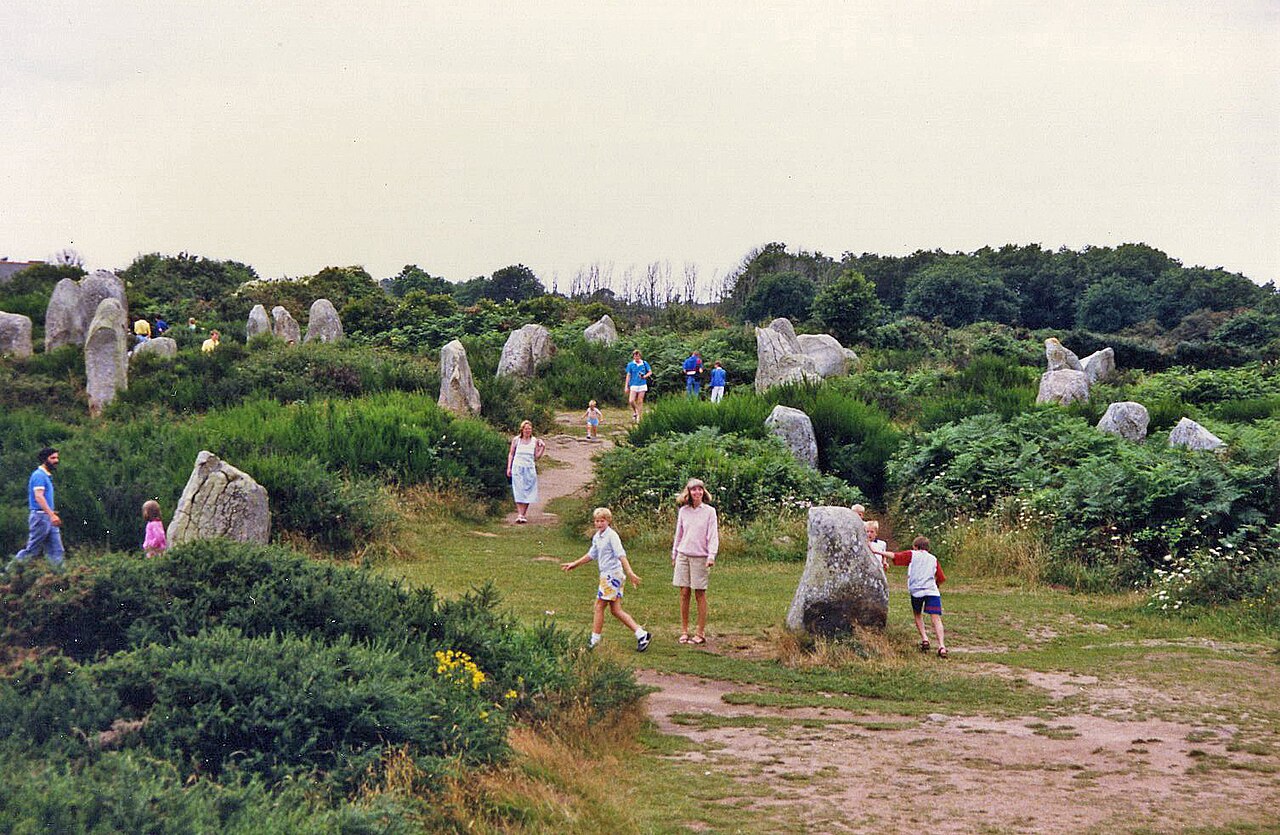
Brittany, in northwestern France, is the heartland of the European megalithic tradition and home to its densest concentration of monuments. The Carnac alignments, located near the southern coast of the Morbihan department, comprise approximately 3,000 standing stones arranged in multiple parallel rows stretching over four kilometres across the landscape in three principal groups: Le Ménec, Kermario, and Kerlescan.3, 12 The stones vary from roughly half a metre to over four metres in height and generally decrease in size from west to east along each alignment, a pattern whose significance remains debated. The alignments date primarily to the middle Neolithic, approximately 4000–3000 BCE, and their construction represents an enormous investment of communal labour over an extended period.12
The Breton megalithic landscape also includes some of the most impressive individual monuments in Europe. The cairn of Barnenez, on the northern Brittany coast, is a stepped passage-grave complex dating to approximately 4800–4200 BCE that contains eleven burial chambers and is sometimes described as the oldest significant stone building in the world. The island of Gavrinis in the Gulf of Morbihan contains a passage grave whose orthostats are covered with exceptionally elaborate carved designs—spirals, concentric arcs, serpentine lines, and hafted axe motifs—that represent one of the finest examples of megalithic art in Europe.5, 7 Together, these monuments demonstrate that Brittany was not merely the geographic origin of the megalithic tradition but remained one of its most innovative and productive centres throughout the Neolithic.14
Newgrange and astronomical alignments
Newgrange, the largest passage grave in the Brú na Bóinne (Bend of the Boyne) complex in County Meath, Ireland, is one of the most celebrated megalithic monuments in Europe. Constructed around 3200 BCE—predating both Stonehenge and the Egyptian pyramids—the monument consists of a cruciform passage grave covered by a kidney-shaped mound approximately 85 metres in diameter and 13 metres tall, retained by a kerb of 97 decorated stones.2, 6 The passage, 19 metres long, leads to a central chamber with a corbelled roof that has remained waterproof for over five millennia.
Newgrange's most famous feature is its roofbox, an aperture above the entrance passage through which sunlight penetrates to illuminate the rear wall of the central chamber for approximately 17 minutes at dawn on the winter solstice. This alignment, first documented by Michael O'Kelly during his excavations in the 1960s and confirmed by subsequent observation, indicates that the builders incorporated precise astronomical knowledge into the monument's design.2, 13 Similar solstice and equinox alignments have been identified at other passage graves in the Boyne Valley complex (Knowth and Dowth) and at Maeshowe in Orkney, where the setting sun at the winter solstice illuminates the rear of the passage chamber.9, 13 Clive Ruggles has cautioned against interpreting these alignments as evidence of systematic astronomical observation, arguing instead that they reflect the embedding of solar symbolism within mortuary ritual—linking the cycle of the sun to themes of death and renewal.13
Social organisation and meaning
The construction of megalithic monuments required substantial communal labour. Experimental archaeology and engineering analyses suggest that transporting and erecting stones weighing tens of tonnes demanded the coordinated effort of hundreds of people using wooden sledges, rollers, levers, ropes, and earthen ramps—resources that imply the existence of social mechanisms capable of mobilising labour beyond the scale of an individual household or kin group.4, 10 Richard Bradley has argued that the monuments themselves served as the focal points around which such social cooperation was organised, and that the process of construction was as socially significant as the finished monument, creating and reinforcing communal bonds through shared effort.8
Ancient DNA studies have provided new perspectives on the populations who built and used the megaliths. Genome-wide analyses of Neolithic individuals buried in megalithic tombs across Britain and Ireland have shown that the megalith builders were descended from Anatolian farming lineages that spread across Europe during the Neolithic expansion, reaching the Atlantic coast via a predominantly Mediterranean and then Atlantic route.11 These populations largely replaced the indigenous Mesolithic hunter-gatherers of Atlantic Europe, and the construction of monumental tombs may have served to establish territorial claims and ancestral legitimacy in newly colonised landscapes.8, 11
The European megalithic tradition eventually declined during the late third and early second millennia BCE, coinciding with the arrival of Beaker-associated populations carrying substantial steppe-related ancestry and the spread of copper and bronze metallurgy. Whether the incoming populations actively abandoned megalithic traditions or whether the monuments gradually lost their cultural relevance in the context of changing social and religious systems remains an open question.11, 15 What is clear is that the megaliths, even after falling out of active ritual use, continued to shape the landscapes and cultural memories of the communities that succeeded their builders, and many remained sites of veneration, folklore, and contested meaning well into the historical period and beyond.8
References
The Significance of Monuments: On the Shaping of Human Experience in Neolithic and Bronze Age Europe