Overview
- The transition from hunting and gathering to farming in Europe was driven primarily by the westward migration of Anatolian farming populations beginning around 7000 BCE, who spread along two principal routes — a Mediterranean coastal path and a Danubian inland corridor — largely replacing rather than assimilating indigenous Mesolithic hunter-gatherers.
- Ancient DNA has revolutionised understanding of the European Neolithic, revealing at least three major ancestral population turnovers: the initial spread of Anatolian farmers, partial resurgence of hunter-gatherer ancestry in the Middle Neolithic, and the massive Yamnaya-related steppe migration around 3000 BCE that reshaped the genetic landscape of northern and western Europe.
- The Neolithic brought not only agriculture but also new forms of social complexity — monumental architecture (megaliths, long barrows, causewayed enclosures), specialised craft production, long-distance exchange networks, and evidence of both cooperation and endemic violence — that laid the foundations for the hierarchical societies of the Bronze Age.
The Neolithic transformation of Europe — the transition from mobile hunting and gathering to settled farming, animal husbandry, and village life — was one of the most consequential processes in human prehistory. Beginning around 7000 BCE in southeastern Europe and reaching Scandinavia and the British Isles by approximately 4000 BCE, this transformation was not a single event but a multi-millennial process involving the migration of farming populations from the Near East, complex interactions between incoming farmers and indigenous hunter-gatherers, the independent adoption and adaptation of agricultural practices to diverse European environments, and the emergence of new forms of social organisation, ritual practice, and material culture.1, 8 The Neolithic laid the demographic, economic, and social foundations upon which all subsequent European civilizations were built, and its study has been revolutionised in recent years by the application of ancient DNA analysis, which has revealed population dynamics of a scale and complexity that were previously invisible to archaeology alone.3, 4
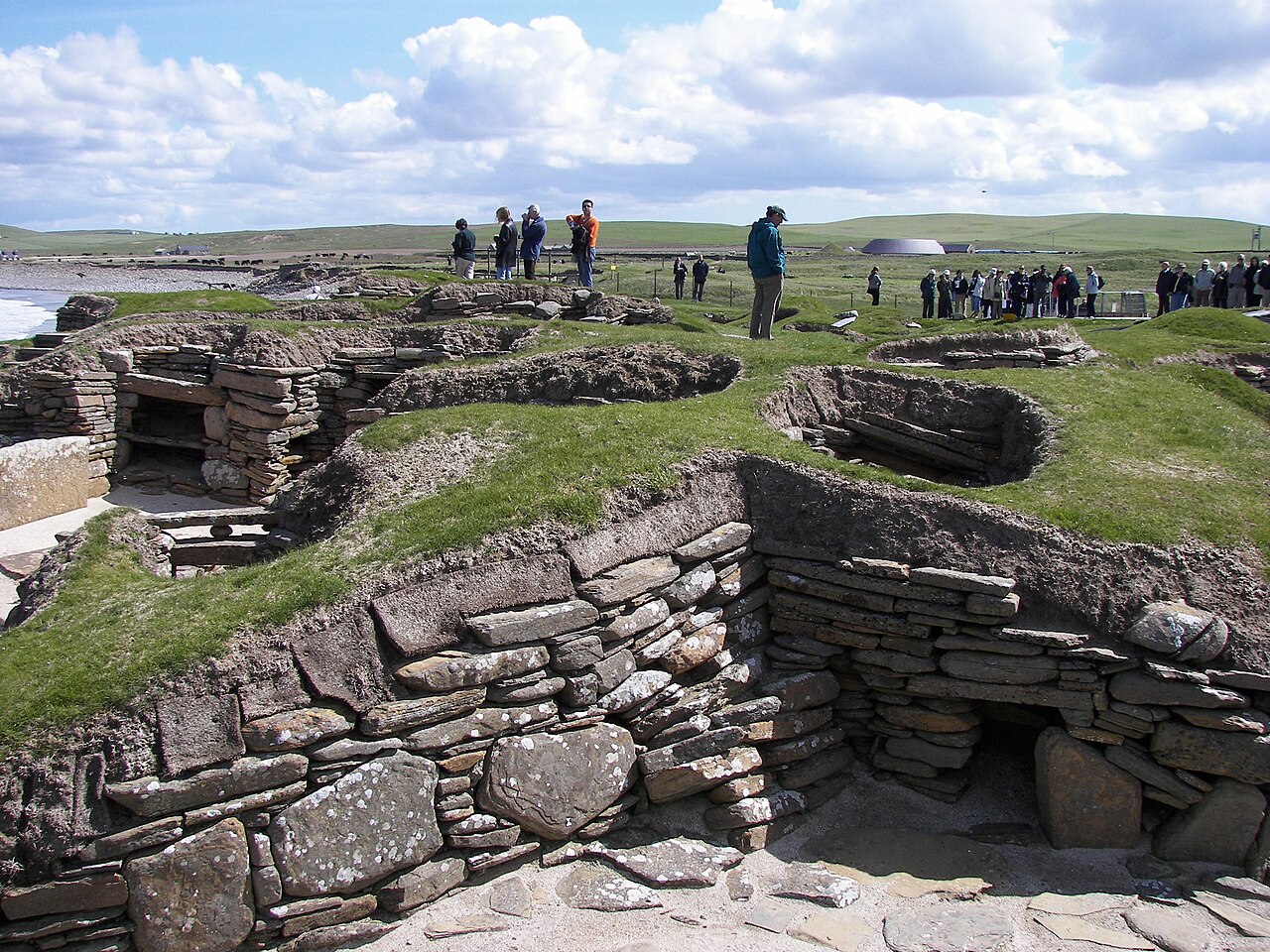

Origins and the spread of farming
Agriculture originated in the Fertile Crescent of the Near East, where the wild progenitors of wheat, barley, lentils, sheep, goats, cattle, and pigs were first domesticated between approximately 10,000 and 8000 BCE. The spread of this agricultural package into Europe was first modelled quantitatively by Albert Ammerman and Luigi Cavalli-Sforza in 1971, who demonstrated that the earliest radiocarbon dates for farming sites across Europe formed a gradient from southeast to northwest, consistent with a "wave of advance" spreading at an average rate of approximately one kilometre per year.6 This rate was too slow for simple cultural diffusion of ideas and too fast for purely demographic expansion, and the question of whether farming spread through the migration of people (demic diffusion) or the adoption of farming techniques by indigenous hunter-gatherers (cultural diffusion) remained one of the most debated questions in European prehistory for decades.6, 2
Ancient DNA evidence has now largely resolved this debate in favour of demic diffusion as the primary mechanism, at least for the initial spread. Genome-wide studies of early European farmers, beginning with Haak et al.'s landmark 2010 analysis of Linearbandkeramik (LBK) individuals, demonstrated that the earliest farmers in central Europe were genetically distinct from local Mesolithic hunter-gatherers and instead closely related to Neolithic populations from Anatolia and the Aegean.4, 5 These Anatolian-derived farmers carried a distinctive genetic signature that was substantially different from the "Western Hunter-Gatherer" (WHG) ancestry characteristic of Europe's indigenous Mesolithic populations, confirming that the Neolithic transition in Europe involved a large-scale population replacement, not merely the transmission of ideas.4, 7
The spread of farming into Europe followed two principal routes. The Mediterranean route carried farming populations westward along the coasts of Greece, southern Italy, southern France, and Iberia, associated archaeologically with Impressed Ware and Cardial Ware pottery traditions. This route was remarkably rapid, reaching the Atlantic coast of Portugal by approximately 5400 BCE, suggesting that maritime movement along coastlines played a significant role.10, 13 The Danubian route, by contrast, carried farming populations northwestward from the Balkans through the Hungarian Plain and into the loess lands of central Europe, associated archaeologically with the Linearbandkeramik (LBK) culture. The LBK appeared suddenly across a vast swathe of central Europe around 5500 BCE, establishing farming villages from Hungary to the Paris Basin within a few centuries.19, 8
The Linearbandkeramik culture
The Linearbandkeramik (LBK), named after its distinctive pottery decorated with incised linear bands, was the first farming culture to occupy the temperate forests of central Europe and represents one of the most archaeologically visible episodes of the Neolithic expansion. LBK settlements appeared across a territory stretching from western Hungary to the Paris Basin and from the upper Danube to the North European Plain between approximately 5500 and 4900 BCE, an expansion of remarkable speed and geographic scope for a pre-state society.19, 8
LBK communities shared a remarkably uniform material culture across this vast area. Settlements typically consisted of clusters of large timber longhouses, rectangular structures up to 40 metres in length, oriented northwest–southeast and constructed with massive timber posts supporting wattle-and-daub walls and a thatched roof.19, 10 These longhouses appear to have served as multi-functional domestic spaces housing extended family units, their livestock, and stored grain. LBK communities practiced a mixed farming economy based on emmer and einkorn wheat, barley, lentils, peas, and flax, supplemented by cattle, sheep, goats, and pigs, with cattle appearing to hold particular economic and symbolic importance.8, 10
LBK communities preferentially settled on loess soils — the fine, fertile wind-deposited sediments that blanket much of the North European Plain and the Danube basin — avoiding both the heavy clay soils of river floodplains and the lighter soils of upland areas. This selective settlement pattern suggests that early LBK farmers practiced a relatively intensive form of cultivation that required the easily worked, naturally fertile loess, and it had the consequence of leaving large areas of intervening landscape available for indigenous hunter-gatherer populations, who may have continued to occupy these areas for centuries alongside farming communities.8, 1
Despite the apparent cultural uniformity of the LBK, evidence of violence within and between communities is remarkably common. The mass grave at Talheim in southern Germany, dating to approximately 5000 BCE, contained the remains of 34 men, women, and children who had been killed by blows to the head from LBK-type adzes and stone axes, then dumped without the burial rites characteristic of normal LBK interment.20, 16 A similar massacre site at Asparn-Schletz in Austria contained at least 67 victims, and the mass grave at Schoeneck-Kilianstaedten in Germany revealed 26 individuals, many with shattered lower legs suggesting deliberate mutilation of the living or the dead.20 These massacre sites, combined with the construction of defensive palisades and ditches around late LBK settlements, suggest that inter-community violence was a recurring feature of early Neolithic life in central Europe, possibly driven by competition for the limited areas of prime loess farmland.16, 20
The ancient DNA revolution
No area of Neolithic studies has been more transformed by ancient DNA than the reconstruction of European population history. Prior to the genomic era, the relative contributions of migrating farmers and indigenous hunter-gatherers to the ancestry of modern Europeans could only be inferred indirectly from archaeological distributions, modern genetic variation, or limited mitochondrial DNA data. The advent of genome-wide ancient DNA analysis after 2010 has enabled direct measurement of ancestry proportions in ancient individuals, revealing a far more dynamic and complex population history than previously imagined.3, 4
The emerging picture involves at least three major ancestral components contributing to modern European genomes. The first is "Western Hunter-Gatherer" (WHG) ancestry, derived from the Mesolithic populations that inhabited Europe after the Last Glacial Maximum. The second is "Early European Farmer" (EEF) ancestry, carried by the Anatolian-derived populations that spread farming across Europe beginning around 7000 BCE. The third is "steppe" ancestry, associated with Yamnaya and related pastoral populations from the Pontic-Caspian steppe who expanded into Europe around 3000 BCE.3, 5
The initial Neolithic expansion involved a near-complete replacement of WHG ancestry by EEF ancestry in many regions, particularly along the Mediterranean route. In Iberia, for example, early Neolithic individuals show almost entirely Anatolian farmer ancestry with minimal hunter-gatherer admixture.13 However, this pattern was not uniform: in some regions, particularly around the Baltic and in Scandinavia, hunter-gatherer populations persisted alongside farming communities for centuries, and a gradual increase in WHG ancestry among farmer populations during the Middle Neolithic (roughly 4500–3500 BCE) suggests eventual admixture between the two groups, a process that Brunel et al. documented in detail for present-day France.7, 11
Major ancestral components in European population history3, 5
| Component | Origin | Arrival in Europe | Associated cultures |
|---|---|---|---|
| Western Hunter-Gatherer (WHG) | Post-glacial Europe | Indigenous (from c. 14,000 BCE) | Mesolithic forager traditions |
| Early European Farmer (EEF) | Anatolia / Aegean | c. 7000–4000 BCE | LBK, Cardial, Impressed Ware |
| Steppe (Yamnaya-related) | Pontic-Caspian steppe | c. 3000–2500 BCE | Corded Ware, Bell Beaker (partly) |
The third and most dramatic demographic event in European prehistory was the expansion of steppe-derived populations into Europe around 3000 BCE, documented in the landmark study by Haak et al. in 2015. Individuals from the Corded Ware culture, which spread across northern Europe from approximately 2900 BCE, carried approximately 75 percent steppe-related ancestry, indicating a massive population influx from the east that largely replaced the preceding Neolithic farming populations in many parts of northern and central Europe.3, 17 This steppe expansion is widely associated with the spread of Indo-European languages, though the precise mechanism — elite dominance, mass migration, or some combination — remains debated.3
Megaliths and monumental architecture
One of the most visually striking legacies of the European Neolithic is the tradition of megalithic construction — the building of monuments using large, often undressed stones — that spans the Atlantic and Mediterranean coasts from southern Iberia to Scandinavia. Megalithic tombs, standing stones, stone circles, and alignments were constructed over a period of roughly three thousand years, from approximately 4800 BCE (the earliest known examples in Brittany and the Iberian Atlantic coast) to the late third millennium BCE.9, 10
Bettina Schulz Paulsson's 2019 analysis of over 2,000 radiocarbon dates from megalithic sites across Europe demonstrated that the megalithic tradition originated in a single region — most likely northwestern France (Brittany and the Channel coast) — and spread outward along maritime routes to the Iberian Peninsula, the British Isles, and Scandinavia over the following millennia.9 This finding challenged earlier models that had proposed multiple independent origins for megalithic traditions in different regions and instead suggested that the practice was transmitted through coastal maritime networks, implying a surprising degree of long-distance contact and cultural exchange among Neolithic communities along the Atlantic seaboard.9
The diversity of megalithic monument types is enormous. Passage graves, such as Newgrange in Ireland (c. 3200 BCE) and Maeshowe in Orkney, consist of a stone-lined passage leading to one or more burial chambers beneath a large earthen mound, often with astronomically aligned entrances that admit sunlight only at specific times of year, such as the winter solstice sunrise at Newgrange.10, 1 Portal dolmens are simpler structures consisting of massive capstones supported by upright stones, and long barrows — elongated earthen mounds often containing timber or stone burial chambers — were among the earliest monumental constructions in northern Europe. The stone circles of the British Isles, of which Stonehenge is only the most famous example, represent a later development within the megalithic tradition, dating primarily to the third millennium BCE.10
The social implications of megalithic construction have been intensely debated. The labour required to build even a modest megalithic tomb was substantial, implying the ability to mobilise and coordinate collective effort beyond the level of a single household. Some scholars have interpreted megaliths as territorial markers, asserting community claims to land and resources in an increasingly settled and competitive agricultural landscape. Others have emphasised their role as ancestral monuments, creating a visible link between the living community and its dead that reinforced social identity and continuity over generations.10, 8 The fact that many megalithic tombs were used for collective burial over extended periods, with bones disarticulated and rearranged rather than maintained as individual interments, suggests funerary practices emphasising communal identity over individual distinction, a pattern that contrasts markedly with the individual burials characteristic of the later Corded Ware and Bell Beaker cultures.10
The Funnel Beaker and Corded Ware cultures
The later European Neolithic, from approximately 4000 to 2500 BCE, witnessed a succession of archaeological cultures that reflect the increasing social complexity and demographic dynamism of farming societies. The Funnel Beaker culture (Trichterbecherkultur, or TRB), dating from approximately 4300 to 2800 BCE, was the first farming culture to occupy the North European Plain and southern Scandinavia, regions that had remained the domain of hunter-gatherer populations for more than a millennium after farming was established farther south.18, 10
The Funnel Beaker culture is named for its characteristic pottery form — a beaker with a flared, funnel-shaped rim — and is associated with the construction of many of the megalithic tombs and long barrows of northern Germany, Denmark, and southern Sweden. TRB communities practiced a mixed farming economy, but with a greater emphasis on cattle pastoralism and dairying than their LBK predecessors, reflecting adaptation to the cooler, wetter conditions of northern Europe.10, 18 Ancient DNA analysis has confirmed that TRB populations were primarily of Anatolian farmer descent, with variable but generally modest proportions of hunter-gatherer ancestry, indicating that the northward expansion of farming into Scandinavia around 4000 BCE was once again driven primarily by the movement of farming populations rather than the adoption of farming by local foragers.18, 11
The Funnel Beaker culture was followed, and in many areas replaced, by the Corded Ware culture (c. 2900–2300 BCE), one of the most widespread archaeological phenomena of later European prehistory. Named for the cord-impressed decoration on its characteristic pottery, the Corded Ware complex extended from the Rhine to the Volga and from Scandinavia to the Alps, encompassing a vast area of northern and central Europe.17, 10 Corded Ware communities are characterised by single inhumation burials (in contrast to the collective burials of the preceding megalithic tradition), with males typically buried on their right side oriented east–west and females on their left side, accompanied by gender-specific grave goods: stone battle-axes and beakers for men, pottery and ornaments for women.10
The genomic revolution has demonstrated that the Corded Ware culture was associated with a massive population influx from the Pontic-Caspian steppe. Corded Ware individuals carry approximately 75 percent steppe-related (Yamnaya) ancestry, a proportion so high that it implies a large-scale demographic replacement of the preceding farming populations in many parts of northern Europe.3, 17 This steppe migration, occurring around 3000–2500 BCE, introduced not only new genetic lineages but also new subsistence strategies emphasising mobile pastoralism, new social structures reflected in individual burial practices and status-differentiated grave goods, and — according to the prevailing linguistic hypothesis — the Indo-European languages that would eventually dominate most of Europe.3
The secondary products revolution
Andrew Sherratt's influential concept of the "secondary products revolution," first proposed in 1981, describes a suite of innovations in the exploitation of domestic animals that transformed Neolithic economies across Europe during the fourth and third millennia BCE. Sherratt argued that the earliest Neolithic farmers had exploited domestic animals primarily for their "primary products" — meat, hides, and bone — obtaining these by slaughtering the animals. The secondary products revolution involved the systematic exploitation of animals for renewable products obtainable from living animals: milk and dairy products, wool and other textile fibres, and traction power for ploughing and transport.14
The evidence for dairying in the European Neolithic has been substantially strengthened by lipid residue analysis of pottery, which can detect the molecular signatures of dairy fats absorbed into ceramic vessel walls. These analyses have demonstrated that dairy products were being processed in pottery across much of Europe by the fifth millennium BCE, considerably earlier than Sherratt originally proposed, though the intensity of dairying appears to have increased significantly during the fourth millennium, consistent with his broader chronological framework.14, 10 The exploitation of wool, by contrast, appears to be a somewhat later development, with the earliest evidence for woolly sheep (as opposed to hairy-fleeced sheep) dating to the fourth millennium BCE in the Near East and somewhat later in Europe.14
The use of animal traction for ploughing was perhaps the most transformative of the secondary products, as it allowed the cultivation of heavier soils that had been impractical to farm with hand-held hoes and digging sticks, dramatically expanding the area of land available for agriculture. Evidence for ard (scratch-plough) cultivation appears in the archaeological record from the fourth millennium BCE onward, in the form of ard-marks preserved beneath burial mounds and the widespread adoption of paired cattle yokes.14, 10 The introduction of wheeled transport, attested archaeologically from the mid-fourth millennium BCE in both the Near East and Europe, further enhanced the utility of animal traction and facilitated the movement of bulk goods over longer distances. Together, these innovations in animal exploitation contributed to a fundamental transformation in the scale and productivity of Neolithic farming economies, supporting larger populations, more permanent settlements, and more complex forms of social organisation.14, 15
Social complexity and the transition to the Bronze Age
The European Neolithic was not merely a technological transition from foraging to farming but a social transformation of the first order. The adoption of agriculture brought with it the concept of land ownership and hereditary property rights, the accumulation of surplus food that could support non-producing specialists, and the potential for economic inequality that had been largely absent from mobile hunter-gatherer societies.8, 15 The archaeological evidence for increasing social complexity during the Neolithic is extensive, though its interpretation remains debated.
The "Neolithic demographic transition," a marked increase in birth rates associated with the adoption of sedentary farming, is well documented in the European archaeological record through the analysis of cemetery age profiles and the increasing density of settlement sites.15 Jean-Pierre Bocquet-Appel's research has demonstrated that farming communities experienced a significant increase in fertility compared to hunter-gatherer populations, probably due to a combination of sedentism (which reduced the need for birth spacing), the availability of weaning foods (soft cereal gruels), and the economic value of child labour in agricultural societies. This demographic expansion fuelled the geographic spread of farming itself, as growing populations pushed into new territories, and it also created the population densities that made more complex forms of social organisation both possible and necessary.15, 2
Evidence of social differentiation appears in the Neolithic record in multiple forms. Differences in grave goods — the quantity and quality of pottery, stone tools, ornaments, and other objects buried with the dead — suggest varying degrees of status among individuals within communities, though whether these differences reflect hereditary rank or achieved status remains a matter of debate for most Neolithic contexts.10, 8 The construction of causewayed enclosures — large ditched and banked enclosures found across Britain, northern France, and northern Germany from the fourth millennium BCE onward — implies the existence of communal meeting places where dispersed farming communities gathered for seasonal festivals, exchange, feasting, and possibly conflict resolution, indicating levels of inter-community coordination that went beyond the capacity of individual settlements.10
Long-distance exchange networks also expanded significantly during the Neolithic. The distribution of polished stone axes made from specific geological sources — such as the jadeite axes originating in the western Alps that have been found across much of western Europe — demonstrates exchange relationships spanning hundreds or even thousands of kilometres.10, 1 The social significance of these exchange networks extended beyond the economic value of the goods themselves; the possession and display of exotic, far-travelled objects served as markers of social status and connections, foreshadowing the prestige-goods economies that would characterise the subsequent Bronze Age.
By the late third millennium BCE, the European Neolithic was giving way to the Early Bronze Age, a transition marked by the introduction of copper and bronze metallurgy, the emergence of more clearly hierarchical social structures reflected in richly furnished individual burials, and the demographic upheavals associated with the Corded Ware and Bell Beaker cultural horizons. The foundations laid during the Neolithic — settled agricultural communities, domesticated animals exploited for secondary products, long-distance exchange networks, monumental communal architecture, and the demographic growth made possible by farming — provided the essential substrate upon which the increasingly stratified and interconnected societies of Bronze Age Europe would be constructed.10, 3
References
Ancient DNA from European early Neolithic farmers reveals their Near Eastern affinities
Population genomics of Mesolithic Scandinavia: Investigating early postglacial migration routes and high-latitude adaptation