Overview
- The Gupta Empire (c. 320–550 CE), founded by Chandragupta I after a strategic marriage alliance with the Lichchhavi clan, unified much of the northern Indian subcontinent and at its territorial peak under Chandragupta II encompassed roughly 1.7 to 3.5 million square kilometres and a population of approximately 75 million.
- Under Samudragupta, Chandragupta II, and Kumaragupta I the empire presided over what later historians called India's classical age, producing the mathematical and astronomical work of Aryabhata, the Sanskrit drama and poetry of Kalidasa, the foundation of the Nalanda monastic university, and the earliest surviving structural Hindu temples.
- Gupta gold coinage, the Allahabad pillar inscription of Samudragupta composed by the court poet Harisena, the rust-resistant Iron Pillar of Delhi, and the travel record of the Chinese pilgrim Faxian provide an unusually rich body of primary evidence for an empire that fragmented in the late fifth and early sixth centuries under successive Huna (Hephthalite) invasions.
The Gupta Empire (c. 320–550 CE) was the dominant political power of the northern Indian subcontinent for the better part of two and a half centuries and presided over a flowering of Sanskrit literature, mathematics, astronomy, sculpture, and temple architecture so distinctive that nineteenth- and twentieth-century historians coined the phrase "classical age" or "golden age" to describe it.1, 2 Founded by Chandragupta I in approximately 320 CE, the empire reached its territorial peak under his grandson Chandragupta II Vikramaditya around the turn of the fifth century, when it controlled an estimated 1.7 to 3.5 million square kilometres and a population of roughly 75 million people stretching from the foothills of the Hindu Kush to the Bay of Bengal and from the Himalayas to the Narmada River.2, 4
Unlike the earlier Maurya Empire, whose history depends heavily on the inscribed proclamations of a single emperor, the Gupta period is reconstructed from a far more diverse body of sources: official Sanskrit eulogies (prashastis) on stone pillars, an extraordinarily rich gold coinage struck in dozens of types, the literary works of Kalidasa and other court poets, the surviving Sanskrit treatise Aryabhatiya, the Chinese pilgrim Faxian's travel account, the rock-cut shrines of Udayagiri, and the rust-resistant Iron Pillar of Delhi. Together these sources document an imperial system that combined a relatively decentralized administration with vigorous patronage of Brahmanical Hinduism, Buddhism, and Jainism, and that exported its cultural forms across South and Southeast Asia.1, 2, 7
Origins and the foundation of the dynasty
The origins of the Gupta family are obscure. The dynasty's earliest known ancestors are Maharaja Sri Gupta and his son Maharaja Ghatotkacha, who appear in later inscriptions only as subordinate rulers bearing the modest title maharaja rather than the imperial maharajadhiraja ("great king of kings") that their successors would adopt. Their original power base appears to have been in the eastern Gangetic plain, perhaps in the region of Magadha or Prayaga (modern Allahabad/Prayagraj), but the surviving sources do not allow firm conclusions about either the family's caste origins or the precise geography of its early holdings.2, 3
The transformation of the Guptas from local chieftains into a major imperial power is conventionally dated to the accession of Chandragupta I around 319 or 320 CE. The decisive event of his reign was a marriage alliance with the Lichchhavi clan of Vaishali, an ancient and prestigious kshatriya lineage with roots in the republican confederations of the eastern Gangetic plain. The alliance, sealed by Chandragupta I's marriage to the Lichchhavi princess Kumaradevi, is commemorated on a remarkable series of gold coins of the so-called "King and Queen" type, which depict Chandragupta and Kumaradevi on the obverse, the goddess Lakshmi seated on a lion on the reverse, and the legend Lichchhavayah ("the Lichchhavis") in Brahmi script.16, 2 No prior Indian dynasty had so prominently advertised a maternal connection on its coinage, and the gesture suggests that the Lichchhavi alliance was central to the legitimacy of the new imperial enterprise.
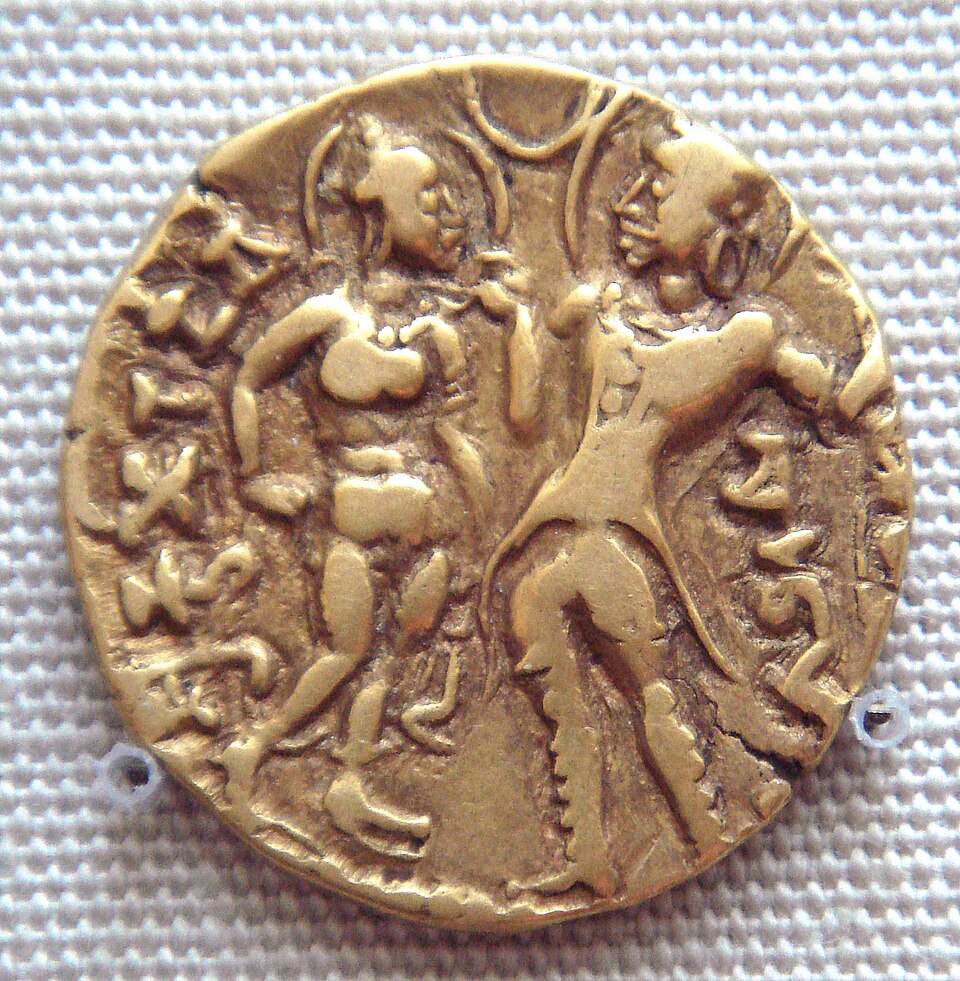

The Gupta Era, an era of regnal years used in inscriptions for several centuries thereafter, is conventionally calculated from 26 February 320 CE, the date most scholars associate with Chandragupta I's accession or coronation.8, 2 Chandragupta I assumed the title maharajadhiraja, signalling the dynasty's break with its earlier subordinate status. By the end of his reign (c. 335 CE), the Guptas controlled the core of the middle and lower Gangetic plain, including the fertile lands of Magadha, Saketa (Ayodhya), and Prayaga, providing the agrarian and demographic base for the imperial expansion that would follow under his son Samudragupta.1, 4
Samudragupta and the Allahabad pillar inscription
Samudragupta (r. c. 335–375 CE), the son of Chandragupta I and the Lichchhavi princess Kumaradevi, transformed his father's regional kingdom into a subcontinental empire through a long series of military campaigns. The most important source for his reign is the Allahabad pillar inscription, also known as the Prayaga Prashasti, a long Sanskrit eulogy composed by his court poet and minister Harisena (who held the senior offices of sandhivigrahika, kumaramatya, and mahadandanayaka) and engraved on a polished sandstone pillar that also bears earlier inscriptions of the Mauryan emperor Ashoka. Some nineteenth- and twentieth-century scholars have argued that the column originally stood at Kausambi and was later moved to its present location at Allahabad, while others maintain that the pillar has always stood at Prayaga; in either case, the appropriation of an existing Mauryan monument for a Gupta dynastic statement was deliberate.8, 1
The Prayaga Prashasti is composed in classical Sanskrit in the mixed prose-and-verse champu style and is regarded as the single most important historical document of the Gupta period. It was first read accurately and translated by James Prinsep in the 1830s and republished in J. F. Fleet's standard 1888 edition of the Gupta inscriptions in volume three of the Corpus Inscriptionum Indicarum.8, 13 The inscription names Samudragupta's military adversaries in carefully ordered geographic groups: nine kings of Aryavarta (the northern plains) whom Samudragupta is said to have "violently exterminated"; twelve kings of Dakshinapatha (the southern Deccan) whom he captured and then released; the rulers of forest kingdoms (atavika rajya) who were reduced to servitude; the frontier states of the eastern, western, and northern peripheries that paid tribute; and the foreign powers, including the Daivaputra Shahi Shahanushahi (the Kushans of the northwest), the Sakas of western India, and the rulers of Sinhala (Sri Lanka), who acknowledged Gupta supremacy through tribute, marriage alliance, or the petition for charters of authority.8, 2
Categories of states in the Allahabad pillar inscription of Samudragupta8, 2
| Category | Region | Treatment |
|---|---|---|
| Nine kings of Aryavarta | Northern Gangetic plain | Defeated and territories annexed |
| Twelve kings of Dakshinapatha | Eastern Deccan and south India | Captured and reinstated as tributaries |
| Forest kings (atavika) | Central Indian forests | Reduced to servitude |
| Frontier kingdoms | Samatata, Kamarupa, Nepala, Kartripura | Paid tribute and obeyed orders |
| Tribal republics | Punjab and Rajasthan (Malavas, Yaudheyas, Arjunayanas) | Submitted and paid tax |
| Foreign powers | Kushans, Sakas, Sinhala, "all islands" | Self-surrender, daughters in marriage, request for charters |
The differentiated treatment of conquered states — outright annexation in the north, tribute and reinstatement in the south, and tributary subordination on the periphery — reflects a deliberate imperial strategy. The Gangetic plain, with its dense agricultural population and proximity to the Gupta heartland, could be governed directly through provincial administration. Distant southern kingdoms could not, and Samudragupta's policy of capturing southern rulers and then restoring them to their thrones produced a network of subordinate dependencies rather than a directly governed southern dominion.1, 2 The inscription also celebrates Samudragupta's personal accomplishments as a poet and a musician, and a famous gold coin of the period depicts him seated cross-legged playing a stringed instrument (the so-called Lyrist type), an iconographic statement of cultivated kingship that has no precedent in earlier Indian numismatics.16
Chandragupta II Vikramaditya and the Saka campaign
Chandragupta II (r. c. 375–415 CE) succeeded his father Samudragupta after a brief and possibly contested reign by his elder brother Ramagupta, an episode preserved in the later Sanskrit drama Devichandraguptam by Vishakhadatta but absent from the official inscriptions. Whatever the circumstances of his accession, Chandragupta II adopted the regnal title Vikramaditya ("Sun of Valour") and presided over the empire's territorial and cultural climax. His most significant military achievement was the conquest of the Western Kshatrapas, a Saka (Indo-Scythian) dynasty that had ruled Malwa, Gujarat, and Saurashtra in western India for nearly four centuries.2, 4
The campaign against the Saka ruler Rudrasimha III, completed by approximately 409 CE, brought the entire western coast of the subcontinent under direct Gupta control for the first time. The strategic consequences were considerable: the empire gained access to the major Arabian Sea ports such as Bharukaccha (Broach) and Sopara, integrating the Gupta economy directly into the maritime trade networks linking India to the Sasanian Persian Empire, the Roman Mediterranean, and the Red Sea. Numismatic evidence in the form of Roman gold coins (aurei and solidi) found in substantial hoards at sites in southern and western India confirms the scale of this commerce, while Gupta silver coinage in western India was struck on the Saka model and weight standard, indicating a deliberate policy of monetary continuity in the newly acquired provinces.16, 2
Chandragupta II further extended Gupta influence through marriage diplomacy, marrying his daughter Prabhavatigupta to the Vakataka king Rudrasena II of central India. When Rudrasena died young, Prabhavatigupta governed the Vakataka kingdom as regent for her young sons for some twenty years, effectively integrating the Vakataka realm into the Gupta sphere of influence and providing a secure southern flank for the western campaign against the Sakas.2, 3 The territorial extent of the empire under Chandragupta II was the greatest in Gupta history. Modern estimates of the area under direct or tributary Gupta control around 400 CE range from approximately 1.7 million square kilometres on the lower estimate to 3.5 million square kilometres on the higher estimate, with a population in the order of 75 million inhabitants, making the Gupta state one of the largest political entities in the world of late antiquity.2, 4
Chandragupta II's court at Pataliputra, with secondary capitals at Ujjain (the conquered Saka capital) and Vidisha in central India, became the focal point of an extraordinary cultural patronage that would define the Gupta age in cultural memory. The traditional list of "nine jewels" (navaratna) of his court — including the poet Kalidasa, the lexicographer Amarasimha, the astronomer Varahamihira, and the physician Dhanvantari — is a later compilation of uncertain historical reliability, but the underlying picture of an unusually concentrated literary and scientific patronage is supported by independent evidence from inscriptions and surviving texts.12, 1
Administration, economy, and gold coinage
The administrative structure of the Gupta state, reconstructed from inscriptions, land-grant copperplates, and the literary sources, was less centralized and less heavily bureaucratic than that of the earlier Maurya Empire. The empire was divided into provinces called bhuktis or deshas, each governed by an uparika (provincial governor) who was usually a member of the royal family or a senior court official appointed directly by the emperor. The provinces were further subdivided into districts known as vishayas, administered by vishayapatis (district officers) assisted by local councils or adhikaranas. Below the district level, the empire's smallest administrative units were villages and groups of villages (vithis in eastern India), and at this level the imperial administration relied heavily on village headmen and on local councils of respected householders, brahmins, and merchants.2, 3
This pattern of indirect rule through layered local structures contrasts with the more intrusive Mauryan model of direct bureaucratic control. The Gupta state appears to have collected most of its revenue through a fixed share of the agricultural produce, conventionally estimated at one-sixth (shadbhaga) of the harvest, supplemented by tolls on trade, taxes on craft production, fines, and the forced labour (vishti) of villagers for public works. A particularly distinctive feature of Gupta and post-Gupta land tenure was the proliferation of religious land grants (brahmadeya and devadana grants), in which the king transferred to brahmin recipients or to religious institutions not only the right to collect revenue from specified villages but also, in many cases, administrative and judicial authority. These land grants were recorded on engraved copperplates and constitute one of the most important sources for the agrarian and social history of the period.1, 2
The most visible material legacy of the Gupta economy is the empire's gold coinage. Beginning under Chandragupta I and reaching extraordinary refinement under Samudragupta and his successors, the Guptas struck gold coins (dinaras) on a weight standard derived from the Kushan coinage of the preceding period, with most early Gupta gold coins weighing close to 7.9 grams, later increased under Skandagupta to approximately 9.2 grams in conformity with the Indian suvarna standard.16 Samudragupta alone issued at least eight distinct iconographic types, including the Standard type (the king holding a battle-standard with Garuda), the Archer type, the Battle-Axe type, the Tiger-Slayer type, the Lyrist type, the Ashvamedha type (commemorating the horse sacrifice), and the King-and-Queen type. Each type was designed to communicate a specific aspect of imperial ideology — military prowess, royal piety, dynastic continuity, or cultivated refinement — and the dies were cut by craftsmen of remarkable technical skill.16, 2
Approximate gold weight of Gupta dinaras by reign16
Beneath the gold currency, the Gupta monetary system included silver coins (rupakas), which were issued in significant volume only after Chandragupta II's conquest of the Saka territories of the west and which were modelled on the existing Western Kshatrapa silver standard, and copper coinage of more local circulation. The presence of Roman gold and silver coins in Indian hoards, and of Indian-style coins in trading entrepots on the Red Sea coast, attests to a maritime commercial network in which Gupta India was a major exporter of pepper, textiles, gemstones, ivory, and aromatic woods.16, 2
Aryabhata and the mathematics of the classical age
The most influential scientific work of the Gupta age is the Aryabhatiya, a compact Sanskrit treatise on mathematics and astronomy composed by Aryabhata in 499 CE. Aryabhata himself records that he was twenty-three years old in the year 3600 of the Kali Yuga, which corresponds to 499 CE, fixing his birth in 476 CE and placing the composition of the Aryabhatiya in the late Gupta period during the reign of Narasimhagupta Baladitya or his immediate predecessor. Aryabhata identifies himself as a native of Kusumapura, which most scholars identify with Pataliputra, the Gupta capital.5, 6
The Aryabhatiya is divided into four sections (padas) totalling 121 verses. The first, Gitikapada, sets out a system of alphabetic numerals and gives the basic astronomical parameters of his system. The second, Ganitapada, contains the mathematical core of the work and treats arithmetic, the extraction of square and cube roots, plane and solid geometry, the method of finding the area of a triangle and a circle, the geometry of a sphere, the solution of indeterminate linear equations (the kuttaka method, which would become a central topic of later Indian mathematics), and a detailed treatment of trigonometry. The third and fourth sections, Kalakriyapada and Golapada, treat the reckoning of time, the rules of celestial motion, and the geometry of the celestial sphere.5, 6
Aryabhata's mathematical achievements include a sine table giving the sine of every multiple of 3 degrees 45 minutes from 0 to 90 degrees (twenty-four entries) accurate to four decimal places, the use of a positional decimal system in his calculations (although the symbol for zero as a numeral does not appear in the surviving text of the Aryabhatiya itself), and an approximation for pi given as the ratio of 62,832 to 20,000, which equals 3.1416 — accurate to four decimal places and explicitly described by Aryabhata as asanna, "approximate," in a passage that demonstrates an understanding that pi cannot be expressed exactly as a ratio of two integers.5, 6 In astronomy, Aryabhata proposed that the apparent daily rotation of the heavens is in fact caused by the rotation of the Earth on its axis, an idea that would not become orthodox in European astronomy for another thousand years. He calculated the length of the sidereal day as 23 hours, 56 minutes, and 4.1 seconds, a value that differs from the modern figure by less than a second. He correctly explained both lunar and solar eclipses as the consequence of shadows cast by the Earth and the Moon, in opposition to the traditional Indian astronomical doctrine that ascribed eclipses to the demon Rahu.6, 5
Selected mathematical and astronomical results in the Aryabhatiya5, 6
| Quantity | Aryabhata's value | Modern value |
|---|---|---|
| Pi (π) | 62,832 / 20,000 = 3.1416 | 3.14159265… |
| Length of sidereal day | 23 h 56 min 4.1 s | 23 h 56 min 4.091 s |
| Sine table interval | 3° 45′ (24 entries) | — |
| Cause of day and night | Rotation of the Earth | Rotation of the Earth |
| Cause of eclipses | Shadows of Moon and Earth | Shadows of Moon and Earth |
The decimal positional numeral system that would later be transmitted to the Islamic world and from there to medieval Europe is documented in essentially its mature form in Indian inscriptions and texts of the Gupta and immediately post-Gupta period. The numeral symbol for zero as a placeholder, attested epigraphically in a Sanskrit inscription at the Chaturbhuja temple at Gwalior dated to 876 CE, was preceded by several centuries of conceptual and practical use of zero in Indian arithmetic, with the sixth-century mathematician Brahmagupta being the first author to give explicit rules for arithmetic operations involving zero in his Brahmasphutasiddhanta of 628 CE. The Aryabhatan system of place-value computation, as Plofker has shown, was already complete in the sense that any decimal numeral could be unambiguously written and manipulated, even though the surviving text uses an alphabetic rather than a digital notation for very large numbers.5
Kalidasa and Sanskrit literature
The Gupta period was the great age of classical Sanskrit literature, and its single most celebrated author is Kalidasa, conventionally dated to the late fourth or fifth century CE on the basis of internal references in his works and his association in tradition with the court of a king named Vikramaditya, most plausibly Chandragupta II. Three plays and three long poems are accepted as genuinely his: the dramas Abhijnanashakuntalam ("The Recognition of Shakuntala"), Vikramorvashiyam ("Urvashi Won by Valour"), and Malavikagnimitram ("Malavika and Agnimitra"); the long poems Raghuvamsha ("The Dynasty of Raghu") and Kumarasambhava ("The Birth of the War God"); and the lyric Meghaduta ("The Cloud Messenger").12, 1
The Abhijnanashakuntalam, a seven-act play that dramatizes the love story of King Dushyanta and the forest-born maiden Shakuntala from a brief episode in the Mahabharata, is generally regarded as the masterpiece of classical Sanskrit drama. It was the first work of Sanskrit literature to be translated into a European language, when Sir William Jones published an English version in 1789, and Goethe's enthusiastic praise of the play in his correspondence and verse helped to introduce Sanskrit literature to nineteenth-century European readers.12 The Meghaduta, a lyric of just over a hundred stanzas in the slow, four-line mandakranta metre, takes the form of a message sent by an exiled yaksha (a minor demigod) to his distant beloved through the medium of a passing rain cloud. The poem's sustained geographical itinerary, in which the cloud is asked to travel north over a precise sequence of mountains, rivers, and cities, has been analyzed both as a poetic tour of the Gupta cultural landscape and as evidence for the political geography of fifth-century India.12
The Sanskrit literature of the Gupta age was not limited to court poetry and drama. The two great Sanskrit epics, the Mahabharata and the Ramayana, reached approximately their present form during this period through a long process of editing and accretion, and the foundational texts of Hindu religious literature known as the Puranas — voluminous Sanskrit works combining cosmogony, dynastic genealogies, mythology, and religious instruction — were compiled and elaborated in the Gupta and immediately post-Gupta centuries. Sanskrit, which had been largely confined to ritual and elite scholarly contexts in the preceding Maurya and post-Maurya periods, displaced the Prakrit dialects as the language of imperial inscriptions, court literature, and learned discourse. The Allahabad pillar inscription of Samudragupta is itself the earliest substantial public inscription in classical Sanskrit, and the Sanskrit "renaissance" of the Gupta period would shape the literary and intellectual culture of South and Southeast Asia for the next thousand years.1, 2
Nalanda, Buddhism, and the travels of Faxian
Although the Guptas were themselves devotees of Vishnu and patronized brahmanical Hinduism on a vast scale, they were also consistent and generous patrons of Buddhism and Jainism, and the most significant institutional development of Buddhism in the Gupta age was the foundation of the great monastic university at Nalanda in Magadha. The traditional foundation date assigns Nalanda's establishment to Kumaragupta I (r. c. 415–455 CE), whose epithet Shakraditya appears on a monastic seal recovered from the site, and whose successors Buddhagupta, Tathagatagupta, Baladitya, and Vajra are credited with the construction of additional monasteries, temples, and residential buildings within the rapidly expanding complex.11, 18 Hartmut Scharfe's comprehensive 2002 study of education in ancient India accepts the identification of Shakraditya with Kumaragupta I and notes that the donor seals recovered from Nalanda include images of Lakshmi, Ganesha, Shivalinga, and Durga, indicating that the monastery's patrons were drawn from across the religious spectrum of Gupta India.11
From its modest Gupta-era beginnings as a cluster of monasteries, Nalanda grew over the following centuries into the greatest centre of Buddhist learning in Asia. By the seventh century, when the Chinese pilgrim Xuanzang visited and described it in detail, the institution housed several thousand monks and students who pursued a curriculum that included Mahayana and Hinayana Buddhist philosophy, the Vedas, logic, grammar, medicine, mathematics, and astronomy. The physical remains excavated by the Archaeological Survey of India since the early twentieth century — eleven monastic residences, fourteen temples, and the great brick stupa of Sariputra — cover an area of approximately fourteen hectares and demonstrate continuous building activity from the fifth century to the institution's destruction in the late twelfth century.18, 11
The most important external account of Gupta India is the travel record of the Chinese Buddhist monk Faxian, who left China in 399 CE in search of authoritative texts of the Buddhist monastic discipline (Vinaya) and travelled overland across Central Asia into the Indian subcontinent, where he spent approximately ten years before returning to China by sea. His account of his travels, the Foguoji ("Record of the Buddhist Kingdoms"), translated into English by James Legge in 1886, is the earliest detailed eyewitness description of India by a foreign visitor since Megasthenes seven centuries earlier and the only such description from the Gupta period itself.9
Faxian's portrait of Madhyadesha (the "middle country" of the Gupta heartland) is one of remarkable peace and prosperity. He reports that the people were generally vegetarian, that they did not kill animals, drink wine, or eat onion or garlic; that the kingdom had no capital punishment and that judicial penalties consisted mainly of fines proportional to the offence; that there were free hospitals (punya-shalas) maintained for the destitute and the sick; and that travellers could move freely throughout the realm without passes or permits. He describes Pataliputra as a flourishing city with magnificent palaces and Buddhist monasteries, and he records the existence of a great procession of images held annually in honour of the Buddha. While Faxian's account is undoubtedly idealized and reflects his Buddhist preoccupations — he is silent on most aspects of brahmanical Hinduism that surrounded him — it provides the only contemporary external evidence for the social and religious conditions of the empire under Chandragupta II.9, 1
Art, architecture, and the early Hindu temple
The Gupta period witnessed the consolidation of the structural Hindu temple as a distinctive architectural form, building on earlier traditions of rock-cut sanctuary architecture inherited from the Maurya and post-Maurya periods. The earliest surviving Gupta temples, dating from the late fourth to the sixth century CE, are small, square-plan stone shrines consisting of a single cella (garbhagriha) housing the cult image, often preceded by a pillared porch (mandapa). The Tigawa temple in Madhya Pradesh, the Sanchi Temple 17, and the small shrine at Eran are typical of this earliest phase of Gupta temple construction.14, 7
The most fully developed Gupta temple to survive is the Dashavatara Temple at Deogarh in Uttar Pradesh, dated to approximately the early sixth century CE on stylistic grounds and constructed in the panchayatana plan in which a central shrine is surrounded by four subsidiary shrines at the corners of a raised platform. The Deogarh temple is the earliest surviving north Indian temple to possess a shikhara, the curvilinear tower over the sanctum that would become the defining vertical element of subsequent north Indian Hindu temple architecture. Its exterior walls bear three large narrative reliefs depicting episodes from the mythology of Vishnu — Sheshashayi Vishnu reclining on the cosmic serpent Ananta, Nara-Narayana, and Gajendramoksha — that are among the masterpieces of Gupta sculpture.14, 7
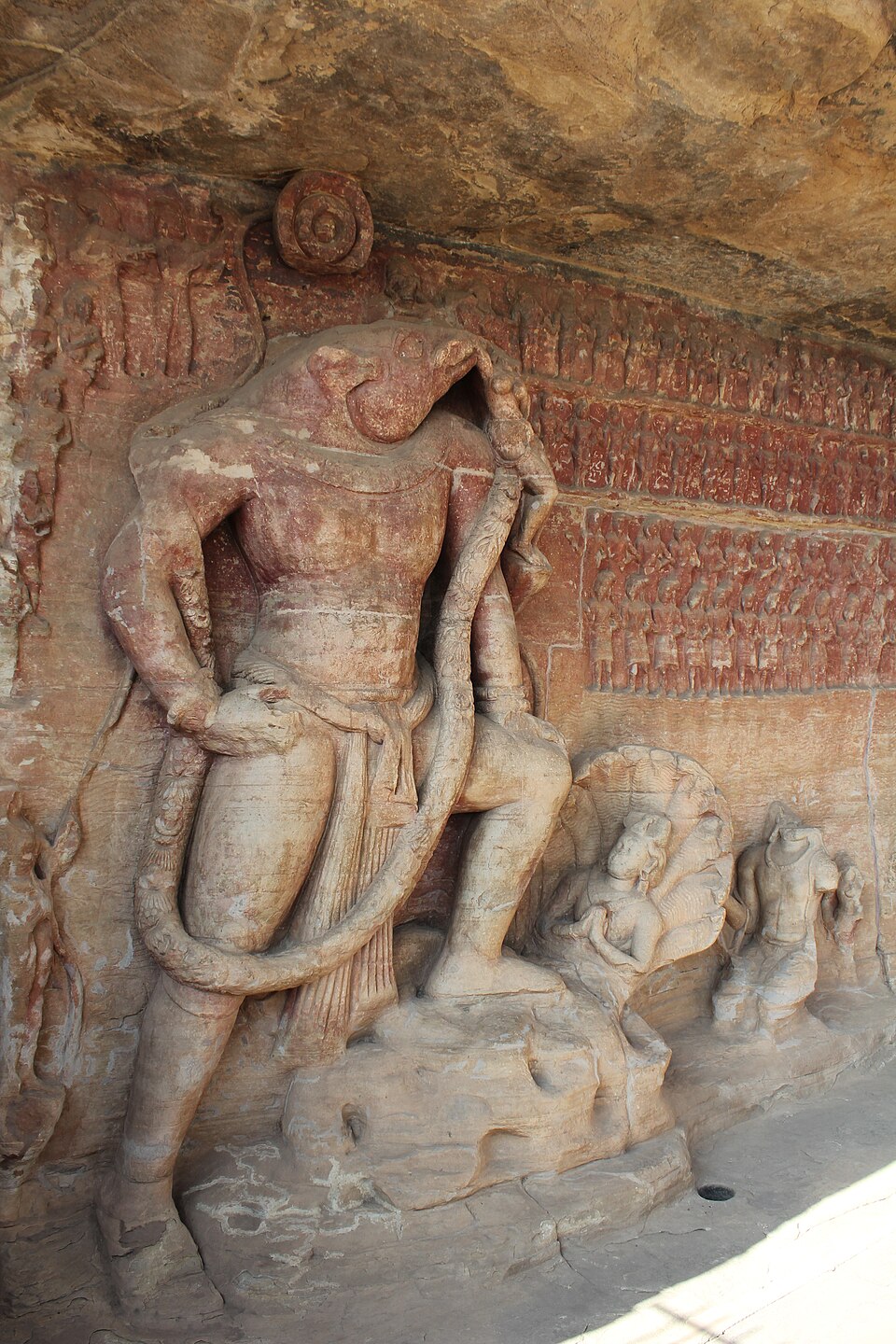
A complementary tradition of rock-cut religious architecture is represented by the Udayagiri Caves in Madhya Pradesh, a complex of approximately twenty rock-cut shrines and reliefs carved into a sandstone hill near Vidisha during the reigns of Chandragupta II and Kumaragupta I. The site is securely dated by inscriptions of the Gupta period and is the only surviving imperial Gupta religious complex with verifiable royal connections. Cave 5 contains a monumental relief of Vishnu in his Varaha (boar) avatar lifting the goddess Earth (Bhudevi) from the cosmic ocean, a composition that the British Museum scholar Michael D. Willis has interpreted as a deliberate political allegory of Chandragupta II's "rescue" and unification of India through his conquest of the Saka territories.7 Willis's archaeological and epigraphic study of Udayagiri argues that the caves were not simply pious foundations but the central ritual stage on which the Gupta emperor enacted his role as both chakravartin (universal sovereign) and supreme devotee of Vishnu, making the site a key document for understanding the relationship between Gupta kingship and Hindu religious ritual.7
.jpg)
Gupta sculpture in stucco, terracotta, stone, and bronze achieved a refinement and serenity that became canonical for later Indian art. The standing Buddha images from Sarnath in the late fifth century — with their thin, clinging robes that reveal the body beneath, their downcast eyes, and their characteristically gentle expressions — defined the iconographic conventions for representations of the Buddha across Asia for centuries. The seated Buddha preaching the First Sermon, also from Sarnath, is widely regarded as one of the supreme achievements of Indian religious sculpture. In Hindu iconography, the standardized images of Vishnu, Shiva, Durga, and the goddess Lakshmi that became the templates for later devotional sculpture across the subcontinent took shape during the Gupta period.2, 3
The Iron Pillar of Delhi and Gupta metallurgy
One of the most remarkable surviving artefacts of the Gupta period is the Iron Pillar of Delhi, a free-standing wrought iron column standing 7.21 metres above its present base, with a diameter of approximately 41 centimetres at the base tapering to 30 centimetres at the top, and a total mass of approximately 6,500 kilograms. The pillar bears a six-line Sanskrit inscription in Gupta Brahmi script naming a king Chandra (Sanskrit Chandra), generally identified by epigraphists with the Gupta emperor Chandragupta II Vikramaditya, and recording his military victories in the regions of Vanga (Bengal), Sindhu (the Indus valley), and Vahlika (Bactria).10, 8 The pillar was almost certainly erected in the late fourth or early fifth century CE; based on paleographic comparison with the dated Udayagiri inscriptions, the metallurgist R. Balasubramaniam and the historian Meera Dass have argued that the pillar originally stood at Udayagiri before its later transfer to Delhi.10
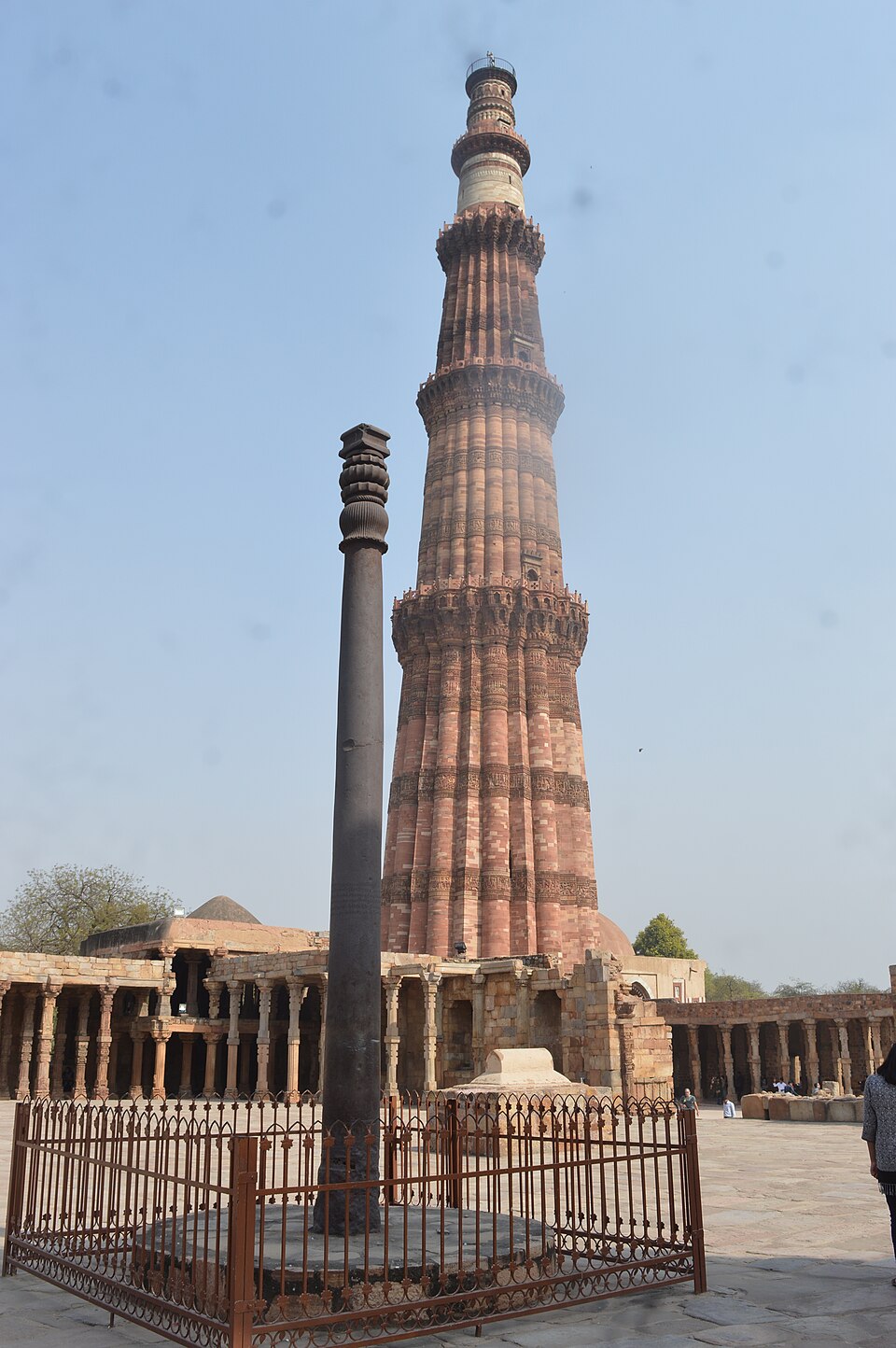

The Iron Pillar's most famous property is its extraordinary resistance to atmospheric corrosion. After more than 1,600 years of exposure to the variable Delhi climate, the pillar shows only superficial rusting, in striking contrast to the rapid degradation that would be expected of a comparable mass of modern wrought iron in the same environment. The basis for this resistance has been established by R. Balasubramaniam and his collaborators at the Indian Institute of Technology, Kanpur, in a series of published metallurgical investigations beginning in 2002. The pillar's wrought iron has an unusually high phosphorus content (approximately 0.25 percent by mass, compared with less than 0.05 percent in modern wrought iron) combined with low sulphur and manganese contents, and the corrosion resistance results from the formation of a thin, adherent passivating layer of crystalline iron hydrogen phosphate hydrate at the metal-rust interface, which inhibits further corrosion.10
The pillar is a monumental witness to the technological capabilities of fifth-century Indian iron metallurgy. The 6,500-kilogram mass was produced not by casting (the iron was forge-welded together from many smaller blooms produced in charcoal-fired bloomery furnaces) but by the patient hot forging and welding of multiple pieces, with the resulting structure remaining intact and standing for more than a millennium and a half. As Balasubramaniam observes, the achievement implies a sophisticated understanding by Gupta-period ironworkers of the relationship between alloy composition, the deliberate use of phosphorus-rich ores, and the resulting durability of the finished artefact — an empirical metallurgical knowledge that anticipated, in functional terms, principles of corrosion science that would not be formally established until the twentieth century.10
Religion, society, and the consolidation of classical Hinduism
The Gupta age is sometimes described as the period in which the diverse traditions of Vedic ritual, philosophical speculation, devotional cults, and local worship coalesced into the broad religious system that would later be called Hinduism. The Gupta emperors styled themselves parama-bhagavatas ("supreme devotees of the Lord [Vishnu]") in their inscriptions and on their coins, and their patronage of Vaishnavism — the worship of Vishnu and his incarnations — was sustained and visible. The emergence of Vishnu as the central deity of imperial devotion is reflected in the iconography of the Udayagiri caves, where the Varaha relief and the related images of Vishnu's other avatars functioned as both religious icons and emblems of the legitimacy and reach of Gupta kingship.7, 2
This Vaishnava emphasis did not exclude other devotional traditions. Shaivism (the worship of Shiva) was widespread, and the goddess Durga, the river goddesses Ganga and Yamuna, and a range of yakshas, nagas, and local deities were absorbed into the expanding pantheon of classical Hinduism. Buddhism remained vigorous, particularly in Magadha and the eastern provinces, and was supported by Gupta royal patronage at Nalanda and at the great pilgrimage centres of Bodh Gaya and Sarnath. Jainism flourished in the western regions of the empire and produced its own substantial literature in Sanskrit and Prakrit during this period.1, 2
Social and economic life under the Guptas was structured around the Brahmanical varna system, which had been undergoing centuries of elaboration and which the Gupta age saw further codified and entrenched through the religious land grants that gave brahmin recipients hereditary control over villages and their revenues. The texts known as the Dharmashastras, particularly the recensions of the Manusmriti that took shape in the early centuries CE, provided the prescriptive framework within which the increasingly rigid hierarchy of castes was justified and enforced. At the same time, the proliferation of subordinate caste groups (jatis), the assimilation of foreign populations such as the Sakas and Hunas into the social order through the granting of kshatriya status, and the absorption of tribal communities through brahmanical rituals of incorporation produced a much more complex social mosaic than the simple four-varna scheme of the older texts.1, 2 The position of women in elite Gupta society can be glimpsed through inscriptions, literary works, and the prominent political role of figures like the regent Prabhavatigupta, but the prescriptive texts of the Dharmashastra tradition record an increasingly restrictive set of social norms for upper-caste women, including child marriage, prohibitions on widow remarriage, and the elaboration of the stridharma ("dharma of women") as a code of subordination and domestic seclusion.1
The Huna invasions and the decline of the empire
The Gupta Empire's long decline is associated above all with the invasions of the Hunas, a confederation of nomadic peoples from Central Asia identified by most modern scholars with the Hephthalites or "White Huns" who simultaneously threatened the eastern frontiers of the Sasanian Persian Empire and the Roman Eastern frontier. The first significant Huna pressure on the Gupta northwestern frontier appears in the reign of Kumaragupta I, whose latest inscriptions hint at military difficulties on the empire's borders, and the Bhitari pillar inscription of his son Skandagupta records that the new emperor restored a kingdom that had been "thrown into disorder" through victories over the Pushyamitras and the Hunas.17, 15
Skandagupta (r. c. 455–467 CE), whose reign is documented in the Bhitari, Junagadh, and other rock and pillar inscriptions, is generally regarded as the last great Gupta emperor. His Junagadh rock inscription records the repair of the Sudarshana lake dam in Saurashtra, originally built in the Maurya period under Chandragupta and repaired in the time of the Saka Mahakshatrapa Rudradaman, and provides important evidence for the continuity of state-sponsored hydraulic engineering across Indian dynasties. The Bhitari inscription records his hard-fought victory over the Hunas, but the same record alludes to economic strains, and the gold coinage struck under Skandagupta shows a marked decline in fineness and weight standards from the high point of his predecessors, suggesting that the wars on the northwestern frontier had imposed a severe burden on the imperial treasury.16, 17
After Skandagupta's death the empire fragmented rapidly. A succession of weak emperors — Purugupta, Kumaragupta II, Buddhagupta, Narasimhagupta Baladitya, Kumaragupta III, Vishnugupta — presided over a steadily contracting realm in the late fifth and first half of the sixth century. Around 500 CE the Hephthalite ruler Toramana broke through the Gupta frontier defences in the northwest and established Hun control over the Punjab, Rajasthan, and parts of central India. His son Mihirakula extended the conquest further into the Gangetic plain and is remembered in Buddhist sources as a particularly destructive ruler responsible for the burning of monasteries and the persecution of the Buddhist sangha.15, 1 The Huna ascendancy was relatively short-lived: Mihirakula was defeated around 528 CE by a coalition of Indian rulers led by Yashodharman of Malwa and Narasimhagupta Baladitya, but the damage to the Gupta political order was irreversible, and by the middle of the sixth century the empire had effectively dissolved into a patchwork of regional successor kingdoms ruled by former Gupta governors and feudatories.15, 2
The causes of the Gupta decline have been debated by historians since the nineteenth century. The traditional explanation that emphasizes the Huna invasions as the decisive factor is supported by the inscriptional and numismatic evidence for military and economic strain in the second half of the fifth century, but it is not by itself a sufficient explanation. Romila Thapar and other modern historians have argued that the structural transformations of the late Gupta state — the proliferation of religious land grants that transferred fiscal and administrative authority away from the central treasury, the increasing reliance on subordinate feudatories rather than directly appointed officials, and the gradual emergence of a more decentralized political and economic order — were already weakening imperial integration in the decades before the Huna invasions and would have produced regional fragmentation even in the absence of external pressure. On this view, the Hunas accelerated and completed a transformation that was already under way and that would shape the political landscape of early medieval India for centuries thereafter.1, 2
Legacy and historical significance
The Gupta Empire's place in the history of the Indian subcontinent is a complicated one. The label "golden age," coined by nineteenth-century European Indologists and embraced by twentieth-century Indian nationalist historians, has proved durable in popular memory but increasingly contested in scholarly writing. The achievements of the period in mathematics, astronomy, literature, philosophy, sculpture, and temple architecture were unquestionably extraordinary and laid the foundations of much of what would later be regarded as classical Indian civilization. At the same time, the consolidation of the brahmanical varna and jati hierarchies during the Gupta age, the codification of the Dharmashastra tradition, and the increasing constraints on women and on lower-caste populations represent a side of the period that the celebratory "golden age" framing tends to obscure.1, 2
The cultural legacy of the Gupta period extended far beyond the political life of the empire itself. The Sanskrit language, which the Guptas had adopted as the medium of imperial discourse and royal eulogy, became the prestige language of literary and religious culture across South and Southeast Asia, and Sanskrit inscriptions, manuscripts, and ritual practices spread to Sri Lanka, Burma, Thailand, Cambodia, the Indonesian archipelago, and as far as central Vietnam in the centuries after the empire's fall. Gupta-period iconographic conventions for representing the Buddha and the principal Hindu deities became canonical from Bamiyan in Afghanistan to Borobudur in Java. The Aryabhatan tradition of mathematics and astronomy, transmitted through the work of Brahmagupta and his successors, reached the Islamic world in the eighth and ninth centuries through Arabic translations of Indian astronomical works and from there entered the medieval European mathematical tradition, where the decimal place-value system and the numeral zero became the foundation of all modern computational arithmetic.5, 2
The reconstruction of Gupta history continues to advance through ongoing archaeological excavation and the reinterpretation of existing inscriptional and numismatic evidence. The work of Michael D. Willis on the ritual landscape of Udayagiri, of R. Balasubramaniam on the metallurgy of the Iron Pillar, of Frederick Asher and others on the archaeology of Nalanda, and of historians such as Romila Thapar and Upinder Singh on the broader social and economic history of the period has substantially refined the older narratives that depended on a small canon of Sanskrit literary sources. The Gupta Empire emerges from this scholarship not as a static "golden age" but as a dynamic political and cultural system whose transformations — the rise of devotional Hinduism, the consolidation of Sanskrit court culture, the institutionalization of large monastic universities, and the elaboration of the early Hindu temple — defined the shape of Indian civilization for the next millennium.1, 2, 7, 10
References
A Record of Buddhistic Kingdoms: Being an Account by the Chinese Monk Fa-Hien of his Travels in India and Ceylon (A.D. 399–414)