Overview
- The Kingdom of Benin (c. 1180–1897 CE) was one of the most powerful and long-lived states in precolonial West Africa, centered on Benin City in present-day southern Nigeria. Under the Oba (divine king), the Edo people built a sophisticated political system with a centralized bureaucracy, hereditary guilds, and an elaborate court culture that produced some of the finest metal sculptures in human history.
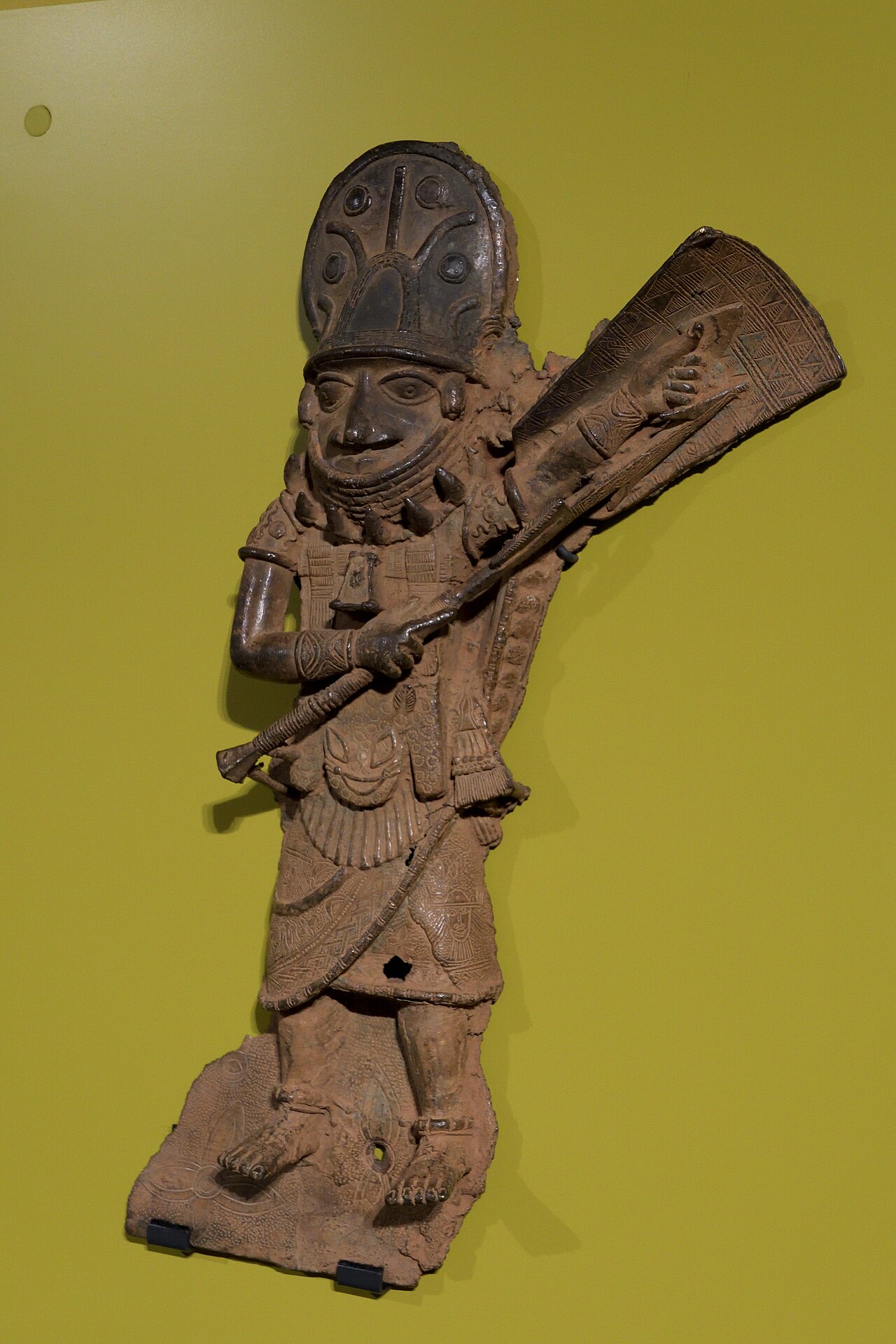
- The Benin Bronzes — thousands of brass plaques, commemorative heads, and ivory carvings created by specialized court guilds using the lost-wax casting technique — rank among the greatest achievements of world art. These objects documented the kingdom's history, rituals, and diplomatic encounters, including first contact with Portuguese traders in 1485, and served as records of royal authority spanning centuries.
- The kingdom was violently destroyed during the British Punitive Expedition of 1897, which burned Benin City and looted an estimated 3,000–5,000 art objects now dispersed across Western museums. The ongoing international campaign for restitution of the Benin Bronzes has become the defining case in global debates over colonial-era cultural property, with Nigeria, Germany, and other nations negotiating returns since 2021.
The Kingdom of Benin was a precolonial West African state centered on Benin City (Edo) in what is now southern Nigeria. Founded by the Edo people around the late twelfth century CE and enduring until the British conquest of 1897, the kingdom developed one of the most centralized political systems in sub-Saharan Africa, a court art tradition of extraordinary technical sophistication, and an urban center whose scale and planning astonished European visitors from the fifteenth century onward.3, 9 The kingdom is not to be confused with the modern Republic of Benin (formerly Dahomey), which lies to the west; the historical Kingdom of Benin was an Edo-speaking polity in the Niger Delta hinterland whose capital, Benin City, remains a major city in Nigeria's Edo State.2

Origins and the Ogiso dynasty
Edo oral traditions, compiled most extensively by the Benin historian Jacob Egharevba, describe an initial period of rule by a line of kings known as the Ogisos ("rulers of the sky"), whose dynasty is said to have governed the Edo people for centuries before the establishment of the present Oba dynasty around 1180 CE.3, 14 The historicity of the Ogiso period remains difficult to evaluate archaeologically, though Graham Connah's excavations in and around Benin City have confirmed continuous occupation of the area from at least the first millennium CE, with evidence of early settlement, forest clearance, and earthwork construction predating the dynastic period.10
According to tradition, the Ogiso dynasty ended in political crisis, and the Edo elders invited a prince named Oranmiyan from the Yoruba kingdom of Ife to restore order. Oranmiyan is said to have fathered a son, Eweka, who became the first Oba of Benin around 1180 CE, inaugurating the second dynasty that would rule until the British conquest.3, 14 Whether this tradition reflects an actual migration from Ife or a legitimating charter connecting Benin's rulers to the prestigious Ife kingship remains debated, but the close artistic and ritual connections between Benin and Ife are well documented in the archaeological record. Naturalistic bronze heads excavated at Ife display technical and stylistic features that clearly influenced early Benin court art, and the Benin royal guild of brass casters (Igun Eronmwon) traditionally traces its techniques to Ife origins.1, 8
Ewuare the Great and political centralization
The Kingdom of Benin reached a decisive turning point under Oba Ewuare the Great, who ruled during the mid-fifteenth century (c. 1440–1473 CE). Ewuare is credited in oral tradition with transforming Benin from a loose confederation of villages into a centralized state with an elaborate administrative hierarchy.3, 9 He reorganized the political structure by creating two orders of titled chiefs — the Uzama (hereditary nobles) and the town chiefs appointed by the Oba — establishing a system of checks and balances that distributed power while concentrating ultimate authority in the kingship.2, 14 Ewuare is also credited with rebuilding and fortifying Benin City, expanding the palace complex, instituting new court ceremonies, and launching military campaigns that extended Benin's territory across much of the western Niger Delta region.3
The political system that emerged under Ewuare and his successors rested on the concept of divine kingship. The Oba was considered a semi-divine figure whose ritual authority underpinned the spiritual well-being of the entire kingdom. He served as the supreme political, judicial, and religious authority, and elaborate court rituals — including the annual Igue festival of spiritual renewal — reinforced the sacred dimensions of his rule.2, 13 The Oba's authority was further expressed through a monopoly on certain prestige materials, notably coral beads, ivory, and brass, which could be distributed to chiefs and titleholders as marks of royal favor. This control over luxury goods and their symbolic redistribution was central to the maintenance of political loyalty and hierarchical order within the kingdom.1, 2
Benin City and the earthworks
European visitors to Benin City consistently remarked on its size and orderly layout. The Dutch geographer Olfert Dapper, writing in 1668 on the basis of earlier travellers' reports, described a city comparable in size to contemporary Amsterdam, with broad, straight streets, large houses, and a massive royal palace.4, 9 Archaeological and survey evidence has confirmed these impressions. Connah's excavations in the 1960s documented deep stratified deposits within the city, and his work established that the inner city walls and ditch enclosed an area of approximately six square kilometres, with suburbs extending well beyond.10
The most striking physical feature of Benin's hinterland was an enormous system of earthen walls and ditches — the Benin Earthworks — surveyed extensively by Patrick Darling beginning in the 1970s. Darling's fieldwork revealed that the earthworks extended over approximately 6,500 square kilometres of territory surrounding Benin City, comprising an estimated 16,000 kilometres of walls and ditches — a construction effort that, in total volume of earth moved, has been compared to the Great Wall of China.6, 11 These earthworks were not a single defensive perimeter but a complex, accretive network built over several centuries, delineating community boundaries, agricultural zones, and the territories of subordinate settlements within the Benin political sphere. The innermost circuit enclosed the capital itself, while outer rings marked the boundaries of dependent communities and frontier zones.6 The sheer scale of the earthworks attests to the kingdom's capacity to mobilize and coordinate massive labor forces over extended periods, and they represent one of the largest single archaeological features in precolonial Africa.11
The guild system and court art
The production of art in the Kingdom of Benin was organized through a system of hereditary craft guilds operating under direct royal patronage and control. The most prestigious of these was the Igun Eronmwon, the guild of brass casters, whose members lived in a designated quarter of Benin City near the palace and produced commemorative heads, plaques, and other objects exclusively for the Oba.1, 7 Other guilds included the ivory carvers (Igbesanmwan), leather workers, weavers, and blacksmiths, each occupying its own quarter and operating under guild heads who reported to the Oba's court.2, 8 This system ensured that artistic production served the ideological needs of the state: court art documented royal history, commemorated deceased Obas, recorded diplomatic encounters, and reinforced the divine authority of the kingship.1
The technical centerpiece of Benin's artistic tradition was the lost-wax (cire perdue) casting process used by the brass casters' guild. In this technique, the artist models the object in beeswax over a clay core, encases the wax model in a clay mold, heats the mold to melt out the wax, and pours molten brass into the resulting cavity. The Benin casters achieved extraordinary precision and thinness of casting, producing plaques as little as two to three millimetres thick with intricate surface detail.7 Metallurgical analysis by Paul Craddock and others at the British Museum has demonstrated that Benin castings used a leaded brass alloy (copper-zinc-lead), with the zinc and lead content varying over time in ways that reflect changing trade relationships and raw material sources. Earlier castings tend to be purer copper or bronze, while later works incorporate more zinc obtained through European trade, producing true brass.7, 1
The objects collectively known as the Benin Bronzes — though many are technically brass rather than bronze — encompass several distinct categories. Commemorative heads of deceased Obas were placed on ancestral altars in the palace, each surmounted by a carved ivory tusk. Rectangular plaques depicting court scenes, military exploits, and Portuguese visitors decorated the wooden pillars of the palace. Queen mother heads (iyoba) commemorated the Oba's mother, a figure of considerable political importance. Pendant masks, leopard figures, and ceremonial objects completed the repertoire.1, 8 Together, these objects constitute a visual archive of Benin's political and cultural history spanning approximately five centuries, from the early fifteenth to the late nineteenth century.5
Portuguese contact and Atlantic trade
The Portuguese navigator João Afonso de Aveiro reached Benin City in 1485, initiating the kingdom's first sustained contact with European traders. The encounter was diplomatically managed on both sides: the Oba sent an ambassador to Lisbon, and the Portuguese established a trading factory at Ughoton, Benin's main port on the Benin River.4 The primary commodities exchanged were pepper, cloth, ivory, and enslaved persons from Benin in return for brass manillas (bracelets used as currency), coral beads, firearms, and other European manufactures. The brass manillas were particularly significant, as they provided the raw material that the Benin casters' guild reworked into court art — meaning that European trade directly fueled the kingdom's artistic production.4, 7
The Portuguese presence at Benin was documented in contemporary accounts that provide some of the earliest European descriptions of a sub-Saharan African state. Duarte Pacheco Pereira, writing around 1508, described the Oba as a powerful king ruling over a large, well-organized territory, and noted the kingdom's wealth in pepper and ivory.4 Missionary efforts met with limited success: the Oba permitted Portuguese missionaries to operate but resisted conversion, and Christianity never gained significant traction in the kingdom.4, 9 Portuguese influence on Benin art is visible in the depiction of Portuguese soldiers, traders, and missionaries on brass plaques and ivory carvings, where European figures appear as exotic visitors incorporated into the kingdom's visual record rather than as conquerors or cultural models.1, 8
Benin's engagement with the Atlantic trade system expanded over the following centuries as Dutch and English traders succeeded the Portuguese. The kingdom participated in the slave trade, though the Oba periodically restricted or banned the export of male captives depending on political and military circumstances.4 Trade in ivory and palm oil grew in importance during the eighteenth and nineteenth centuries as European demand shifted. Throughout this period, the Oba maintained control over foreign trade as a royal prerogative, channeling commerce through designated ports and officials and using the revenue to sustain the court, the military, and the guild system.2, 4
The 1897 British Punitive Expedition
The destruction of the Kingdom of Benin came swiftly in February 1897, when a British military force of approximately 1,200 troops attacked and occupied Benin City. The immediate pretext was the killing of a British diplomatic party led by Acting Consul-General James Phillips, who had attempted to enter Benin City during the sacred Igue festival despite the Oba's explicit request to delay the visit. Phillips and most of his party were killed by Benin forces in January 1897, and the British organized a retaliatory expedition within weeks.4, 5
The broader context, however, was the Scramble for Africa and Britain's determination to bring the Niger Delta region under direct colonial control and to open Benin's trade — particularly its palm oil and rubber — to British commercial interests. Phillips himself had written to the Foreign Office before the ill-fated expedition requesting permission to depose the Oba and annex his territory, noting that the costs could be offset by seizing the palace's ivory stores.5 The punitive expedition that followed was not merely a response to the deaths of British officials but the culmination of decades of pressure to absorb Benin into the British sphere of influence.4, 5
British forces burned much of Benin City, including the royal palace, and looted an estimated 3,000 to 5,000 art objects — brass plaques, commemorative heads, ivory carvings, coral regalia, and other items accumulated over centuries of royal production.5 These objects were dispersed through military auctions and private sales, eventually entering the collections of museums across Europe and North America. The British Museum alone holds over 900 Benin objects. Other major collections are held in the Ethnologisches Museum in Berlin, the Pitt Rivers Museum in Oxford, and institutions in Vienna, Chicago, New York, and elsewhere.1, 5 The Oba, Ovonramwen, was deposed and exiled to Calabar, where he died in 1914. Although the British permitted the restoration of a ceremonial Oba in 1914, the kingdom's political sovereignty was permanently extinguished.4
Restitution and the Benin Bronzes debate
The question of returning the Benin Bronzes to Nigeria has become the most prominent case in global debates over the repatriation of colonial-era cultural property. Nigerian demands for restitution date to the independence era, but the issue gained decisive international momentum following the 2018 publication of the Sarr-Savoy Report, commissioned by French President Emmanuel Macron, which recommended the permanent return of African cultural objects held in French museums.12 Although the report focused on French collections, its arguments — that objects taken during colonial military campaigns cannot be considered legitimately acquired — reframed restitution as an ethical imperative rather than a legal technicality, and its conclusions have been widely applied to the Benin Bronzes case.12, 5
Dan Hicks's 2020 book The Brutish Museums further intensified the debate by documenting in detail how the 1897 looting was inseparable from the broader violence of colonial conquest and by arguing that Western museums' continued possession of the Bronzes perpetuates the ideological framework of imperial extraction.5 Since 2021, a series of institutional and governmental decisions have begun to shift the landscape. Germany announced in 2021 that it would return its extensive Benin holdings — over 1,100 objects in the Ethnologisches Museum, Berlin — and formal transfers to Nigeria began in 2022. The Smithsonian Institution, the Horniman Museum in London, and several other institutions have followed with their own restitution commitments or transfers of ownership.5 The British Museum, which holds the single largest collection, has resisted outright transfer, citing the 1963 British Museum Act, which restricts deaccessioning, though it has engaged in discussions about long-term loans and collaborative arrangements with Nigerian institutions.5
Nigeria has been developing the Edo Museum of West African Art (EMOWAA) in Benin City, designed by the architect David Adjaye, as a purpose-built institution to receive and display returned objects alongside archaeological and contextual materials. The project, supported by the Benin Dialogue Group (a consortium of European museums and Nigerian stakeholders formed in 2010), aims to recontextualize the Bronzes within their place of origin and to serve as a model for collaborative cultural heritage management between African nations and former colonial powers.1
Archaeological evidence
Archaeological investigation of the Kingdom of Benin has been shaped by the dual challenges of tropical forest environments, which accelerate organic decomposition, and the extensive disturbance of Benin City itself through colonial demolition, modern urbanization, and uncontrolled digging. Nevertheless, the work of Graham Connah in the 1960s and Patrick Darling from the 1970s onward has established a substantial archaeological framework.10, 11 Connah's excavations within Benin City revealed deep cultural deposits at the palace site and in surrounding areas, with stratified sequences spanning several centuries and yielding ceramics, metalworking debris, and evidence of architectural modifications to the palace complex over time.10
Darling's survey of the earthworks produced the most dramatic archaeological evidence for the scale and organizational capacity of the Benin state. His systematic mapping, conducted largely on foot over many field seasons, documented not only the vast extent of the earthwork network but also its internal complexity: walls and ditches of varying size and date, some defining small community enclosures, others marking major territorial boundaries stretching tens of kilometres across the forest zone.6, 11 Radiocarbon dates from the earthworks indicate that construction began by at least the thirteenth century CE, broadly contemporary with the traditional founding of the Oba dynasty, and continued into the early modern period.11
The archaeological evidence, combined with oral traditions and European documentary sources, paints a picture of a kingdom that achieved remarkable urban complexity within a tropical forest environment — an ecological context often assumed to be unfavorable for state formation. Benin City's planned layout, its surrounding earthwork infrastructure, and its specialized craft production quarters demonstrate a level of political and economic organization comparable to contemporary urban centers in other parts of the world.9, 10 The kingdom's history underscores the diversity of pathways to complex urbanism across different environments and challenges narratives that locate the origins of political complexity exclusively in temperate or riverine settings. As a center of artistic achievement, state formation, and long-distance commerce, the Kingdom of Benin stands alongside Great Zimbabwe, the Aksumite Empire, and the Kingdom of Kush as evidence that precolonial Africa produced a wide range of sophisticated, interconnected civilizations — each with its own trajectory, achievements, and legacy within the broader story of the rise of urban civilizations and ancient trade networks.9
References
The Archaeology of Benin: Excavations and Other Researches in and around Benin City, Nigeria