Overview
- Teotihuacán was the largest city in the pre-Columbian Americas, covering more than 20 square kilometres in the Basin of Mexico and housing an estimated 100,000 to 125,000 people at its peak between 150 and 550 CE — making it one of the six largest cities in the world during the first half of the first millennium.
- The city's monumental core — the Pyramid of the Sun (the third-largest pyramid on Earth by volume), the Pyramid of the Moon, the Feathered Serpent Pyramid, and the 5-kilometre Avenue of the Dead — was constructed without metal tools, draught animals, or the wheel, and its standardised apartment compounds housed a multiethnic population drawn from across Mesoamerica.
- Teotihuacán dominated Mesoamerican politics, trade, and culture for nearly five centuries through its control of obsidian exchange networks and diplomatic ties reaching as far as Tikal in the Maya lowlands, before a catastrophic internal burning event around 550 CE destroyed the city's ceremonial core and ended its regional hegemony.
Teotihuacán was the dominant urban centre of Mesoamerica for nearly five centuries and one of the largest cities in the ancient world.4, 20 Located approximately 50 kilometres northeast of modern Mexico City in the Basin of Mexico, the city covered more than 20 square kilometres at its peak between approximately 150 and 550 CE and housed an estimated 100,000 to 125,000 inhabitants — a population comparable to imperial Rome and Han-dynasty Chang'an.1, 3, 4 Its monumental core, dominated by the Pyramid of the Sun, the Pyramid of the Moon, and the 5-kilometre-long Avenue of the Dead, was constructed without metal tools, draught animals, or the wheel, and represents one of the most ambitious programmes of urban planning in the pre-industrial world.4, 20 Inscribed as a UNESCO World Heritage Site in 1987, Teotihuacán exerted political, economic, and cultural influence across an area stretching from the arid deserts of northern Mexico to the tropical Maya lowlands of Guatemala and Honduras, yet the identity of its builders, the language they spoke, and the political system that governed the city remain subjects of active archaeological debate.20, 4, 11
Chronology and urban growth
The Teotihuacán Valley had been occupied by scattered farming villages since at least the Middle Formative period (c. 900–300 BCE), but the nucleation of population into a single large settlement began during the Terminal Formative, around 100 BCE.4, 21 René Millon's comprehensive archaeological survey, which mapped the entire 20-square-kilometre urban zone between 1962 and 1970, established the chronological framework that remains the foundation of Teotihuacán studies, dividing the city's history into a sequence of ceramic phases: Tzacualli (1–150 CE), Miccaotli (150–200 CE), Tlamimilolpa (200–350 CE), Xolalpan (350–550 CE), and Metepec (550–650 CE).1, 2, 4
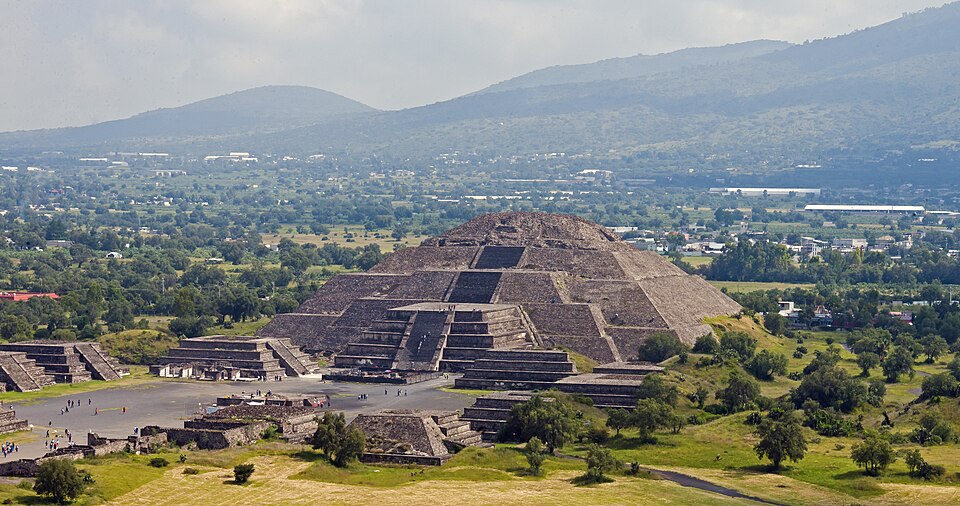

During the Tzacualli phase, the city experienced explosive growth. The Pyramid of the Sun — with a base measuring approximately 225 by 225 metres and an original height of roughly 65 metres, making it the third-largest pyramid by volume in the world — was constructed in a single massive building campaign, probably completed within a few decades.4, 5 Roberta Sload's analysis of construction fill and ceramic evidence suggests the pyramid was erected during the late first or early second century CE, and that its rapid construction reflected an unprecedented mobilisation of labour that likely drew populations from across the Basin of Mexico into the growing city.5 The Avenue of the Dead was laid out on a north-south axis oriented 15.5 degrees east of true north, and this distinctive alignment was imposed on the entire urban grid, including residential neighbourhoods extending kilometres from the ceremonial core.1, 4
By the Tlamimilolpa phase (c. 200–350 CE), the city had reached its maximum extent and population. Michael Smith and colleagues have estimated the population at between 100,000 and 125,000, based on systematic analysis of the more than 2,000 apartment compounds mapped by Millon's project.3 This figure made Teotihuacán not only the largest city in the Americas but one of the largest in the world during the first half of the first millennium CE.4, 3 The city's growth appears to have been driven in part by a deliberate policy of population concentration: survey data from the surrounding Basin of Mexico indicate that rural settlement declined sharply as Teotihuacán expanded, suggesting that much of the basin's population was drawn or compelled into the city.21, 4
Monumental architecture
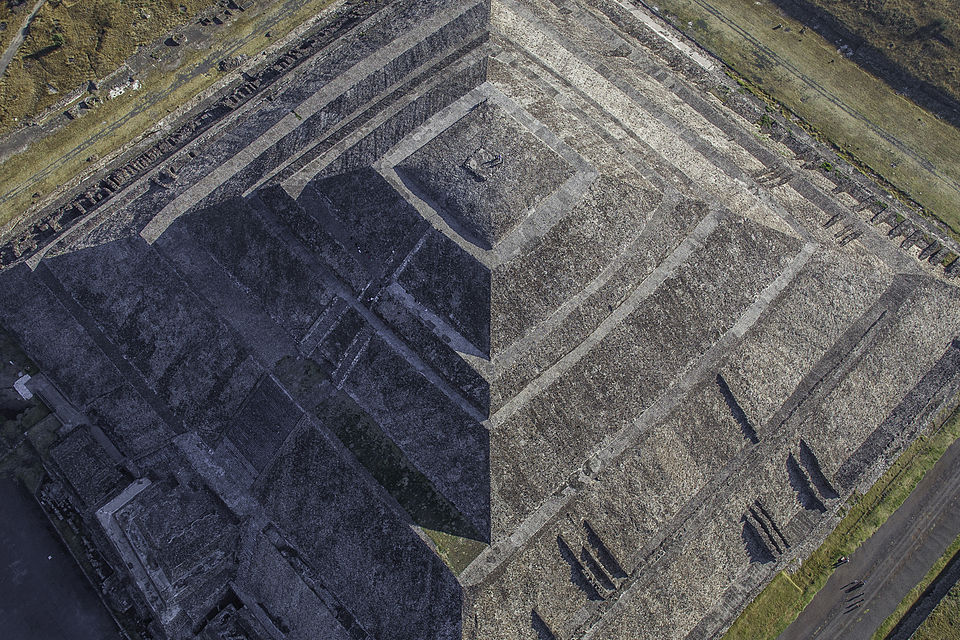

The ceremonial core of Teotihuacán was organised along the Avenue of the Dead (Miccaotli), a processional boulevard running approximately 5 kilometres from the Pyramid of the Moon at its northern terminus southward past the Pyramid of the Sun and the Ciudadela compound.4, 20 The avenue was not a road in the conventional sense but an enormous architectural space, up to 40 metres wide, flanked by elevated platforms and temple complexes, and punctuated by plazas that could have accommodated tens of thousands of participants in ritual events.4
The Pyramid of the Sun, constructed primarily during the Tzacualli phase, is the city's largest structure and the dominant landmark of the site.5 It was built over a natural cave system that extends beneath the pyramid's centre, a feature with probable cosmological significance — caves held deep symbolic importance throughout Mesoamerica as places of origin and portals to the underworld.4, 5 The pyramid's enormous volume of approximately 1.2 million cubic metres of sun-dried adobe, rubble, and earth required the coordinated labour of thousands of workers and the quarrying and transport of vast quantities of material from the surrounding valley.5, 4
The Pyramid of the Moon, smaller but positioned on higher ground so that its summit matches the height of the Pyramid of the Sun's, was built in at least seven construction stages spanning from approximately 100 to 350 CE.6 Saburo Sugiyama and Rubén Cabrera Castro's excavations between 1998 and 2004 revealed a sequence of dedicatory burials and offerings deposited at each stage of enlargement, including the remains of sacrificed humans, wolves, pumas, eagles, rattlesnakes, and marine creatures, along with obsidian blades, pyrite mirrors, and greenstone figurines.6 The increasing scale and complexity of these offerings across successive building stages suggest a progressive intensification of state power and ritual authority over the pyramid's 250-year construction history.6, 14
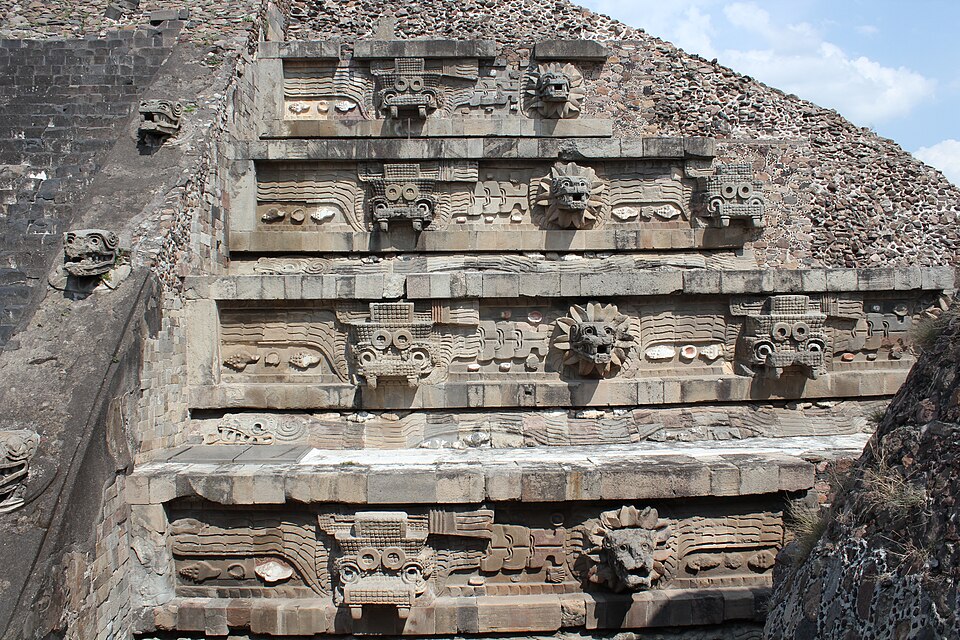
The Feathered Serpent Pyramid (also called the Temple of Quetzalcoatl), located within the Ciudadela compound at the southern end of the Avenue of the Dead, is the most elaborately decorated structure at Teotihuacán.7 Its façade bears carved stone heads of feathered serpents and a second creature variously identified as Tlaloc (a rain deity) or a primordial crocodilian being, alternating in rows across the stepped platforms.7, 4 Excavations in the 1980s and 1990s uncovered the remains of more than 200 sacrificial victims buried in pits arranged symmetrically around the pyramid's base, many with their hands tied behind their backs and accompanied by elaborate offerings of shell, obsidian, and greenstone.7, 13
The tunnel beneath the Feathered Serpent Pyramid
In 2003, heavy rains revealed a sinkhole near the Feathered Serpent Pyramid that led to the discovery of a sealed tunnel extending approximately 103 metres beneath the structure, reaching a depth of roughly 14 metres below the surface.8 Excavations directed by Sergio Gómez Chávez of Mexico's National Institute of Anthropology and History (INAH) between 2009 and 2017 revealed that the tunnel had been deliberately sealed with rubble around 250 CE and contained an extraordinary assemblage of offerings, including pyrite mirrors, carved greenstone figures, rubber balls, jaguar remains, and large quantities of liquid mercury — a substance rarely encountered in Mesoamerican archaeological contexts.8, 4
AMS radiocarbon dating of organic materials from the tunnel indicates that it was constructed and used between approximately 100 and 250 CE, placing its period of activity within the Tzacualli through Miccaotli phases, when the city was undergoing its most rapid expansion.8 The tunnel's terminus opened into a series of cross-shaped chambers whose walls were impregnated with pyrite to create a glittering, reflective surface, and the entire space appears to have been designed as a symbolic representation of the underworld.8 The deliberate sealing of the tunnel, the extraordinary richness of the offerings, and the absence of human burials at the terminal chambers have led some researchers to hypothesise that the tunnel was used for state rituals of cosmological significance, possibly connected to the legitimation of political authority or the foundation of the city itself.8, 4
Social organisation and the apartment compound system
One of Teotihuacán's most distinctive features was its residential architecture. Rather than the dispersed houses or palace-and-hut patterns typical of other ancient cities, Teotihuacán's population lived in standardised, multi-family apartment compounds — walled residential complexes of 20 to 100 rooms arranged around open courtyards, covering an average of approximately 3,600 square metres each.3, 1 Millon's survey identified more than 2,000 of these compounds across the urban zone, and their remarkably uniform layout suggests that their construction was planned or at least regulated by a central authority.1, 3
Smith and colleagues' 2019 analysis estimated that each compound housed an average of 60 to 100 people, organised into multiple households sharing cooking facilities and ritual spaces.3 The compounds varied considerably in elaboration: some featured richly painted murals, fine imported ceramics, and abundant prestige goods, while others contained simpler furnishings, indicating significant socioeconomic differentiation within the city's nominally standardised residential grid.3, 4 Linda Manzanilla's excavations at the Teopancazco compound revealed evidence of specialised craft production, including the working of foreign materials such as marine shell, slate, and mica that originated hundreds of kilometres from the city, suggesting that individual compounds served as centres of particular economic activities integrated into the city's larger exchange networks.11
The political structure of Teotihuacán remains one of the great unsolved questions of Mesoamerican archaeology. Unlike contemporary Maya cities, which produced abundant inscriptions naming specific rulers and dynasties, Teotihuacán left no readable texts and virtually no depictions of identifiable individual rulers.4, 11 Manzanilla has argued that the city was governed not by a single dynastic lineage but by a co-rulership or corporate form of governance, in which power was shared among the leaders of the city's major districts and ethnic groups — a model she calls "corporate organisation" in contrast to the "exclusionary" rule of Maya kings.11 This hypothesis draws support from the city's architectural emphasis on anonymous, standardised forms rather than individualised royal monuments, and from the apparent destruction of the Feathered Serpent Pyramid's façade in antiquity — possibly an act of political iconoclasm against an early attempt at autocratic rule.7, 11
A multiethnic metropolis
Archaeological and bioarchaeological evidence demonstrates that Teotihuacán was a profoundly multiethnic city that drew immigrants from across Mesoamerica.11, 16 T. Douglas Price, Linda Manzanilla, and William Middleton's pioneering strontium isotope study of human skeletal remains from several residential compounds found that a substantial proportion of individuals had grown up outside the Teotihuacán Valley, with isotopic signatures consistent with origins in Oaxaca, the Gulf Coast, western Mexico, and the Maya region.16
The best-documented immigrant community is the Oaxaca Barrio, a neighbourhood in the western part of the city whose residents maintained architectural styles, burial practices, ceramic traditions, and even a distinct writing system derived from their Zapotec homeland in the Valley of Oaxaca, more than 300 kilometres to the southeast.11, 4 Genetic analysis has confirmed the distinctiveness of this community: Brenda Álvarez-Sandoval and colleagues' mitochondrial DNA study of remains from the Teopancazco compound found multiple haplogroups consistent with diverse Mesoamerican origins, providing molecular-level confirmation that the compound's residents were drawn from geographically dispersed populations.12 A similar "merchants' barrio" on the city's eastern periphery contained Maya-style ceramics, architecture, and burial practices, indicating the presence of a resident Gulf Coast or Maya trading community.4, 16
Manzanilla has argued that this ethnic diversity was managed through a system of neighbourhood-level autonomy within the larger corporate political framework: each ethnic enclave maintained its own internal social organisation, craft specialisations, and ritual practices, while contributing to the city's collective economy and participating in shared urban institutions.11 The tensions inherent in this arrangement may have been a contributing factor in the city's eventual collapse, as the bonds holding the multiethnic polity together weakened over time.11, 18
Economy and obsidian trade
The economy of Teotihuacán was anchored by agriculture — the city sat amid the fertile alluvial soils of the Teotihuacán Valley, supplemented by irrigation from spring-fed canals — but its regional dominance rested on its control of obsidian, the volcanic glass that served as the primary raw material for cutting tools across Mesoamerica.9, 4 Michael Spence's analysis of obsidian workshop debris identified more than 400 obsidian workshops within the city, concentrated in particular residential zones, producing blades, projectile points, scrapers, and other implements on an industrial scale.9
Teotihuacán's workshops drew their raw material from two major sources: the Pachuca source in the state of Hidalgo, which produced a distinctive green obsidian prized across Mesoamerica, and the Otumba source closer to the city, which yielded grey obsidian for more utilitarian products.9, 10 Barbara Stark and colleagues' regional analysis of obsidian consumption patterns across Mesoamerica found that the distribution of Pachuca green obsidian closely tracked the spatial extent of Teotihuacán's political and economic influence, with quantities peaking during the city's apogee and declining sharply after its collapse — strong evidence that the obsidian trade was managed or at least facilitated by the Teotihuacán state.10
Estimated number of obsidian workshops at Teotihuacán by district9
Beyond obsidian, Teotihuacán's economy encompassed the production and exchange of fine ceramics (notably the Thin Orange ware that circulated across Mesoamerica), worked greenstone, shell ornaments, and textiles.4, 11 The presence of foreign materials in compound workshops — marine shell from both the Pacific and Gulf coasts, mica from Oaxaca, jade and cinnabar from the Maya lowlands — documents exchange networks spanning the full breadth of Mesoamerica, networks that Teotihuacán occupied a central position in for centuries.11, 4
Sacrifice and ritual life
.jpg)
Human sacrifice was integral to the ritual life of Teotihuacán, as demonstrated by the dedicatory burials associated with its major monuments.7, 6 The most extensively documented case is the Feathered Serpent Pyramid, where excavations uncovered the remains of more than 200 individuals interred in carefully arranged groups around the pyramid's base and within its fill.7 Sugiyama's analysis revealed that the victims were deposited in groups of 4, 8, 9, 18, and 20, numbers with probable calendrical and cosmological significance in the Mesoamerican ritual system.7 Many victims were adult males buried with their hands tied, wearing necklaces of imitation human jawbones carved from shell and accompanied by obsidian projectile points — a pattern Sugiyama interprets as representing warriors or war captives sacrificed to consecrate the building and materialise the state's military ideology.7
Isotopic analysis has revealed that many of these victims originated far from the city. Christine White and colleagues' oxygen and strontium isotope study of the Feathered Serpent Pyramid victims identified individuals from at least four isotopically distinct regions, including the Gulf Coast, Oaxaca, and western Mexico, demonstrating that the sacrificial programme drew victims from across Teotihuacán's sphere of influence.13 Subsequent isotopic work on victims from the Moon Pyramid confirmed a similar pattern of geographic diversity, with individuals showing isotopic signatures consistent with multiple distinct homelands.14 Price, Spence, and Longstaffe's 2020 reanalysis with expanded datasets reinforced these findings, indicating that the sacrificial victims were not local captives but representatives of distant polities, possibly sent as tribute or taken in military campaigns.15
The Moon Pyramid's dedicatory burials followed a different pattern from the Feathered Serpent Pyramid. Excavations revealed burials containing not only human victims but also large predatory animals — pumas, wolves, eagles, and rattlesnakes — interred in elaborate arrangements that appear to reference cosmological themes of predation, warfare, and celestial symbolism.6 The association of these burials with successive construction stages indicates that each enlargement of the pyramid was a politically charged event, marked by state-sponsored sacrificial rituals that simultaneously consecrated the structure, renewed the cosmic order, and demonstrated the reach of Teotihuacán's power through the geographic diversity of the victims.6, 14
Teotihuacán's influence across Mesoamerica
The reach of Teotihuacán extended far beyond the Basin of Mexico. Archaeological evidence of Teotihuacán-style architecture, ceramics, iconography, and ritual practices has been identified at sites across Mesoamerica, from the deserts of Zacatecas and Durango in the north to the Maya lowlands of Guatemala, Belize, and Honduras in the south.4, 10 This widespread pattern of influence, often termed the "Teotihuacán interaction sphere," has been one of the most debated phenomena in Mesoamerican archaeology, with interpretations ranging from military conquest and direct political control to indirect economic influence and voluntary emulation by local elites.4
The relationship between Teotihuacán and the Maya civilization was particularly complex. At Tikal, one of the largest Maya cities, an inscription dated to 378 CE records the "arrival" of a figure called Siyaj K'ahk' ("Fire Is Born") on the same day that Tikal's existing king died, followed by the installation of a new ruler with Teotihuacán connections — an event widely interpreted as a military intervention or political takeover orchestrated from central Mexico.4, 17 Architectural platforms in Teotihuacán talud-tablero style were constructed at Tikal, Copán, Kaminaljuyú, and other Maya centres during the fourth and fifth centuries CE, demonstrating the adoption of central Mexican forms in distant regions.4
Nawa Sugiyama and colleagues' 2022 discovery of spider monkey and puma remains in a dedicatory deposit at the Moon Pyramid — animals native to the tropical lowlands, not the highland Basin of Mexico — provided direct zoological evidence for long-distance gift diplomacy between Teotihuacán and the Maya region.17 Isotopic analysis confirmed that the spider monkey had been raised in captivity and transported alive to Teotihuacán from the Maya lowlands, representing the earliest documented case of primate translocation in the Americas and tangible proof of the elite exchange networks linking central Mexico and the Maya world.17
Collapse and aftermath
Around 550 CE, Teotihuacán's ceremonial core was destroyed by an intense and apparently deliberate burning event.18, 19 The fire was concentrated along the Avenue of the Dead and targeted temples, administrative buildings, and elite residential compounds, while many ordinary apartment compounds in the outer city were left intact — a pattern strongly suggesting an intentional act of political destruction rather than an accidental conflagration or external military attack.4, 19 Archaeomagnetic survey work by Romero and colleagues has confirmed the intensity and extent of the burning event along the Avenue of the Dead, with temperatures reaching levels sufficient to permanently alter the magnetic signature of the affected structures.19
Sarah Clayton's Bayesian chronological analysis places the burning event and subsequent depopulation between approximately 530 and 570 CE, followed by a protracted period of demographic decline rather than a sudden abandonment.18 The city continued to be occupied on a reduced scale through the Metepec phase (c. 550–650 CE), but its population fell to perhaps 20,000 to 40,000 and its regional political influence collapsed.18, 4 The causes of the collapse remain debated. Manzanilla has pointed to growing internal tensions between the city's ethnic and occupational groups, exacerbated by resource depletion in the overexploited Teotihuacán Valley; others have emphasised the effects of volcanic eruptions (including the 536 CE dust-veil event) on agricultural productivity; and still others have suggested that the burning represents an internal revolution against the ruling elite.11, 18, 4
The collapse of Teotihuacán reverberated across Mesoamerica. The distribution of Pachuca green obsidian contracted sharply, long-distance exchange networks were disrupted, and former client polities in the Basin of Mexico and beyond fragmented into competing regional centres during the Epiclassic period (c. 650–900 CE).10, 18 Yet the city's cultural legacy endured. The Aztec Empire, which rose to power in the same Basin of Mexico nearly a millennium later, revered Teotihuacán as the place where the gods had created the world and the sun, incorporating the ancient city into their own origin mythology and conducting pilgrimages to its ruins.4, 20 The very name Teotihuacán, meaning "the place where the gods were created" in Nahuatl, was bestowed by the Aztecs centuries after the city's abandonment and reflects the enduring awe that its monumental ruins inspired in later Mesoamerican peoples.4
Archaeological significance
Teotihuacán holds a central place in the comparative study of ancient urbanism and state formation. As a city that achieved a scale and organisational complexity comparable to Old World urban centres without any demonstrable contact with Eurasian civilisations, it provides an independent case study for understanding the processes by which human societies create cities, states, and complex institutions.4, 21 The city's corporate political structure, if Manzanilla's model is correct, challenges assumptions derived from Mesopotamian and Egyptian precedents that early states necessarily required a visible, named ruler concentrating power in a single lineage.11, 4
The multiethnic character of the city, documented through isotopic, genetic, and material culture evidence, offers an ancient analogue for processes of migration, integration, and identity maintenance that remain relevant to contemporary urban societies.12, 16 The scale of the Millon mapping project, which produced 147 foldout maps covering every structure in the 20-square-kilometre urban zone, set a methodological standard for large-scale urban archaeology that continues to influence field practice.1, 2 And the ongoing excavation of the tunnel beneath the Feathered Serpent Pyramid has demonstrated that even the most intensively studied archaeological sites can still yield transformative discoveries, fundamentally altering understanding of a civilisation that, despite more than a century of research, continues to guard many of its secrets.8
References
Apartment Compounds, Households, and Population in the Ancient City of Teotihuacan, Mexico
The Moon Pyramid Project and the Teotihuacan State Polity: A Brief Summary of the 1998–2004 Excavations
Human Sacrifice, Militarism, and Rulership: Materialization of State Ideology at the Feathered Serpent Pyramid, Teotihuacan
AMS 14C Dating of Materials Recovered from the Tunnel under the Temple of the Feathered Serpent in Teotihuacan, Mexico
Cooperation and Tensions in Multiethnic Corporate Societies Using Teotihuacan, Central Mexico, as a Case Study
Genetic Evidence Supports the Multiethnic Character of Teopancazco, a Neighborhood Center of Teotihuacan, Mexico (AD 200–600)
Geographic Identities of the Sacrificial Victims from the Feathered Serpent Pyramid, Teotihuacan: Implications for the Nature of State Power
Residential Histories of the Human Sacrifices at the Moon Pyramid, Teotihuacan: Evidence from Oxygen and Strontium Isotopes
The Temple of Quetzalcoatl, Teotihuacan: New Data on the Origins of the Sacrificial Victims
Immigration and the Ancient City of Teotihuacan in Mexico: A Study Using Strontium Isotope Ratios in Human Bone and Teeth
Earliest Evidence of Primate Captivity and Translocation Supports Gift Diplomacy Between Teotihuacan and the Maya
The Collapse of Teotihuacan and the Regeneration of Epiclassic Societies: A Bayesian Approach
Fire Along the Street of the Dead: New Comprehensive Archaeomagnetic Survey in Teotihuacan (Central Mesoamerica)