Overview
- The Columbian Exchange — a term coined by historian Alfred Crosby in 1972 — refers to the massive transfer of plants, animals, diseases, peoples, and ideas between the Eastern and Western Hemispheres following Christopher Columbus's 1492 voyage, reshaping agriculture, demography, and ecology on every inhabited continent.
- New World crops such as maize, potatoes, and cassava fueled Old World population growth (the potato alone may account for a quarter of Europe's population increase between 1700 and 1900), while Old World livestock — horses, cattle, pigs, and sheep — transformed the economies and landscapes of the Americas.
- The exchange carried devastating consequences for indigenous Americans: Old World diseases including smallpox, measles, and influenza killed an estimated 90 percent of the pre-contact population — a demographic catastrophe of approximately 56 million people — with cascading effects on land use severe enough to measurably alter atmospheric carbon dioxide levels in the late sixteenth century.
The Columbian Exchange denotes the massive, sustained transfer of plants, animals, microorganisms, peoples, technologies, and ideas between the Eastern and Western Hemispheres that began after Christopher Columbus's first transatlantic voyage in 1492. The term was coined by the historian Alfred W. Crosby in his 1972 book The Columbian Exchange: Biological and Cultural Consequences of 1492, which reframed the European colonization of the Americas as fundamentally a biological event rather than a purely military or political one.1 In the decades since Crosby's work, the concept has become central to world history, environmental history, and historical demography, generating a vast interdisciplinary literature on the ecological, epidemiological, and economic consequences of sustained contact between two hemispheres that had been biologically isolated for thousands of years.3
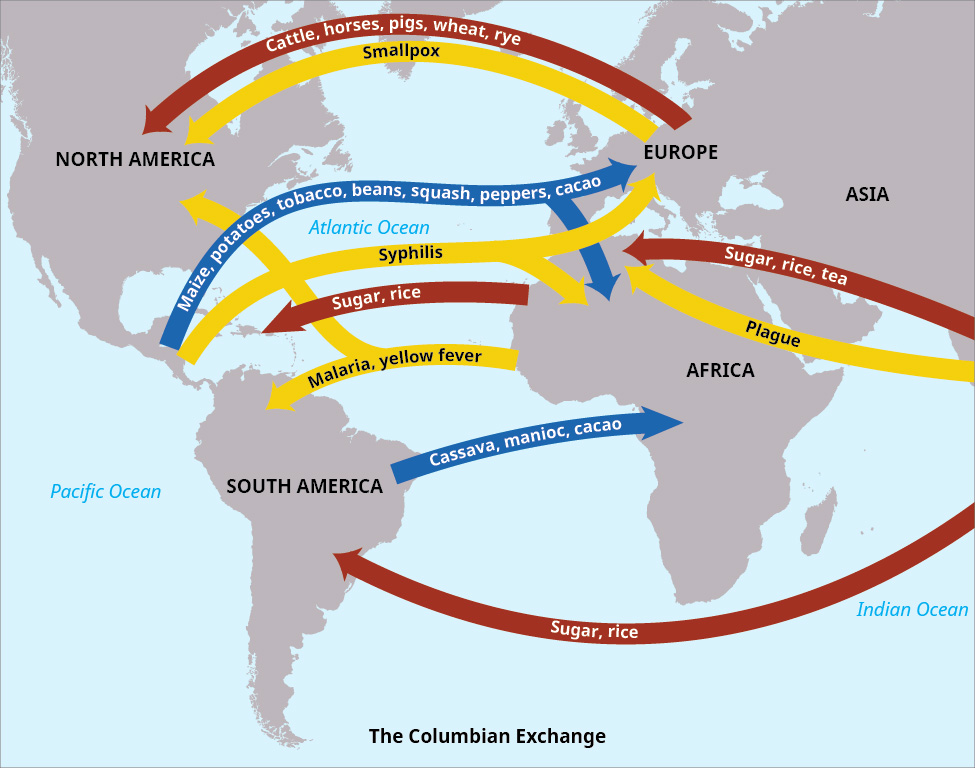

The exchange was profoundly asymmetric. The Americas contributed staple crops that would transform Old World agriculture and drive population growth across Europe, Asia, and Africa. The Old World contributed domesticated livestock, cereal grains, and — most consequentially — infectious diseases to which indigenous American populations had no acquired immunity. The resulting demographic catastrophe, in which an estimated 90 percent of the pre-contact American population perished within a century of European arrival, ranks among the largest mortality events in human history and had cascading ecological, political, and climatic consequences that are still being measured by researchers today.6, 10
Crosby's framework and historiographic impact
Before Crosby's intervention, historical narratives of European expansion emphasized military technology, political organization, and cultural superiority as explanations for the conquest of the Americas. Crosby's 1972 book shifted the focus to biological factors: the crops, livestock, weeds, pests, and pathogens that accompanied European colonists and, in many cases, preceded them. He argued that the biological organisms Europeans brought — intentionally and unintentionally — were more decisive in the displacement of indigenous peoples than any military campaign.1
Crosby extended this argument in Ecological Imperialism (1986), which examined European biological expansion across what he termed the "Neo-Europes" — temperate-zone regions including the Americas, Australia, and New Zealand where European organisms gained decisive ecological advantages over native species. The success of European colonization, Crosby contended, rested on the co-migration of an entire biological package: grasses, weeds, rats, livestock, and pathogens that collectively displaced indigenous ecosystems and the human societies dependent on them.2 Jared Diamond's Guns, Germs, and Steel (1997) subsequently popularized many of these arguments, emphasizing that Eurasia's east-west continental axis and greater inventory of domesticable plants and animals gave its civilizations structural advantages that ultimately shaped the outcome of contact with the Americas.5
Plants: New World to Old World
The Americas contributed an extraordinary array of domesticated crops to global agriculture, many of which had been cultivated for millennia before European contact. Maize (Zea mays), first domesticated from teosinte in the Balsas River valley of Mexico approximately 9,000 years ago, became one of the world's most widely grown cereals after its introduction to Europe, Africa, and Asia in the sixteenth century. Its high yields and adaptability to diverse climates made it a staple food from southern Europe to sub-Saharan Africa to China, where it expanded the agricultural frontier into upland areas unsuitable for rice or wheat.3, 9
The potato (Solanum tuberosum), domesticated in the Andean highlands of modern Peru and Bolivia by at least 8000 BCE, had an even more measurable demographic impact. Potatoes produce more calories per hectare than any Old World cereal grain and thrive in the cool, wet climates of northern Europe where wheat cultivation is marginal. A 2011 econometric study by Nunn and Qian estimated that the introduction of the potato accounted for approximately one-quarter of the growth in Old World population and urbanization between 1700 and 1900, making it one of the most consequential single crop transfers in human history.4 Other New World crops that became globally significant include the tomato, which transformed Mediterranean cuisine; cassava (manioc), which became a staple food across tropical Africa and Asia; tobacco, which created vast new commercial markets; cacao, the basis of chocolate; and rubber (Hevea brasiliensis), which became indispensable to industrial economies in the nineteenth century.3
The domestication of plants and animals in the Americas followed a fundamentally different trajectory from that of the Old World. Where Eurasian agriculture developed around cereal grains and large domesticated mammals during the Neolithic Revolution, American agriculture centered on crops such as maize, beans, and squash — the "Three Sisters" intercropping system — with far fewer domesticated animal species. This difference in the composition of agricultural systems meant that the Columbian Exchange was not a symmetrical trade but a massive net transfer of biological diversity in both directions, each hemisphere contributing what the other lacked.1, 5
Plants: Old World to New World
European colonists introduced a complementary suite of Old World crops to the Americas, many of which rapidly became dominant in colonial agriculture. Wheat, the foundation of European diets, was planted wherever climate permitted and became the primary grain crop of temperate regions in North and South America. Sugarcane, originally domesticated in New Guinea and cultivated across South and Southeast Asia before reaching the Mediterranean, became the single most economically consequential crop introduced to the New World. Planted first in Hispaniola in the early sixteenth century, sugarcane production expanded rapidly across the Caribbean, Brazil, and coastal lowlands, driving the development of plantation agriculture and the transatlantic slave trade.12
Coffee, native to Ethiopia and cultivated in the Arabian Peninsula before European contact, was introduced to the Americas in the eighteenth century and found ideal growing conditions in the highlands of Central America, Colombia, and Brazil. Rice, domesticated independently in Asia and West Africa, was brought to the Carolinas and other coastal lowlands of the Americas, where enslaved Africans with expertise in rice cultivation were specifically targeted by slave traders. Citrus fruits, grapes, olives, and a wide range of garden vegetables also crossed the Atlantic, fundamentally altering the dietary landscape of the Americas.3, 9
Animals
The transfer of domesticated animals was overwhelmingly one-directional: from the Old World to the New. The Americas at the time of contact had very few large domesticated animals — the llama and alpaca of the Andes, the domesticated turkey and Muscovy duck, and the dog — while Eurasia possessed horses, cattle, pigs, sheep, goats, chickens, and donkeys, all products of thousands of years of selective breeding.5
The horse, extinct in the Americas since the late Pleistocene, was reintroduced by Spanish colonists in the sixteenth century and transformed indigenous cultures across the Great Plains of North America, the Pampas of South America, and northern Mexico. Within two centuries, feral horse populations had spread across vast grassland regions, and peoples such as the Comanche, Lakota, and Mapuche built new equestrian cultures around the animal. Cattle, pigs, and sheep similarly multiplied with extraordinary speed in the Americas, where they encountered vast grasslands with no native competing grazers of comparable size and few endemic diseases. Spanish cattle herds on Hispaniola, introduced in the 1490s, grew to tens of thousands within decades, and feral pig populations spread so rapidly through the forests of the Caribbean and mainland that they preceded European settlers into many regions, disrupting indigenous agriculture and wild food sources.1, 2
The turkey was the most significant animal transferred from the Americas to the Old World. Domesticated in Mesoamerica, turkeys were brought to Spain in the early sixteenth century and spread across Europe within decades, becoming an established element of European poultry farming by the late 1500s. The guinea pig, raised as a food source in Andean households, also traveled to Europe but remained primarily a curiosity rather than a significant livestock species. The Muscovy duck, domesticated independently in lowland South America, was adopted into European poultry keeping as well.3
The ecological impact of Old World livestock on the Americas was compounded by the introduction of the European honeybee (Apis mellifera), which colonized environments across the temperate and tropical Americas. The earthworm, largely absent from northern North America since the last glaciation, was reintroduced through European ship ballast and agricultural soils, fundamentally altering the decomposition cycles and nutrient dynamics of forest ecosystems across the continent.2, 14
Disease and demographic catastrophe
The most devastating component of the Columbian Exchange was the transfer of infectious diseases from the Old World to the Americas. Indigenous American populations had no prior exposure to — and therefore no acquired immunity against — smallpox, measles, influenza, typhus, plague, malaria, and yellow fever, all of which were endemic in Eurasia and Africa. The epidemiological asymmetry was a consequence of the different histories of animal domestication in the two hemispheres: millennia of close contact between humans and domesticated livestock in the Old World had produced a large reservoir of zoonotic diseases, while the Americas' limited roster of domestic animals meant that comparatively few such diseases had evolved.5, 6
Smallpox was the most lethal of the introduced diseases. It reached Hispaniola by 1518 and spread to the mainland ahead of the Spanish conquistadors, devastating the Aztec Empire in 1520 during the siege of Tenochtitlan and the Inca Empire in the early 1530s, where it killed the emperor Huayna Capac and triggered a succession crisis that Pizarro exploited. Noble David Cook's research documented how successive waves of epidemics — smallpox followed by measles, typhus, influenza, and plague in overlapping cycles — prevented demographic recovery, each new outbreak striking populations still weakened by the last.6
The scale of the resulting population collapse remains debated, but the direction and magnitude are not in serious dispute. Estimates of the pre-contact population of the Americas range from approximately 8 million to over 100 million, with a growing scholarly consensus favoring figures in the range of 50 to 60 million.7, 8 A 2019 study by Koch and colleagues, synthesizing 119 published regional estimates, calculated a pre-1492 population of approximately 60.5 million, of whom roughly 90 percent — some 56 million people — died within a century of European contact, primarily from epidemic disease.10 This "Great Dying," as the authors termed it, resulted in the abandonment of approximately 56 million hectares of previously cultivated or managed land, leading to massive secondary forest regrowth that sequestered enough carbon to measurably reduce atmospheric CO2 concentrations by 7–10 parts per million in the late sixteenth and early seventeenth centuries — contributing to the cooling period known as the Little Ice Age.10
Estimated pre-contact population and post-contact decline by region7, 10
| Region | Pre-contact estimate | Approximate decline |
|---|---|---|
| Central Mexico | 15–25 million | ~90% |
| Inca territories (Andes) | 10–15 million | ~90% |
| Caribbean | 1–8 million | >95% |
| Amazon basin | 5–8 million | ~90% |
| North America (north of Mexico) | 5–10 million | ~90% |
| Total Americas | ~60 million | ~90% |
The demographic collapse had immediate political and military consequences. The civilizations encountered by European conquistadors were already reeling from epidemic disease before sustained military campaigns began. The population of central Mexico, estimated at 15 to 25 million before contact, may have fallen to approximately one million by 1600. The Maya civilization of the Yucatan and Guatemala experienced comparable losses, as did the chiefdoms and confederacies of North America. The Mississippian culture, whose great center at Cahokia had already declined before European contact, saw its successor polities devastated by epidemics introduced by the de Soto expedition of 1539–1543, which spread disease through the interior Southeast well ahead of permanent European settlement.6, 8
The disease exchange was not entirely one-directional, though the asymmetry was extreme. The question of whether syphilis originated in the Americas and was carried to Europe by Columbus's returning crew remains contested, with skeletal evidence and genomic studies producing conflicting conclusions. If the "Columbian hypothesis" of syphilis is correct, it represents the only major disease transferred from the New World to the Old — a stark contrast to the dozens of lethal pathogens flowing in the opposite direction.3, 6
Ecological transformation
The Columbian Exchange restructured ecosystems on both sides of the Atlantic. In the Americas, European livestock and plants displaced native species and transformed landscapes on a continental scale. Feral cattle and horses multiplied across the grasslands of the Pampas, the Llanos, and the Great Plains. European grasses and weeds, including dandelion, plantain, and Kentucky bluegrass (which is actually of Eurasian origin), spread so pervasively that indigenous peoples reportedly called plantain "the white man's footprint" because it appeared wherever Europeans settled.1, 2
Deforestation accelerated dramatically under colonial land use. Sugar plantations in the Caribbean and Brazil consumed vast quantities of timber for fuel and construction, denuding entire islands. The introduction of cattle ranching and European-style grain agriculture replaced diverse native land management systems — including the sophisticated milpa agriculture of Mesoamerica and the managed forest landscapes of the Mississippian culture and Amazonian peoples — with monocultures and pasture. In the Old World, the introduction of American crops enabled the cultivation of previously marginal lands: maize and potatoes expanded the agricultural frontier into upland and northern European regions, while cassava enabled farming in tropical African soils too poor for indigenous grain crops.3, 14
The ecological consequences extended to disease vectors. The introduction of African mosquito species (Aedes aegypti) to the Americas, likely carried in water casks aboard slave ships, established yellow fever and intensified malaria transmission in the tropical lowlands of the Caribbean and Central America. As J. R. McNeill has documented, these mosquito-borne diseases became geopolitical forces in their own right, killing European soldiers and settlers at far higher rates than acclimated African and Creole populations, thereby shaping the outcomes of colonial wars and slave revolts from Haiti to the American South.13
Economic consequences
The Columbian Exchange generated new global economic networks of unprecedented scale and fundamentally altered the trajectory of early modern capitalism. The most transformative single commodity was silver. The Spanish discovery of massive silver deposits at Potosí (in modern Bolivia, 1545) and Zacatecas (Mexico, 1546), extracted through the forced labor of indigenous and African workers, produced a flood of bullion that financed the Spanish Empire and restructured global trade. Flynn and Giráldez have argued that the founding of Manila in 1571 — which connected American silver to Chinese demand via the Pacific galleon trade — marked the birth of truly global commerce, as silver flowed from the Americas to Europe and Asia while Chinese silk, porcelain, and spices moved in the opposite direction.11
Plantation agriculture, particularly sugar production, created a second major economic transformation. As Sidney Mintz documented in Sweetness and Power, sugar evolved from a rare luxury available only to European elites into a mass commodity consumed by the industrial working class, with profound consequences for labor systems, trade patterns, and dietary habits. The sugar plantation was among the earliest forms of industrialized agriculture, requiring massive capital investment, regimented labor, and complex processing technology. Its insatiable demand for labor drove the transatlantic slave trade, which forcibly transported an estimated 12.5 million Africans to the Americas between the sixteenth and nineteenth centuries, principally to work on sugar, tobacco, coffee, and cotton plantations.12, 9
The Aztec Empire and Inca Empire, both sophisticated state systems with complex economies, were dismantled and replaced by colonial extraction regimes. The Spanish encomienda and mita systems conscripted indigenous labor for mining and agriculture, while the Portuguese developed plantation slavery in Brazil on a scale that dwarfed earlier Mediterranean models. These forced labor systems were not incidental to the Columbian Exchange but integral to it: the crops, metals, and commodities that flowed across the Atlantic depended on coerced labor at every stage of production.9, 12
The economic consequences extended to the Old World as well. The massive influx of American silver caused sustained price inflation across Europe — the so-called "Price Revolution" of the sixteenth and seventeenth centuries — which eroded the purchasing power of fixed-income populations while enriching merchants and colonial elites. In China, where the Ming dynasty's fiscal and monetary systems had converted to a silver standard, the demand for American silver created a trade imbalance that drew bullion eastward across both the Atlantic and Pacific, linking the economies of Seville, Potosi, Manila, and Guangzhou in a single global circuit of exchange.11, 9
Long-term demographic and agricultural effects
Over the long term, the Columbian Exchange contributed to an unprecedented acceleration of global population growth. New World crops — particularly maize, potatoes, sweet potatoes, and cassava — supplemented or replaced existing staples across the Old World, increasing total caloric output and enabling population expansion in regions where agriculture had previously been constrained by climate or soil quality. Nunn and Qian's research on the potato alone demonstrated that its introduction to the Old World accounted for roughly 12 percent of the increase in average Old World population growth rates between 1700 and 1900.4 Maize had comparable effects in Africa and China, where it became a critical food source for expanding populations in marginal agricultural zones.3
The global redistribution of crops also homogenized agricultural systems worldwide. Before 1492, the food plants of the Eastern and Western Hemispheres were almost entirely distinct; by 1800, farmers on every inhabited continent cultivated species from multiple continents. This biological globalization increased total food production but also created new vulnerabilities, as monoculture dependence on introduced crops exposed populations to catastrophic risk. The Irish Potato Famine of 1845–1852, caused by the oomycete Phytophthora infestans, killed approximately one million people and drove another million to emigrate, demonstrating the dangers of over-reliance on a single introduced crop with limited genetic diversity.3, 4
In the Americas, demographic recovery was slow and incomplete. Indigenous populations in many regions did not return to pre-contact levels until the twentieth century, and in some areas they never did. The populations that eventually filled the demographic vacuum were predominantly of European and African descent, along with mixed populations, fundamentally altering the genetic, linguistic, and cultural composition of the Western Hemisphere. The biological legacy of the Columbian Exchange thus extends far beyond agriculture: it reshaped the human geography of the planet, creating the multiethnic societies of the modern Americas and establishing agricultural and ecological patterns that persist into the present.7, 9, 10
Crosby's original framework has been refined and challenged in the half-century since its publication, but its central insight — that the encounter between the hemispheres was primarily a biological event with biological consequences — remains the organizing principle of a vast and growing body of scholarship. The Columbian Exchange was not a single event but a continuing process: the global redistribution of species that began in 1492 accelerated through the colonial period, the industrial age, and into the present, making it one of the most consequential transformations in the history of life on Earth.1, 3, 14
References
The Potato's Contribution to Population and Urbanization: Evidence from a Historical Experiment
Earth System Impacts of the European Arrival and Great Dying in the Americas after 1492