Overview
- Black hole X-ray binaries are systems in which a stellar-mass black hole—typically 5 to 21 solar masses—accretes matter from a companion star through an accretion disk, converting gravitational potential energy into X-ray luminosities of up to 1038 erg per second; the first dynamically confirmed example, Cygnus X-1, was identified in 1972 through independent radial velocity measurements by Webster & Murdin and by Bolton.
- These systems cycle through distinct spectral states—a hard state dominated by Comptonised emission from a hot corona and a soft state dominated by thermal disk radiation—tracing a characteristic q-shaped hysteresis pattern in the hardness-intensity diagram during transient outbursts triggered by the hydrogen ionisation disk instability.
- Black hole X-ray binaries serve as scaled-down laboratories for studying relativistic jet physics, with microquasars such as GRS 1915+105 exhibiting apparent superluminal motion at velocities up to 0.92c, and they provide the primary means of measuring stellar-mass black hole spins through continuum fitting and iron Kα line profile modelling.
Black hole X-ray binaries are binary star systems in which a stellar-mass black hole accretes matter from a companion star, producing luminous X-ray emission as gravitational potential energy is converted into radiation in an accretion disk heated to millions of kelvins. These systems represent some of the most extreme environments in the observable universe, offering direct access to the physics of strong-field gravity, relativistic jets, and accretion onto compact objects. With dynamically confirmed black hole masses ranging from approximately 5 to 21 solar masses, they provide the primary observational evidence for the existence of stellar-mass black holes and serve as essential laboratories for testing general relativity in the strong-field regime.4, 5
The study of black hole X-ray binaries began with the identification of Cygnus X-1 as the first strong black hole candidate in 1972 and has since expanded to encompass dozens of confirmed and candidate systems exhibiting a rich phenomenology of spectral state transitions, quasi-periodic oscillations, and relativistic jet ejections.1, 2, 4 Because the dynamical timescales in these systems are hours to months rather than the millennia characteristic of active galactic nuclei, observers can witness entire accretion cycles—from quiescence through outburst to jet ejection and back—within a single observing campaign, making black hole X-ray binaries uniquely powerful probes of accretion physics.6
Discovery and identification
The existence of stellar-mass black holes was first established through X-ray binary observations. Following the birth of X-ray astronomy in 1962 with the detection of Scorpius X-1, the field rapidly catalogued bright X-ray sources across the sky.18 Among these was Cygnus X-1, discovered during a rocket flight in 1964 and soon recognised as one of the brightest persistent X-ray sources in the Galaxy. The critical breakthrough came in 1972, when two independent teams—Louise Webster and Paul Murdin at the Royal Greenwich Observatory, and Charles Thomas Bolton at the University of Toronto—measured the radial velocity curve of the blue supergiant companion star HDE 226868 and derived a mass function implying a compact companion of at least several solar masses.1, 2
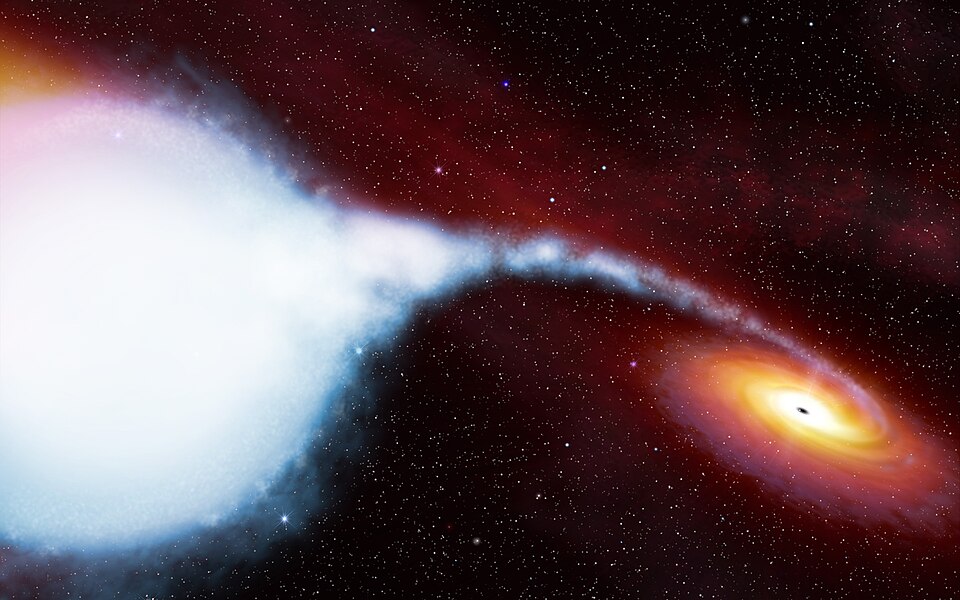

Since the maximum mass of a neutron star is approximately 2 to 3 solar masses, a compact object exceeding this limit must be a black hole. The mass function of Cygnus X-1 placed the compact companion firmly above this threshold, making it the first dynamically confirmed black hole candidate.1, 2 Modern parallax and orbital measurements using very long baseline interferometry have refined the black hole mass in Cygnus X-1 to 21.2 ± 2.2 solar masses, making it the most massive stellar-mass black hole known in an X-ray binary and implying significantly reduced mass-loss rates from its progenitor star's winds.13
The discovery of Cygnus X-1 was followed over subsequent decades by the identification of numerous additional black hole X-ray binaries. The BlackCAT catalogue compiled by Corral-Santana and colleagues lists 59 black hole X-ray transients discovered in the Galaxy since 1966, of which 18 have been dynamically confirmed through radial velocity measurements.9 Population synthesis models suggest that the true Galactic population of black hole X-ray binaries numbers approximately 1,300, with the vast majority remaining undetected in quiescence at very low luminosities.9
Accretion and the disk
The X-ray luminosity of black hole X-ray binaries is powered by accretion—the infall of matter from the companion star onto the black hole through a differentially rotating disk. As material spirals inward, viscous friction converts gravitational potential energy into thermal radiation with an efficiency that depends on the black hole spin: a non-rotating (Schwarzschild) black hole can release up to approximately 6 percent of the accreted rest-mass energy, while a maximally spinning (Kerr) black hole can reach efficiencies of up to 42 percent—far exceeding the less than 1 percent efficiency of nuclear fusion.3, 5
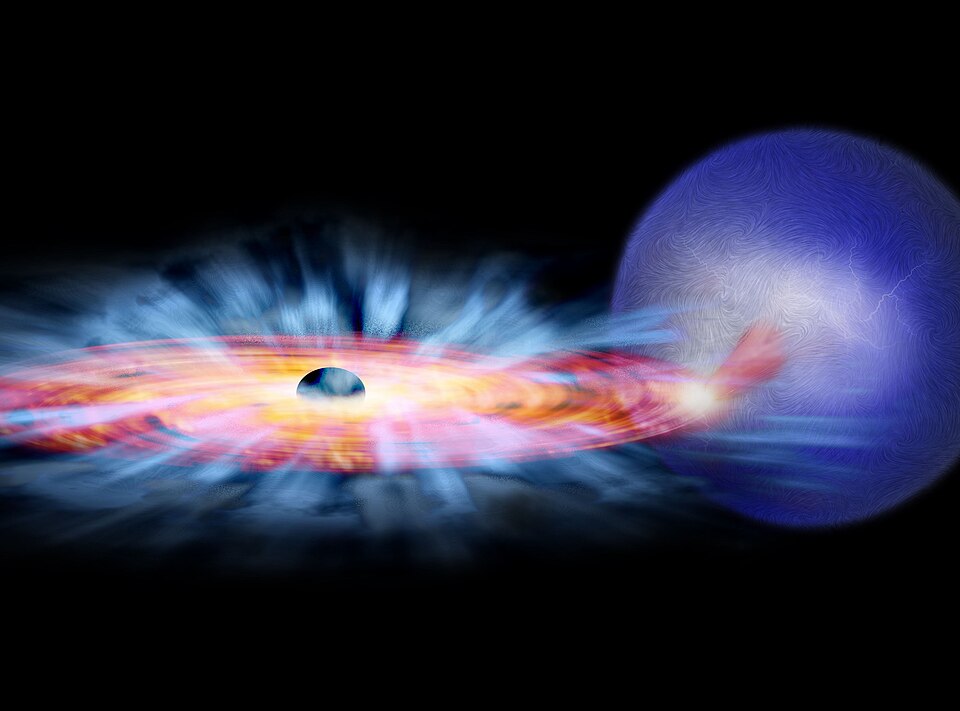

The foundational theoretical framework for understanding this process is the Shakura-Sunyaev thin-disk model, published in 1973. In this model, matter orbits the black hole on nearly circular Keplerian trajectories in a geometrically thin, optically thick disk. Angular momentum is transported outward by viscous stresses—now understood to originate from magnetohydrodynamic turbulence driven by the magnetorotational instability—allowing matter to spiral gradually inward. Each annulus of the disk radiates approximately as a blackbody at a temperature that increases with decreasing radius, producing a characteristic multicolour disk spectrum that peaks in the soft X-ray band at temperatures of roughly 0.5 to 1.5 keV.3, 5
The inner edge of the accretion disk is bounded by the innermost stable circular orbit (ISCO), below which no stable circular orbits exist and matter plunges directly into the black hole. The ISCO radius is a fundamental prediction of general relativity: it lies at 6 gravitational radii (6 Rg = 6 GM/c2) for a non-spinning black hole and contracts to approximately 1 Rg for a maximally prograde-spinning black hole.3, 11 The location of the ISCO determines both the maximum temperature of the disk and the radiative efficiency of accretion, making it a critical observable for constraining black hole spin.
In addition to the thermal disk emission, black hole X-ray binaries produce a hard X-ray component extending to energies of hundreds of keV. This emission is attributed to a corona—a region of hot, optically thin electrons at temperatures of approximately 109 K (roughly 100 keV)—that inverse-Compton scatters soft photons from the disk to higher energies. The geometry of the corona remains debated; proposed configurations include a hot inner accretion flow replacing the truncated disk, a patchy atmosphere sandwiching the disk, and the base of a relativistic jet.5, 12
Spectral states and outbursts
Most black hole X-ray binaries are transient systems that spend the majority of their time in a faint quiescent state, punctuated by dramatic outbursts during which the X-ray luminosity increases by factors of 103 to 106 over timescales of weeks to months.4, 14 These outbursts are triggered by the hydrogen ionisation disk instability: in quiescence, the outer accretion disk is cool and neutral, with a low viscosity that allows matter to accumulate. When the surface density exceeds a critical threshold, hydrogen ionises, the viscosity rises abruptly, and a heating front propagates through the disk, initiating a rapid increase in the mass accretion rate onto the black hole.14
During an outburst, the X-ray spectrum evolves through a sequence of distinct spectral states. The two canonical states are the hard state and the soft state. In the hard state, which typically prevails at low to moderate luminosities, the spectrum is dominated by a power-law component with a photon index of approximately 1.5 to 2.0, produced by inverse Compton scattering in the hot corona. The accretion disk is thought to be truncated at large radii, replaced inward by a hot, geometrically thick, radiatively inefficient accretion flow.4, 5 In the soft state, observed at higher luminosities, the spectrum is dominated by thermal emission from the accretion disk extending inward to or near the ISCO, with a peak temperature of approximately 1 keV. The corona is greatly diminished and the radio jet is quenched.4, 6
The transitions between these states trace a characteristic q-shaped hysteresis pattern in the hardness-intensity diagram (HID): the hard-to-soft transition occurs at a higher luminosity during the rising phase of the outburst than the soft-to-hard transition during the decline. This hysteresis indicates that the accretion geometry depends not only on the instantaneous luminosity but also on the history of the accretion flow, likely reflecting the timescale required for the disk to extend inward or the corona to reform.4, 5, 6 The hard-to-soft transition is frequently accompanied by the ejection of discrete, bright, relativistic plasma blobs visible as transient radio flares, while the soft-to-hard transition is typically quieter.6
Relativistic jets and microquasars
Black hole X-ray binaries can launch powerful, collimated, bipolar outflows of relativistic plasma from the innermost regions of the accretion flow. The direct analogy between these jets and the much larger jets produced by active galactic nuclei led Mirabel and Rodríguez to introduce the term microquasars in 1994, following their detection of apparently superluminal radio ejections from the black hole X-ray binary GRS 1915+105.7
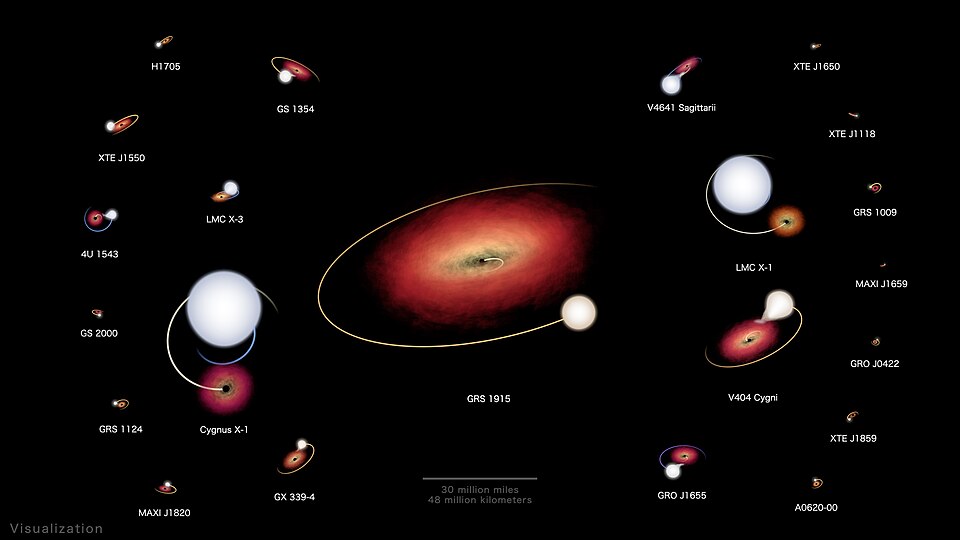

The GRS 1915+105 observation was transformative. Using the Very Large Array, Mirabel and Rodríguez detected two-sided radio-emitting plasma ejections separating at an apparent velocity exceeding the speed of light—the first detection of superluminal motion within the Milky Way. The effect is a well-understood geometric illusion: when plasma moves at a large fraction of the speed of light (approximately 0.92c in this case) along a direction close to the observer's line of sight, relativistic time compression causes the approaching component to appear to travel faster than light.7
The relationship between jets and spectral states follows a systematic pattern described by the unified jet model of Fender, Belloni, and Gallo. In the hard state, a steady, compact jet produces a flat or slightly inverted radio spectrum from partially self-absorbed synchrotron emission in a continuous conical outflow, with bulk Lorentz factors typically between 1.5 and 5. During the hard-to-soft state transition, discrete ballistic ejections are launched with higher Lorentz factors (2 to 10 or more), producing bright optically thin radio flares. In the soft state, the jet is suppressed, with radio emission dropping by factors of 50 or more.6
The fundamental plane of black hole activity, discovered by Merloni, Heinz, and di Matteo in 2003, quantifies the connection between accretion and jet production across the entire mass scale of accreting black holes. This empirical correlation links X-ray luminosity, radio luminosity, and black hole mass in a single relation spanning from stellar-mass black holes in X-ray binaries (roughly 5–20 solar masses) to supermassive black holes in active galactic nuclei (106–109 solar masses)—more than eight orders of magnitude in mass.19 The existence of this plane demonstrates that the same fundamental accretion-jet coupling physics operates regardless of black hole mass, with microquasars providing the time-compressed laboratory for studying processes that unfold over millennia in AGN.6, 19
Mass measurements and the mass distribution
Black hole X-ray binaries provide the primary method for weighing stellar-mass black holes. The technique of dynamical mass determination relies on measuring the radial velocity curve of the companion star from Doppler-shifted absorption or emission lines, yielding the mass function—a lower limit on the compact object's mass that depends on the orbital period, velocity semi-amplitude, and orbital inclination. When the mass function exceeds approximately 3 solar masses, the compact object must be a black hole.4, 20
The 18 dynamically confirmed black holes in the BlackCAT catalogue have masses ranging from approximately 5 to 21 solar masses, with a concentration around 7 to 10 solar masses.9, 20 This distribution reveals a notable feature: the apparent absence of compact objects in the mass range of approximately 3 to 5 solar masses, between the heaviest neutron stars and the lightest confirmed black holes. This so-called lower mass gap may reflect the physics of core-collapse supernovae—rapid explosion mechanisms that either produce a neutron star below 2 solar masses or a black hole above 5 solar masses, with few outcomes in between—or it may be an observational selection effect, since lower-mass black holes produce weaker X-ray emission and are harder to detect dynamically.9, 20 Recent gravitational-wave detections by LIGO and Virgo have begun to populate this gap, suggesting that the paucity of mass-gap objects in X-ray binaries may partly reflect selection biases rather than a true astrophysical absence.20
Selected dynamically confirmed black hole X-ray binaries4, 9, 13
| System | Companion type | BH mass (M⊙) | Orbital period |
|---|---|---|---|
| Cygnus X-1 | O9.7 Iab supergiant | ~21 | 5.6 days |
| GRS 1915+105 | K/M III giant | ~12 | 33.5 days |
| V404 Cygni | K0 III giant | ~9 | 6.47 days |
| A0620−00 | K4 V dwarf | ~6.6 | 7.75 hr |
| XTE J1118+480 | K7/M0 V dwarf | ~7.5 | 4.08 hr |
| GX 339−4 | Late-type | ~6 | 1.76 days |
Spin measurements
Measuring the spin of a black hole is one of the most challenging and consequential goals in high-energy astrophysics. The spin parameter a* (ranging from 0 for a non-spinning black hole to 1 for a maximally spinning Kerr black hole) determines the location of the ISCO, the radiative efficiency, and potentially the power of relativistic jets. Two principal techniques have been developed for measuring black hole spin in X-ray binaries: continuum fitting and reflection spectroscopy.11, 4
The continuum-fitting method models the thermal X-ray spectrum of the accretion disk during the soft state, when the disk extends to the ISCO. By fitting the observed spectrum to a relativistic thin-disk model (based on the Novikov-Thorne equations), and using independently determined values of the black hole mass, orbital inclination, and distance, the ISCO radius—and hence the spin—can be inferred. This technique has yielded spin measurements for more than ten black hole X-ray binaries, with values spanning the full range from nearly zero to near-maximal spin.11 The most extreme measurement is that of GRS 1915+105, whose spin parameter was estimated at a* > 0.98 by McClintock and colleagues, making it one of the most rapidly spinning black holes known.15
The reflection spectroscopy method (also called the iron line method) exploits the broad, asymmetric profile of the iron Kα fluorescence line at 6.4 keV, produced when hard X-rays from the corona irradiate the inner accretion disk. The line profile is shaped by Doppler shifts from the orbital motion of the disk gas, gravitational redshifts from the deep potential well near the black hole, and relativistic beaming. The degree of broadening and asymmetry depends on how close the disk extends to the black hole—and thus on the spin. Fitting the full reflection spectrum (including the iron line, Compton hump, and associated features) has provided spin estimates for more than a dozen systems, with several showing evidence for near-maximal spin.4, 5
Black hole spin measurements from continuum fitting11, 15
The wide range of measured spins carries implications for black hole formation and evolution. A black hole born in a supernova is expected to have moderate spin unless it accretes a significant fraction of its mass from the companion star or was spun up during the collapse process. Near-maximal spins in systems like GRS 1915+105 and Cygnus X-1 may indicate efficient angular momentum transport during core collapse or prolonged accretion, while low spins in systems such as A0620−00 suggest that the black hole has accreted relatively little mass since formation.11, 15
Quasi-periodic oscillations
The X-ray light curves of black hole X-ray binaries frequently exhibit quasi-periodic oscillations (QPOs)—narrow peaks in the power density spectrum that indicate characteristic timescales in the accretion flow without being strictly periodic. These oscillations are among the most powerful probes of matter dynamics in the immediate vicinity of black holes.10
Low-frequency QPOs (LFQPOs) at 0.1 to 30 Hz are ubiquitous in the hard and intermediate spectral states and are classified into three types. Type-C QPOs, the most common, are strong, narrow features riding on a flat-top noise continuum. The leading theoretical explanation invokes Lense-Thirring precession of the hot inner accretion flow: the frame-dragging effect predicted by general relativity for spinning black holes causes the geometrically thick inner flow to precess, modulating the X-ray flux at the precession frequency. As the inner flow contracts during a state transition, the precession frequency increases, matching the observed evolution of type-C QPO frequency during outbursts.10
High-frequency QPOs (HFQPOs) at 40 to 450 Hz have been detected in a handful of black hole binaries, often appearing as a pair with a 3:2 frequency ratio. These frequencies correspond to orbital or epicyclic timescales near the ISCO of a stellar-mass black hole, making them potential direct probes of strong-field general relativity and black hole spin. The 3:2 commensurability has been observed in GRS 1915+105 (at 113 and 168 Hz), XTE J1550−564 (at 184 and 276 Hz), and GRO J1655−40 (at 300 and 450 Hz), among others.4, 10 Proposed models include parametric resonance between orbital and epicyclic motions in the disk, and diskoseismic oscillation modes trapped in the inner disk by the relativistic potential. If the connection between HFQPO frequencies and the ISCO can be firmly established, these oscillations would provide an independent method for measuring black hole mass and spin.10
Formation and evolutionary channels
The formation of a black hole X-ray binary requires that a binary star system survive the core-collapse supernova that creates the black hole—a stringent condition, since the explosion ejects mass from the system and may impart a natal kick to the newborn compact object, both of which tend to unbind the binary.8
Black hole X-ray binaries divide into two evolutionary classes that mirror the broader classification of X-ray binaries. In high-mass systems (BH-HMXBs), the companion is a massive O or B star whose powerful stellar wind feeds the black hole directly. These systems are young, with ages limited by the nuclear evolution of the massive companion to a few million years, and are found preferentially in star-forming regions of the Galactic disk. Cygnus X-1, with its O9.7 supergiant companion HDE 226868, is the archetype.8, 13
In low-mass systems (BH-LMXBs), the companion is a late-type main-sequence star, subgiant, or giant of roughly 1 solar mass or less, and mass transfer proceeds through Roche lobe overflow. These systems are old—typically billions of years—and are concentrated toward the Galactic centre and bulge. The vast majority of known black hole X-ray binaries are low-mass transients, spending most of their time in quiescence and undergoing occasional outbursts driven by the disk instability mechanism.8, 14
The long-term evolution of BH-LMXBs is driven by angular momentum losses that sustain mass transfer. For systems with orbital periods above roughly 3 hours, magnetic braking of the companion star's rotation (coupled tidally to the orbit) extracts angular momentum from the system. Below 3 hours, gravitational wave emission becomes the dominant angular momentum loss mechanism, driving the orbit to shrink over gigayear timescales. These processes determine the mass transfer rate, outburst recurrence interval, and ultimately the fate of the binary.8, 17
Recent advances and observational frontiers
The past several years have witnessed transformative advances in the study of black hole X-ray binaries, driven by new instrumentation and observational capabilities. NASA's Imaging X-ray Polarimetry Explorer (IXPE), launched in December 2021, has opened an entirely new observational dimension by measuring the polarisation of X-rays from accreting black holes. In 2022, IXPE observed Cygnus X-1 in the hard state and measured a polarisation degree of 4.01 ± 0.20 percent at 2 to 8 keV, with the polarisation angle aligned with the radio jet axis. This result demonstrated that the hot corona is extended in a plane perpendicular to the jet, favouring a disk-like or sandwich geometry over a compact lamppost model, and provided the first direct observational link between coronal geometry and jet orientation.12
Observations of the black hole transient MAXI J1820+070 in 2023 revealed evidence for the formation of a magnetically arrested disk (MAD)—a state in which magnetic flux accumulated near the black hole becomes dynamically important, disrupting the smooth inflow of matter and producing powerful magnetically driven outflows. This was the first time a MAD state had been observationally identified in a stellar-mass black hole system, confirming a prediction of general relativistic magnetohydrodynamic (GRMHD) simulations and providing a new physical mechanism for the launching and collimation of relativistic jets.16
The continued refinement of mass and distance measurements through very long baseline interferometry has also reshaped the field. The revised mass of Cygnus X-1 at 21 solar masses, reported by Miller-Jones and colleagues in 2021, was significantly higher than previous estimates and implied that the massive progenitor star lost far less mass through stellar winds than standard models predicted—a finding with implications for the upper end of the stellar-mass black hole population and for the masses of black holes detectable through gravitational-wave mergers.13, 21
Looking forward, next-generation observatories such as the European Space Agency's Advanced Telescope for High Energy Astrophysics (Athena), planned for the late 2030s, will combine large collecting area with high spectral resolution to enable time-resolved spectroscopy of the inner accretion flow on dynamical timescales of milliseconds. Combined with multi-wavelength monitoring and gravitational-wave observations, these capabilities promise to resolve longstanding questions about the disk-jet connection, the nature and geometry of the corona, and the role of black hole spin in powering relativistic outflows.12, 21
References
A review of quasi-periodic oscillations from black hole X-ray binaries: Observation and theory
Black Hole Spin via Continuum Fitting and the Role of Spin in Powering Transient Jets
Polarized x-rays constrain the disk-jet geometry in the black hole x-ray binary Cygnus X-1
Observations of a black hole x-ray binary indicate formation of a magnetically arrested disk
Fifty Years After the Discovery of the First Stellar-Mass Black Hole: A Review of Cyg X-1