Overview
- The Chandrasekhar limit is the maximum mass at which a white dwarf can remain stable against gravitational collapse, set by the failure of electron degeneracy pressure to support the star once electrons become ultra-relativistic; for the standard carbon-oxygen composition (mean molecular weight per electron μe = 2) the canonical value is approximately 1.44 solar masses.
- First derived in its modern form by Subrahmanyan Chandrasekhar in 1931, building on earlier work by Edmund Stoner and Wilhelm Anderson, the limit was famously rejected by Arthur Eddington in 1935 in a public confrontation at the Royal Astronomical Society, despite immediate private support from Bohr, Pauli, and Rosenfeld; Chandrasekhar was ultimately vindicated and awarded the 1983 Nobel Prize in Physics.
- The limit governs the fate of all stars below roughly eight solar masses and sets the explosion mass for Type Ia supernovae, which serve as the standard candles used to discover the accelerating expansion of the universe; rare overluminous events such as SN 2003fg suggest that rotation, magnetic fields, or white dwarf mergers can in some circumstances allow the limit to be exceeded.
The Chandrasekhar limit is the maximum mass that a white dwarf star can possess and still remain in stable hydrostatic equilibrium. For a star composed of fully ionized carbon and oxygen—the typical end product of stellar evolution for progenitors between roughly one and eight solar masses—the limit takes its canonical value of approximately 1.44 solar masses.1, 13 Above this mass, the quantum-mechanical electron degeneracy pressure that holds the star up against its own gravity becomes inadequate, and the star must either ignite carbon explosively, collapse into a neutron star, or collapse directly into a black hole. The existence of a definite maximum mass for the most common stellar remnant in the universe is one of the most consequential results in twentieth-century astrophysics, and its derivation by the nineteen-year-old Subrahmanyan Chandrasekhar on a steamer from India to England in 1930 is among the most celebrated episodes in the history of physics.3, 10
The limit unifies several distinct strands of physics that had only recently been developed when Chandrasekhar performed his calculation: the Pauli exclusion principle and Fermi-Dirac statistics, special relativity, the polytropic theory of stellar structure, and Eddington's earlier insight that white dwarfs were supported by something other than ordinary thermal pressure. Its consequences extend far beyond the structure of a single class of compact objects. The Chandrasekhar mass sets the explosion threshold for Type Ia supernovae, the standard candles whose unexpectedly faint appearance in the late 1990s revealed the accelerating expansion of the universe.21, 22 The limit also defines the dividing line between the two qualitatively different fates of stars: those whose cores remain below it become quiescent white dwarfs, while those whose cores exceed it must continue collapsing past nuclear densities into objects in which general relativity governs the structure.23
Historical background and Fowler's degenerate gas
The puzzle that motivated Chandrasekhar's calculation arose in the early 1920s, when astronomers first appreciated how strange the white dwarf companion of Sirius really was. Walter Adams's 1925 measurement of the gravitational redshift of Sirius B, combined with the orbital determination of its mass at roughly one solar mass and an estimate of its radius from its luminosity and surface temperature, implied a mean density of nearly a million grams per cubic centimetre—more than fifty thousand times the density of any ordinary matter then known. Eddington called this conclusion "absurd" and famously remarked that the message of the companion of Sirius, when decoded, was "I am composed of material 3,000 times denser than anything you have ever come across; a ton of my material would be a little nugget that you could put in a matchbox," to which the only reasonable reply was: "Shut up. Don't talk nonsense."10
The puzzle of how such matter could exist was resolved in 1926 by Ralph Fowler in a paper titled "On Dense Stars," published in the Monthly Notices of the Royal Astronomical Society.7 Fowler applied the brand-new Fermi-Dirac statistics—published only months earlier by Enrico Fermi and Paul Dirac—to the electrons in white dwarf matter and showed that at the densities inferred for Sirius B, the electron gas would be highly degenerate. In a degenerate gas, the Pauli exclusion principle forces electrons into ever-higher momentum states because all the lower-energy states are already occupied. The resulting electron degeneracy pressure is independent of temperature and depends only on density, and it can be enormous: at densities of order 106 g cm−3, it is sufficient to support an entire star against its own gravity even when the temperature has fallen to nearly zero.7, 13 Fowler's resolution removed the apparent paradox of Sirius B, and it implied that white dwarfs could in principle exist for any mass: the denser the star, the higher the degeneracy pressure, and the higher the gravity it could resist.
Fowler's treatment, however, used the non-relativistic equation of state for the electron gas. As the density rises, the Fermi momentum of the electrons rises with it, and at sufficiently high densities the electrons must be treated relativistically. The consequences of doing so were not immediately apparent in 1926, but they would prove decisive.3, 13
Stoner, Anderson, and the priority question
Although the maximum-mass result is universally associated with Chandrasekhar, the historical record shows that two other physicists derived essentially the same conclusion before him. In 1929, the Estonian physicist Wilhelm Anderson, working at the University of Tartu, applied a relativistic correction to Stoner's earlier uniform-density white dwarf model and obtained a maximum mass of approximately 1.37 × 1030 kg—close to the modern value, although his derivation contained mathematical inconsistencies that he himself acknowledged.5, 12 The following year, Edmund C. Stoner of the University of Leeds derived the fully relativistic equation of state for a degenerate electron gas and used it, in the uniform-density approximation, to obtain a more rigorous upper bound for the white dwarf mass that depended on the chemical composition through the mean molecular weight per electron.4, 11
Stoner's 1930 paper in the Philosophical Magazine, titled "The equilibrium of dense stars," explicitly recognized that the relativistic equation of state implied a maximum mass above which no equilibrium configuration could exist; for what he called the "limiting density" the star would simply collapse.4 Chandrasekhar was aware of Stoner's work and cited it in his own papers, noting that the polytrope mass limit he obtained was about twenty percent smaller than Stoner's uniform-density estimate because the polytrope correctly accounts for the variation of density with radius.1, 11 A separate calculation by Lev Landau, published in 1932 in the Soviet physics journal Physikalische Zeitschrift der Sowjetunion, arrived at a similar result by a different route, although Landau applied the limit to ordinary stars rather than white dwarfs and ultimately drew different physical conclusions.6
The historian of science Michael Nauenberg has argued that the Chandrasekhar limit should more properly be called the Stoner-Anderson-Chandrasekhar limit in recognition of these earlier contributions.11, 12 What distinguishes Chandrasekhar's work is the combination of three elements: the use of the polytropic stellar model with index n = 3, the systematic treatment of both the non-relativistic and ultrarelativistic regimes within a single framework, and the explicit identification of the limit as a fundamental property of degenerate matter that determines the fate of stellar evolution. It was Chandrasekhar's papers, not those of Stoner or Anderson, that brought the limit into mainstream astrophysics—and it was Chandrasekhar who endured the public scientific battle to defend it.3, 9
Derivation from electron degeneracy pressure
The Chandrasekhar limit can be derived from a remarkably simple argument that exposes its physical origin. In a white dwarf, the electron gas is described by an equation of state of the form P = Kργ, where γ is the polytropic index. In the non-relativistic limit, where electron speeds are small compared with the speed of light, the equation of state is P = K1ρ5/3, with the coefficient K1 determined by fundamental constants and the mean molecular weight per electron, μe. For carbon-oxygen matter, in which each nucleus contributes equal numbers of protons and neutrons and therefore one electron per two nucleons, μe = 2.13 In this regime, hydrostatic equilibrium can always be achieved: as gravity is increased, the density rises, and degeneracy pressure rises faster, so the star simply contracts until the two are balanced.13, 14
The situation changes qualitatively when the electron Fermi momentum becomes comparable to or larger than mec, where me is the electron rest mass and c is the speed of light. In this ultrarelativistic regime, the kinetic energy of an electron is approximately pc rather than p2/2me, and the equation of state softens to P = K2ρ4/3. The relevant polytropic index is now n = 3. The crucial property of an n = 3 polytrope is that the total mass it admits in hydrostatic equilibrium is independent of the central density: it depends only on the constant K2, which is itself a combination of the Planck constant, the speed of light, the gravitational constant, and the molecular weight per electron. There is one and only one mass for which an ultrarelativistic degenerate sphere can be in equilibrium, and any star that approaches this mass collapses.1, 3, 13
The result is the Chandrasekhar mass:
MCh ≈ 1.456 (2/μe)2 M☉
For pure carbon-oxygen composition with μe = 2, this gives the canonical value MCh ≈ 1.44 M☉. For matter with a higher fraction of nucleons per electron—such as iron, with μe ≈ 2.15—the limit is somewhat lower.13, 14 The constants entering the formula are the most fundamental in physics: MCh can be written as approximately (ℏc/G)3/2/(μemH)2, an expression containing only Planck's constant, the speed of light, Newton's constant, the proton mass, and a dimensionless composition factor. That five fundamental constants combine to produce a mass close to that of an ordinary star is one of the most striking numerical coincidences in physics, and Chandrasekhar himself returned to its significance repeatedly in his later writings.3, 13
The mass-radius relation
The most direct observational signature of electron degeneracy pressure—and of the existence of the Chandrasekhar limit—is the inverse mass-radius relation followed by white dwarfs. Unlike ordinary stars, in which more massive stars are larger, more massive white dwarfs are smaller. As the mass increases, the gravitational compression rises, the central density rises, and the electrons are forced into higher-momentum states; the star contracts to provide the additional pressure. As the mass approaches the Chandrasekhar value, the radius shrinks toward zero.13, 14
For a non-relativistic n = 3/2 polytrope, the radius scales as R ∝ M−1/3; this approximation is reasonable for low-mass white dwarfs but breaks down severely above about one solar mass, where relativistic effects become important. The full relativistic mass-radius relation was first computed by Chandrasekhar himself and later refined for realistic compositions by Hamada and Salpeter in 1961, who treated white dwarfs of helium, carbon, magnesium, and iron composition and incorporated electrostatic corrections from Coulomb interactions among the ions.14 Their tabulated mass-radius curves remain a standard reference for white dwarf interior models.
Mass-radius relation for cold carbon-oxygen white dwarfs, after Hamada & Salpeter (1961)14
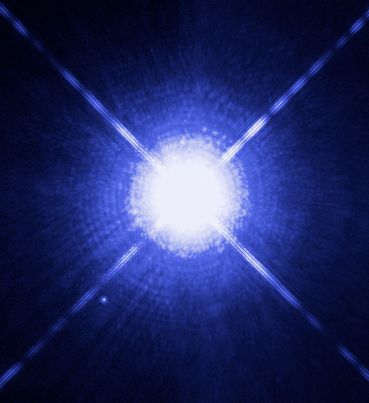

The empirical confirmation of this relation came in stages. The crucial early benchmark was Sirius B itself: with a parallax provided by the Hipparcos satellite, Provencal and collaborators in 1998 derived a mass of 0.984 ± 0.074 solar masses and a radius of 0.0084 ± 0.00025 solar radii—values in close agreement with the theoretical mass-radius relation for a carbon-oxygen white dwarf.15 A parallel analysis by Holberg and collaborators, using the same Hipparcos parallax in combination with new ultraviolet spectroscopy, refined the radius to 0.0083 solar radii and the surface temperature to approximately 24,800 kelvins.16 Later studies of dozens of white dwarfs in visual binaries and common-proper-motion systems extended this confirmation across a wide range of masses, with all measured points lying close to the theoretical curve.15 The mass-radius relation is one of the cleanest tests of degenerate matter physics available in nature, and it constrains both the equation of state and any hypothetical departures from standard physics in dense matter.15, 16
The 1935 confrontation with Eddington
By 1935 Chandrasekhar had refined his 1931 result in a longer paper in the Monthly Notices of the Royal Astronomical Society, in which he set out the full mass-radius relation incorporating relativistic effects throughout the equation of state.2 The implication was inescapable: stars whose cores exceeded the limiting mass had no equilibrium state available to them at all. They must continue contracting indefinitely, raising the unsettling question of what their final fate would be. Chandrasekhar himself concluded his 1935 paper with the observation that "the life history of a star of small mass must be essentially different from the life history of a star of large mass," and that for a sufficiently massive star "one is left speculating on other possibilities."2, 3
The Royal Astronomical Society meeting on 11 January 1935 was supposed to be Chandrasekhar's moment. He had been invited to present his results, and the previous evening at dinner Eddington—then the most prominent astrophysicist in Britain and a personal mentor—had told him that he had asked the secretary of the society to allow him extra speaking time. Chandrasekhar took this as a gesture of support. It was not. Immediately following Chandrasekhar's presentation, Eddington rose and delivered his own paper, titled simply "Relativistic Degeneracy."8, 9 In it, he attacked Chandrasekhar's derivation as physically meaningless on the grounds that it combined relativistic mechanics with non-relativistic quantum theory in an inconsistent manner, and he declared that "there should be a law of Nature to prevent a star from behaving in this absurd way."8, 9 The result was a public humiliation: Eddington's authority was such that few in the audience were prepared to defend Chandrasekhar, and the chair moved on to the next item without giving him an opportunity to respond.
Eddington's objection was wrong. The relativistic Fermi-Dirac equation of state Chandrasekhar had used was perfectly consistent: it is the equation of state of an ideal gas of free particles obeying both special relativity and quantum statistics, which is precisely the appropriate description of degenerate electrons in a white dwarf interior.13 Privately, the leading quantum physicists agreed. Chandrasekhar wrote to Niels Bohr, who replied that he was "absolutely unable to see any meaning in Eddington's statements." Wolfgang Pauli, the originator of the exclusion principle on which the entire calculation rested, told Chandrasekhar that his treatment was correct. Rudolf Peierls published a paper in 1936 demonstrating that Chandrasekhar's equation of state was the only consistent one. Paul Dirac, encountering Eddington at a 1937 meeting in England, told him directly that he was wrong.9, 10
None of this private support translated into public vindication. Henry Norris Russell, the senior American astronomer to whom Chandrasekhar appealed, advised him not to reply publicly to Eddington in print, fearing the dispute would become personally damaging. Eddington, for his part, never retracted, and at a meeting at Harvard in 1936 he referred to Chandrasekhar's result as "stellar buffoonery." The episode left Chandrasekhar permanently scarred. He completed his definitive monograph An Introduction to the Study of Stellar Structure in 1939—a book that included the full derivation and remains a standard reference—and then turned away from white dwarfs entirely, devoting the next several decades to other problems in astrophysics.3, 10 The community as a whole quietly accepted the result over the following decades, but no formal acknowledgement of Chandrasekhar's vindication came until much later. He received the Nobel Prize in Physics in 1983, forty-eight years after the Royal Astronomical Society meeting, "for his theoretical studies of the physical processes of importance to the structure and evolution of the stars."3
Composition dependence and the role of μe
The numerical value of the Chandrasekhar mass depends on the chemical composition of the white dwarf material through the mean molecular weight per electron, μe, defined as the average number of nucleons per free electron in the fully ionized gas. Because each fully ionized atom contributes one electron per proton (for hydrogen) or one electron per two nucleons (for nuclei with equal numbers of protons and neutrons), μe takes simple values for the most relevant compositions. Pure hydrogen would give μe = 1, pure helium μe = 2, pure carbon and oxygen also μe = 2 (since carbon-12 and oxygen-16 have equal numbers of protons and neutrons), and pure iron-56 about μe = 2.15 (because iron has more neutrons than protons).13
White dwarfs in nature are not made of hydrogen: any hydrogen at the bottom of the star would be at sufficient density and temperature to fuse, releasing energy and lifting the star out of equilibrium. The interiors of typical white dwarfs are therefore composed of the products of helium burning, predominantly carbon-12 and oxygen-16, with the precise C/O ratio depending on the rate of the 12C(α,γ)16O reaction in the helium-burning core of the progenitor.14, 25 A small minority of white dwarfs, descended from progenitors near the upper end of the white-dwarf-producing mass range (roughly 8 to 10 solar masses), are instead composed of oxygen, neon, and magnesium produced by the carbon-burning shell that ignited briefly before the envelope was ejected. These oxygen-neon-magnesium white dwarfs have an essentially identical μe ≈ 2 and therefore the same Chandrasekhar limit to within the precision of the calculation.13
The empirical mass distribution of white dwarfs supports this picture. Spectroscopic surveys of large samples drawn from the Sloan Digital Sky Survey show a sharply peaked distribution centred on approximately 0.6 solar masses, with a long tail extending toward higher masses; very few white dwarfs are observed with masses above 1.2 solar masses, and none have ever been confirmed at the Chandrasekhar limit itself.25 The empirical initial-final mass relation determined by Cummings and collaborators in 2018 confirms that even the most massive single-star progenitors produce white dwarfs only marginally above one solar mass, comfortably below the limit. White dwarfs that approach the Chandrasekhar mass do so almost exclusively through binary mass transfer, in which a companion donates material to push the white dwarf upward toward instability.19, 25
Type Ia supernovae and the cosmological consequences
The astrophysical importance of the Chandrasekhar limit is most dramatically expressed in Type Ia supernovae, the thermonuclear explosions of white dwarfs in binary systems. In the standard picture, a carbon-oxygen white dwarf accretes matter from a companion star until its mass approaches the Chandrasekhar limit. Compressional heating in the increasingly dense core eventually raises the central temperature high enough to ignite carbon fusion under degenerate conditions. Because degenerate matter does not expand and cool in response to heating, the burning runs away catastrophically: a thermonuclear flame propagates outward through the star, releasing enough energy in roughly a second to unbind the entire white dwarf in a luminous explosion that briefly outshines its host galaxy.18
Because every Type Ia explosion involves the same triggering mass—the Chandrasekhar limit—and burns essentially the same fuel through nearly the same nuclear reactions, the resulting explosions have remarkably uniform peak luminosities. The peak brightness is set primarily by the mass of radioactive nickel-56 synthesized in the explosion, which decays first to cobalt-56 and then to iron-56, with the energy released by these decays powering the optical light curve over the following months. Type Ia light curves can be standardized to even greater precision through empirical relations between peak brightness and the rate at which the light curve declines, allowing them to serve as standard candles for measuring cosmological distances.18, 21
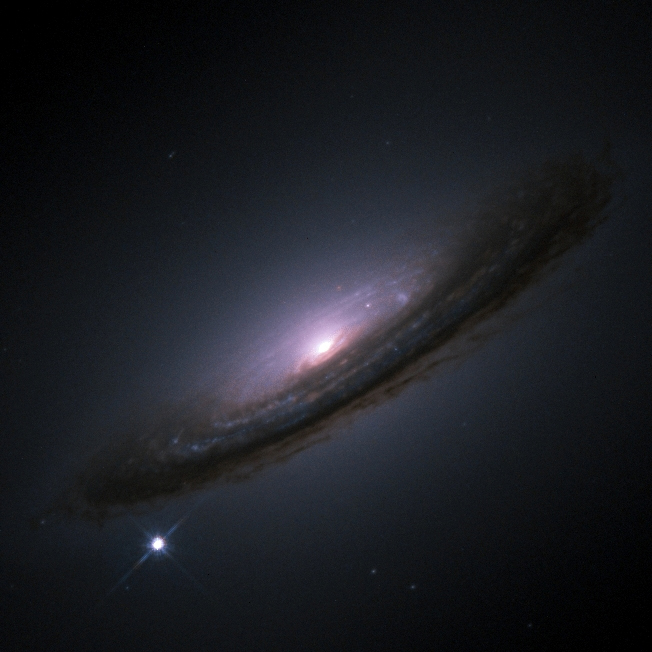

It was this property that allowed the High-Z Supernova Search Team led by Adam Riess and the Supernova Cosmology Project led by Saul Perlmutter to discover, in 1998 and 1999, that distant Type Ia supernovae were systematically dimmer than they should be in a decelerating or coasting universe. Their independent analyses indicated that the expansion of the universe was accelerating, driven by some form of dark energy with negative pressure.21, 22 The discovery, recognized with the 2011 Nobel Prize in Physics, depended at every step on the constancy of the explosion mass: it was the universal Chandrasekhar limit that made Type Ia supernovae trustworthy enough to use as standard candles in the first place.21, 22
The detailed mechanism by which a Chandrasekhar-mass white dwarf actually explodes remains an active area of research. The flame begins as a subsonic deflagration, propagating by thermal conduction and turbulent mixing, but pure deflagration models tend to underproduce intermediate-mass elements and overproduce iron-group ash compared with observations. Most successful contemporary models therefore invoke a deflagration-to-detonation transition, in which the subsonic flame somewhere converts to a supersonic detonation that consumes the outer layers and produces the observed mix of silicon, sulfur, calcium, and iron.18 Whether the trigger is a single-degenerate accreting system or a double-degenerate merger of two white dwarfs is also still debated, with the delay-time distribution of Type Ia events derived from large galaxy surveys favouring the double-degenerate channel for the bulk of the population.19
Exceeding the limit: rotation, magnetism, and SN 2003fg
The Chandrasekhar limit derived in its classical form assumes a non-rotating, unmagnetized white dwarf in which gravity is balanced solely by electron degeneracy pressure. Departures from these assumptions can in principle allow somewhat higher masses to remain in stable equilibrium. Rapid rotation provides centrifugal support that reduces the effective gravity in the equatorial plane, and magnetic fields, if sufficiently strong, can also contribute to the pressure budget. Yoon and Langer in 2005 constructed two-dimensional models of differentially rotating white dwarfs and showed that, for plausible accretion histories, super-Chandrasekhar masses could be sustained: a uniformly rotating white dwarf can reach roughly 1.48 solar masses, while differentially rotating configurations can in principle exceed two solar masses, although their stability against secular instabilities remains uncertain.20
For decades these were theoretical possibilities without observational support. That changed with the discovery of SN 2003fg, an unusual Type Ia supernova found in 2003 by the Supernova Legacy Survey and reported by Howell and collaborators in 2006. SN 2003fg, nicknamed the "Champagne Supernova," was approximately twice as luminous as a normal Type Ia at peak brightness, with ejecta moving at the unusually low velocity of about 8,000 kilometres per second (compared with 10,000 to 12,000 for a normal Type Ia). Howell and collaborators inferred that the explosion synthesized roughly 1.3 solar masses of nickel-56 alone, with additional intermediate-mass elements bringing the total ejected mass to approximately 2.1 solar masses—substantially above the Chandrasekhar limit.17 They concluded that the progenitor had to have been a super-Chandrasekhar white dwarf, most plausibly a rapidly rotating object whose rotation provided the additional support needed to reach this mass.
Several similar events have been identified since, including SN 2006gz, SN 2007if, and SN 2009dc, collectively known as 2003fg-like or super-Chandrasekhar supernovae.17, 19 They share the common features of high luminosity, slow ejecta, and prominent unburned carbon in their early-time spectra. Whether they truly represent the explosion of single rotating white dwarfs above the Chandrasekhar mass, the merger of two near-Chandrasekhar white dwarfs that briefly forms a super-Chandrasekhar configuration, or the interaction of a normal Type Ia with a dense circumstellar envelope remains debated. The events are rare—making up only a few percent of the Type Ia population—and their existence does not undermine the use of normal Type Ia events as standard candles, but they demonstrate that the canonical limit is not absolutely inviolable when angular momentum and binary dynamics are taken into account.19, 20
Recent fully general-relativistic calculations of the structure of ultra-massive carbon-oxygen white dwarfs by Althaus and collaborators in 2022 have shown that general relativity itself further reduces the maximum stable mass below the Newtonian Chandrasekhar value. They find that carbon-oxygen white dwarfs more massive than approximately 1.382 solar masses become gravitationally unstable to general-relativistic effects, and that the radii of massive white dwarfs are roughly 33 percent smaller in general relativity than in Newtonian gravity at masses near 1.415 solar masses.24 These corrections do not change the qualitative picture but they refine the precise location of the limit and influence the physics of accretion-induced collapse, in which a white dwarf pushed past the limit by binary mass transfer collapses to form a neutron star rather than exploding as a Type Ia.
Beyond the limit: neutron stars and black holes
The most profound implication of the Chandrasekhar limit is that it forces a qualitative branching in the fates of stars. A star whose final core mass is below 1.4 solar masses ends as a stable, slowly cooling white dwarf supported by electron degeneracy pressure. A star whose final core mass exceeds the limit cannot stop at the white dwarf stage. The collapse of such a core is the engine of the core-collapse supernova mechanism: as the iron core of a massive star approaches the Chandrasekhar mass through silicon shell burning, it loses pressure support and begins to fall inward at a substantial fraction of the speed of light. Within a fraction of a second the inner core reaches nuclear density, the strong force halts further compression, and the core rebounds, launching a shock wave that—assisted by neutrino reheating—eventually disrupts the rest of the star.13, 23
The remnant of this collapse is a neutron star, in which gravity is balanced by the much stiffer pressure of degenerate neutrons rather than electrons. The maximum mass of a neutron star, often called the Tolman-Oppenheimer-Volkoff limit, was first computed by J. Robert Oppenheimer and George Volkoff in 1939 by solving the equations of hydrostatic equilibrium within general relativity. They obtained an initial value of approximately 0.7 solar masses, which has since been revised upward to roughly 2.0 to 2.4 solar masses through the inclusion of repulsive nuclear forces and the use of modern equations of state.23 Stellar cores that exceed even this neutron-star maximum cannot find any hydrostatic equilibrium and must collapse all the way to a black hole.23
Chandrasekhar himself, in his 1983 Nobel lecture, described this branching of fates as the central physical content of his early work: "Once the central density of a star exceeds the maximum density that can be supported by the electron degeneracy pressure, the star must collapse to densities at which other physical processes become relevant—the formation of a neutron star or, for sufficiently massive stars, a black hole." He had recognized this implication as early as 1934, in the closing passage of his second 1935 paper, where he wrote that "the life history of a star of small mass must be essentially different from the life history of a star of large mass. For a star of small mass the natural white dwarf stage is an initial step towards complete extinction. A star of large mass cannot pass into the white dwarf stage and one is left speculating on other possibilities."2, 3 The "other possibilities" he could only speculate about in 1935 are now known: they are the neutron stars and black holes that populate the universe and that are detected, today, through their X-ray emission, their gravitational wave signals, and the deformation they impress on the orbits of their companions.
Legacy
The Chandrasekhar limit occupies a singular place in twentieth-century physics. It was the first quantitative demonstration that quantum mechanics imposes a hard limit on the mass of a class of astronomical objects; it was the first prediction that some stars must end their lives in something other than a quiescent equilibrium state; and it was, in the form Chandrasekhar gave it in 1931 and 1935, the seed from which the entire modern theory of compact objects grew. Its derivation requires only a handful of fundamental constants and a few lines of dimensional reasoning, yet it links the microscopic physics of the electron to the cosmological role of supernovae as standard candles for measuring the geometry of spacetime.3, 13
Chandrasekhar himself summed up the result in his Nobel lecture by emphasizing that the limit emerges from the interplay of quantum statistics, special relativity, and Newtonian gravity, with each ingredient playing an essential role. Remove any one and the limit vanishes: classical statistics gives no degeneracy pressure, non-relativistic quantum mechanics gives an equation of state too stiff to allow a maximum, and absent gravity there is nothing for the pressure to balance. The mass that emerges—within a factor of order unity of the mass of the Sun—is determined entirely by fundamental constants of nature, and its proximity to ordinary stellar masses is not a coincidence but a consequence of the fact that ordinary stars are themselves built from the same physics.3 Eddington's instinct that something so consequential could not really be true was, in the end, the only thing about the limit that has not survived. The limit itself, in essentially the form Chandrasekhar derived it on the steamer from Bombay to Southampton in the summer of 1930, remains one of the most secure results in stellar astrophysics, confirmed by the mass-radius measurements of nearby white dwarfs, by the uniformity of Type Ia supernova explosions, and by the existence of the neutron stars and black holes that mark the territory beyond it.13, 15, 23
References
Empire of the Stars: Obsession, Friendship, and Betrayal in the Quest for Black Holes
On the evolution of rapidly rotating massive white dwarfs towards supernovae or collapses
Observational Evidence from Supernovae for an Accelerating Universe and a Cosmological Constant