Overview
- Big Bang nucleosynthesis (BBN) predicts that the universe's primordial composition was approximately 75% hydrogen and 25% helium-4 by mass, with trace quantities of deuterium, helium-3, and lithium-7 — a prediction confirmed by observations of the oldest, most metal-poor objects in the universe.
- The remarkable agreement between BBN predictions and observed abundances for hydrogen, helium-4, and deuterium constitutes one of the three primary observational pillars of the Big Bang model, alongside the cosmic microwave background and the expansion of the universe.
- The cosmological lithium problem — where observed lithium-7 in ancient stars is roughly three times lower than BBN predicts — is an active open question, most likely explained by stellar physics that gradually depletes lithium rather than by a failure of the underlying theory.
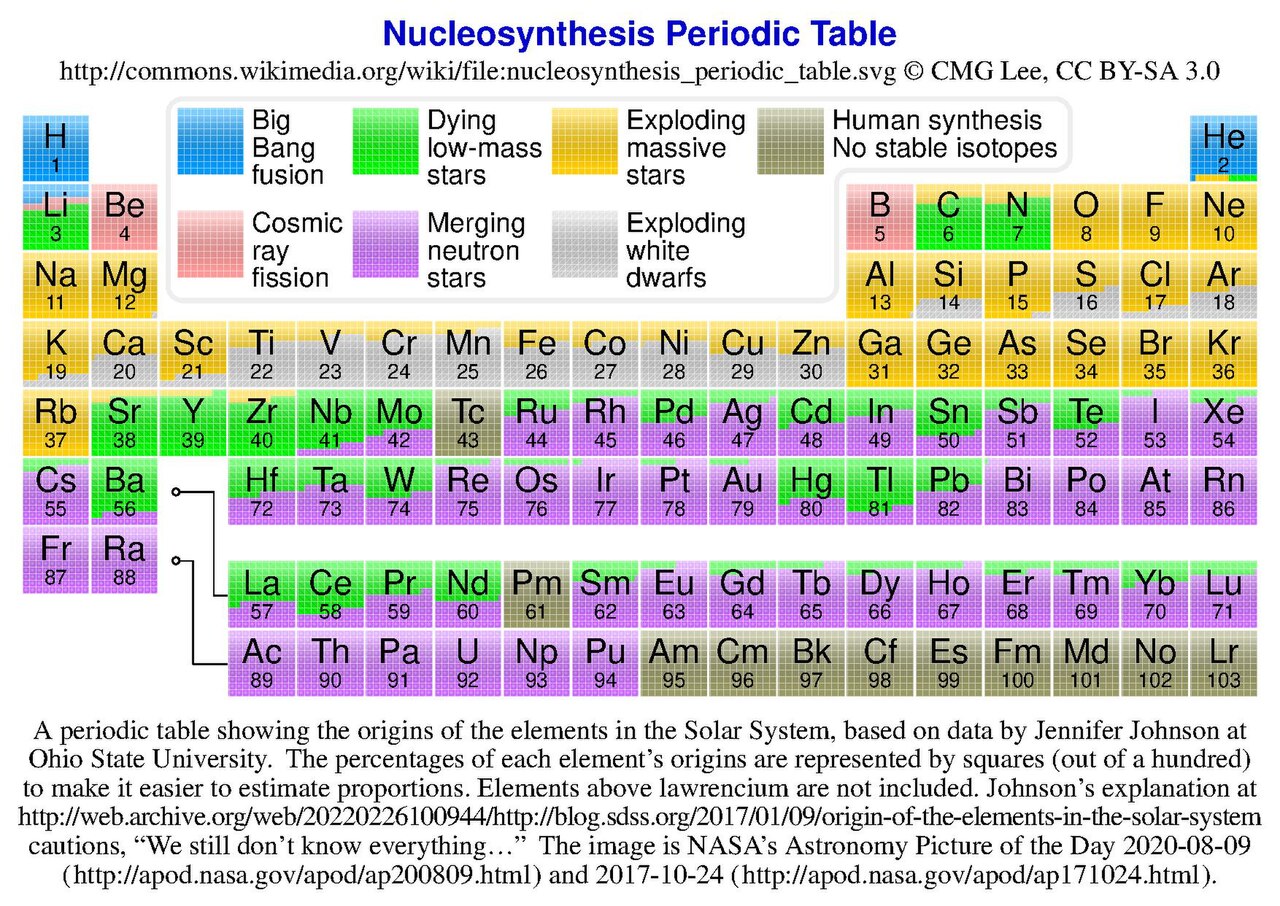
Among the most striking confirmations of the Big Bang model is the agreement between the observed abundances of the lightest chemical elements and the quantitative predictions of Big Bang nucleosynthesis (BBN). The theory holds that in the first few minutes of cosmic history, when the universe was a ferociously hot plasma of protons, neutrons, electrons, and photons, nuclear reactions proceeded rapidly enough to forge a specific mixture of light nuclei. That mixture — roughly 75% hydrogen and 25% helium-4 by mass, with sub-percent traces of deuterium, helium-3, and lithium-7 — was locked in as the universe cooled below fusion temperatures after approximately twenty minutes.4 Billions of years later, astronomers can measure these primordial proportions in the most chemically pristine objects in the universe and compare them against the predictions. The match is, for most elements, extraordinary. It is not merely a qualitative success; it is a quantitative one, achieved by a theory with essentially one free parameter — the density of ordinary matter.
The Alpher–Bethe–Gamow prediction
The theoretical groundwork was laid in a landmark 1948 paper by Ralph Alpher and George Gamow, to which Hans Bethe’s name was appended as a physicist’s joke on the Greek letters alpha, beta, and gamma.1 The paper proposed that the extreme heat of the early universe drove the nucleosynthesis of all the elements from a primordial neutron gas. While this original proposal proved only partially correct — stellar nucleosynthesis, not the Big Bang, is responsible for elements heavier than lithium — the core insight was sound: the first minutes of cosmic time produced a specific, calculable inventory of light nuclei.13 Later that same year, Alpher and Robert Herman sharpened the predictions and also forecast the existence of a relic radiation field, now known as the cosmic microwave background.2
The theoretical framework has been steadily refined over subsequent decades as nuclear reaction cross-sections have been measured with increasing precision in laboratory accelerators. Modern BBN calculations incorporate hundreds of nuclear reactions and use as their primary input the baryon-to-photon ratio — the number of ordinary matter particles per photon in the universe, denoted by the Greek letter η (eta). This ratio is extraordinarily small: approximately 6 × 10⁻¹⁰, meaning there are roughly a billion photons for every baryon.5 This single parameter governs how long and how efficiently nuclear reactions can proceed before the plasma cools past the fusion threshold, and it therefore determines the final abundances of every light nuclide. Crucially, the baryon-to-photon ratio can be independently measured from the CMB anisotropies, allowing the two observational pillars to cross-check one another.6
A second physical quantity of central importance is the neutron-to-proton ratio at the onset of nucleosynthesis. In the first second of cosmic time, neutrons and protons interconvert freely via weak-force reactions. As the universe cools and expands, these reactions freeze out at a ratio of approximately one neutron for every seven protons.12 Because nearly all available neutrons end up bound in helium-4 nuclei — each of which contains two protons and two neutrons — this freeze-out ratio directly sets the primordial helium mass fraction. The neutron lifetime, which governs how quickly free neutrons decay before nucleosynthesis begins, is therefore a measurable laboratory quantity that feeds directly into BBN predictions with no free parameters.17
Observed primordial abundances
Measuring the primordial abundances of light elements is not trivial. The universe today is chemically enriched: stars have spent billions of years fusing hydrogen and helium into heavier elements and dispersing those metals through supernova explosions.13 Any observation aimed at recovering the primordial composition must therefore target objects that formed earliest, processed the least material through stellar nucleosynthesis, and retained the closest approximation to the original Big Bang mixture. Three complementary observational strategies have been developed for this purpose, each suited to a different element.
The primordial helium-4 abundance is measured in compact, low-luminosity galaxies called H II (ionized hydrogen) regions — clouds of gas around hot young stars where recombination line emission allows the helium and hydrogen abundances to be read simultaneously from the spectrum. Crucially, astronomers select samples with the lowest possible oxygen and nitrogen content, since these metals are produced entirely by stars and serve as a proxy for the degree of chemical enrichment. By plotting the helium abundance against metallicity indicators and extrapolating to zero metallicity, researchers estimate the primordial helium mass fraction Yp. Modern measurements converge on a value of approximately 0.245 – 0.249, consistent with BBN predictions of around 0.247.7
The primordial deuterium abundance is determined from the spectra of ancient quasar absorption systems. When the light from a distant quasar passes through a diffuse cloud of primordial gas at high redshift, that gas imprints characteristic absorption features on the quasar’s spectrum. Deuterium, being chemically nearly identical to hydrogen but slightly heavier, produces absorption lines that are shifted by a small, predictable amount relative to ordinary hydrogen. Because deuterium is only destroyed, never significantly created, by stellar processes — it is burned efficiently in stellar interiors — the deuterium measured in these pristine high-redshift systems represents a lower bound on, and a close approximation to, the primordial value.8 Precision measurements from high-resolution spectra place the primordial deuterium-to-hydrogen ratio at D/H = (2.527 ± 0.030) × 10−5, in remarkable agreement with BBN predictions.9, 15 Earlier constraints from Lyman-limit quasar absorption systems confirmed this same order of magnitude two decades prior.14
The primordial lithium-7 abundance is inferred from the spectra of the oldest, most metal-poor stars in the Milky Way halo — stars belonging to Population II, which formed in the first billion years of cosmic history from gas that had undergone minimal chemical enrichment. A seminal 1982 study by Françoise Spite and Monique Spite found that these ancient stars exhibit a strikingly uniform lithium abundance regardless of their temperature or metallicity, a feature now known as the Spite plateau.11 The existence of a plateau suggested a primordial origin rather than lithium produced by stellar processes, which would scatter with metallicity. However, the plateau value — Li/H ∼ 1.6 × 10⁻¹⁰ by number — is approximately a factor of three below what BBN predicts, a discrepancy that defines the cosmological lithium problem.9
Primordial light-element abundances: BBN predictions versus observations12, 5, 7, 9, 9
| Nuclide | BBN prediction | Observed primordial value | Agreement |
|---|---|---|---|
| Hydrogen (mass fraction) | ~75% | ~75% | Excellent |
| Helium-4 Yp (mass fraction) | ~0.247 | 0.245–0.249 | Excellent |
| Deuterium D/H (× 10−5) | ~2.45–2.60 | 2.527 ± 0.030 | Excellent |
| Helium-3 3He/H (× 10−5) | ~1.0–1.2 | ~1–2 (uncertain) | Consistent |
| Lithium-7 Li/H (× 10−10) | ~5.0 | ~1.6 (Spite plateau) | Discrepant (×3) |
Why stellar nucleosynthesis cannot explain the primordial abundances
A foundational question in cosmochemistry is why the universe contains so much helium. Roughly one quarter of the mass of ordinary matter is helium-4, yet stellar nucleosynthesis — the process by which stars fuse hydrogen into heavier elements over their lifetimes — cannot account for this quantity. The argument is straightforward. The total amount of helium-4 that all the stars in the observable universe could have produced over the entire age of the cosmos, given their luminosities and lifetimes, falls far short of the observed abundance by more than an order of magnitude.4 Stars have simply not burned enough hydrogen to produce a quarter of the universe’s mass as helium.
Furthermore, if helium were of stellar origin, its abundance would correlate tightly with the heavy elements that stars produce simultaneously. Old, metal-poor stars and galaxies would be expected to contain far less helium than metal-rich systems. The observations show the opposite: helium never falls below approximately 24% by mass regardless of how metal-poor the environment, implying a universal baseline abundance that predates all star formation.7 This floor is precisely the primordial floor predicted by BBN.4
The same logic applies to deuterium, though in the opposite direction. Stars destroy deuterium — it is one of the first isotopes burned in stellar interiors because its fusion cross-section is much larger than that of ordinary hydrogen. Any deuterium observed in the universe today must therefore be a remnant of the primordial supply, and it could only have been created in significant quantities in the hot, dense environment of the early universe. The Burbidge–Burbidge–Fowler–Hoyle paper of 1957, which laid the foundations of stellar nucleosynthesis theory, explicitly acknowledged that deuterium and helium-4 could not be produced by stars in the required amounts and pointed toward a cosmological origin.13
The cosmological lithium problem
The single significant discrepancy between BBN theory and observation — the factor-of-three shortfall in observed lithium-7 — is one of the most discussed open problems in cosmology and nuclear astrophysics.9, 12 It is important to characterize it correctly: it does not represent a failure of the Big Bang model, because every other prediction of BBN is confirmed. It represents either an incompleteness in our understanding of stellar physics, a gap in nuclear reaction rates, or a hint of new physics beyond the standard model. Distinguishing between these possibilities is an active area of research.9
The most widely favored explanation involves processes internal to the ancient halo stars where lithium is measured. Lithium is an exceptionally fragile element; it is destroyed at temperatures exceeding roughly 2.5 × 10⁶ Kelvin, far below the central temperatures of most stars. If slow convective mixing, diffusion, or rotationally induced turbulence gradually transports lithium from the cooler outer layers of a star into the hotter interior over billions of years, the surface abundance measurable by spectroscopy will be systematically depleted below the initial value.19 Models of atomic diffusion and mixing in old metal-poor stars can reproduce a factor of two to three depletion, which would reconcile the Spite plateau with the BBN prediction, though the precise mechanism has not been definitively confirmed.18
Alternative hypotheses involve nuclear physics. If the reaction rates governing lithium-7 production and destruction during BBN have been measured incorrectly in the laboratory, the predicted abundance could shift. Dedicated experiments at accelerators have re-examined several relevant reactions, but no measurement error large enough to resolve the discrepancy has been found.10 More speculative proposals invoke new physics: the decay of an exotic particle during or after BBN could, in principle, alter the final lithium yield. None of these mechanisms has obtained confirmation from independent observations. For now, the stellar depletion explanation remains the most parsimonious, and the lithium problem is best understood as an open puzzle in stellar physics rather than evidence against the Big Bang.
BBN as a probe of fundamental physics
Beyond testing the Big Bang model itself, the agreement between BBN predictions and observations constrains fundamental parameters of particle physics and cosmology in ways that are independent of, and complementary to, those derived from the cosmic microwave background.5, 12
The most celebrated constraint concerns the number of neutrino species. Neutrinos influence BBN in two ways. First, at temperatures above roughly 1 MeV, neutrinos keep the neutron-to-proton ratio in equilibrium through weak-force reactions; more neutrino species means a faster expansion rate, which causes freeze-out at a slightly higher ratio, producing more helium. Second, neutrinos contribute to the total radiation energy density of the early universe, and additional neutrino species would accelerate the expansion rate, again shifting the freeze-out temperature and the final helium yield. The measured primordial helium abundance is sensitive enough to constrain the number of light neutrino species to approximately Nν = 3, consistent with the three known neutrino flavors (electron, muon, and tau neutrinos) and ruling out a fourth light neutrino species at high confidence.16 This constraint, derived from nuclear abundances and the physics of the first minutes, independently confirms what particle accelerators determine from the decay width of the Z boson.
The primordial deuterium abundance provides the tightest single constraint on the baryon density of the universe. Because deuterium is highly sensitive to the baryon-to-photon ratio — higher baryon density means more efficient deuterium burning, leaving less residual deuterium — a precise measurement of D/H pins down η sharply. The value inferred from precision deuterium spectroscopy implies a baryon density Ωbh2 = 0.0222 ± 0.0005, where h is the Hubble constant in units of 100 km s−1 Mpc−1.9 This value is in excellent agreement with the baryon density independently inferred from the CMB power spectrum by the Planck satellite (Ωbh2 = 0.02237 ± 0.00015).6 The convergence of two entirely independent measurement paths — one from the first minutes of cosmic history, one from 380,000 years later when the CMB was emitted — provides a powerful consistency test of the entire cosmological framework.
The baryon density implied by BBN is also of direct cosmological significance: it establishes that ordinary baryonic matter constitutes only about 5% of the total energy density of the universe. The remainder is dark matter (roughly 27%) and dark energy (roughly 68%), neither of which participates in nucleosynthesis or leaves a trace in the BBN light-element record.6 This means the remarkable precision of BBN is achieved entirely within the ordinary-matter sector, while the dominant constituents of the universe remain invisible to it — a striking illustration of how much of the cosmos still lies beyond full understanding.
Measuring primordial abundances: methods in detail
The observational infrastructure required to measure primordial element abundances spans multiple wavelength regimes, generations of telescopes, and distinct physical objects. Each target system has its own systematics and limitations, and the convergence of independent methods provides confidence in the results.7, 8, 11
For helium-4, the key tool is optical spectroscopy of metal-poor extragalactic H II regions. When hydrogen gas is ionized by the ultraviolet radiation of hot young stars and then recombines, it emits a cascade of photons at characteristic wavelengths. Helium recombines in an analogous process, emitting its own set of spectral lines whose intensities relative to hydrogen lines encode the He/H abundance ratio. The analysis requires correcting for collisional excitation, underlying stellar absorption, and the presence of dust. Multiple helium emission lines are measured simultaneously to overconstrain the solution and minimize systematic error.7
For deuterium, the key observations exploit high-resolution spectrographs on large ground-based telescopes — instruments such as HIRES on the Keck Observatory or UVES on the Very Large Telescope — to resolve the Lyman-series absorption lines of hydrogen and deuterium in the spectra of bright background quasars. The isotope shift between hydrogen and deuterium is small (81.6 km s−1 in velocity units), so only absorbers with simple, well-resolved velocity structure yield reliable D/H measurements free of blending artifacts. The number of pristine damped Lyman-alpha systems suitable for this measurement is small — fewer than two dozen systems with reliable constraints exist — but the measurements are highly consistent, giving confidence in the inferred primordial value.15
For helium-3, the situation is more complex. Helium-3 is both produced in stellar interiors and returned to the interstellar medium, making its observed abundance in the Milky Way’s H II regions a mixture of primordial and stellar contributions that is difficult to disentangle. Radio observations of the 8.665 GHz hyperfine line of 3He+ provide abundance measurements in Galactic H II regions, but inferring the primordial value requires uncertain chemical evolution modeling. Consequently, helium-3 provides a less powerful constraint on BBN than the other light elements, and its observed abundance is considered broadly consistent rather than precisely confirming.5
Significance and synthesis
The measurement of cosmic element abundances occupies a unique position in the hierarchy of cosmological evidence. Unlike the CMB or the large-scale structure of galaxies, the light-element abundances probe the universe at a cosmic age of minutes rather than hundreds of thousands of years.4, 5 They are determined by nuclear physics — quantum mechanics and the strong force — in a regime that has been extensively tested in terrestrial laboratories. The success of BBN is therefore not merely an empirical coincidence; it connects cosmology to the most precisely tested branch of physics and demonstrates that the same laws governing nuclear reactions in particle accelerators also governed the universe when it was a few seconds old.
The independent confirmation of the baryon density from both BBN and the CMB is particularly compelling. The BBN constraint comes from observations of gas clouds at redshifts of 2 to 3, processed through nuclear physics, while the CMB constraint comes from the pattern of acoustic oscillations in the photon-baryon plasma at a redshift of approximately 1100, processed through gravitational and fluid dynamics. That both measurements return the same baryon density — to within their respective uncertainties — constitutes a stringent, multi-epoch consistency test of the standard cosmological model that is difficult to reproduce in any competing framework.6, 9
The outstanding lithium problem, for all its interest, does not undermine this picture. The elements that BBN predicts most confidently — helium-4, whose abundance is governed by the large-scale neutron-to-proton ratio, and deuterium, whose abundance is a sensitive barometer of baryon density — agree with observation at the few-percent level. Lithium-7 is the most fragile of the primordial nuclides, the most susceptible to stellar depletion, and the most difficult to measure reliably in ancient stars. The existence of a plateau, the consistency of the plateau value across thousands of stars spanning a wide range of temperatures and metallicities, and the plausibility of depletion mechanisms all argue for a stellar-physics explanation.18, 19 Resolving the discrepancy remains an important goal, but the weight of the evidence strongly favors an astrophysical rather than cosmological solution.
Taken together, the observed primordial abundances of hydrogen, helium-4, deuterium, and lithium represent one of the most precise quantitative tests of the Big Bang cosmology, and the one that reaches furthest back in cosmic time.4, 12 They confirm that the universe was, in its first seconds, a hot dense plasma governed by known physics; that it expanded and cooled in a specific, calculable way; and that ordinary matter constitutes only a small fraction of its total content. No alternative cosmological model has reproduced this success.