Overview
- The James Webb Space Telescope (JWST) is a 6.5-meter infrared-optimized observatory orbiting the Sun–Earth Lagrange point L2, designed to detect light from the first galaxies that formed after the Big Bang, characterize the atmospheres of exoplanets, and study the full lifecycle of stars — capabilities that make it the most powerful space telescope ever deployed.
- Within its first two years of science operations, JWST discovered unexpectedly luminous and massive galaxies at redshifts beyond z = 10, corresponding to less than 500 million years after the Big Bang, challenging existing models of early galaxy formation that predicted slower mass assembly at such early epochs.
- JWST's Mid-Infrared Instrument (MIRI) and Near-Infrared Spectrograph (NIRSpec) have enabled the first detailed atmospheric characterizations of rocky exoplanets, including the detection of carbon dioxide in the atmosphere of the gas giant WASP-39b and constraints on the atmospheric composition of TRAPPIST-1 system planets.
The James Webb Space Telescope (JWST) is a space-based infrared observatory developed over more than two decades by the National Aeronautics and Space Administration (NASA) in collaboration with the European Space Agency (ESA) and the Canadian Space Agency (CSA).1, 2 Launched on 25 December 2021 aboard an Ariane 5 rocket from Kourou, French Guiana, and achieving first light in early 2022, JWST is the largest and most sensitive space telescope ever constructed, with a segmented primary mirror 6.5 meters in diameter and a suite of four scientific instruments optimized for wavelengths from 0.6 to 28.5 micrometers — the near-infrared to mid-infrared portion of the electromagnetic spectrum.1, 17 Operating from a halo orbit around the Sun–Earth Lagrange point L2, approximately 1.5 million kilometers from Earth, JWST was designed to address some of the most fundamental questions in astrophysics: when and how did the first galaxies form after the Big Bang, how do planetary systems develop, and what are the atmospheric compositions of worlds orbiting other stars.1, 2
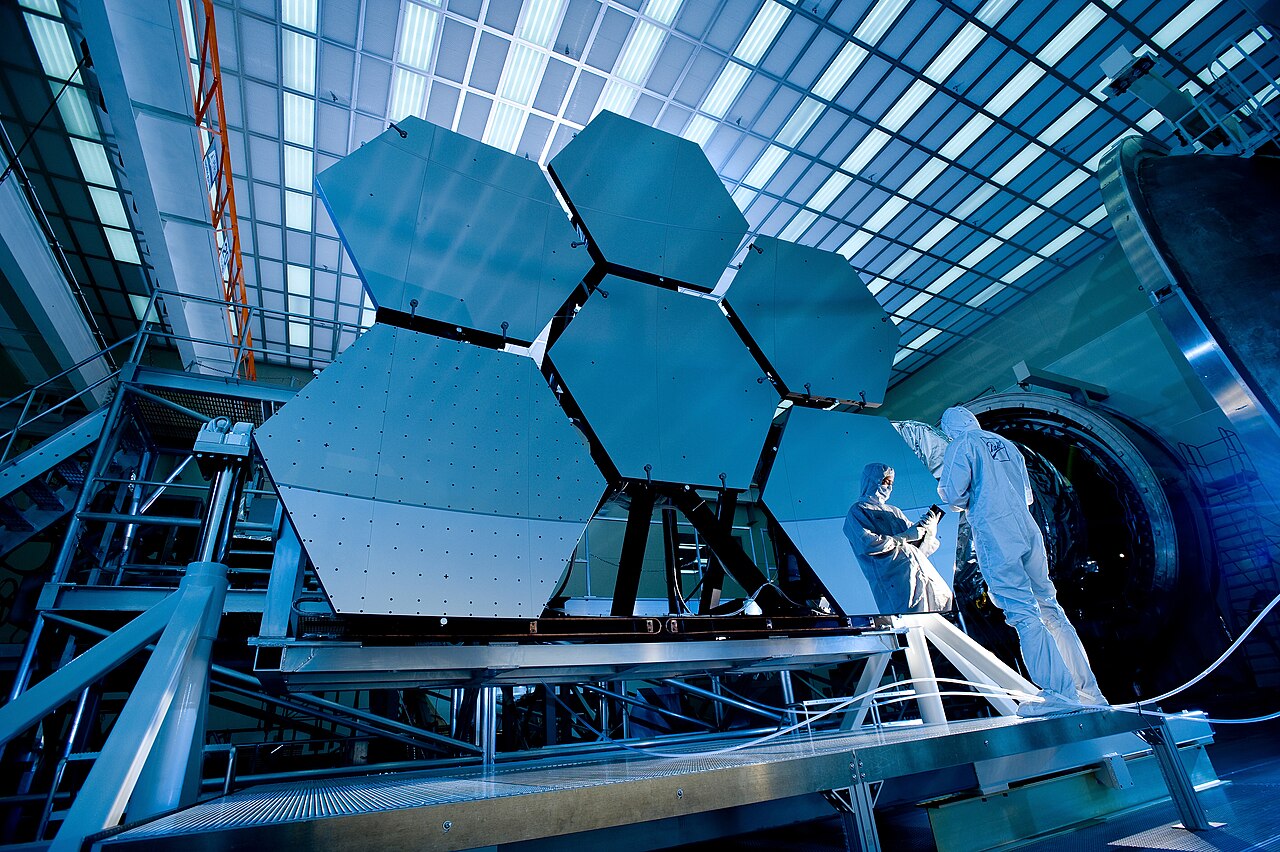

Design and instrumentation
JWST's primary mirror consists of 18 hexagonal segments made of gold-coated beryllium, each approximately 1.32 meters in diameter, which unfold and align after launch to form a single collecting area of 25.4 square meters — more than six times the collecting area of the Hubble Space Telescope.1, 2 Because JWST observes primarily in the infrared, its optics and instruments must be kept extremely cold to prevent the telescope's own thermal emission from overwhelming the faint signals of distant objects. This is achieved by a five-layer sunshield the size of a tennis court, made of aluminized and silicon-coated Kapton, which passively cools the telescope side to approximately 40 kelvins (minus 233 degrees Celsius) while the Sun-facing side reaches temperatures above 350 kelvins.1
The observatory carries four science instruments. The Near-Infrared Camera (NIRCam), built by the University of Arizona, provides imaging from 0.6 to 5 micrometers and serves as both the primary imager and the wavefront sensor used to align the mirror segments.17, 18 The Near-Infrared Spectrograph (NIRSpec), provided by ESA, can obtain spectra of up to 200 objects simultaneously using a programmable microshutter array — a capability critical for surveying large numbers of distant galaxies efficiently.17 The Mid-Infrared Instrument (MIRI), a joint contribution of ESA and NASA's Jet Propulsion Laboratory, extends coverage to 28.5 micrometers and includes both an imager and a spectrograph, enabling observations of dust-enshrouded star-forming regions, protoplanetary disks, and the coolest, most distant objects.17 Finally, the Fine Guidance Sensor/Near Infrared Imager and Slitless Spectrograph (FGS/NIRISS), provided by CSA, supports precision pointing and offers specialized modes for exoplanet transit spectroscopy and aperture masking interferometry.17
Early universe observations
One of JWST's primary science goals was to detect and characterize the first luminous objects to form after the Big Bang — galaxies and stars that assembled during the epoch of cosmic dawn, when the universe was less than a few hundred million years old.1 Prior to JWST, the Hubble Space Telescope had pushed the observational frontier to approximately redshift z = 11, corresponding to roughly 400 million years after the Big Bang, but the number of confirmed galaxies at such distances was extremely small and their physical properties poorly constrained.10
Within months of commencing science operations, JWST deep field surveys — including the JWST Advanced Deep Extragalactic Survey (JADES), the Grism Lens-Amplified Survey from Space (GLASS), and the Cosmic Evolution Early Release Science Survey (CEERS) — identified large numbers of galaxy candidates at redshifts exceeding z = 10, and spectroscopic follow-up with NIRSpec confirmed multiple objects at z > 10, including galaxies at z = 10.6, z = 11.4, z = 12.6, and a record-holder at approximately z = 13.2, observed when the universe was barely 330 million years old.9, 12, 6 These spectroscopic confirmations transformed the study of the first stars and reionization from a field of sparse, uncertain photometric candidates into one with a rapidly growing, statistically robust sample of confirmed objects at the highest redshifts ever observed.7
Challenges to galaxy formation models
Perhaps the most unexpected result from JWST's early observations was the discovery that some of these very high-redshift galaxies are far more luminous and apparently more massive than standard models of galaxy formation predicted.4, 10 Labbé and colleagues reported the identification of several candidate massive galaxies at z approximately 7 to 9 — less than 700 million years after the Big Bang — with inferred stellar masses of 1010 to 1011 solar masses, comparable to the Milky Way despite forming in a fraction of the time available.4 If confirmed, such masses would be difficult to reconcile with the Lambda-CDM concordance model of cosmology, which predicts that dark matter halos at these early epochs were too small to host such rapid stellar mass assembly through normal star formation processes.4, 13
Subsequent work has refined these initial estimates. Some of the most extreme mass claims were reduced when improved photometric calibrations, spectroscopic data, and more sophisticated spectral energy distribution modeling were applied, and it was recognized that certain red, compact sources initially classified as massive galaxies might instead be dust-reddened active galactic nuclei whose luminosity is dominated by accretion onto a central black hole rather than by starlight.5, 12 Nevertheless, even the revised estimates indicate a higher abundance of UV-luminous galaxies at z > 10 than most pre-JWST models predicted, suggesting that star formation in the early universe was either more efficient, less dust-obscured, or governed by a different stellar initial mass function than assumed in standard models.7, 9 This tension has stimulated a productive wave of theoretical work exploring mechanisms such as bursty star formation, reduced dust attenuation in low-metallicity environments, and top-heavy initial mass functions that could naturally produce more UV-bright galaxies at early times without requiring modifications to fundamental cosmological parameters.7, 13
Exoplanet atmosphere characterization
JWST's infrared sensitivity and spectroscopic precision have opened a new era in the study of exoplanet atmospheres. During the Early Release Science program, the JWST Transiting Exoplanet Community team obtained a transmission spectrum of the hot gas giant WASP-39b, detecting carbon dioxide (CO2) at 4.5 micrometers with a signal-to-noise ratio that was not achievable with any previous facility.14 This represented the first unambiguous detection of CO2 in an exoplanet atmosphere and demonstrated JWST's capacity to identify specific molecular species through their infrared absorption signatures during planetary transits.14
For smaller, potentially rocky worlds, JWST has begun to provide the first constraints on whether such planets possess atmospheres at all. Greene and colleagues used MIRI to measure the thermal emission from TRAPPIST-1 b, the innermost planet of the TRAPPIST-1 system, during secondary eclipse and found a dayside temperature consistent with a bare rock with little or no atmosphere, or at most a thin, tenuous envelope lacking significant greenhouse warming.16 These observations, while placing only upper limits on atmospheric density, represent a critical first step toward the systematic atmospheric characterization of Earth-sized worlds in the habitable zones of nearby stars — a goal that will require many hundreds of hours of JWST observing time and may push the limits of what the observatory can achieve for the smallest and coolest targets.16, 15
Operational performance and scientific legacy
JWST has significantly exceeded its pre-launch performance specifications in several key areas. The optical alignment of the mirror segments achieved a wavefront error well below the requirement, producing images sharper than the design target, and the thermal performance of the sunshield has kept the instruments cooler than the minimum required temperature, extending the sensitivity of the mid-infrared channels.2 The fuel efficiency of the launch and mid-course correction maneuvers was far better than planned, and NASA estimated that sufficient propellant remains for more than 20 years of station-keeping at L2 — roughly double the original 10-year mission design lifetime.2
In its first years of operation, JWST has fundamentally altered the observational landscape of multiple fields: the study of cosmic dawn and reionization, the physics of galaxy formation and evolution, the characterization of exoplanetary systems, the life cycles of stars and their surrounding disks, and the composition of solar system bodies including asteroids, comets, and planetary atmospheres.2, 7 The torrent of data from large-scale programs such as JADES, GLASS, CEERS, COSMOS-Web, and the UNCOVER survey of the Abell 2744 galaxy cluster has made JWST the most scientifically productive space observatory since Hubble itself, and its observations continue to reveal a universe that is, in several important respects, different from what pre-launch models had predicted.6, 9, 12
References
The JWST Advanced Deep Extragalactic Survey (JADES): discovery of an extreme galaxy overdensity at z = 5.4
GN-z11 in context: possible signatures of globular cluster precursors at redshift 10.6
Identification of a large sample of spectroscopically confirmed galaxies at 8.5 < z < 13.2 using JWST NIRSpec in GOODS-S
Early Results from GLASS-JWST. XIX: A High Density of Bright Galaxies at z ≃ 10 in the A2744 Region