Overview
- A magnetosphere is the region of space surrounding a planet, star, or other body where the magnetic field dominates the behaviour of charged particles, deflecting the solar wind and creating a protective bubble that shields the body’s atmosphere from erosion by energetic particles — Earth’s magnetosphere, generated by convection currents in its liquid iron outer core through the dynamo mechanism, extends roughly 65,000 kilometres sunward and stretches millions of kilometres into a long magnetotail on the nightside.
- Jupiter possesses the largest and most powerful magnetosphere in the solar system, with a magnetic field roughly 20,000 times stronger than Earth’s at the cloud tops and a magnetospheric volume that, if visible, would appear several times the size of the full Moon from Earth; its inner magnetosphere traps the most intense radiation belts known, fed in part by volcanic material from the moon Io, which injects approximately one tonne of sulphur dioxide plasma into the system every second.
- The presence or absence of a global magnetic field has profound implications for planetary habitability: Venus and Mars, which lack global dipole fields, have experienced significant atmospheric stripping by the solar wind over geological time, while Earth’s magnetosphere has shielded its atmosphere for billions of years, preserving the surface conditions necessary for liquid water and the development of complex life.
A magnetosphere is the region of space around a celestial body in which the body’s magnetic field dominates over the external magnetic environment, controlling the motion of charged particles and deflecting the stream of plasma known as the solar wind. Every planet with a significant internally generated magnetic field possesses a magnetosphere, as do many stars, some moons, and certain classes of compact objects. Earth’s magnetosphere, the first to be explored by spacecraft, was discovered in 1958 when James Van Allen’s instruments aboard Explorer 1 detected belts of energetically trapped charged particles — the radiation belts that now bear his name.3
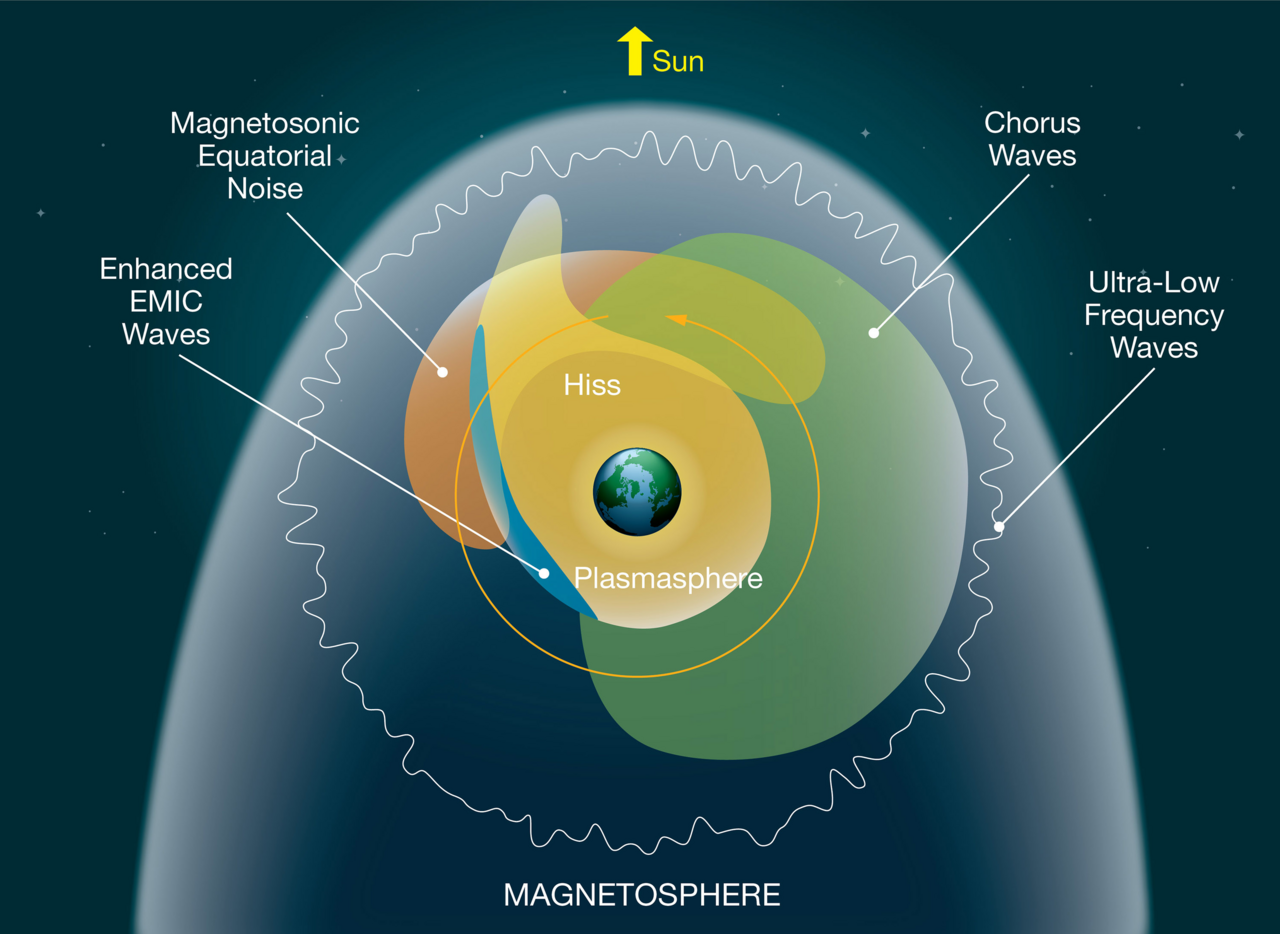

Magnetospheres are not merely passive magnetic bubbles. They are dynamic systems in which the solar wind continuously interacts with the planetary magnetic field, driving currents, accelerating particles, generating auroral displays, and influencing the long-term evolution of planetary atmospheres. The comparative study of magnetospheres across the solar system — from Mercury’s tiny, compressed magnetosphere to Jupiter’s vast magnetic domain — reveals how the same underlying physics produces dramatically different outcomes depending on the strength of the planetary field, the planet’s rotation rate, and the sources of plasma within the system.1, 17
Earth’s magnetosphere
Earth’s magnetosphere is generated by the geodynamo — convective motions of electrically conducting liquid iron in the planet’s outer core that sustain a self-exciting magnetic dynamo. The resulting magnetic field at Earth’s surface is approximately dipolar, with a strength of roughly 25 to 65 microtesla (0.25 to 0.65 gauss) depending on latitude, and magnetic poles that are currently tilted about 11 degrees from the rotational axis. This internal field extends outward into space, where it interacts with the solar wind — a continuous stream of charged particles (predominantly protons and electrons) flowing outward from the Sun at speeds of 300 to 800 kilometres per second.1, 2
The solar wind compresses Earth’s magnetic field on the dayside and stretches it into an elongated magnetotail on the nightside. The boundary where the solar wind pressure balances the magnetic pressure of the dipole field is called the magnetopause, typically located at a distance of roughly 10 Earth radii (about 65,000 kilometres) on the sunward side during quiet solar wind conditions, though this distance can shrink to 6 Earth radii during intense solar storms. Upstream of the magnetopause, the supersonic solar wind decelerates through a bow shock, a standing shock wave analogous to the bow wave of a ship, transitioning from supersonic to subsonic flow in a turbulent region called the magnetosheath before encountering the magnetopause itself.1, 2
The Van Allen radiation belts are two toroidal regions of energetically trapped charged particles within Earth’s magnetosphere. The inner belt, centred at roughly 1.5 Earth radii (about 10,000 kilometres altitude), consists primarily of high-energy protons (10 to 100 MeV) produced by the decay of neutrons created when cosmic rays strike atmospheric atoms. The outer belt, centred at roughly 4 to 5 Earth radii, contains mainly high-energy electrons (0.1 to 10 MeV) that are accelerated by magnetospheric processes including wave-particle interactions and radial diffusion driven by fluctuations in the magnetic field. The radiation belts pose a significant hazard to spacecraft electronics and to astronauts, and their intensity varies in response to geomagnetic storms driven by solar activity.3, 1
Auroral generation
The aurora borealis (northern lights) and aurora australis (southern lights) are the most visually spectacular manifestation of magnetospheric physics. Auroral displays are produced when energetic charged particles from the magnetosphere are accelerated along magnetic field lines into the upper atmosphere at high latitudes, where they collide with atmospheric atoms and molecules, exciting them to higher energy states. The subsequent de-excitation produces photons at characteristic wavelengths: green light at 557.7 nanometres from excited atomic oxygen, red light at 630.0 nanometres from oxygen at higher altitudes where collisional de-excitation is less frequent, and blue and violet emissions from excited nitrogen molecules.1, 12
The particles responsible for the aurora originate from the solar wind and from magnetospheric plasma that has been energised by processes in the magnetotail. During magnetic reconnection events on the nightside — in which oppositely directed magnetic field lines in the magnetotail merge, releasing stored magnetic energy — large quantities of plasma are accelerated earthward along field lines that converge at auroral latitudes (typically 65 to 75 degrees magnetic latitude). This process, called a magnetospheric substorm, produces the bright, dynamic auroral displays that sweep across the sky during geomagnetically active periods. The auroral oval — the ring-shaped region of peak auroral activity circling each magnetic pole — expands equatorward during intense geomagnetic storms, sometimes bringing visible aurora to mid-latitudes.1, 2
Jupiter’s magnetosphere
Jupiter possesses the largest, most powerful, and most complex magnetosphere in the solar system. Its internal magnetic field, generated by convective currents of metallic hydrogen deep within the planet’s interior, produces a dipole moment approximately 20,000 times stronger than Earth’s, with a surface field strength of roughly 400 microtesla at the equator. The resulting magnetosphere extends approximately 50 to 100 Jupiter radii (3.5 to 7 million kilometres) sunward and stretches into a magnetotail that extends beyond the orbit of Saturn — more than 5 astronomical units, making it the largest coherent structure in the solar system after the heliosphere itself.6, 14
What distinguishes Jupiter’s magnetosphere from Earth’s, beyond its sheer size, is the dominant role of internal plasma sources. The volcanic moon Io, orbiting deep within the magnetosphere at 5.9 Jupiter radii, ejects approximately one tonne of sulphur dioxide and related gases per second through its intense volcanic activity. This material is ionised by solar ultraviolet radiation and electron impact, creating the Io plasma torus — a dense ring of sulphur and oxygen ions centred on Io’s orbit and tilted with respect to Jupiter’s rotational equator due to the offset of the magnetic dipole from the rotation axis. The plasma torus is the dominant source of magnetospheric plasma, and its continuous replenishment by Io’s volcanism drives a massive system of electric currents and energy flows that have no analogue at Earth.7
Jupiter’s rapid rotation (a period of approximately 9 hours and 55 minutes) imposes centrifugal forces on the magnetospheric plasma that are far stronger than the gravitational forces at the distances of interest, causing the plasma to be flung outward into a magnetodisk — a thin, equatorial sheet of current-carrying plasma that stretches the magnetic field into a disk-like configuration beyond about 20 Jupiter radii. The outward transport of plasma through the magnetodisk is accompanied by inward transport of magnetic flux, driving a global circulation pattern that is fundamentally different from Earth’s solar-wind-driven magnetospheric convection: at Jupiter, the magnetosphere is rotation-dominated rather than solar-wind-dominated. The Juno spacecraft, which entered Jupiter orbit in 2016, has provided the first close-range measurements of the polar magnetic field, auroral particle precipitation, and magnetospheric currents, revealing a magnetic field that is far more complex than a simple dipole, with intense localised features and a hemispheric asymmetry not predicted by pre-Juno models.6, 14
Jupiter’s inner magnetosphere contains the most intense radiation belts in the solar system. High-energy protons and electrons trapped in the strong magnetic field near the planet reach energies of hundreds of MeV, producing intense synchrotron radiation at radio wavelengths that has been detected from Earth since the 1950s. These radiation belts are so energetic that they pose a lethal hazard to unshielded spacecraft electronics and have constrained the orbital design of every mission to the Jupiter system.14
Saturn’s magnetosphere
Saturn’s magnetosphere, explored in detail by the Cassini spacecraft from 2004 to 2017, is intermediate in size and complexity between Earth’s and Jupiter’s. Saturn’s magnetic field is remarkable for being almost perfectly aligned with the planet’s rotation axis (the tilt is less than 0.01 degrees, far smaller than any other planetary dipole), a configuration that remains poorly understood theoretically, since dynamo theory generally predicts that dipole fields should be tilted relative to the rotation axis. The magnetosphere extends roughly 20 to 25 Saturn radii on the dayside and is influenced by the solar wind, the ring system, and the icy moons.8
The dominant internal plasma source in Saturn’s magnetosphere is Enceladus, a small icy moon that ejects water vapour and ice grains from geysers at its south pole through cracks in the surface known as “tiger stripes.” Cassini measurements showed that Enceladus produces approximately 200 to 300 kilograms of water per second, which is subsequently ionised and distributed through the inner magnetosphere as a plasma of water-group ions (H2O+, OH+, O+, H3O+). This makes Saturn’s magnetosphere, like Jupiter’s, internally sourced rather than solar-wind-driven, though at a considerably lower mass loading rate than Jupiter’s Io-dominated system.15, 8
Planets without global magnetic fields
Mercury possesses a global magnetic field, but it is extremely weak — roughly 1 percent of Earth’s surface field strength. The resulting magnetosphere is tiny and highly compressed by the solar wind, with the magnetopause located at only about 1.5 Mercury radii above the surface on the dayside. MESSENGER spacecraft observations revealed that solar wind particles can directly impact the surface in broad regions near the cusps, sputtering sodium, calcium, and magnesium atoms from surface minerals into Mercury’s tenuous exosphere. Mercury’s magnetosphere is thus a borderline case — present but barely adequate to deflect the solar wind, and qualitatively different from the large, well-developed magnetospheres of Earth, Jupiter, and Saturn.9, 17
Venus and Mars lack global dipole magnetic fields entirely. Venus may once have had a dynamo, but if so, it shut down at some point in the planet’s history, possibly because Venus’s lack of plate tectonics resulted in insufficient heat loss from the core to sustain convection. Without a magnetosphere, Venus’s upper atmosphere interacts directly with the solar wind, which induces currents in the ionosphere that create a weak, draped magnetic barrier called an induced magnetosphere. Venus Express measurements showed that the solar wind strips oxygen ions from Venus’s atmosphere at a rate of approximately 1025 ions per second, a process that has likely contributed to the loss of any primordial water Venus may have possessed over the 4.5-billion-year age of the solar system.11
Mars presents a particularly instructive case. While Mars lacks a global dipole field today, the Mars Global Surveyor spacecraft detected strong, localised crustal magnetic anomalies in the ancient southern highlands, with field strengths up to 20 times that of any crustal magnetic anomaly on Earth. These anomalies are the remnants of an ancient global magnetic field that was active during the first several hundred million years of Mars’s history but ceased when the core dynamo shut down, likely due to cooling and solidification of the core. The MAVEN mission, which entered Mars orbit in 2014, has quantified the ongoing loss of atmospheric ions (primarily O+, O2+, and CO2+) to the solar wind at rates of roughly 100 grams per second, and has demonstrated that this loss rate increases by an order of magnitude during solar storms. The cumulative atmospheric loss over 4 billion years — after the dynamo ceased — is thought to have played a significant role in transforming Mars from a planet with a thicker atmosphere and possible surface liquid water into the cold, thin-atmosphere desert it is today.10
Dynamo theory
The dynamo mechanism is the process by which the motion of electrically conducting fluid within a planet’s interior generates and sustains a large-scale magnetic field. The basic principle, first proposed by Joseph Larmor in 1919 and developed into a quantitative theory by Walter Elsasser in the 1940s, is that convective motions in a conducting fluid (liquid iron in the case of Earth, metallic hydrogen in the case of Jupiter) stretch, twist, and fold magnetic field lines, amplifying the field against the ohmic dissipation that would otherwise cause it to decay. The process is self-sustaining: the existing magnetic field induces electric currents in the moving fluid, and these currents regenerate the magnetic field, provided the fluid motion is sufficiently vigorous and geometrically complex.4, 5
For Earth, the dynamo operates in the liquid iron outer core, which extends from roughly 2,900 to 5,150 kilometres depth. The energy driving the convection comes from two main sources: the secular cooling of the core (releasing latent heat as the inner core solidifies and grows) and compositional buoyancy (the release of light elements such as sulphur, silicon, and oxygen at the inner core boundary as iron preferentially freezes out). These buoyancy sources drive vigorous convective flows in the liquid outer core at velocities of roughly 10 to 40 kilometres per year, and the Coriolis force due to Earth’s rotation organises these flows into columnar structures aligned with the rotation axis, producing the predominantly dipolar geometry of the geomagnetic field.5, 13
Numerical simulations of the geodynamo, pioneered by Glatzmaier and Roberts in 1995, have successfully reproduced many features of the observed geomagnetic field, including its predominantly dipolar structure, its secular variation, and even spontaneous magnetic field reversals in which the north and south magnetic poles swap. The paleomagnetic record preserved in rocks shows that the geomagnetic field has reversed hundreds of times over Earth’s history, with an average interval between reversals of roughly 200,000 to 300,000 years during the past few million years, though the intervals are highly irregular. The last reversal, the Brunhes-Matuyama reversal, occurred approximately 780,000 years ago.5, 13
Paleomagnetic evidence
The geological record preserves evidence of ancient magnetic fields through the mechanism of remanent magnetisation: when igneous rocks cool below the Curie temperature of their iron-bearing minerals (typically magnetite or hematite), the minerals become permanently magnetised in the direction of the ambient magnetic field. By measuring the direction and intensity of this remanent magnetisation in rocks of known age, paleomagnetists can reconstruct the history of the geomagnetic field over billions of years.13
Tarduno and colleagues reported in 2015 that single-crystal paleointensity measurements from Hadean-age Jack Hills zircon crystals in Western Australia indicate that Earth possessed a magnetic field at least 3.45 billion years ago, and possibly as early as 4.2 billion years ago. If confirmed, this would mean that the geodynamo was active within a few hundred million years of Earth’s formation, providing magnetic shielding during the period when the early atmosphere was most vulnerable to stripping by the young Sun’s more intense solar wind. The early establishment of a magnetosphere may have been a critical factor in Earth’s retention of its atmosphere and, consequently, in the development of habitable surface conditions and the origin of life.16
Magnetospheres and habitability
The comparative study of planetary magnetospheres has underscored the importance of magnetic shielding for long-term atmospheric retention and, by extension, for planetary habitability. Earth’s magnetosphere deflects the bulk of the solar wind around the planet, limiting atmospheric ion escape to modest rates that are easily replenished by volcanic outgassing and other geological processes. Venus and Mars, lacking global magnetic fields, have experienced billions of years of direct solar wind interaction, losing atmospheric constituents — particularly water — at rates that have cumulatively transformed their surface environments. The MAVEN mission’s measurements at Mars and Venus Express observations at Venus have provided quantitative constraints on these loss rates, demonstrating that the absence of a magnetosphere accelerates atmospheric erosion by roughly an order of magnitude during solar storm events.10, 11
These findings have direct implications for the assessment of habitability around other stars, particularly M-dwarf stars, whose habitable-zone planets orbit close enough to experience intense stellar winds and flare activity. A planet in an M-dwarf habitable zone without a strong magnetic field may lose its atmosphere on timescales of hundreds of millions of years, too quickly for complex life to develop. The question of whether rocky planets around M dwarfs can sustain dynamos — which depends on planetary mass, composition, rotation rate, and thermal evolution — has thus become a central concern in the study of exoplanet habitability.17, 18
Stellar magnetospheres
Stars, too, possess magnetospheres, generated by dynamo processes in their convective envelopes (for solar-type and lower-mass stars) or in their convective cores (for massive stars). The Sun’s magnetic field produces the heliosphere, the vast magnetised bubble of solar wind plasma that extends well beyond the orbit of Pluto and defines the boundary between the solar system and interstellar space. The Voyager 1 spacecraft crossed the heliopause — the outer boundary of the heliosphere — in August 2012 at a distance of approximately 121 astronomical units, providing the first in-situ measurements of the interstellar medium.18
Other stars exhibit a wide range of magnetic field strengths and topologies. Young, rapidly rotating stars tend to have much stronger magnetic fields than the Sun, producing correspondingly more intense stellar winds and more energetic magnetospheric environments. Highly magnetic stars such as the Ap/Bp stars can possess surface fields of thousands of gauss, while certain compact objects — neutron stars and magnetars — have fields of 108 to 1015 gauss, the strongest magnetic fields known in the universe. The study of stellar magnetospheres through spectropolarimetry (measuring the polarisation of light to infer surface magnetic field geometry) has revealed that magnetic activity, stellar winds, and angular momentum loss are intimately connected, influencing the rotational evolution of stars over their lifetimes and the environments experienced by any orbiting planets.18
Comparison of solar system magnetospheres1, 6, 8, 9, 17
| Body | Dipole moment (Earth = 1) | Magnetopause distance | Key features |
|---|---|---|---|
| Mercury | ~0.0007 | ~1.5 planet radii | Tiny, compressed; surface sputtering |
| Earth | 1 | ~10 Earth radii | Van Allen belts; aurora; magnetotail |
| Jupiter | ~20,000 | ~50–100 Jupiter radii | Io plasma torus; intense radiation; synchrotron |
| Saturn | ~600 | ~20–25 Saturn radii | Enceladus plasma; near-zero dipole tilt |
| Uranus | ~50 | ~18 Uranus radii | Highly tilted (59°) and offset dipole |
| Neptune | ~25 | ~23 Neptune radii | Tilted (47°) and offset; complex geometry |
| Venus | None (induced) | — | No global field; atmospheric stripping |
| Mars | None (crustal remnants) | — | Crustal anomalies; atmospheric loss |
References
A three-dimensional self-consistent computer simulation of a geomagnetic field reversal
Jupiter’s magnetosphere and aurorae observed by the Juno spacecraft during its first polar orbits