Overview
- The Oort cloud is a hypothesized roughly spherical reservoir of icy planetesimals surrounding the Sun at heliocentric distances of approximately 2,000 to 200,000 astronomical units, first proposed by Jan Oort in 1950 to explain the energy distribution of long-period comet orbits and now understood to contain a flattened, more tightly bound inner component (the Hills cloud) and an outer, isotropic outer Oort cloud.
- The cloud is the principal reservoir of long-period and dynamically new comets; observed long-period comets exhibit a sharp spike in their original reciprocal semi-major axis distribution near 1/a ≈ 10⁻⁴ AU⁻¹, corresponding to aphelia near 20,000–30,000 AU, and these comets are injected into observable orbits by the combined action of the Galactic tide and passing-star perturbations.
- Modern dynamical models indicate that Oort cloud planetesimals were scattered outward by the giant planets during and after the era of planet formation, with the present cloud probably preserved by the Sun's birth in a dense stellar cluster; observed sednoids such as 90377 Sedna and 2012 VP₁₁₃, with perihelia of roughly 76 and 80 AU, are widely regarded as the only directly observed candidates for inner Oort cloud bodies.
The Oort cloud is a hypothesized roughly spherical reservoir of icy planetesimals surrounding the Sun at heliocentric distances of approximately 2,000 to 200,000 astronomical units (AU), forming the outermost component of the solar system. First proposed by the Dutch astronomer Jan Oort in 1950 to explain the orbital energy distribution of long-period comets, the cloud is now understood to be the principal source of dynamically new comets entering the planetary region from random directions on the sky.1, 5 Its existence has never been directly imaged — the constituent bodies are too small, too cold, and too distant for current telescopes — but the statistical properties of long-period comet orbits, together with the discovery of a small number of extremely distant minor planets such as 90377 Sedna and 2012 VP113, provide the empirical foundations for the model.8, 9, 15
The cloud is conventionally divided into two regions: an extended, roughly isotropic outer Oort cloud stretching from a few tens of thousands of AU to perhaps 100,000–200,000 AU, and a more flattened, more tightly bound inner Oort cloud — sometimes called the Hills cloud after the astrophysicist Jack Hills, who proposed it in 1981 — located at roughly 2,000 to 20,000 AU.2, 5, 17 Together the two reservoirs are thought to contain hundreds of billions to trillions of icy bodies and to record the dynamical history of the early solar system, including the era of giant-planet scattering, possible interactions with sibling stars in the Sun's natal cluster, and the slow modulation of orbits by the gravitational tide of the Milky Way disk and by occasional close passages of other field stars.4, 10, 11, 19
Definition and structure
An object is conventionally regarded as belonging to the Oort cloud if its osculating orbit has a semi-major axis larger than a few thousand AU and a perihelion distance large enough that it is not strongly coupled to the giant planets — typically beyond Neptune's orbit at roughly 30 AU. The cloud has no sharp inner or outer boundary; rather, the inner edge is set by the heliocentric distance at which orbital evolution from external perturbations (Galactic tides, passing stars, and giant molecular clouds) becomes faster than evolution from interior planetary scattering, while the outer edge corresponds to the distance at which the Sun's gravity loses control of bodies against random impulses from passing stars and the differential pull of the Galactic potential.3, 4, 5
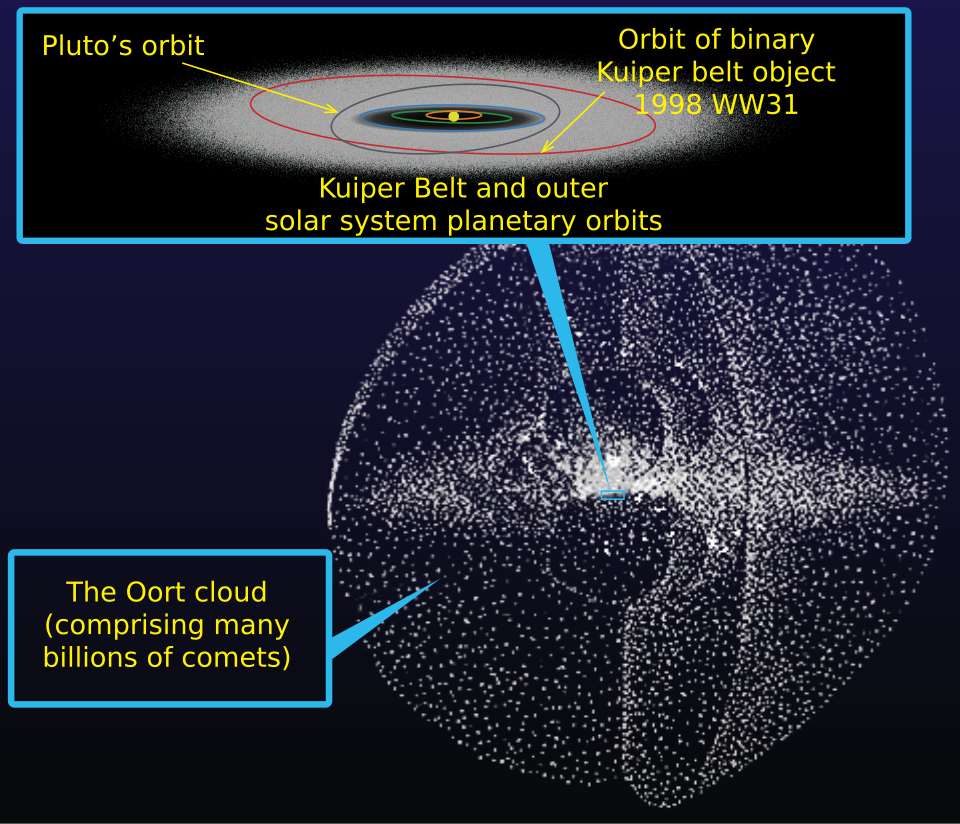

Modern dynamical work places the inner edge of the dense outer cloud at roughly 20,000 AU and the outer edge near 100,000 AU, with a low-density tail extending out to perhaps 200,000 AU — about a third of the distance to the nearest star, Proxima Centauri.5, 17, 19 The inner Oort cloud, defined empirically by the simulations of Duncan, Quinn, and Tremaine in 1987, begins near 2,000–3,000 AU, where the timescales for stellar and Galactic perturbations to randomize cometary inclinations become comparable to the age of the solar system; interior to that distance, surviving icy bodies retain a substantial memory of their original near-ecliptic orbits and form a flattened disk-like structure.3, 5
The geometry of the cloud reflects this division. The outer Oort cloud is approximately spherical: external perturbations have had ample time to stir its inhabitants into nearly random orientations, with no preferred plane. The inner cloud, by contrast, is significantly flattened toward the ecliptic, retaining a vestigial disk geometry inherited from the solar system's formation; it is also more tightly bound, harder to perturb, and consequently invisible under ordinary conditions because its members rarely diffuse into observable orbits.2, 7, 17
Observational evidence: the Oort spike
The Oort cloud is inferred rather than imaged. The principal evidence for its existence comes from the orbital energies of long-period comets — comets with orbital periods longer than 200 years — whose original orbits, computed by integrating their motion backward to remove planetary perturbations and tracing them to a position outside the planetary region, can be compared in a single statistical distribution.15, 22
When this exercise is carried out, the resulting distribution of original reciprocal semi-major axes 1/a shows a remarkable feature first identified by Oort in 1950: a sharp concentration of comets at very small positive values of 1/a, corresponding to enormous semi-major axes of tens of thousands of AU. This concentration is now called the Oort spike. In the analysis of Marsden, Sekanina, and Everhart in 1978, which examined 200 well-determined original orbits, the spike was found to peak near 1/a ≈ 4–5 × 10⁻⁵ AU−1, corresponding to original semi-major axes of roughly 20,000 to 25,000 AU; once non-gravitational forces from cometary outgassing are taken into account, the peak shifts slightly inward.15
The interpretation of the Oort spike is straightforward: it represents dynamically new comets, on their first passage through the inner solar system, arriving from a reservoir far beyond the planetary region. The presence of a sharp peak rather than a broad distribution shows that these comets cannot have been randomly drawn from a continuum of orbital sizes; instead, they must originate in a population whose binding energies are concentrated near the boundary at which Galactic and stellar perturbations begin to dominate over the Sun's gravity. Comets at smaller 1/a than the spike represent objects whose orbits have been further altered by interactions with Jupiter and Saturn during previous perihelion passages, while comets at larger 1/a have either been ejected from the solar system entirely or are arriving from the inner Oort cloud after stronger external perturbation.1, 6, 16
The directions from which long-period comets arrive provide the second key constraint. Their inclinations are distributed nearly isotropically across the sky: comets from the Oort cloud reach the inner solar system with all possible orbital orientations, prograde and retrograde alike, with no preferred concentration toward the ecliptic plane. This isotropy directly implies that the parent population is itself approximately spherically symmetric — the defining geometric property of the outer Oort cloud and the property that distinguishes it from the flattened, ecliptic-aligned Kuiper belt and scattered disk.1, 5, 16
Oort's 1950 hypothesis
The reservoir is named for Jan Hendrik Oort, who in 1950 published "The structure of the cloud of comets surrounding the Solar System and a hypothesis concerning its origin" in the Bulletin of the Astronomical Institutes of the Netherlands. Oort analyzed the available original orbits of nineteen well-observed long-period comets and noticed that, after correction for planetary perturbations, the distribution of their inverse semi-major axes was sharply peaked at small positive values, with a deficit of comets at slightly larger 1/a. He concluded that the comets must arrive from heliocentric distances of roughly 50,000 to 150,000 AU and that the source of these comets was a vast reservoir of icy bodies bound to the Sun, isotropically distributed in angle, and only loosely held by solar gravity.1, 16
Oort recognized that comets in such loosely bound orbits would be vulnerable to perturbations from passing stars. He showed that random stellar encounters would diffuse the velocities of the comets over time, occasionally driving individual orbits inward toward the planetary region and producing a roughly steady-state flux of new long-period comets. He also recognized that the same encounters would, on the other side of the velocity distribution, eject some comets from the solar system entirely. The reservoir is therefore necessarily losing members continuously, and Oort estimated that the present population must be roughly 1011 comets to sustain the observed long-period comet flux for the age of the solar system.1, 16
For the cloud's origin, Oort offered a tentative hypothesis: he suggested that the comets had originated as fragments of a hypothetical disrupted planet between Mars and Jupiter, scattered outward by close encounters with the giant planets. This particular formation hypothesis has not survived — the modern view places the comets' origin in the giant-planet region itself, and the asteroid belt is no longer interpreted as the remnant of a disrupted planet — but Oort's central insight, that an extended cometary reservoir exists at distances of tens of thousands of AU and is fed by gravitational scattering, has proved durable and has been refined rather than overturned by every subsequent generation of dynamical work.5, 17
The Hills cloud and the inner Oort cloud
In 1981 Jack Hills, then at Los Alamos National Laboratory, published a paper in the Astronomical Journal showing that Oort's 1950 cloud, taken alone, could not be the steady-state source of long-period comets it was assumed to be. Hills demonstrated analytically that comets in the classical outer Oort cloud, at semi-major axes of 20,000 AU and beyond, would have been depleted faster than they could be replenished if a rare close stellar passage ever penetrated the cloud and triggered a "comet shower." For the present cometary flux to remain consistent with the observed orbital distribution, there must be a more populous, more tightly bound inner reservoir that buffers the outer cloud against such disruptive events and gradually replenishes it over time.2
Hills proposed that this inner reservoir extended from approximately 2,000 AU to 20,000 AU and contained perhaps an order of magnitude more bodies than the outer Oort cloud. Because the inner reservoir is more tightly bound to the Sun, its members are normally inaccessible to the perturbations that pull comets out of the outer cloud and inject them into the planetary region. Only during occasional close stellar passages, when the outer cloud is partially stripped, does the inner reservoir release a burst of comets that resupplies the outer regions. The inner reservoir has subsequently come to be known as the Hills cloud, although the term inner Oort cloud is also widely used in the technical literature.2, 5, 17
The numerical simulations of Duncan, Quinn, and Tremaine in 1987 placed Hills's analytical argument on a firmer dynamical footing. By integrating the orbits of large samples of test particles under the combined influence of the giant planets, the Galactic tide, and passing stars over the age of the solar system, they confirmed that the population scattered to large heliocentric distances naturally settles into a two-component structure: a flattened, dense inner component preserved against external perturbations and an extended, isotropic outer component subject to ongoing erosion. They also identified the inner edge of the cloud, near 3,000 AU, as the radius at which the Galactic tide and stellar perturbations become competitive with planetary scattering, naturally producing the boundary first inferred by Hills.3
A subsequent reanalysis by Kaib and Quinn in 2009 strengthened the case that the inner Oort cloud is dynamically important. Using high-resolution simulations, they showed that bodies from the Hills cloud can be injected into observable long-period comet orbits through a previously underappreciated dynamical pathway in which slow drift of perihelion under the Galactic tide gradually moves objects inward across the planetary region, and concluded that the inner Oort cloud is at minimum a major contributor to, and possibly the dominant source of, the observed long-period comet flux. Their results imply that earlier estimates of the total Oort cloud population, derived under the assumption that all observed long-period comets came from the outer cloud alone, were systematically too high for that component and that the inner cloud is correspondingly more populous than commonly assumed.7
Dynamics: Galactic tides and stellar perturbations
The Sun is not isolated. It orbits the center of the Milky Way at a distance of roughly 8 kpc, embedded in the disk of the Galaxy with its mass concentrated toward the midplane. As the Sun moves through the Galactic potential, the Oort cloud experiences the gradient of that potential as a tidal force, pulling the comets in a direction perpendicular to the Galactic plane and gradually distorting their orbits. This Galactic tide is the dominant external perturbation acting on the Oort cloud over most of its lifetime.4, 6
The seminal analytical treatment of the Galactic tide was given by Heisler and Tremaine in 1986, who showed that for an axisymmetric tidal field the dominant effect is to drive a slow secular drift in the cometary orbital angular momentum, with the perihelion distance oscillating up and down on a timescale set by the comet's orbital period and the local Galactic density. When the angular momentum drops below a critical value, the comet's perihelion enters the planetary region and the comet becomes detectable as a long-period comet. Heisler and Tremaine demonstrated that the loss rate of comets from the Oort cloud due to the Galactic tide exceeds the loss rate from individual stellar perturbations by a factor of roughly 1.5–2, identifying the tide as the dominant injection mechanism for the steady-state long-period comet flux.4
Stellar perturbations nevertheless remain important, especially for the dynamics of the outermost parts of the cloud. As individual field stars drift through the solar neighborhood, they occasionally pass within a few thousand to a few tens of thousands of AU of the Sun, and the impulses they impart to comets in the outer Oort cloud can substantially alter their angular momenta, sometimes scattering them into the planetary region in a "comet shower" and sometimes ejecting them from the solar system altogether.21 Hut and Tremaine in 1980 estimated the rate of close stellar encounters within a parsec of the Sun and showed that, statistically, such encounters are frequent enough over the age of the solar system to play a significant role in shaping the cometary distribution; close passages within a few thousand AU, capable of stripping a large fraction of the outer cloud, are rarer but still expected several times in 4.5 Gyr.21
A third class of external perturbations comes from encounters with giant molecular clouds (GMCs), which can exert tidal forces comparable to those of close stellar passages over much longer interaction times. Penetrating encounters with massive GMCs would have been more frequent earlier in solar history, when the Sun is thought to have been embedded in or near a star-forming region, and Fernández argued in 1997 that an Oort cloud built only by passing stars and the present-day Galactic tide would not have survived the cumulative disruption of GMC encounters over 4.5 Gyr; the present cloud must therefore have been more tightly bound at formation than the simple steady-state picture suggests, implying a denser early Galactic environment than the Sun inhabits today.10
Formation during giant-planet scattering
The modern picture of the Oort cloud's origin places its constituent bodies in the giant-planet region rather than the asteroid belt. As Jupiter, Saturn, Uranus, and Neptune accreted within the protoplanetary disk and as their orbits subsequently rearranged themselves during a phase of dynamical instability, vast numbers of icy planetesimals from the trans-Jovian region were gravitationally scattered onto highly eccentric orbits with aphelia far beyond the planetary domain. For perihelia inside the giant-planet region the scattered bodies were eventually re-encountered and either ejected from the solar system entirely or returned to the inner system; for those whose perihelia were lifted — by the action of the Galactic tide, by passing stars, or by other planetesimals — out of reach of the giant planets, the orbits became dynamically detached and the bodies became permanent inhabitants of the Oort cloud.3, 5, 17
This emplacement process is closely tied to the rearrangement of giant-planet orbits described by the Nice model and its successors, in which an instability among the giant planets — triggered, in some versions, by the crossing of mean-motion resonances during gas-disk dispersal — leads to a brief epoch of large-scale planetary migration and intense scattering of trans-Neptunian planetesimals.18 Brasser and Morbidelli, in a 2013 study explicitly modelling Oort cloud and scattered disk formation in the framework of a late dynamical instability, found that this scenario reproduces the observed ratio of Oort cloud to scattered-disk bodies of roughly 12 to 1 when planetary migration and dynamical friction are properly included, in agreement with observational estimates that fall in the range 10–1000 depending on the assumed cometary size distribution.12
A more provocative line of evidence comes from the apparent population of the Oort cloud itself. Detailed simulations of in situ formation by giant-planet scattering consistently produce final clouds whose populations fall short of what is required to sustain the observed long-period comet flux, by factors ranging from a few to more than ten. Levison, Duncan, Brasser, and Kaufmann in 2010 proposed an unconventional resolution: the Sun's birth in a dense stellar cluster would have brought sibling stars close enough that comets stripped from their protoplanetary disks could have been captured into orbits around the young Sun. Their simulations indicated that this capture mechanism could supply the bulk of the present Oort cloud's population, with as many as 90 percent or more of the cloud's bodies being of extrasolar origin.11 This proposal remains under active investigation, and subsequent work has continued to refine estimates of how much cluster capture and how much native scattering each contribute to the final cloud.23
The role of the Sun's natal cluster in the formation of the inner Oort cloud is even more direct. Simulations by Kaib, Roškar, and Quinn in 2011 of cometary dynamics around a Sun migrating outward through the Galactic disk showed that close stellar encounters in the early cluster environment, far rarer in the present-day Galactic neighborhood, are well suited to producing the highly inclined and highly eccentric orbits characteristic of inner Oort cloud objects. They found that Sedna-like orbits are produced in roughly 20–30 percent of solar-type stars in their cluster simulations, naturally accounting for the existence of objects like Sedna without requiring an undiscovered planet or an exotic perturber.13
Sedna, 2012 VP₁₁₃, and the sednoids
For more than half a century after Oort's 1950 paper, the cloud remained an entirely indirect inference: every comet associated with it had perihelion well inside the planetary region, where its orbit had already been substantially modified by Jupiter and Saturn. The first direct candidate for an Oort cloud body in residence at large heliocentric distances was discovered in November 2003 by Michael Brown, Chad Trujillo, and David Rabinowitz using the 48-inch Samuel Oschin Telescope at Palomar Observatory. The object, formally designated 2003 VB12 and given the name Sedna after the Inuit goddess of the sea, was reported in 2004 in the Astrophysical Journal with a perihelion of approximately 76 AU, an aphelion near 940 AU, and a semi-major axis of roughly 480 AU.8
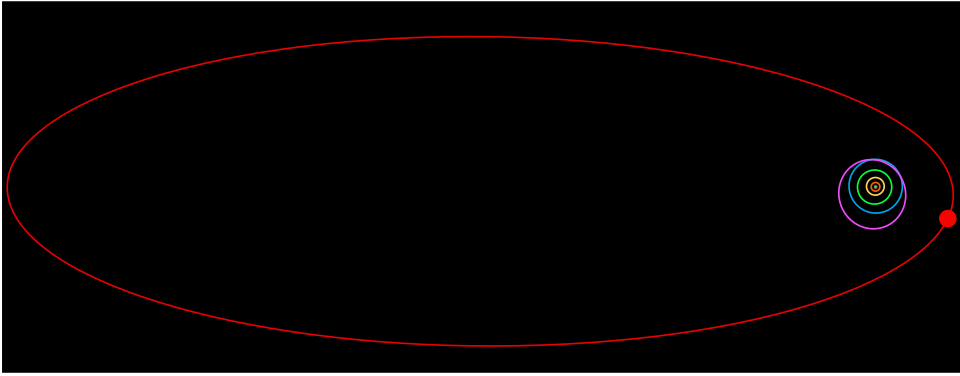

Sedna's orbit was immediately recognized as anomalous. Its perihelion lies far beyond Neptune at 30 AU, ruling out direct gravitational interaction with the known planets at the present epoch, and its semi-major axis places it well inside what would be the inner Oort cloud as defined by the Hills and Duncan–Quinn–Tremaine boundaries. Brown, Trujillo, and Rabinowitz argued that Sedna was best understood as the first observed member of the inner Oort cloud and that its orbit had likely been emplaced by an early stellar encounter, by perturbations from undiscovered massive bodies, or by the dynamical effects of the Sun's birth cluster.8, 14
Morbidelli and Levison, in a 2004 dynamical analysis, examined five candidate mechanisms for the origin of Sedna's orbit and concluded that none of them was decisively favored by the existing observations, but that all of them implied the existence of a substantial population of Sedna-like objects rather than a single rare event.14 A second member of this population was found a decade later: 2012 VP113, reported by Trujillo and Sheppard in 2014 in Nature. The new object has a perihelion of approximately 80 AU — the largest perihelion of any minor planet then known — and a semi-major axis of roughly 260 AU. From the surveyed sky area, Trujillo and Sheppard estimated that approximately 900 inner Oort cloud objects with diameters greater than 1,000 km should exist, and that the total population of the inner Oort cloud may exceed that of the Kuiper belt and main asteroid belt combined.9
Sedna and 2012 VP113 have given rise to a new dynamical class, the sednoids, defined by perihelia greater than approximately 50 AU and semi-major axes larger than about 150 AU. Their orbits cannot be reproduced by interaction with the known planets in the present-day solar system, and the various proposed origin mechanisms — capture from a sibling star in the natal cluster, perturbation by a putative distant planet, or stellar encounters during the early Galactic environment — remain under active study. Together they offer the only direct telescopic access to the inner Oort cloud and provide essential boundary conditions for any successful model of its formation.13, 14, 17
Population, mass, and physical properties
Estimates of the total number of Oort cloud bodies depend on how the long-period comet flux is extrapolated to the underlying reservoir, on the assumed physical lifetimes and fading behavior of comets after their first apparition, and on the assumed cometary size distribution. Wiegert and Tremaine, in a 1999 numerical analysis of long-period comet evolution, confirmed Oort's original conclusion that the observed orbital distribution cannot be reproduced from a steady-state injection of new comets without invoking a fading process — comets must become physically less detectable, or disrupt entirely, after a few tens of perihelion passages — and used this constraint to estimate the populations of the inner and outer reservoirs.6
Reviews by Dones, Weissman, Levison, and Duncan in 2004 and by Dones, Brasser, Kaib, and Rickman in 2015 give converging estimates: the outer Oort cloud, defined as the region beyond approximately 20,000 AU, contains roughly (1–5) × 1011 comets larger than 1 km, while the inner cloud contains several times more, with totals across both reservoirs in the range of 1012 bodies of comparable size.5, 17 A reanalysis of long-period comet statistics by Francis in 2005 derived a smaller outer cloud population near 4 × 10¹⁰, illustrating the substantial systematic uncertainty inherent in these estimates.20 The total mass of the cloud is correspondingly uncertain. Most modern estimates lie in the range of a few Earth masses (5–10 M⊕) for the combined inner and outer reservoirs, although values as small as 1 M⊕ and as large as 30 M⊕ are not excluded.5, 17
Individual Oort cloud bodies are believed to be cometary nuclei: porous mixtures of water ice, other volatile ices (carbon monoxide, carbon dioxide, methane, ammonia), refractory dust, and complex organic compounds, with characteristic diameters from less than a kilometre to perhaps a few hundred kilometres. The largest known sednoids are several hundred kilometres across — Sedna itself has a diameter of roughly 1,000 km — suggesting that the inner cloud contains a tail of unusually large bodies that have not been heavily processed by collisions.8, 9 Equilibrium temperatures at 20,000 AU are only a few kelvin above absolute zero, and at such temperatures essentially all volatiles remain frozen; the Oort cloud bodies are therefore thought to be among the most pristine surviving samples of the volatile-rich material from which the giant planets and their satellites were assembled.5, 17
The scale of the Oort cloud
The most striking single fact about the Oort cloud is the enormous range of distances it spans. The inner edge of the Hills cloud lies roughly two thousand times farther from the Sun than Earth; the outer edge of the outer cloud lies up to a hundred thousand times farther. To make these distances tractable, it is useful to compare them to the more familiar boundaries of the solar system: the orbit of Neptune at 30 AU, the main Kuiper belt out to about 50 AU, the heliopause at roughly 120 AU (where the solar wind is balanced by the interstellar medium), the inner edge of the inner Oort cloud near 2,000 AU, and the outer edge near 100,000–200,000 AU. The scale chart below places these structures on a logarithmic axis, the only practical way to display them simultaneously.5, 19
Heliocentric distances of solar-system structures, logarithmic scale5, 8, 9, 17, 19
The bar widths above are scaled by log10(distance in AU) and so each unit of width corresponds to a factor of ten in distance, not to a linear interval. On a linear scale, the Kuiper belt would be invisible: the entire planetary region from the Sun to Neptune occupies less than 0.1 percent of the radius of the outer Oort cloud's outer edge. Stated differently, the outer edge of the outer Oort cloud at 200,000 AU is about 3.2 light-years from the Sun, roughly three-quarters of the distance to Proxima Centauri at 4.24 light-years; from the perspective of the Galactic neighborhood, the Sun's gravitational domain merges almost imperceptibly into that of its nearest stellar neighbors.5, 19
Boundaries of the Oort cloud and adjacent solar-system structures5, 17, 19
| Structure | Approximate distance | Geometry | Membership |
|---|---|---|---|
| Kuiper belt | 30–50 AU | Flattened disk | Trans-Neptunian objects, short-period comet source |
| Scattered disk | 30–1,000 AU | Eccentric, mildly inclined | Centaurs and Jupiter-family comet source |
| Heliopause | ~120 AU | Boundary of solar wind | Plasma boundary, no bodies |
| Inner Oort cloud (Hills cloud) | 2,000–20,000 AU | Flattened, disk-like | Sednoids, long-lived dynamical reservoir |
| Outer Oort cloud | 20,000–100,000 AU | Approximately spherical | Source of dynamically new long-period comets |
| Outer Oort cloud tail | up to ~200,000 AU | Spherical, low density | Loosely bound, easily perturbed |
Open questions and future observations
Despite seventy-five years of theoretical and observational work, the Oort cloud remains one of the most poorly characterized large structures in the solar system. Direct imaging of individual cometary nuclei at distances of 2,000 AU or more is far beyond present telescopic capability: a 10-km nucleus at 20,000 AU would have an apparent visual magnitude near 35, fainter than anything yet detected. Observational progress instead relies on enlarging the sample of long-period comets and on extending sednoid surveys to fainter limiting magnitudes and broader sky coverage.17, 20
The Vera C. Rubin Observatory, which began operations in 2025, is expected to substantially increase the discovered sample of long-period comets and sednoid candidates over its decade-long Legacy Survey of Space and Time. Larger samples will sharpen the determination of the original 1/a distribution, constrain the relative contributions of inner and outer Oort cloud sources to the long-period flux, and either confirm or disprove the prediction by Trujillo and Sheppard that the inner Oort cloud is more populous than the Kuiper belt.9, 17
Several major theoretical questions remain open. The fraction of Oort cloud bodies that originated in the protoplanetary disks of sibling stars in the Sun's birth cluster, as opposed to those scattered out from the giant-planet region of our own solar system, is uncertain by an order of magnitude; resolving this question would constrain the density and lifetime of the Sun's natal cluster and would have implications for the chemical relationship between Oort cloud comets and the meteorites and asteroids of the inner solar system.11, 23 The total mass and the size distribution of the cloud are uncertain by factors of several, leaving open the question of whether the cloud contains a significant population of dwarf-planet-sized bodies of which Sedna is the brightest visible representative.5, 17 And the dynamical origin of the most extreme sednoid orbits — whether they require an undiscovered planet at hundreds of AU, an unusually close stellar passage in the natal cluster, or some combination of the two — remains unsettled.13, 14
Whatever its detailed structure proves to be, the Oort cloud occupies a unique conceptual position in the architecture of the solar system: it is the only known reservoir whose dynamics are dominated by external rather than internal forces, the principal arena in which the gravity of the Galaxy reaches into the affairs of an individual stellar system, and the most plausible repository of pristine icy material left over from the formation of the giant planets 4.5 billion years ago. Its members, when occasionally injected into the inner solar system as long-period comets, carry information from these outer regions back into the range of direct observation, providing the only practical means by which the cloud can be studied at all.1, 5, 16, 17
References
The structure of the cloud of comets surrounding the Solar System and a hypothesis concerning its origin
Oort cloud and Scattered Disc formation during a late dynamical instability in the Solar System
Scenarios for the origin of the orbits of the trans-Neptunian objects 2000 CR₁₀₅ and 2003 VB₁₂ (Sedna)