Overview
- Population III stars are the hypothesized first generation of stars in the universe, formed from pristine primordial gas composed exclusively of hydrogen, helium, and trace lithium produced during Big Bang nucleosynthesis, with zero metallicity—a property that distinguishes them from all subsequently formed stellar populations and profoundly shaped their physical characteristics.
- Theoretical models and cosmological simulations predict that Population III stars were extraordinarily massive, with characteristic masses of tens to hundreds of solar masses and possibly exceeding 1,000 solar masses, because the absence of metals and dust grains in primordial gas restricted cooling to inefficient molecular hydrogen transitions, yielding Jeans masses far larger than those in present-day star-forming regions.
- No Population III star has been directly observed, but indirect evidence for their existence comes from the chemical abundance patterns of extremely metal-poor stars in the Milky Way halo, the nucleosynthetic yields of pair-instability supernovae, and JWST observations of high-redshift galaxies—all of which are consistent with an early generation of massive, short-lived stars that chemically enriched the universe and contributed to cosmic reionization.
Population III stars (Pop III stars) are the hypothesized first generation of stars to have formed in the universe, assembled from the pristine primordial gas produced during Big Bang nucleosynthesis—hydrogen, helium, and trace amounts of lithium—with no heavier elements whatsoever. Their designation follows the stellar population classification scheme introduced by Walter Baade in the 1940s, in which Population I stars are the young, metal-rich stars found in the disks of spiral galaxies, Population II stars are the older, metal-poor stars concentrated in galactic halos and globular clusters, and Population III stars represent a still more ancient and chemically primitive generation that predates all known stellar populations.3, 12
.jpeg)
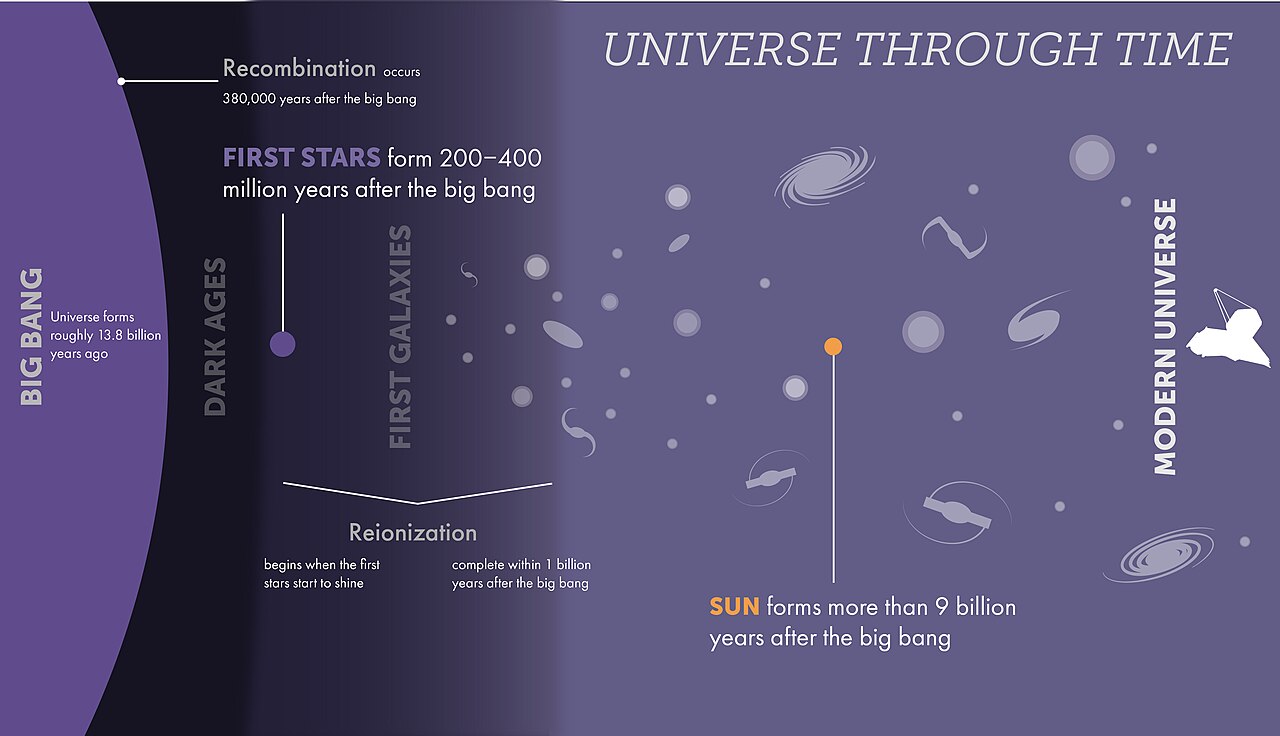
No Population III star has ever been directly observed. Their existence is inferred from the logical necessity that the first stars must have formed from gas that contained no metals, since all elements heavier than lithium are produced by stellar processes. Theoretical models, supported by sophisticated cosmological simulations, predict that the metal-free conditions of the early universe produced stars dramatically different from those forming today—far more massive, far more luminous, and far shorter-lived. These stars are believed to have played a foundational role in cosmic history: their ultraviolet radiation contributed to the [reionization](/cosmology/reionization-and-the-first-stars) of the intergalactic medium, their supernovae forged and dispersed the first heavy elements into the cosmos, and their remnants may have seeded the formation of the earliest supermassive black holes.3, 4, 8
Stellar population classification
The concept of stellar populations originated with Walter Baade's 1944 observations of the Andromeda galaxy, in which he identified two kinematically and chemically distinct groups of stars. Population I stars, exemplified by the Sun, are relatively young, orbit in the thin disks of spiral galaxies, and possess metallicities (the fraction of elements heavier than helium, denoted Z) ranging from roughly solar (Z ~ 0.02) down to about one-tenth solar. These stars formed from gas that had been progressively enriched by generations of prior [stellar evolution](/cosmology/stellar-evolution) and [nucleosynthesis](/cosmology/nucleosynthesis). Population II stars are older, exhibit lower metallicities (Z ~ 10−4 to 10−2 solar), and are found predominantly in the halos and bulges of galaxies and in globular clusters. Their reduced metal content reflects their formation from gas that had undergone fewer cycles of stellar processing.3, 11
Population III represents the logical extension of this sequence to zero metallicity. Stars in this category would have formed from gas whose composition was set entirely by [primordial nucleosynthesis](/cosmology/primordial-nucleosynthesis)—approximately 75 percent hydrogen, 25 percent helium by mass, and lithium at an abundance of roughly 10−10 relative to hydrogen—with no carbon, nitrogen, oxygen, iron, or any other metal. This pristine composition has profound implications for the physics of [star formation](/cosmology/star-formation), because metals and the dust grains they form are the primary coolants in present-day molecular clouds. Without these cooling agents, the thermodynamic pathway of gravitational collapse differs fundamentally from the process that forms stars in the contemporary universe.3, 4, 5
Formation physics
The formation of Population III stars is governed by the physics of gravitational collapse in a metal-free environment. After recombination at redshift z ~ 1100, the baryonic matter of the universe consisted of a nearly uniform sea of neutral hydrogen and helium. Over the following hundred million years, dark matter density perturbations seeded during [cosmic inflation](/cosmology/cosmic-inflation) grew through gravitational instability, eventually collapsing into small structures called minihalos with virial masses of approximately 105 to 106 solar masses. Baryonic gas fell into the gravitational potential wells of these minihalos, but the process of star formation could only begin once the gas was able to dissipate its gravitational energy through radiative cooling.1, 5
In the absence of metals and dust, the only available coolant for primordial gas at temperatures below approximately 104 kelvin is molecular hydrogen (H2). Molecular hydrogen forms through gas-phase reactions involving the intermediary species H− (the hydrogen anion), a process that proceeds slowly and produces H2 at fractional abundances of only about 10−3 to 10−4. The rotational and vibrational transitions of H2 can cool the gas to temperatures of approximately 200 kelvin, but this represents a floor: H2 is a homonuclear molecule without a permanent dipole moment, so its lowest-energy rotational transitions have relatively high excitation temperatures and become ineffective below a few hundred kelvin. By contrast, present-day star-forming clouds cool to approximately 10 kelvin through far more efficient emission from carbon monoxide and dust grains, processes entirely unavailable in primordial gas.1, 2, 6
The minimum temperature to which primordial gas can cool directly determines the Jeans mass—the critical mass above which a gas cloud's self-gravity overwhelms thermal pressure and the cloud collapses. Because the Jeans mass scales as T3/2ρ−1/2, where T is the gas temperature and ρ is the density, the higher floor temperature in metal-free gas produces characteristic Jeans masses of approximately 102 to 103 solar masses, compared to typical Jeans masses of order 1 solar mass in present-day molecular clouds. This fundamental difference explains why theoretical models predict that Population III stars were far more massive than the stars forming in the universe today.2, 3, 4
The landmark cosmological simulations of Abel, Bryan & Norman (2002) and Bromm, Coppi & Larson (2002) were the first to follow the formation of a Population III protostar from cosmological initial conditions through gravitational collapse to the point of protostellar core formation. Abel et al. used an adaptive mesh refinement (AMR) hydrodynamics code to trace the collapse of gas within a minihalo at redshift z ~ 20, finding that the gas settled into a central clump of several hundred solar masses that continued to accrete material from an extended envelope. Bromm et al. employed smoothed-particle hydrodynamics (SPH) simulations to reach similar conclusions, showing that the gas fragmented into clumps of 102 to 103 solar masses within the minihalo potential well.1, 2 These simulations established the paradigm that Population III stars formed in minihalos at redshifts z ~ 20–30, approximately 100 to 200 million years after the Big Bang, during the epoch now called [cosmic dawn](/cosmology/cosmic-dawn).
Predicted masses and the initial mass function
The characteristic mass of Population III stars has been a central question in theoretical astrophysics for decades. Early analytical arguments and the first generation of simulations suggested extremely top-heavy mass functions, with typical masses of several hundred solar masses and some stars potentially reaching 1,000 M☉ or more. The reasoning was straightforward: because molecular hydrogen cooling limited the minimum gas temperature to approximately 200 kelvin, the corresponding Jeans mass remained large, and the absence of efficient fragmentation mechanisms allowed most of the collapsing gas to accrete onto a single central protostar or a small number of massive fragments.2, 3, 6
Subsequent work, however, has introduced important nuances. Higher-resolution simulations in the 2010s revealed that primordial gas can indeed fragment during the accretion phase, forming small protostellar groups or disk-born companions rather than a single monolithic star. Clark et al. (2011) demonstrated that the accretion disk surrounding a Population III protostar becomes gravitationally unstable and fragments into multiple objects, suggesting that the earliest star-forming events may have produced small clusters rather than isolated massive stars.15 Greif et al. (2011) confirmed this result using moving-mesh simulations, finding that minihalos typically produced small groups of protostars with a range of masses.17 Stacy, Greif & Bromm (2010) found similar fragmentation behaviour, with the most massive protostar in each minihalo continuing to grow through competitive accretion while lower-mass companions were occasionally ejected from the system.16
Radiative feedback from the growing protostar also limits its final mass. Hosokawa et al. (2011) showed that once a Population III protostar reaches approximately 20 to 50 solar masses, its extreme ultraviolet luminosity generates an expanding H II region that heats and disperses the surrounding accretion envelope, eventually shutting off further mass growth. Their calculations found typical final masses of approximately 40 solar masses, substantially below the 100–1,000 M☉ estimates from earlier work that did not include radiative feedback.14 The current consensus, as reviewed by Klessen & Glover (2023), is that the Population III initial mass function was broad and top-heavy compared to the present-day IMF, with a characteristic mass of approximately 10 to 100 solar masses but extending both upward into the hundreds of solar masses and downward to perhaps a few solar masses in cases where disk fragmentation produced low-mass companions.4
Physical properties
The physical properties of Population III stars differ markedly from those of their metal-enriched successors. Models of zero-metallicity stellar structure predict that Pop III main-sequence stars were extremely compact and hot, with surface temperatures substantially exceeding those of metal-enriched stars of comparable mass. A Population III star of 100 solar masses would have had an effective temperature of approximately 105 kelvin, compared to roughly 50,000 kelvin for a metal-enriched star of the same mass. This elevated temperature resulted from the lower opacity of metal-free stellar envelopes, which allowed radiation to escape more readily and drove the photosphere to smaller radii and higher temperatures.3, 8
The extreme surface temperatures of Population III stars made them prodigious emitters of ionizing ultraviolet radiation. A single Pop III star of 100 solar masses could produce ionizing photon luminosities of approximately 1050 photons per second, capable of ionizing a bubble of intergalactic hydrogen several kiloparsecs in radius. Their bolometric luminosities ranged from roughly 105 to 107 solar luminosities depending on mass, with the most massive examples approaching the Eddington luminosity limit.3, 12
The lifetimes of Population III stars were correspondingly short. Like all massive stars, they burned through their nuclear fuel at rates that scaled steeply with mass, spending only a few million years on the main sequence before exhausting their core hydrogen supply. A 100 M☉ Pop III star would have had a main-sequence lifetime of approximately 2 to 3 million years, and even stars at the lower end of the predicted mass range (10–20 M☉) would have lived for no more than about 10 to 20 million years. By cosmological standards these lifetimes are negligible, meaning that Population III stars completed their entire evolutionary cycles within a small fraction of the time between their formation epoch (z ~ 20–30) and the completion of [reionization](/cosmology/reionization-and-the-first-stars) (z ~ 6).3, 9
Death and nucleosynthesis
The fate of a Population III star depends critically on its mass. Theoretical models of zero-metallicity stellar evolution identify several distinct regimes, each producing different remnants and different nucleosynthetic yields. Stars below approximately 8 solar masses would have evolved through asymptotic giant branch phases and produced white dwarf remnants, as in the present-day universe, though such low-mass Population III stars would have had main-sequence lifetimes exceeding the current age of the universe and would still be shining today if they existed. Stars in the range of approximately 8 to 40 solar masses are predicted to have ended as core-collapse supernovae, producing neutron star or black hole remnants and ejecting newly synthesized heavy elements into the surrounding medium.8, 9
The most distinctive fate awaits Population III stars in the mass range of approximately 140 to 260 solar masses, which are predicted to explode as pair-instability supernovae (PISNe). In these events, the core of the star reaches temperatures exceeding 109 kelvin during the late stages of nuclear burning, at which point the thermal photons become energetic enough to produce electron-positron pairs. This pair production process converts thermal energy into rest mass energy, reducing the radiation pressure that supports the star against gravitational collapse. The resulting contraction triggers explosive thermonuclear burning of the oxygen and silicon core, which releases sufficient energy to completely unbind the star—leaving no compact remnant whatsoever. The entire stellar mass is ejected into space, enriched with enormous quantities of heavy elements including several solar masses of radioactive nickel-56, which decays to iron-56.7, 8, 9
Pair-instability supernovae are predicted to produce distinctive nucleosynthetic signatures that differ from those of ordinary core-collapse supernovae. The most prominent feature is a strong odd-even effect in elemental abundances, in which elements with even atomic numbers (such as silicon, sulfur, calcium, and iron) are produced in much greater quantities than those with odd atomic numbers (such as sodium, aluminium, and potassium). PISNe are also predicted to produce very high ratios of silicon and calcium relative to iron, and characteristically low abundances of elements beyond the iron peak (such as zinc and cobalt), because the explosive burning occurs at relatively low neutron densities that do not favour neutron-capture nucleosynthesis.8, 9
Stars between approximately 40 and 140 solar masses occupy a transitional regime. In the lower portion of this range (40–100 M☉), core collapse produces a black hole directly, with most or all of the stellar material falling inward and little metal ejection. Stars between approximately 100 and 140 solar masses experience pulsational pair instability, in which pair production triggers one or more thermonuclear pulses that eject the outer layers but do not fully unbind the star; the core eventually collapses to a black hole. Above 260 solar masses, the star is so massive that even the enormous energy released by explosive pair-instability burning is insufficient to unbind it, and the entire star collapses into a black hole—potentially a very massive one that could serve as a seed for the supermassive black holes observed at high redshift.9, 7
Chemical enrichment of the early universe
The chemical enrichment produced by the first Population III supernovae was one of the most consequential events in cosmic history. Before these explosions, the intergalactic medium contained no elements heavier than lithium. The metals dispersed by Pop III supernovae—carbon, oxygen, silicon, iron, and dozens of other species—represented the first heavy elements ever produced in the universe and initiated the process of chemical evolution that would eventually produce the full periodic table of elements observed in the cosmos today.8, 4
The enrichment was not merely additive but transformative. Once the metallicity of the ambient gas exceeded a critical threshold of approximately 10−6 to 10−4 solar metallicity (the exact value depends on the dominant cooling species and the dust-to-gas ratio), fine-structure line cooling from species such as C II, O I, and Si II became effective, dramatically enhancing the ability of gas to radiate away energy during gravitational collapse. This lowered the minimum temperature achievable in collapsing gas clouds from approximately 200 kelvin to approximately 10 kelvin, reducing the characteristic Jeans mass by orders of magnitude and enabling the formation of the first low-mass, long-lived stars—the earliest [Population II](/cosmology/stellar-populations-and-chemical-evolution) stars.3, 4, 20
This transition from the Population III to the Population II mode of star formation is sometimes called the critical metallicity transition. It was not instantaneous or spatially uniform; rather, it proceeded patchily as individual Population III supernovae enriched their local environments to above the critical threshold while more distant regions remained pristine. Cosmological simulations indicate that pockets of truly metal-free gas may have persisted to redshifts as low as z ~ 6–10, allowing Population III star formation to continue in isolated minihalos that had not yet been contaminated by metals from neighbouring sources, even as much of the universe had already transitioned to metal-enriched star formation.4, 20
Connection to reionization
Population III stars are believed to have played an important role in the [reionization](/cosmology/reionization-and-the-first-stars) of the universe, the process by which the intergalactic medium transitioned from a neutral state to the fully ionized state observed at redshifts below approximately z ~ 6. Their extreme surface temperatures and high ionizing photon production rates made individual Pop III stars far more efficient ionizers of hydrogen than the lower-mass, lower-temperature stars that formed subsequently. A single Pop III star of several tens of solar masses could ionize a surrounding volume of intergalactic hydrogen far exceeding the capacity of a present-day O-type star of comparable mass.3, 12
However, the total contribution of Population III stars to reionization remains uncertain and is likely subdominant. Their formation was confined to the relatively rare minihalos that collapsed at the highest redshifts, and each Pop III stellar population enriched its local environment with metals, suppressing further Pop III formation in that vicinity. The bulk of the ionizing photon budget for reionization is thought to have been supplied by the much more numerous Population II stars forming in larger, atomic-cooling halos at redshifts z ~ 6–15. Planck satellite measurements of the Thomson optical depth to the [cosmic microwave background](/cosmology/cosmic-microwave-background) (τ = 0.054 ± 0.007) constrain the midpoint of reionization to z ~ 7.7, well after the peak epoch of Population III formation.13, 19
The role of Pop III stars in reionization is thus best understood as initiatory rather than dominant. They created the first small ionized bubbles in the otherwise neutral intergalactic medium during [cosmic dawn](/cosmology/cosmic-dawn) and, through their chemical enrichment of the gas, enabled the transition to the Population II star formation mode that ultimately completed the reionization process. Their supernovae may also have driven powerful outflows that distributed metals and thermal energy over large volumes, preheating the intergalactic medium and modifying the conditions under which subsequent star formation occurred.4, 12
Observational searches
Despite decades of theoretical study, no Population III star has been directly observed. Their extreme distances (forming at redshifts z > 10) and short lifetimes make individual Pop III stars extraordinarily faint even for the most powerful telescopes. The James Webb Space Telescope (JWST), while capable of detecting luminous galaxies at redshifts z > 14, does not have sufficient sensitivity to resolve individual Pop III stars except in the most optimistic scenarios involving gravitational lensing by foreground galaxy clusters.4, 21
Indirect searches for Population III stars have followed two primary strategies. The first is stellar archaeology—the systematic search for the most metal-poor stars in the Milky Way and its satellite galaxies, on the assumption that these stars represent the earliest surviving generation of Population II objects and that their chemical abundance patterns preserve a fossil record of the nucleosynthetic yields of the Population III supernovae that enriched the gas from which they formed.11
This approach has yielded remarkable discoveries. The most extreme example is SMSS J031300.36−670839.3, discovered by Keller et al. (2014) using the SkyMapper telescope. This star, located in the halo of the Milky Way, has an iron abundance less than 10−7 times solar—making it the most iron-poor star known—while exhibiting detectable abundances of carbon and magnesium. Keller et al. interpreted this abundance pattern as consistent with enrichment by a single low-energy core-collapse supernova from a Population III progenitor of approximately 60 solar masses, in which the innermost iron-rich ejecta fell back onto the compact remnant while the outer layers enriched with lighter elements were successfully expelled.10 Other extremely metal-poor stars discovered through surveys such as the Hamburg/ESO Survey, the SDSS/SEGUE programme, and the PRISTINE survey have revealed abundance patterns consistent with enrichment by various types of Population III supernovae, though no star with truly zero metallicity has been found—as expected, since such objects would require extremely long main-sequence lifetimes (implying very low masses) to have survived to the present epoch.11, 18
The second strategy involves searching for the signatures of pair-instability supernovae, which should produce distinctive chemical abundance patterns in the gas and stars they enrich. The characteristic odd-even effect and high ratios of alpha elements (such as silicon, calcium, and titanium) to iron predicted for PISN yields have been searched for in the most metal-poor known stars, but to date no convincing PISN signature has been identified in any individual star or stellar population. This non-detection has been interpreted in two ways: either pair-instability supernovae were rare events (because most Pop III stars had masses below the 140 M☉ threshold), or their chemical yields were so diluted by mixing with ambient gas that the distinctive PISN signature was washed out below detectable levels.8, 11
Howes et al. (2015) reported the discovery of extremely metal-poor stars in the bulge of the Milky Way, a surprising finding because the high-density bulge environment was expected to have been enriched to higher metallicities very early in cosmic history. These stars, with metallicities below 10−3 solar, may represent among the earliest objects to have formed in the proto-Milky Way and provide additional constraints on the nucleosynthetic yields of the first stellar generation.18
JWST and high-redshift galaxies
While JWST cannot resolve individual Population III stars, it has opened new avenues for constraining their properties through observations of the earliest galaxies. The spectroscopic confirmation of galaxies at redshifts z ~ 14 by Carniani et al. (2024) has demonstrated that vigorous star formation was underway within 290 million years of the Big Bang, implying that the transition from Population III to Population II star formation must have occurred very rapidly in the densest cosmic environments.21
Several JWST programmes have searched for spectroscopic signatures that might indicate the presence of Population III stars within high-redshift galaxies. The most promising diagnostic is the He II λ1640 emission line, which requires photon energies above 54.4 electron volts to produce and is expected to be strong in galaxies whose ultraviolet radiation fields are dominated by the extremely hot spectra of metal-free stars. Detections of anomalously strong He II emission in some high-redshift galaxies observed by JWST have been tentatively interpreted as possible evidence for pockets of Population III star formation, though alternative explanations involving active galactic nuclei or very massive metal-poor (but not metal-free) stars cannot be excluded.4
The unexpectedly high luminosities and star formation rates observed in JWST galaxies at z > 10 have also been invoked as indirect evidence for a top-heavy initial mass function in the earliest stellar populations, possibly reflecting a gradual transition from the top-heavy Pop III IMF to the more bottom-heavy IMF characteristic of present-day star formation. If early galaxies contained a significant fraction of very massive stars, they would produce more ultraviolet luminosity per unit stellar mass, potentially explaining why these galaxies appear brighter than pre-JWST models predicted.4, 21
Cosmological simulations
The study of Population III star formation has been driven largely by computational simulations, because the physical conditions of the early universe cannot be reproduced in terrestrial laboratories and direct observations remain out of reach. The field has progressed through several generations of increasingly sophisticated numerical experiments, each incorporating additional physical processes and achieving higher spatial resolution.
The foundational simulations of Abel, Bryan & Norman (2002) and Bromm, Coppi & Larson (2002) established the basic framework: dark matter minihalos of 105 to 106 solar masses collapsing at z ~ 20–30, with baryonic gas cooling through H2 rotational-vibrational transitions and settling into a central dense clump of several hundred solar masses.1, 2 These simulations were limited to following the collapse up to the formation of the first protostellar core and could not determine the final stellar mass, because the subsequent accretion phase operates on timescales many orders of magnitude longer than the dynamical time of the core.
The second generation of simulations, represented by the work of Stacy, Greif & Bromm (2010), Greif et al. (2011), and Clark et al. (2011), extended the calculations into the accretion phase and revealed that the protostellar accretion disk is susceptible to gravitational fragmentation. These studies showed that Population III star formation was not necessarily a process that produced single isolated massive stars but could instead yield small groups of protostars with a range of masses, some of which might be ejected from the system before accreting to high masses.15, 16, 17 The inclusion of radiative feedback by Hosokawa et al. (2011) further constrained the upper mass limit by demonstrating that protostellar radiation could halt accretion at masses of approximately 40 solar masses under certain conditions.14
More recent simulations have placed Population III star formation within the larger context of early cosmic structure formation, tracking not just individual minihalos but the statistical properties of Pop III stellar populations across cosmological volumes. Smith et al. (2015) explored how metals ejected by early supernovae were transported through the intergalactic medium and mixed into neighbouring minihalos, finding that external enrichment could transition some minihalos from the Population III to the Population II mode of star formation even before they had formed any stars of their own.20 These large-volume simulations have been essential for connecting the microphysics of individual Pop III star formation events to the macroscopic observables—such as reionization history, [cosmic element abundances](/cosmology/cosmic-element-abundances), and the properties of the most metal-poor stars—that can be compared with astronomical data.4
Open questions and future prospects
Despite substantial theoretical progress, fundamental questions about Population III stars remain unresolved. The shape of the Pop III initial mass function—and in particular whether it extends to very low masses that could produce surviving relics in the present-day universe—is still debated, because simulations of the accretion and fragmentation phases are sensitive to numerical resolution, the treatment of magnetic fields (which are poorly constrained in the primordial environment), and the modelling of radiative transfer.4, 15
The question of whether any very low-mass Population III stars (below approximately 0.8 solar masses, with main-sequence lifetimes exceeding the age of the universe) could have formed and survived to the present day remains open. If disk fragmentation in primordial gas occasionally produced sub-solar-mass objects that were dynamically ejected before accreting further material, such stars could in principle still exist in the halos of galaxies. No zero-metallicity star has been found in any survey to date, but this non-detection cannot yet definitively rule out their existence, because extremely metal-poor stellar surveys are still incomplete at faint magnitudes.11, 4
Future observational progress is expected on multiple fronts. Continued JWST observations may identify the spectroscopic signatures of Population III stellar populations in high-redshift galaxies, particularly through deep spectroscopy targeting the He II λ1640 line and other diagnostics of very hot stellar radiation fields. Next-generation ground-based extremely large telescopes—the European Extremely Large Telescope, the Thirty Meter Telescope, and the Giant Magellan Telescope—will extend the reach of stellar archaeology to fainter and more distant metal-poor stars in the Milky Way halo and its satellite galaxies. Gravitational wave observatories may eventually detect the mergers of massive black hole remnants from Population III stars, providing an entirely independent constraint on their masses and formation rates. And the detection of the cosmological 21-cm signal from [cosmic dawn](/cosmology/cosmic-dawn) by experiments such as the Square Kilometre Array would constrain the timing and intensity of the first starlight, offering a statistical measure of the collective impact of Population III stars on the intergalactic medium.4, 13
The search for Population III stars sits at the intersection of stellar astrophysics, cosmology, nuclear physics, and observational astronomy. Though they remain undetected as individual objects, their theoretical necessity is compelling, their predicted consequences are observable through multiple independent channels, and the progressive narrowing of their allowed parameter space through simulation and observation continues to refine the understanding of how the first luminous structures emerged from the darkness of the early universe.
References
A single low-energy, iron-poor supernova as the source of metals in the star SMSS J031300.36−670839.3