Overview
- When stars of roughly 0.8 to 8 solar masses exhaust their nuclear fuel, they ascend the asymptotic giant branch (AGB), where helium shell flashes dredge carbon and s-process elements to the surface, before intense stellar winds strip the outer envelope and expose a hot, compact core that ionizes the expelled gas into a planetary nebula.
- White dwarfs are supported against gravitational collapse by electron degeneracy pressure and cannot exceed the Chandrasekhar limit of approximately 1.4 solar masses; they cool over billions of years through a well-understood process that includes core crystallization—directly detected by the ESA Gaia mission in 2019—making them precise cosmic chronometers for dating stellar populations.
- In binary systems, white dwarfs produce some of the most energetic phenomena in the universe: cataclysmic variables and classical novae from surface hydrogen ignition, and Type Ia supernovae from either the accretion of matter past the Chandrasekhar limit (single-degenerate channel) or the merger of two white dwarfs (double-degenerate channel).
When a star of roughly one to eight solar masses exhausts its core nuclear fuel, it does not explode. Instead, it undergoes a protracted and beautiful death, shedding its outer layers into space as a glowing shell of ionized gas—a planetary nebula—while the exposed stellar core contracts into one of the densest objects in the universe: a white dwarf. These two phenomena are physically inseparable. The planetary nebula is the expelled envelope; the white dwarf is the remnant core. Together they represent the final evolutionary stage for the vast majority of all stars, including the Sun.4, 19
The physics governing this transition connects stellar nucleosynthesis, radiation-driven mass loss, quantum mechanics, and plasma physics into a single coherent narrative. The asymptotic giant branch (AGB) phase that precedes envelope ejection is a crucible of chemical enrichment, responsible for manufacturing much of the carbon and slow-neutron-capture elements in the universe. The white dwarf that remains is an object whose very existence depends on a purely quantum-mechanical phenomenon—electron degeneracy pressure—and whose cooling behavior serves as a cosmic clock for dating stellar populations billions of years old.1, 8
The asymptotic giant branch
After a low- or intermediate-mass star (roughly 0.8 to 8 solar masses) has exhausted the helium in its core during its horizontal-branch phase, it develops a degenerate carbon-oxygen core surrounded by two concentric nuclear-burning shells: an inner shell burning helium and an outer shell burning hydrogen. The enormous luminosity generated by these shells causes the stellar envelope to expand once again, and the star ascends the asymptotic giant branch (AGB) on the Hertzsprung-Russell diagram—so named because its track on the HR diagram approaches asymptotically close to the earlier red giant branch track but at even higher luminosities.1, 19
The AGB phase is punctuated by dramatic episodes called thermal pulses (or helium shell flashes). The helium-burning shell is thermally unstable: helium accumulates from the hydrogen-burning shell above until it reaches a critical mass and ignites in a brief but intense thermonuclear runaway. Each thermal pulse lasts only a few hundred years but releases an enormous burst of energy—up to 108 solar luminosities for a brief interval—that drives vigorous convection in the intershell region between the two burning shells.1 The interval between successive thermal pulses decreases as the star evolves up the AGB, from roughly 100,000 years at the beginning to as little as 10,000 years near the end, depending on the core mass.1, 2
A critical consequence of thermal pulses is the third dredge-up, in which the deep convective envelope penetrates into the intershell region after each pulse and mixes freshly synthesized material to the stellar surface. The primary product dredged up is carbon, produced by the triple-alpha process in the helium-burning shell. If enough carbon is brought to the surface, the star's atmospheric carbon-to-oxygen ratio exceeds unity and it becomes a carbon star—recognizable by its deep red color and distinctive molecular absorption bands of C2, CN, and CH.1, 2 The third dredge-up also transports products of the s-process (slow neutron capture) to the surface. In the intershell region, free neutrons are released primarily by the reaction 13C(α, n)16O, and these neutrons are captured by iron-peak seed nuclei to build up elements heavier than iron—including strontium, barium, lanthanum, and lead—along the valley of nuclear stability.3, 2
In more massive AGB stars (above roughly 4 to 5 solar masses), the base of the convective envelope becomes hot enough to sustain nuclear reactions directly, a process known as hot-bottom burning. This converts carbon to nitrogen via the CNO cycle, preventing the formation of a carbon star and instead producing nitrogen-rich surface compositions. Hot-bottom burning also produces lithium through the Cameron-Fowler mechanism and modifies the isotopic ratios of several light elements.1, 2
Mass loss and envelope ejection
AGB stars are prodigious factories of mass loss. As a star ascends the AGB, its luminosity increases, its radius swells to hundreds of solar radii, and its surface gravity drops to extremely low values. Under these conditions, stellar winds driven by radiation pressure on dust grains that condense in the cool outer atmosphere become increasingly powerful, stripping mass from the star at rates that ultimately dominate its evolution.1, 4
The mass-loss rate on the AGB increases dramatically with luminosity. Early on the AGB, mass-loss rates are modest—roughly 10−7 solar masses per year—and are reasonably described by the empirical Reimers relation, which parameterizes the mass-loss rate as proportional to the product of luminosity and radius divided by mass.19 But as the star approaches the tip of the AGB, the mass-loss rate accelerates by orders of magnitude, reaching 10−5 to 10−4 solar masses per year in a phase called the superwind. During this brief episode, lasting only tens of thousands of years, the star ejects the bulk of its remaining hydrogen-rich envelope—several tenths of a solar mass or more—into the surrounding space.1, 4
The mechanism driving the superwind involves a two-step process. First, radial pulsations of the AGB star—which cause the star to vary in brightness with periods of roughly 100 to 1,000 days, as observed in Mira-type variables—levitate gas to distances where temperatures fall below roughly 1,500 kelvins. At these temperatures, refractory dust grains (silicates in oxygen-rich stars, carbonaceous grains in carbon stars) condense from the gas phase. Once formed, these dust grains absorb and scatter stellar photons efficiently, and the resulting radiation pressure accelerates the grains outward. Frictional coupling between the dust and the surrounding gas drags the gas along, producing a dusty outflow.1, 4
The total mass lost during the AGB phase determines the mass of the white dwarf that remains. The relationship between a star's initial main-sequence mass and the final white dwarf mass—the initial-final mass relation (IFMR)—has been measured empirically from white dwarfs in open clusters, where the age of the cluster constrains the progenitor mass. Cummings and collaborators (2018) determined this relation for progenitors ranging from 0.85 to 7.5 solar masses, finding that a solar-mass progenitor produces a white dwarf of roughly 0.53 solar masses, while a 3-solar-mass progenitor produces a white dwarf of roughly 0.7 solar masses.14 The steepness of this relation at the upper end—progenitors of 6 to 8 solar masses produce white dwarfs barely exceeding 1.0 to 1.1 solar masses—demonstrates the remarkable efficiency of AGB mass loss in stripping away the majority of the stellar envelope.14
Planetary nebula formation and morphology
The term "planetary nebula" is a historical misnomer coined by William Herschel in the 1780s because the round, greenish disks of these objects resembled the planet Uranus through his telescope. In reality, planetary nebulae have nothing to do with planets. They are shells of gas expelled by AGB stars, rendered visible by the ultraviolet radiation of the extremely hot remnant core.4
.jpg)
.jpg)
After the superwind strips the AGB star's envelope, the exposed core—now called the central star of the planetary nebula (CSPN)—contracts rapidly and heats up. When the surface temperature of the central star exceeds roughly 25,000 to 30,000 kelvins, it emits sufficient ultraviolet photons to photoionize the surrounding expelled gas, causing it to fluoresce in characteristic emission lines of hydrogen, helium, oxygen, nitrogen, and other elements.4, 5 The planetary nebula phase is brief by astronomical standards: it lasts only about 10,000 to 30,000 years before the nebular gas disperses into the interstellar medium and the central star fades below the luminosity needed to keep the gas ionized.4
One of the most striking features of planetary nebulae is the extraordinary diversity of their shapes. Only about 20 percent of known planetary nebulae are approximately round or spherical. The remainder display elliptical, bipolar (butterfly-shaped), multipolar, or point-symmetric morphologies, often with complex internal structures including jets, knots, halos, and concentric arcs.5 This morphological diversity presents a fundamental theoretical puzzle known as the shaping problem: how does a spherically symmetric AGB star produce an aspherical nebula?
The leading explanation invokes binary companions. A companion star—or even a sufficiently massive planet—orbiting within or near the AGB envelope can gravitationally focus the mass loss into the orbital plane, producing a dense equatorial torus of material. When the fast wind from the emerging hot central star interacts with this toroidal structure, it is channeled preferentially along the polar directions, inflating bipolar lobes.5, 6 De Marco (2009) reviewed the evidence for the binary hypothesis and concluded that a growing body of observational data—including the high fraction of aspherical nebulae and the detection of close binary central stars in an increasing number of cases—supports the view that binary interaction plays a central role in shaping most planetary nebulae.6 Magnetic fields, possibly amplified during common-envelope evolution with a companion, provide an additional shaping mechanism by collimating outflows into narrow jets that sculpt the nebular gas into point-symmetric and multipolar patterns.5
Famous planetary nebulae
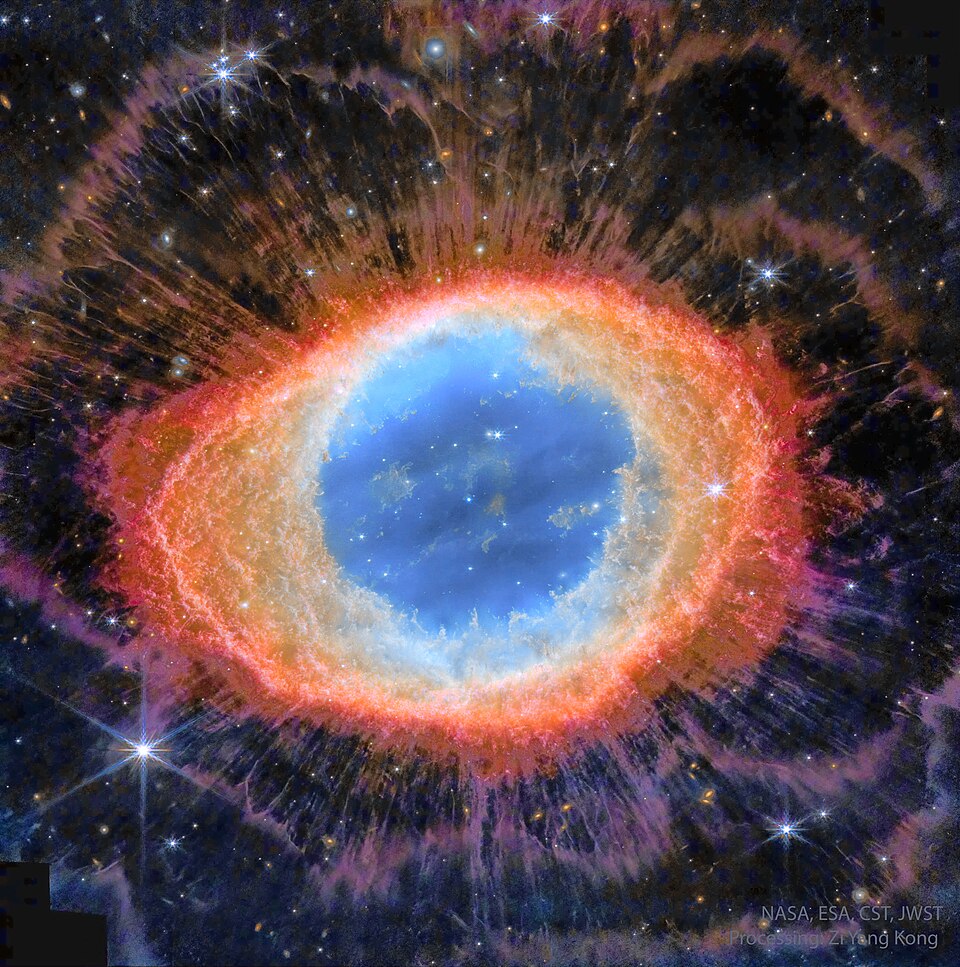
Several well-studied planetary nebulae serve as observational touchstones that illustrate the morphological diversity and physical processes discussed above. The Ring Nebula (M57, NGC 6720), located approximately 790 parsecs away in the constellation Lyra, is one of the best-known planetary nebulae and has been studied since its discovery by Antoine Darquier de Pellepoix in 1779. Modern observations, including detailed imaging by the Hubble Space Telescope and the James Webb Space Telescope, reveal that its apparently simple ring-like appearance is an illusion of projection: the nebula is actually a barrel-shaped or cylindrical structure viewed nearly pole-on, with a faint outer halo of earlier mass-loss episodes extending far beyond the bright inner ring.4, 5

The Helix Nebula (NGC 7293), at a distance of approximately 200 parsecs in the constellation Aquarius, is one of the nearest and largest planetary nebulae on the sky. Its central star is a hot white dwarf with a surface temperature of approximately 120,000 kelvins. Deep imaging reveals thousands of dense, cometary knots with bright ionized heads and long neutral tails pointing radially away from the central star, structures produced by the interaction of the fast stellar wind and ionizing radiation with dense clumps in the slow AGB ejecta.4
The Cat's Eye Nebula (NGC 6543), located roughly 1,000 parsecs away in the constellation Draco, is a textbook example of complex morphology. Hubble Space Telescope images reveal nested shells, jets, and an intricate pattern of concentric rings surrounding the bright inner nebula—structures interpreted as evidence for multiple mass-ejection episodes and possibly a precessing jet driven by a binary companion. The central star has one of the highest surface temperatures among planetary nebula nuclei, exceeding 50,000 kelvins.5
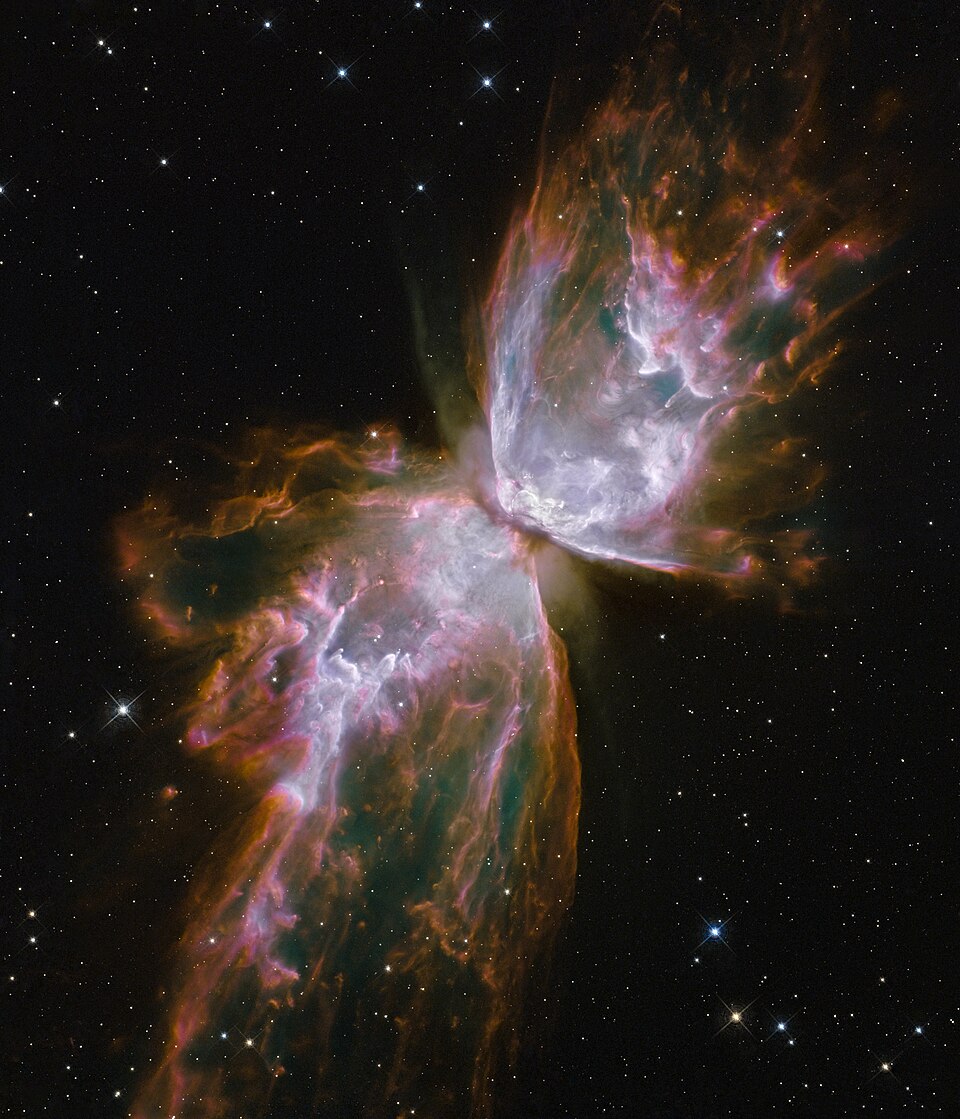
The Butterfly Nebula (NGC 6302) represents the extreme of bipolar morphology. Two enormous lobes of ionized gas extend over 3 parsecs from a dense equatorial waist of dust and molecular gas. The central star, one of the hottest known, has a surface temperature exceeding 200,000 kelvins and a progenitor mass estimated at approximately 5 solar masses. The extreme bipolarity of NGC 6302 strongly suggests shaping by a binary interaction or powerful magnetic fields during the AGB mass-loss phase.5, 6

White dwarf structure
When the planetary nebula disperses, the naked remnant core is a white dwarf—an object roughly the size of the Earth but with a mass comparable to the Sun's. White dwarfs are supported against gravitational collapse not by thermal pressure from nuclear reactions (which have ceased) but by electron degeneracy pressure, a quantum-mechanical effect arising from the Pauli exclusion principle. Because no two electrons can occupy the same quantum state, the electrons in the dense white dwarf interior are forced into progressively higher energy levels, generating a pressure that is independent of temperature and depends only on density.7, 8
In 1931, the Indian-American astrophysicist Subrahmanyan Chandrasekhar showed that electron degeneracy pressure has a fundamental limit. As the mass of a white dwarf increases, the electrons become relativistic—their velocities approach the speed of light—and the degeneracy pressure increases less steeply with density. Chandrasekhar calculated that above a critical mass of approximately 1.4 solar masses (for a composition of carbon and oxygen with two nucleons per electron), no amount of electron degeneracy pressure can support the star against gravity.7 This upper bound, now known as the Chandrasekhar limit, is one of the most important results in twentieth-century astrophysics. It establishes that white dwarfs more massive than this limit cannot exist in stable equilibrium and must either collapse further or be disrupted.
White dwarfs exhibit an unusual mass-radius relation: more massive white dwarfs are smaller, not larger. This is the opposite of the behavior of ordinary matter and is a direct consequence of the physics of degenerate matter. As mass is added, the higher gravitational compression forces the electrons into higher energy states, increasing the density and shrinking the radius. A typical white dwarf of 0.6 solar masses has a radius of roughly 0.012 solar radii (about 8,400 kilometers), comparable to the radius of the Earth. A white dwarf near the Chandrasekhar limit would have a radius only about two-thirds as large.8, 9
Properties of white dwarf types8, 9, 13, 14
| Composition | Progenitor mass (M☉) | Typical WD mass (M☉) | Core temperature | Spectral type(s) |
|---|---|---|---|---|
| Helium (He) | <0.5 (binary evolution) | 0.3–0.5 | ~107 K (young) | DA, DB |
| Carbon-oxygen (CO) | 0.8–6 | 0.5–0.9 | ~107 K (young) | DA, DB, DC, DQ, DZ |
| Oxygen-neon (ONe) | 6–8 | 1.0–1.3 | ~108 K (young) | DA, DB |
The most common white dwarfs have carbon-oxygen (CO) cores, produced by helium burning via the triple-alpha process and subsequent alpha-capture reactions in progenitor stars of roughly 0.8 to 6 solar masses. More massive progenitors (roughly 6 to 8 solar masses) ignite carbon burning in their cores before the AGB phase, producing oxygen-neon (ONe) white dwarfs with masses typically exceeding 1.0 solar mass.9, 14 A third class, helium (He) white dwarfs, has masses below roughly 0.5 solar masses. Because single stars of such low mass have main-sequence lifetimes exceeding the age of the universe, helium white dwarfs are understood to form through binary interactions in which a companion star strips the envelope before helium ignition can occur.9 Observational surveys of the Sloan Digital Sky Survey have established that the mean mass of DA (hydrogen-atmosphere) white dwarfs is approximately 0.59 solar masses, with a sharply peaked distribution confirming that the majority of white dwarfs descend from solar- and intermediate-mass progenitors.13
White dwarf cooling and crystallization
Because a white dwarf generates no energy through nuclear fusion, it cools gradually over time, radiating away the thermal energy stored in its interior. The theoretical framework for white dwarf cooling was established by Leon Mestel in 1952, who showed that a white dwarf can be modeled as a degenerate core of nearly uniform temperature (because degenerate matter is an excellent thermal conductor) surrounded by a thin, non-degenerate envelope that acts as an insulating blanket.10 The rate of energy loss is governed by the opacity of this envelope, and Mestel derived the relationship between luminosity and cooling age: luminosity decreases roughly as the inverse of time to the five-sevenths power, meaning that white dwarfs dim rapidly at first and then slow progressively as they cool.10
Modern cooling models incorporate physics far beyond Mestel's original treatment. Detailed evolutionary calculations include the effects of residual nuclear burning in the hydrogen and helium shell sources shortly after the star leaves the AGB, neutrino emission from the hot core (which dominates the cooling at early times when core temperatures exceed roughly 107 kelvins), convective coupling between the core and the envelope, and the gradual settling of heavier elements toward the center through gravitational sedimentation.8, 9
At sufficiently low temperatures, the ions in the white dwarf core undergo a phase transition from a liquid to a solid crystalline lattice—the white dwarf literally crystallizes from the center outward. This occurs when the Coulomb energy between neighboring ions exceeds the thermal kinetic energy by a factor of roughly 175, a condition first predicted theoretically in the 1960s. Crystallization releases latent heat and gravitational energy (the latter from the sedimentation of heavier oxygen nuclei toward the center as lighter carbon nuclei float upward during the phase transition), both of which inject additional energy into the star and delay its cooling by roughly 1 to 2 billion years.8, 9
In 2019, Tremblay and collaborators used photometric and astrometric data from the ESA Gaia satellite to provide the first direct observational evidence of white dwarf crystallization. By constructing an HR diagram of white dwarfs within 100 parsecs of the Sun, they identified a distinct pile-up of objects at luminosities and colors consistent with the predicted onset of crystallization—an excess of white dwarfs spending more time at a particular evolutionary stage because crystallization slows their cooling. The location of this pile-up matched theoretical predictions precisely, confirming that the interiors of cooling white dwarfs do indeed solidify.11
The well-understood physics of white dwarf cooling has made these objects valuable cosmic chronometers. The observed luminosity function of white dwarfs—the number of white dwarfs per unit luminosity interval—rises steeply toward faint luminosities but then drops abruptly at the faintest end. This cutoff corresponds to the oldest and coldest white dwarfs in the population and provides an independent estimate of the age of the stellar population from which they descend. Applied to the solar neighborhood, white dwarf cosmochronology yields a disk age of approximately 8 to 10 billion years, consistent with independent estimates from main-sequence turnoff ages of the oldest open clusters and from radioactive isotope dating.8, 12
White dwarfs in binary systems
Approximately half of all stars exist in binary or multiple systems, and when one member of a close binary evolves into a white dwarf, the gravitational interaction between the two stars can produce spectacular astrophysical phenomena. The most common of these are cataclysmic variables (CVs)—binary systems in which a white dwarf accretes matter from a low-mass companion star, typically a main-sequence K or M dwarf, that fills its Roche lobe. Material flowing through the inner Lagrangian point forms an accretion disk around the white dwarf, and the release of gravitational energy as gas spirals inward through the disk generates luminosities of roughly 0.01 to 10 solar luminosities, primarily at ultraviolet and optical wavelengths.15
Cataclysmic variables exhibit a range of eruptive behaviors. Dwarf novae undergo quasi-periodic outbursts of 2 to 5 magnitudes lasting days to weeks, caused by thermal instabilities in the accretion disk that trigger episodes of enhanced mass transfer onto the white dwarf. Classical novae are far more energetic events in which hydrogen-rich material accreted onto the surface of the white dwarf accumulates until it reaches temperatures and pressures sufficient to ignite a thermonuclear runaway in the accreted layer. The resulting explosion ejects roughly 10−5 to 10−4 solar masses of material at velocities of 500 to 5,000 kilometers per second and briefly brightens the system by 6 to 19 magnitudes.15 Unlike a supernova, a nova does not destroy the white dwarf; after the eruption subsides, accretion resumes and the cycle can repeat on timescales of 104 to 105 years.
The most consequential role of white dwarfs in binary systems is as the progenitors of Type Ia supernovae. Two broad classes of progenitor scenarios have been proposed. In the single-degenerate (SD) channel, a white dwarf accretes material from a non-degenerate companion star until it approaches the Chandrasekhar limit, at which point carbon fusion ignites throughout the degenerate core in a thermonuclear detonation that completely disrupts the white dwarf, leaving no remnant. In the double-degenerate (DD) channel, two white dwarfs in a close binary spiral together through the emission of gravitational waves until they merge; if the combined mass exceeds the critical threshold, a thermonuclear explosion ensues.16 The relative contributions of these two channels remain an active area of research, with observational evidence including the absence of hydrogen in Type Ia spectra and the detection of Type Ia supernovae in old stellar populations (where no massive donor stars survive) favoring a significant contribution from the double-degenerate channel.16
A specialized class of ultracompact binaries known as AM Canum Venaticorum (AM CVn) stars consists of two white dwarfs, or a white dwarf accreting from a helium-rich donor, in orbits so tight that their periods range from 5 to 65 minutes. These systems are expected to be strong sources of gravitational waves at millihertz frequencies, detectable by future space-based observatories such as LISA (Laser Interferometer Space Antenna).17
The Sun's future
The evolutionary processes described in this article are not abstract astrophysical concepts—they describe the future of the Sun. The Sun is currently a G2V main-sequence star approximately 4.6 billion years into its roughly 10-billion-year hydrogen-burning lifetime. Detailed stellar evolution models allow its subsequent fate to be predicted with considerable precision.18, 19
In approximately 5.4 billion years, the Sun will exhaust the hydrogen in its core. The core will contract and heat while hydrogen shell burning causes the envelope to expand, transforming the Sun into a red giant with a radius of roughly 250 times its present value—large enough to engulf the orbits of Mercury and Venus. Schröder and Connon Smith (2008) modeled this phase in detail and found that the expanding Sun will reach a maximum radius of approximately 1.2 astronomical units. Although the Earth's orbit will expand somewhat due to the Sun's mass loss, these authors concluded that this expansion will be insufficient to save the Earth from engulfment.18
At the tip of the red giant branch, the Sun's degenerate helium core will reach roughly 100 million kelvins and ignite in the helium flash. The Sun will then settle onto the horizontal branch, burning helium in its core and hydrogen in a surrounding shell for approximately 100 million years. When core helium is exhausted, the Sun will ascend the AGB, experiencing thermal pulses, dredge-up episodes, and increasing mass loss. The superwind phase will strip away the Sun's remaining envelope, producing a planetary nebula that will glow for roughly 10,000 to 20,000 years before dispersing.18, 19
The remnant will be a carbon-oxygen white dwarf of approximately 0.54 solar masses, initially very hot (surface temperature exceeding 100,000 kelvins) but cooling and fading over billions of years.18, 14 After tens of billions of years, the white dwarf Sun will have cooled to temperatures comparable to the cosmic microwave background—a few kelvins—and will be virtually undetectable, a cold, dark, crystallized sphere of carbon and oxygen drifting through space. The entire arc from nuclear-burning star to inert stellar cinder, spanning trillions of years, is the destiny shared by the vast majority of all stars in the universe.8, 9
References
The Dawes Review 2: Nucleosynthesis and Stellar Yields of Low- and Intermediate-Mass Single Stars
The Origin and Shaping of Planetary Nebulae: Putting the Binary Hypothesis to the Test