Overview
- Macroevolution refers to evolutionary patterns and processes at or above the species level, including the origin of major body plans, mass extinctions and subsequent radiations, long-term trends in diversity, and the tempo and mode of morphological change over geological time.
- The relationship between microevolution and macroevolution has been debated since the Modern Synthesis, with some biologists arguing that macroevolutionary patterns are fully explained by accumulated microevolutionary processes and others proposing that species selection, developmental constraints, and contingency introduce dynamics not reducible to population genetics alone.
- Evidence from the fossil record, molecular phylogenetics, and evolutionary developmental biology collectively demonstrates that large-scale evolutionary change is real, documentable, and consistent with known evolutionary mechanisms, even when the tempo and pattern of change are complex and episodic.
Macroevolution is the study of evolutionary patterns and processes at or above the species level. It encompasses phenomena such as the origin and extinction of species and higher taxa, the emergence of novel body plans and morphological innovations, long-term trends in organismal diversity and complexity, and the tempo and mode of evolutionary change over geological time.1, 15 The term was introduced by the Russian entomologist Yuri Filipchenko in 1927 and was adopted into English-language biology by Theodosius Dobzhansky and later George Gaylord Simpson, who made the relationship between micro- and macroevolution a central concern of the Modern Synthesis.1 Whether macroevolutionary patterns can be fully explained by the accumulation of microevolutionary processes — natural selection, genetic drift, mutation, and gene flow operating within populations — or whether additional dynamics emerge at higher levels of the biological hierarchy remains one of the most discussed questions in evolutionary biology.3, 16

Relationship to microevolution
The Modern Synthesis of the 1930s and 1940s generally held that macroevolution is microevolution writ large: given sufficient time, the same processes that produce variation within populations and drive adaptation to local environments are capable of generating species, families, and phyla. Simpson articulated this view most explicitly in Tempo and Mode in Evolution, arguing that the fossil record's patterns of gradual change, rapid bursts, and long-term trends could all be explained by variation in the rate and direction of natural selection acting on populations.1
This continuity thesis has been challenged from several directions. Eldredge and Gould's theory of punctuated equilibria proposed that most species exhibit morphological stasis through most of their duration, with significant change concentrated in geologically brief episodes associated with speciation events.2 If stasis is the norm within species, then the direction of macroevolutionary change depends not on within-species trends but on the differential origination and extinction of species — a process Gould termed species selection.3, 4 Stanley independently developed the concept of species selection, arguing that macroevolutionary trends such as increasing body size (Cope's Rule) might reflect the differential proliferation of species with certain traits rather than directional change within lineages.15 Jablonski's empirical studies of Late Cretaceous mollusks provided evidence that traits promoting species-level survival during mass extinctions differ from traits favoured by selection within species during background intervals, demonstrating that macroevolutionary sorting operates at the species level with dynamics distinct from population-level selection.4
Evidence from the fossil record
The fossil record provides the most direct evidence for macroevolutionary patterns. The Phanerozoic record of marine animal diversity, compiled from hundreds of thousands of fossil occurrences, reveals a pattern of overall increasing diversity punctuated by five major mass extinction events — the end-Ordovician, Late Devonian, end-Permian, end-Triassic, and end-Cretaceous — each of which eliminated a large fraction of existing species and was followed by a recovery radiation that produced new dominant groups.6, 7
The Cambrian explosion, approximately 540 to 520 million years ago, represents the most dramatic episode of morphological innovation in the fossil record. Within a geologically brief interval of roughly 20 million years, representatives of nearly all modern animal phyla appeared in the fossil record, along with numerous extinct body plans known from exceptional fossil deposits such as the Burgess Shale.5, 13 The rapidity of this morphological diversification has been interpreted both as evidence for unique macroevolutionary dynamics and as the predictable consequence of the colonization of empty ecological space by organisms that had recently evolved key developmental innovations.5
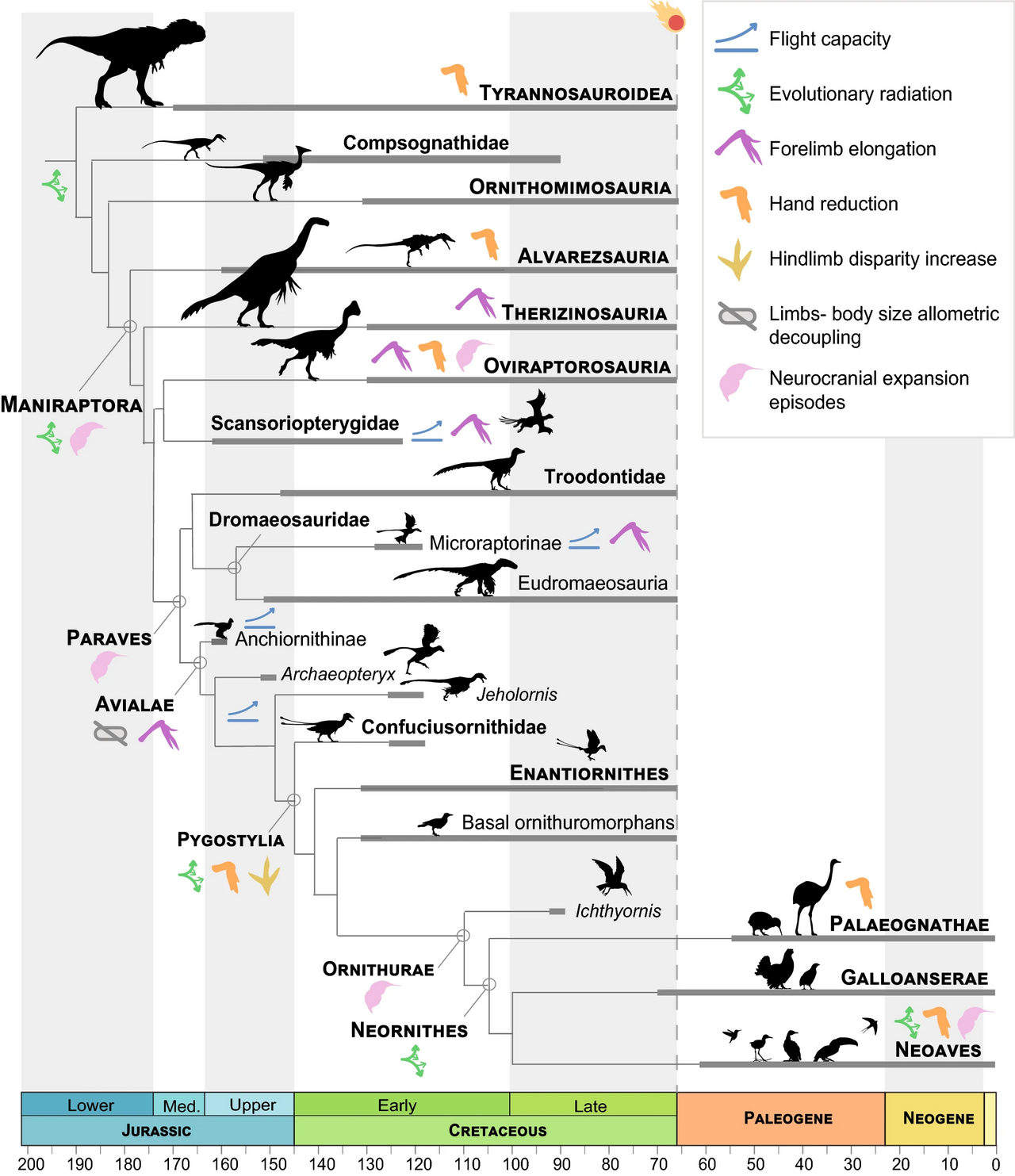
Mass extinction events reset the trajectory of life in ways that are not predictable from the microevolutionary dynamics operating during intervals of background extinction. The end-Cretaceous extinction 66 million years ago, caused by an asteroid impact, eliminated the non-avian dinosaurs and enabled the subsequent adaptive radiation of mammals into ecological roles previously occupied by dinosaurian lineages.11 The selectivity of mass extinctions — which traits promote survival through catastrophic events versus during normal times — introduces a macroevolutionary filter that population genetics cannot predict.4, 6
Molecular evidence
Molecular phylogenetics has transformed the study of macroevolution by providing time-calibrated trees of life that can be compared with the fossil record. Molecular clock analyses estimate divergence times between lineages based on the accumulation of neutral substitutions, calibrated against known fossil dates.14 These analyses frequently reveal that the molecular divergence of lineages predates their first appearance in the fossil record, suggesting that the origin of morphological novelty may follow the establishment of genetically distinct lineages by millions of years.10
Comparative genomics has also revealed the molecular mechanisms underlying macroevolutionary transitions. The evolution of novel body plans is associated not only with changes in protein-coding genes but also, and perhaps more importantly, with changes in cis-regulatory elements that alter the spatial and temporal expression of conserved developmental genes. Jablonka and Lamb have further argued that epigenetic inheritance systems introduce additional channels of heritable variation with potential macroevolutionary consequences.16, 17 The deep conservation of toolkit genes such as the Hox genes across animal phyla, combined with the diversity of body plans that these genes pattern, demonstrates that macroevolutionary innovation in morphology often results from regulatory rewiring rather than the invention of entirely new genes.5
Developmental constraints and evolvability
The concept of developmental constraint holds that the architecture of developmental systems biases the direction and magnitude of phenotypic variation available to natural selection, thereby influencing macroevolutionary trajectories.8 Maynard Smith and colleagues defined developmental constraints as biases on the production of variant phenotypes caused by the structure, character, composition, or dynamics of the developmental system. If certain phenotypic changes are developmentally impossible or extremely unlikely, then selection cannot produce them regardless of their potential fitness advantage, and macroevolution is channeled along paths of developmental least resistance.8
Foote demonstrated that in many clades, the disparity of morphological forms (the range of body plans present) reaches its maximum early in the clade's history, with subsequent diversification occurring within the established morphospace rather than expanding its boundaries.9 This early-burst pattern of morphological evolution, documented in trilobites, blastoids, and other groups, suggests that the developmental and ecological conditions permitting radical morphological innovation may be restricted to narrow temporal windows, after which internal constraints and ecological saturation limit the range of achievable forms.
Tempo and mode
Simpson's framework of "tempo and mode" distinguished three rates of macroevolutionary change: horotelic (standard rate), bradytelic (exceptionally slow, producing "living fossils"), and tachytelic (exceptionally rapid, associated with the invasion of new adaptive zones).1 The theory of punctuated equilibria reframed this spectrum by proposing that stasis (bradytely at the species level) is the dominant mode, with change concentrated in brief speciation events.2
Empirical studies have supported elements of both the gradualist and punctuationist perspectives. Some lineages show well-documented gradual trends, while many others exhibit long intervals of stasis punctuated by rapid shifts.9, 18 Rabosky and Adams showed that rates of morphological evolution are positively correlated with species richness in salamanders, consistent with the idea that speciation itself facilitates morphological divergence.18 The emerging consensus is that the tempo and mode of macroevolution are variable, context-dependent, and influenced by the interplay of ecological opportunity, developmental constraint, and historical contingency.
Macroevolutionary trends
Long-term directional patterns in the fossil record — such as the tendency toward increasing body size in many mammalian lineages (Cope's Rule) or the increase in maximum organismal complexity over geological time — have been interpreted as macroevolutionary trends.12 Alroy's analysis of North American fossil mammals confirmed that mean and maximum body size increased over the Cenozoic, but that this trend reflected a passive diffusion of lineages away from a small-bodied ancestral state combined with selective extinction of small-bodied species, rather than a universal within-lineage drive toward larger size.12 This distinction between driven trends (in which selection within lineages pushes change in a consistent direction) and passive trends (in which change is diffusive but bounded) is a key insight of macroevolutionary analysis.3, 15
Contingency and predictability
Gould argued that macroevolution is deeply contingent — that the history of life has been shaped by unique, unrepeatable events such as asteroid impacts, continental configurations, and chance survivorship during mass extinctions, and that replaying the tape of life would produce a radically different outcome.13 This emphasis on contingency contrasts with the view that macroevolution is largely predictable from ecological and functional principles, as suggested by the widespread convergent evolution of similar body forms in independent radiations.3
The tension between contingency and predictability remains a productive area of macroevolutionary research. The emerging picture is that macroevolution operates through the familiar mechanisms of population genetics — mutation, selection, drift, and gene flow — but that these mechanisms interact with species-level dynamics, developmental constraints, ecological opportunity, and historical accidents to produce patterns that are not straightforwardly predictable from microevolutionary theory alone.3, 4, 16
References
Evolution in four dimensions: genetic, epigenetic, behavioral, and symbolic variation in the history of life