Overview
- Gregor Mendel's experiments on pea plants in the 1860s established the foundational laws of inheritance — segregation and independent assortment — which demonstrated that hereditary factors are transmitted as discrete particulate units rather than blending fluids.
- Extensions to Mendel's original framework, including incomplete dominance, codominance, multiple alleles, epistasis, and polygenic inheritance, reveal that while his core principles remain valid, the phenotypic expression of genes is often more complex than simple dominant-recessive relationships.
- The modern evolutionary synthesis of the 1930s and 1940s united Mendelian genetics with Darwinian natural selection through the mathematical work of Fisher, Haldane, and Wright, establishing that Mendelian inheritance provides the precise particulate mechanism that natural selection requires to drive adaptive evolution in populations.
Mendelian genetics is the branch of biology concerned with the principles of heredity first described by Gregor Mendel, an Augustinian friar and naturalist who conducted systematic hybridisation experiments on garden peas (Pisum sativum) at the monastery in Brünn (now Brno, Czech Republic) during the 1850s and 1860s. His 1866 paper, Versuche über Pflanzen-Hybriden (Experiments on Plant Hybrids), established that hereditary information is transmitted as discrete, particulate units — now called genes — rather than as a blending fluid, and that these units follow predictable mathematical patterns across generations.1 Mendel's work was largely ignored for more than three decades until its independent rediscovery around 1900 by Hugo de Vries, Carl Correns, and Erich von Tschermak, an event that launched the modern science of genetics and ultimately provided the mechanistic foundation that Darwin's theory of natural selection had lacked.2, 4
Mendel's experiments
Mendel chose the garden pea as his experimental organism for several practical reasons: pea plants are easy to cultivate, have a short generation time, produce large numbers of offspring, and possess clearly distinguishable contrasting traits — such as round versus wrinkled seeds, yellow versus green seed colour, and tall versus short stems — that can be scored unambiguously. Critically, peas normally self-fertilise, which allowed Mendel to establish true-breeding (homozygous) lines, but their flowers can also be artificially cross-pollinated, enabling controlled hybridisation between lines differing in one or more traits.1, 3
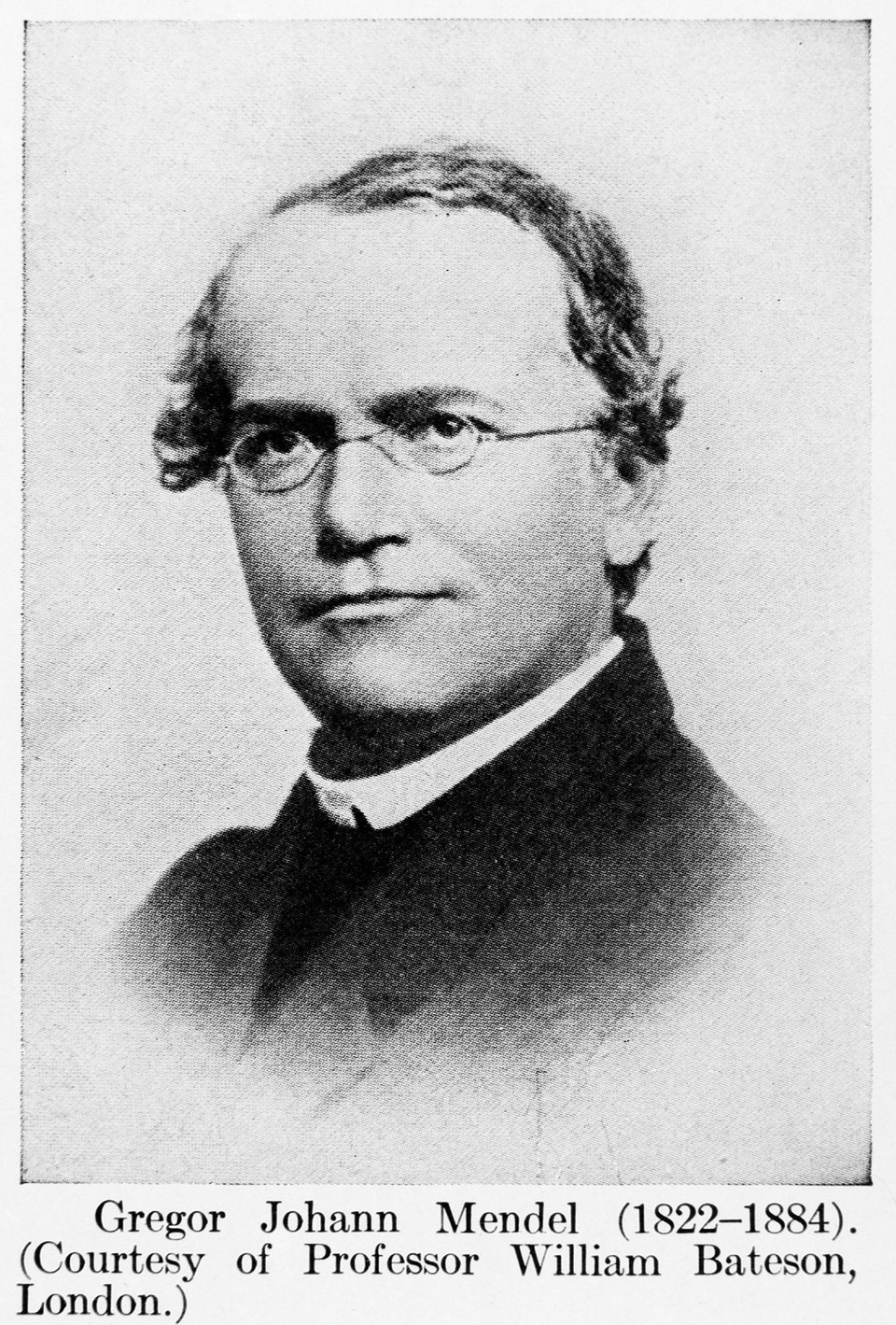

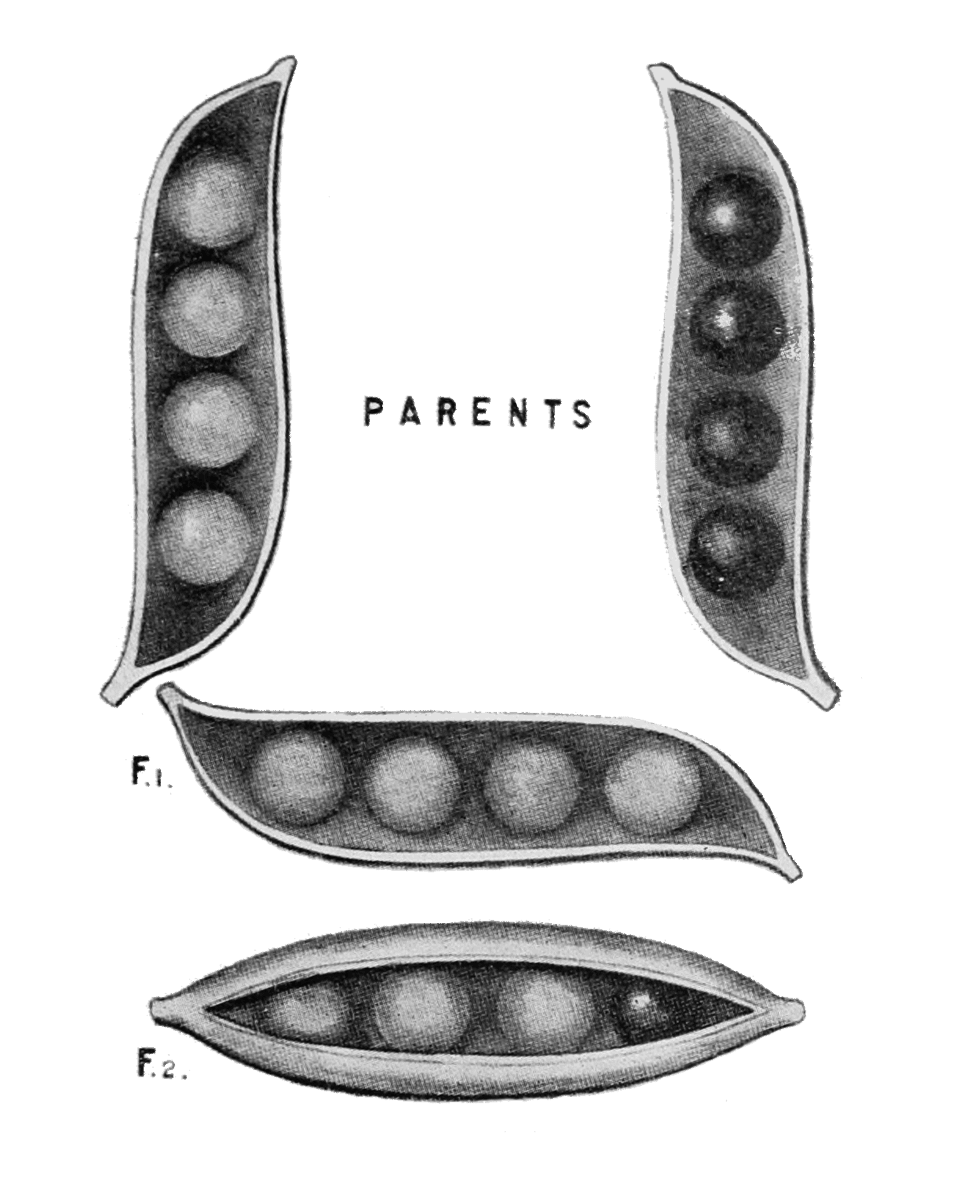
Over the course of eight years (1856 to 1863), Mendel performed thousands of crosses involving seven pairs of contrasting characters. His experimental design was remarkably rigorous for the era: he began by establishing pure-breeding parental lines (the P generation) through multiple generations of self-fertilisation, then crossed plants exhibiting contrasting forms of a single trait (monohybrid crosses) and carefully recorded the phenotypes of the resulting first filial generation (F1) and second filial generation (F2). In every monohybrid cross, the F1 plants uniformly resembled one parent — Mendel called this the "dominant" form — while the contrasting "recessive" form disappeared entirely. When the F1 plants were allowed to self-fertilise, the recessive form reappeared in the F2 generation in a ratio of approximately 3 dominant to 1 recessive.1
Mendel's insight was to count his results precisely. Across all seven traits, the F2 ratios were remarkably consistent: for seed shape, he observed 5,474 round to 1,850 wrinkled (2.96:1); for seed colour, 6,022 yellow to 2,001 green (3.01:1); for flower colour, 705 violet to 224 white (3.15:1). These ratios, all approximating 3:1, were not coincidental but reflected an underlying mathematical regularity that Mendel interpreted as evidence for the particulate nature of hereditary factors.1 Mendel further demonstrated that when he allowed F2 plants to self-fertilise, one-third of the dominant-phenotype F2 plants bred true while two-thirds produced both dominant and recessive offspring, revealing the underlying 1:2:1 genotypic ratio (one true-breeding dominant, two heterozygous, one true-breeding recessive).1, 13
The law of segregation
Mendel's first law, the law of segregation, states that each organism carries two copies of each hereditary factor (one inherited from each parent), and that these two copies separate — or segregate — during the formation of reproductive cells so that each gamete carries only one copy. At fertilisation, two gametes fuse to restore the pair. In modern terminology, diploid organisms possess two alleles at each genetic locus on homologous chromosomes, and these alleles are separated into different gametes during meiosis.1, 13
The law of segregation explains the 3:1 phenotypic ratio Mendel observed in F2 generations. If a heterozygous individual (carrying one dominant allele A and one recessive allele a) produces gametes, half will carry A and half will carry a. When two such heterozygotes are crossed, the resulting offspring follow the genotypic ratio 1 AA : 2 Aa : 1 aa. Because the dominant allele masks the recessive allele in heterozygotes, the phenotypic ratio is 3 dominant : 1 recessive.1 The physical basis for segregation was not understood until the early twentieth century, when Theodor Boveri and Walter Sutton independently proposed the chromosome theory of inheritance, recognising that the behaviour of chromosomes during meiosis — pairing and subsequent separation of homologous chromosomes — precisely mirrors Mendel's postulated behaviour of hereditary factors.6
The law of independent assortment
Mendel's second law, the law of independent assortment, states that the alleles of different genes are transmitted independently of one another during gamete formation, provided those genes reside on different chromosomes. Mendel derived this principle from dihybrid crosses — crosses tracking two traits simultaneously. When he crossed plants that were true-breeding for round yellow seeds with plants true-breeding for wrinkled green seeds, the F1 generation was uniformly round and yellow. The F2 generation, however, produced four phenotypic classes in a ratio approximating 9:3:3:1 — nine round yellow, three round green, three wrinkled yellow, and one wrinkled green — indicating that seed shape and seed colour were inherited independently of each other.1
The 9:3:3:1 ratio is the product of two independent 3:1 ratios (3:1 for seed shape multiplied by 3:1 for seed colour), a mathematical relationship that only holds if the two traits assort independently during gamete formation. Independent assortment reflects the random orientation of homologous chromosome pairs on the metaphase plate during meiosis I: the orientation of one pair has no influence on the orientation of any other pair, so the alleles they carry are distributed to gametes in all possible combinations with equal probability.6, 13
Independent assortment has an important caveat: it applies strictly only to genes located on different chromosomes. Genes on the same chromosome tend to be inherited together, a phenomenon called genetic linkage, first demonstrated by Thomas Hunt Morgan's laboratory through experiments on Drosophila melanogaster. Morgan showed that linked genes could be separated by crossing over during meiosis, and that the frequency of recombination between two linked loci is proportional to the physical distance between them on the chromosome — a relationship his student Alfred Sturtevant used to construct the first genetic map in 1913.7
Dominance, recessiveness, and the Punnett square
Mendel observed that in every monohybrid cross, one parental trait appeared in all F1 offspring while the other vanished, only to reappear in the F2. He called the visible trait dominant and the hidden trait recessive. In molecular terms, dominance typically arises because one functional copy of a gene produces sufficient protein to generate the wild-type phenotype, making the loss-of-function (recessive) allele phenotypically invisible in heterozygotes. This is known as haplosufficiency.17 Not all dominance relationships are this simple, however, and the molecular basis of dominance varies: some dominant alleles produce a gain-of-function protein, others act as dominant negatives that interfere with the normal allele's product, and in some cases the heterozygote produces an intermediate phenotype, indicating incomplete dominance.17
The Punnett square, devised by the British geneticist Reginald Punnett in the early 1900s, is a simple combinatorial diagram that predicts the genotypic and phenotypic ratios of offspring from a genetic cross. For a monohybrid cross between two heterozygotes (Aa × Aa), the Punnett square arranges the possible gametes from each parent along the top and side of a grid, generating four equally probable offspring genotypes: AA, Aa, aA, and aa. Because Aa and aA are genetically equivalent, the genotypic ratio is 1:2:1 and the phenotypic ratio (assuming complete dominance) is 3:1, precisely as Mendel observed.5, 13 For dihybrid crosses, a 4 × 4 Punnett square yields 16 possible combinations, producing the characteristic 9:3:3:1 ratio when both genes exhibit complete dominance and assort independently.13
Expected Mendelian ratios in F2 offspring from common cross types1, 13
| Cross type | Parental genotypes | Genotypic ratio | Phenotypic ratio |
|---|---|---|---|
| Monohybrid | Aa × Aa | 1 AA : 2 Aa : 1 aa | 3 dominant : 1 recessive |
| Testcross | Aa × aa | 1 Aa : 1 aa | 1 dominant : 1 recessive |
| Dihybrid | AaBb × AaBb | 9:3:3:1 (four classes) | 9:3:3:1 |
| Incomplete dominance | CRCW × CRCW | 1:2:1 | 1 red : 2 pink : 1 white |
| Codominance | IAIB × IAIB | 1:2:1 | 1 type A : 2 type AB : 1 type B |
Extensions to Mendelian genetics
Although Mendel's laws remain foundational, the seven traits he selected in peas happen to display unusually clean dominant-recessive relationships. Much of the heredity observed in nature involves more complex patterns that extend — but do not contradict — his basic framework.13, 20

Incomplete dominance occurs when the heterozygote displays a phenotype intermediate between the two homozygotes. The classic example is flower colour in snapdragons (Antirrhinum majus): crossing a red-flowered homozygote with a white-flowered homozygote produces F1 plants with pink flowers, and the F2 generation segregates in a 1 red : 2 pink : 1 white ratio, directly revealing the underlying 1:2:1 genotypic ratio because the heterozygote is phenotypically distinguishable.13 Codominance arises when both alleles at a locus are fully expressed in the heterozygote rather than blending. The ABO blood group system in humans provides a well-known example: individuals heterozygous for the IA and IB alleles express both the A and B surface antigens on their red blood cells, producing blood type AB.13
Multiple alleles extend the Mendelian framework beyond two alternatives at a single locus. The ABO system again serves as an illustration: three alleles (IA, IB, and i) segregate in the population, producing six possible genotypes and four blood-type phenotypes. Although any individual diploid organism still carries only two alleles (consistent with Mendel's law of segregation), the population as a whole can harbour many allelic variants at a given locus.13
Epistasis occurs when the expression of one gene is modified or masked by a second gene at a different locus. In Labrador retrievers, for instance, the gene controlling pigment deposition (E locus) is epistatic to the gene determining pigment colour (B locus): dogs homozygous for the recessive ee genotype are yellow regardless of their genotype at the B locus, because the E locus prevents pigment deposition in the coat altogether. Epistatic interactions can produce modified dihybrid ratios such as 9:3:4, 9:7, 12:3:1, and 13:3, each reflecting a different pattern of gene interaction.14 Epistasis is pervasive in complex organisms and has profound implications for understanding the genotype-to-phenotype map, the evolution of gene regulatory networks, and the architecture of complex traits.14
Polygenic inheritance and quantitative traits
Many biologically important traits — height, skin colour, blood pressure, and grain yield in crops — do not segregate into discrete Mendelian classes but instead display continuous variation across a population. These quantitative traits are typically controlled by many genes (polygenic inheritance), each contributing a small additive effect to the phenotype, and are further modified by environmental influences.19
The theoretical reconciliation of continuous variation with Mendelian genetics was achieved in 1918 by Ronald Fisher in a landmark paper, "The Correlation between Relatives on the Supposition of Mendelian Inheritance." Fisher demonstrated mathematically that if a quantitative trait is determined by many independently segregating Mendelian loci, each with a small effect, the resulting phenotypic distribution in a population will be approximately normal (bell-shaped), even though each individual locus obeys Mendel's laws exactly. The continuous variation observed in populations is thus not evidence against particulate inheritance but rather its natural consequence when many loci are involved.8
Human skin colour provides a well-studied example of polygenic inheritance. Research has identified several major loci — including SLC24A5, SLC45A2, KITLG, TYRP1, and MC1R — that contribute to variation in melanin production and distribution, with each locus having a moderate individual effect and the combined action of all loci producing the continuous spectrum of pigmentation observed across human populations.21 Genome-wide association studies (GWAS) have extended this approach to hundreds of complex traits, identifying thousands of genetic variants each contributing a tiny fraction of the total heritable variation and confirming that the polygenic model of quantitative genetics applies broadly across organisms.15 The challenge of accounting for all heritable variation in complex traits — the so-called "missing heritability" problem — remains an active area of research, with contributions from rare variants, gene-gene interactions, and gene-environment interactions all playing a role.16
Approximate individual contributions of major loci to human skin pigmentation variation21
Rediscovery and the chromosome theory
Mendel presented his results to the Natural History Society of Brünn in 1865 and published them in the society's proceedings the following year. The paper attracted almost no attention. Mendel corresponded with the eminent botanist Carl von Nägeli, who was sceptical of the work, and Mendel's findings remained effectively unknown to the broader scientific community for thirty-four years.2 In 1900, three botanists — Hugo de Vries in the Netherlands, Carl Correns in Germany, and Erich von Tschermak in Austria — independently reported results consistent with Mendel's laws and acknowledged his priority, inaugurating the era of Mendelian genetics.4
William Bateson became one of the earliest and most vigorous champions of Mendelism in the English-speaking world, coining the term "genetics" in 1905 and vigorously promoting experimental hybridisation studies.5 The physical basis of Mendelian inheritance was established through the chromosome theory of inheritance, formulated by Boveri and Sutton in 1902 to 1903, which proposed that Mendel's factors are carried on chromosomes. Definitive experimental proof came from Thomas Hunt Morgan's work on Drosophila beginning in 1910, when he demonstrated that the gene for white eye colour is located on the X chromosome, producing sex-linked inheritance patterns that could only be explained if genes reside on specific chromosomes.7 Morgan and his students went on to establish the principles of genetic linkage and crossing over, showing that genes are arranged linearly on chromosomes and that recombination during meiosis generates new allelic combinations — extending Mendelian genetics into the physical domain of the cell.6, 7
Mendelian genetics and the modern synthesis
In the early twentieth century, a sharp debate divided biologists into two camps: the biometricians, who followed Francis Galton and Karl Pearson in studying continuous variation through statistical methods and supported Darwinian gradualism, and the Mendelians, led by Bateson and de Vries, who emphasised discrete hereditary factors and believed evolution proceeded by large mutational jumps rather than gradual selection on small differences. This dispute was one of the great intellectual conflicts in the history of biology, and its resolution transformed evolutionary theory.3, 8
The reconciliation began with the mathematical work of three population geneticists — Ronald Fisher, J. B. S. Haldane, and Sewall Wright — in the 1920s and 1930s. Fisher's The Genetical Theory of Natural Selection (1930) demonstrated rigorously that Mendelian inheritance, far from being incompatible with gradual Darwinian evolution, was its ideal mechanism: particulate inheritance preserves genetic variation in populations (unlike blending inheritance, which halves variation each generation), and natural selection acting on many Mendelian loci of small effect can produce continuous, cumulative adaptive change.8 Wright developed the concept of adaptive landscapes and emphasised the role of genetic drift in small populations as a complement to natural selection, while Haldane calculated the rates at which natural selection could change allele frequencies in populations, showing that even modest selective advantages could drive evolutionary change within biologically reasonable timeframes.9, 10
The mathematical framework of population genetics was integrated with field biology, systematics, and palaeontology in the modern evolutionary synthesis of the late 1930s and 1940s, principally through the work of Theodosius Dobzhansky, Ernst Mayr, Julian Huxley, George Gaylord Simpson, and G. Ledyard Stebbins. Dobzhansky's Genetics and the Origin of Species (1937) was especially influential in bridging laboratory genetics and field naturalism, demonstrating that the genetic variation present in natural populations is consistent with the Mendelian model and provides the raw material on which natural selection acts.11 Huxley's Evolution: The Modern Synthesis (1942) gave the movement its name and synthesised evidence from genetics, ecology, palaeontology, and systematics into a unified evolutionary framework built on the foundation of Mendelian genetics and Darwinian selection.12
The Hardy-Weinberg principle, formulated independently by G. H. Hardy and Wilhelm Weinberg in 1908, provides the null model against which evolutionary change is measured. It states that in an idealised, infinitely large population with random mating, no mutation, no migration, and no natural selection, allele frequencies remain constant from generation to generation and genotype frequencies conform to the simple algebraic relationship p2 + 2pq + q2 = 1. Any departure from Hardy-Weinberg equilibrium indicates that one or more evolutionary forces — selection, drift, mutation, migration, or non-random mating — is acting on the population, making the principle a foundational tool for detecting and quantifying evolutionary change at the genetic level.18
Enduring significance
More than 150 years after Mendel's publication, his laws of segregation and independent assortment remain accurate descriptions of how alleles at individual loci are transmitted from parents to offspring. The particulate nature of inheritance that Mendel inferred from counting peas has been confirmed at every level of biological organisation, from the physical behaviour of chromosomes during meiosis to the molecular structure of DNA and the digital logic of the genetic code.6, 13 The exceptions and extensions to Mendelian genetics — incomplete dominance, epistasis, polygenic inheritance, linkage, genomic imprinting, and non-Mendelian patterns such as mitochondrial inheritance — are refinements that enrich the framework rather than undermine it. As Fairbanks noted on the bicentennial of Mendel's birth, the most productive way to understand genetics has been to learn Mendel's laws first and then to examine the biological mechanisms that generate departures from them.20
The union of Mendelian genetics with Darwinian natural selection through population genetics remains the theoretical core of evolutionary biology. Mendel demonstrated that hereditary variation is maintained in discrete, faithful units; Darwin demonstrated that differential survival and reproduction can shape organisms over time; and the architects of the modern synthesis showed that these two insights are not merely compatible but mutually reinforcing — that particulate Mendelian inheritance is precisely the mechanism of heredity that makes cumulative natural selection possible.8, 11, 12
References
The Mendelian revolution: the emergence of hereditarian concepts in modern science and society
Epistasis — the essential role of gene interactions in the structure and evolution of genetic systems
Mendel's laws of heredity on his 200th birthday: what have we learned by considering exceptions?