Overview
- If evolution is true, phylogenetic trees built independently from morphology, molecular sequences, biogeography, and the fossil record should agree with one another—and they do, converging on the same branching history of life from entirely different types of evidence.
- Evolutionary theory has generated specific, falsifiable predictions that were subsequently confirmed: Tiktaalik was found in precisely the Devonian rock strata where it was predicted to exist; human chromosome 2 was predicted to bear fusion signatures before the genome was sequenced; shared endogenous retroviruses were predicted to map onto the same phylogenetic tree as morphology.
- This predictive power—the consilience of independent inductions converging on the same tree—is what distinguishes evolutionary theory from creationism, which generates no testable predictions and can accommodate any observation after the fact.
A scientific theory is not merely an explanation of events already observed. Its deeper power lies in the predictions it generates about data not yet gathered. When Charles Darwin proposed descent with modification from common ancestors, the theory immediately implied a testable constraint on nature: independent lines of evidence, examined by different methods, should converge on the same account of life's history. The fossil record, the geographic distribution of species, the architecture of embryos, and—though Darwin could not have known it—the sequences of DNA molecules should all tell the same branching story. That they do is one of the most compelling demonstrations in all of science that evolutionary theory describes something real.13, 14
The philosopher William Whewell called this convergence the consilience of inductions: when multiple independent lines of inquiry, each vulnerable to different sources of error, nevertheless arrive at the same conclusion, that conclusion acquires a strength no single line of evidence could provide alone.1, 12 In evolutionary biology, the consilience is not merely qualitative but quantitative and topological. The branching tree of life inferred from vertebrate bone structure is the same tree inferred from mitochondrial DNA sequences, which is the same tree inferred from endogenous retroviral insertion sites, which is the same tree inferred from biogeographic distributions. Different data, different instruments, different scientists, different centuries—same tree. This is what predictive success looks like in historical science.
The logic of phylogenetic prediction
The core logical structure is straightforward. If all living species descended from a series of ancestral populations through branching events, then the record of those branchings should be recoverable from any heritable feature that changes over time. Morphological characters change; DNA sequences change; the positions of transposable elements in genomes change. Each of these changing features records, imperfectly but consistently, the history of branching. Because the features change independently of one another—a retroviral insertion is not caused by a change in bone morphology; neither is caused by geographic separation—they constitute independent tests of the same underlying historical claim.7, 12
The prediction is precise: not merely that molecular and morphological trees should be vaguely similar, but that they should agree in their detailed topology, in the specific branching order of taxa. If molecular trees consistently contradicted morphological trees, or if biogeographic patterns failed to match the phylogeny derived from DNA, the theory of common descent would be in serious trouble. Instead, across thousands of studies conducted since the molecular biology revolution of the 1960s, the agreement is robust and pervasive.7, 11 The exceptions—cases of convergent evolution, horizontal gene transfer, or ancient hybridization—are real and scientifically interesting, but they are explicable within the evolutionary framework and represent a small fraction of the total signal.7
When morphology meets molecules
Before the age of molecular phylogenetics, biologists classified organisms almost entirely on the basis of anatomy and morphology. The resulting classifications, refined over two centuries, produced a nested hierarchy of groups within groups: species within genera, genera within families, families within orders, and so on up to the kingdoms of life. When molecular sequencing became feasible in the 1960s and 1970s, these molecular data could be used to construct entirely independent trees—and the question of whether they would agree with the morphological trees was a genuine empirical test of common descent.7, 11
The answer, across the full sweep of life from bacteria to mammals, is that they do agree. The molecular phylogeny of vertebrates places birds within reptiles, exactly as predicted by the evolutionary interpretation of skeletal homologies. The molecular phylogeny of primates confirms that humans, chimpanzees, and gorillas form a clade to the exclusion of orangutans and gibbons, matching the morphological tree.8 The molecular phylogeny of whales places them within the artiodactyls (the even-toed ungulates), closer to hippos than to any other living group—a result predicted by some paleontologists on anatomical grounds and confirmed by both nuclear and mitochondrial DNA independently.13 The molecular phylogeny of flowering plants resolves relationships that had puzzled morphologists for generations, revealing that the traditional class Dicotyledoneae is not a natural group, a finding subsequently confirmed by additional morphological reanalysis.11
Crucially, when conflicts do arise between morphological and molecular trees, they are typically resolved in ways that make evolutionary sense. Convergent evolution—the independent evolution of similar structures in distantly related lineages—is well documented and well understood mechanistically; when morphological similarity turns out to reflect convergence rather than common ancestry, the molecular tree provides the correct genealogy, and the morphological similarity becomes a case study in natural selection producing similar solutions to similar problems.13 The framework explains the exceptions rather than being refuted by them.
The Tiktaalik prediction
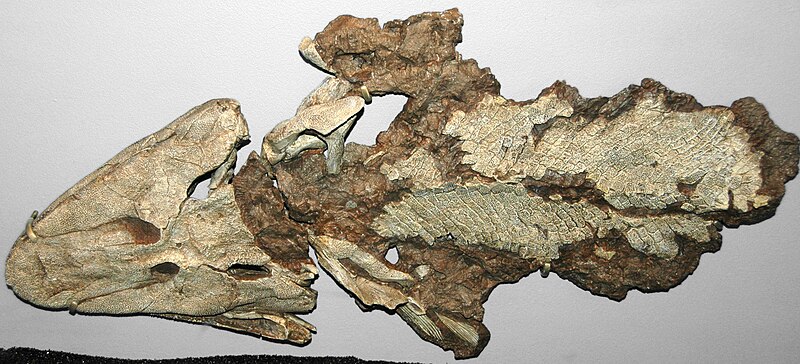
Among the most celebrated examples of evolutionary prediction in the fossil record is the search for—and discovery of—Tiktaalik roseae. By the early 2000s, paleontologists had assembled a reasonably complete picture of the transition from lobe-finned fishes to the first limbed vertebrates. Fossil evidence from the Late Devonian already included fish-like forms with robust pectoral fins and tetrapod-like forms with recognizable limbs, but a key intermediate was missing: a creature that combined fish-like gills and scales with the tetrapod-like wrist anatomy that would enable weight-bearing on a substrate.4
_(Fram_Formation,_Upper_Devonian;_Ellesmere_Island,_Arctic_Canada)_1_(49755118288).jpg)
Phylogenetic analysis of the known taxa indicated that this intermediate should have existed approximately 375 to 385 million years ago, in the Late Devonian. Evolutionary theory further predicted that it would be found in shallow freshwater or near-shore marine deposits from that period, because the transition to land was inferred to have occurred in such environments. Neil Shubin, Edward Daeschler, and Farish Jenkins Jr. identified Late Devonian freshwater deposits on Ellesmere Island in the Canadian Arctic as a promising target and spent several field seasons searching there specifically because those rocks were the right age and the right depositional environment.2, 3, 4
In 2004, they found Tiktaalik. The specimen, described in two papers in Nature in 2006, possessed exactly the mosaic of fish and tetrapod features predicted: scales, gills, and fins alongside a mobile neck (absent in fish), a flattened head, and a pectoral fin with an internal skeletal structure—humerus, radius, and ulna—that constitutes a functional wrist and elbow capable of supporting the animal's weight.2, 3 The rocks in which it was found dated to approximately 375 to 380 million years ago. The prediction specified the age, the environment, and the anatomy. The find confirmed all three. As Neil Shubin wrote, the discovery was not luck but the result of reading geological maps as evolutionary predictions—a direct application of the theory to tell prospectors where in the world to look.4
Molecular predictions confirmed
The molecular era has produced its own set of confirmed predictions, each derived directly from the logic of common descent. Three stand out for their clarity and precision.
The first concerns the human chromosome count. Chimpanzees, gorillas, and orangutans each have 48 chromosomes (24 pairs); humans have only 46 (23 pairs). If humans and the other great apes share a common ancestor, evolutionary theory predicts that this discrepancy must be explained by a chromosomal fusion event somewhere in the human lineage—two ancestral ape chromosomes joining end to end to produce a single human chromosome. Moreover, if such a fusion occurred, the resulting chromosome should carry specific molecular signatures: telomeric DNA (normally found only at chromosome ends) buried in the interior of the chromosome at the fusion point, and a vestigial centromere from one of the two fused ancestral chromosomes. In 1991, IJdo and colleagues sequenced the predicted fusion region of human chromosome 2 and found exactly these signatures: an internal array of telomeric repeat sequences arranged head to head at band 2q13, and a remnant centromeric alpha-satellite DNA from the second ancestral chromosome at band 2q21—the entire structure corresponding precisely to chimpanzee chromosomes 2A and 2B joined end to end.5
The second prediction concerns endogenous retroviruses. When a retrovirus integrates into a host germline cell, the integration site is essentially random with respect to the roughly three billion base pairs of a mammalian genome. If two species share a common ancestor, they should share ERV insertions at identical chromosomal positions—inherited from the ancestral population in which the integration first occurred. And the distribution of these shared insertions should mirror the phylogenetic tree: species that share a more recent common ancestor should share more ERV loci than more distantly related species. In 1999, Johnson and Coffin demonstrated that phylogenetic trees constructed from ERV sequence data accurately recapitulate the known primate phylogeny, independently of any morphological data.6 Subsequent genome-wide analyses have confirmed that humans and chimpanzees share thousands of ERV insertions at orthologous loci, while ERVs unique to one species trace to integrations after the lineages diverged.9
The third prediction is the most general: DNA similarity should correlate precisely with morphological similarity and with divergence times estimated from the fossil record. If evolution is true, species that diverged more recently should share more DNA sequence identity than species that diverged earlier; and that molecular divergence should be concordant with the stratigraphic and anatomical evidence for when the lineages separated. This prediction has been tested thousands of times across all domains of life. The molecular clock, calibrated by fossils, consistently places the human-chimpanzee split at approximately five to seven million years ago, consistent with the oldest known fossil hominins in the Late Miocene. The molecular divergence of birds and crocodilians matches the Triassic split inferred from the fossil record. The molecular phylogeny of mammals resolves into an ordinal radiation consistent with the fossil record of the early Cenozoic.7, 8
The consilience of inductions
The philosopher William Whewell introduced the phrase "consilience of inductions" in his 1840 Philosophy of the Inductive Sciences to describe the epistemic situation in which multiple independent lines of inductive reasoning converge on the same general conclusion. For Whewell, such convergence provided the strongest possible warrant for a scientific theory, because different types of evidence are vulnerable to different types of error: what skews a morphological analysis is unlikely to skew a molecular one, and what confounds a molecular study is unlikely to confound a biogeographic one. When all lines agree, the probability that they are all wrong in exactly the same way approaches zero.1, 12
Evolutionary biology provides one of the clearest examples of Whewellian consilience in science. The phylogenetic tree of life has been reconstructed independently from comparative anatomy, embryology, the fossil record, biogeographic distributions, nuclear DNA sequences, mitochondrial DNA sequences, ribosomal RNA sequences, transposable element insertion sites, endogenous retroviral loci, and protein structure comparisons. These are not merely different measurements of the same thing; they are fundamentally different types of data, collected by different techniques, subject to different systematic biases, processed by different analytical methods. Yet they converge, with remarkable consistency, on the same branching tree.7, 11, 13
The convergence is not perfect. Different genes sometimes produce different trees for the same set of species—a phenomenon called gene tree discordance, arising from incomplete lineage sorting, ancient hybridization, or horizontal gene transfer. These discordances are real and actively studied in molecular phylogenetics. But they occur against a background of overwhelming agreement, and they are themselves explicable within the evolutionary framework. The few cases where the tree is genuinely uncertain do not undermine the vast majority of cases where it is robustly resolved. A theory whose predictions are correct ninety-five percent of the time, and whose exceptions are explained by the same framework, is a very well-confirmed theory.7
Haldane and falsifiability
J.B.S. Haldane, the British geneticist and evolutionary theorist, is widely reported to have said that a single confirmed observation could destroy his confidence in evolution: a fossil rabbit in Precambrian rocks. The remark captures something important about the logical structure of evolutionary theory. The theory predicts that complex multicellular animals cannot appear before the evolution of the cellular and developmental machinery needed to produce them; it predicts that the fossil record should show organisms appearing in a sequence consistent with the inferred phylogeny, with earlier-branching lineages appearing in older rocks. A rabbit—a placental mammal requiring hundreds of millions of years of evolutionary history of its ancestors—in rocks more than 500 million years old, predating not just mammals but virtually all animals, would falsify the theory outright.13
No Precambrian rabbit has been found. More broadly, in over 150 years of systematic fossil collection from every continent and every geological epoch, no organism has ever been found in rocks dramatically older than the phylogenetic position of its lineage would predict. Fish appear before amphibians, which appear before reptiles, which appear before mammals and birds. Flowering plants appear after seed plants. The sequence is not random; it is exactly the sequence evolutionary theory requires. This is not a trivial constraint: the geological column was largely worked out before Darwin, and the observed stratigraphic sequence of fossils could have contradicted common descent. It does not.10, 13, 14
The Haldane criterion illustrates that evolutionary theory is falsifiable in precisely the way good scientific theories should be. It makes specific predictions about the future findings of paleontology, genomics, and comparative biology—predictions that could in principle be refuted—and those predictions have been confirmed repeatedly. The theory has survived every novel test the advance of biological science has placed before it, from the discovery of DNA to the sequencing of ancient genomes from extinct hominins.12, 14
Contrast with creationism
The predictive power of evolutionary theory stands in stark contrast to the explanatory approach of creationism and its variant, intelligent design. These positions claim that the diversity of life results from the direct creative action of an intelligent designer rather than from descent with modification. This claim generates no testable predictions about what biologists should expect to find when they examine genomes, embryos, fossils, or biogeographic distributions.
A creationist account cannot predict, in advance, that phylogenetic trees built from ERV insertion sites should match trees built from bone morphology—because on a creationist account, both trees should reflect the designer's choices, which are not constrained by any physical law. It cannot predict that human chromosome 2 should carry internal telomeric sequences and a vestigial centromere—because a designer could have constructed any chromosome count desired without leaving genomic scars. It cannot predict that Tiktaalik should be found in Late Devonian rocks rather than Cambrian or Cretaceous rocks—because a designer is not bound by a temporal sequence of anatomical complexity. In each case where evolutionary theory generated a specific, confirmed prediction, creationism generated no prediction at all.13, 14
What creationism offers instead is what philosophers of science call post hoc accommodation:12 the ability to interpret any observation, after the fact, as consistent with the designer's inscrutable intentions. The fossil record shows a temporal sequence of forms? The designer chose to create in that order. ERVs at identical loci in related species? The designer used a common design. Human chromosome 2 has internal telomeric sequences? The designer built it that way. Post hoc accommodation is not confirmation; it is the absence of risk. A hypothesis that cannot be surprised by any observation is not a scientific hypothesis at all.12, 14
The philosopher of science Karl Popper argued that falsifiability—the logical possibility of being proven wrong—is the criterion that separates science from non-science. Evolutionary theory meets this criterion precisely because it makes specific, advance predictions. The consilience of independent phylogenies is not a lucky accident; it is what the theory requires, and the theory would be overturned if that consilience were not found. Creationism, by contrast, cannot be overturned by any empirical finding because it makes no empirical predictions. This is not a religious claim but a logical one: a theory that accommodates every possible observation explains nothing.12, 14
Why prediction matters
The predictive success of evolutionary theory is sometimes dismissed as irrelevant because evolution is a historical science—it reconstructs past events rather than producing testable predictions about the future in the way that physics or chemistry might. This dismissal misunderstands the nature of prediction in historical sciences. When a paleontologist specifies the age, environment, and anatomy of a fossil before the search begins, that is a genuine prediction in every epistemically relevant sense. When a molecular biologist predicts that sequencing the human genome will reveal internal telomeric sequences in chromosome 2 before the genome is sequenced, that is a genuine prediction. The predictions concern future observations, not future events, and they carry full epistemic weight.1, 4
The broader significance of phylogenetic prediction is that it demonstrates the coherence and depth of evolutionary theory. A theory that merely explained existing observations could always be accused of having been tailored to fit the data. A theory that generates novel predictions—that tells scientists where to look and what they will find before they look—cannot be so accused. The discovery of Tiktaalik as a result of deliberate search in predicted strata, the confirmation of the chromosome 2 fusion signatures before genome sequencing made them trivially observable, the match between ERV-based and morphology-based phylogenies established before either was complete: these are the signatures of a theory with genuine explanatory depth, a theory whose internal logic tracks the structure of the natural world closely enough to extend reliably beyond the data that inspired it.2, 5, 6
The consilience of inductions that Whewell identified as the hallmark of mature science is present in evolutionary biology to a degree matched by few other disciplines. When the same branching tree of life is read from the bones of extinct animals, the sequences of living genomes, the positions of ancient viral insertions, and the geographic distributions of species, that convergence is not coincidence. It is the accumulated confirmation of a theory that has been asking to be tested for a hundred and fifty years and has not yet been found wanting.1, 7, 12, 13
References
Gaining confidence in the prediction: what does the consilience of inductions mean for science?
Lineage-specific expansions of retroviral insertions within the genomes of African great apes but not humans and orangutans
The consilience of inductions: historical overview and philosophical implications for biology