Overview
- Sexual dimorphism — the systematic difference in form between males and females of the same species — is produced primarily by intrasexual selection, in which same-sex competitors evolve weapons and size, and by intersexual selection, in which one sex evolves ornaments that attract discriminating choosers.
- Bateman's principle, extended by Trivers in 1972, explains why the sex with higher parental investment is typically the choosy one: unequal investment creates asymmetric variance in reproductive success, selecting for competition in the less-investing sex and choosiness in the more-investing one.
- The human lineage shows declining sexual dimorphism over roughly four million years, from the highly dimorphic Australopithecus afarensis to comparatively modest modern human differences, a trend interpreted as a shift toward pair-bonded mating systems and greater male parental investment.
Sexual dimorphism is the systematic phenotypic difference between males and females of the same species. The term encompasses differences in body size, shape, coloration, ornamentation, weaponry, and behaviour, and it ranges from nearly imperceptible in some species to extreme in others. It is among the most pervasive patterns in the animal kingdom and has served as a central test case for evolutionary theory since Darwin first identified sexual selection as a distinct evolutionary force in his 1871 work The Descent of Man, and Selection in Relation to Sex. The origin and maintenance of dimorphic traits sit at the intersection of ecology, genetics, and life history theory, and the study of dimorphism illuminates fundamental questions about how the sexes interact, compete, and evolve.
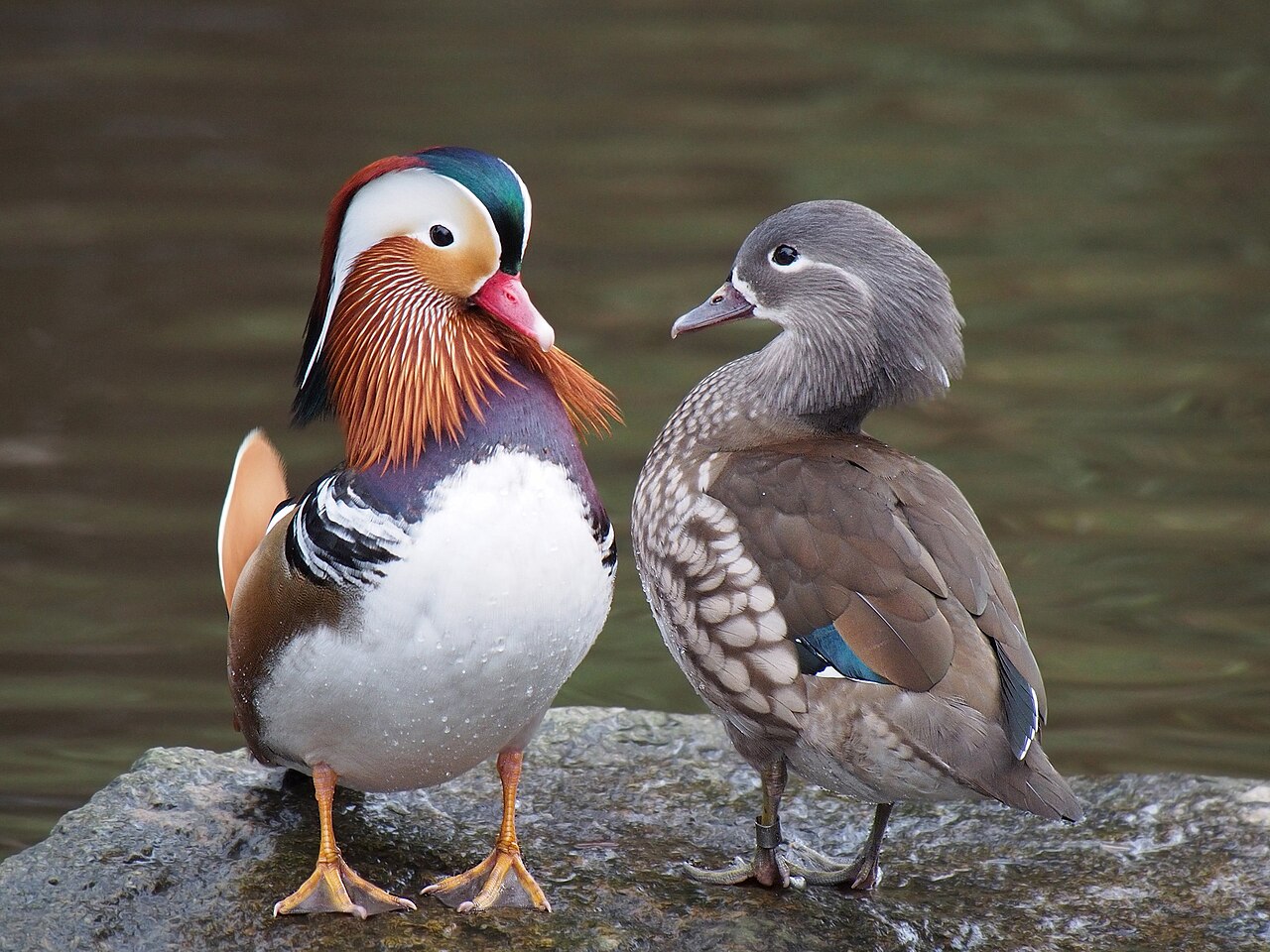

Dimorphism is not a single phenomenon but a family of related patterns with distinct causes. Size dimorphism, in which one sex is substantially larger or smaller than the other, is among the most studied variants and is widespread across mammals, birds, reptiles, and arthropods. Ornamental dimorphism, in which one sex bears elaborate structures absent or reduced in the other, is ubiquitous in birds and many invertebrates. Weapon dimorphism, in which one sex carries structures used in direct combat, appears independently in dozens of lineages. Each variant reflects a particular configuration of selective pressures, mating systems, and parental investment strategies.1, 7
Canonical examples
Among the most dramatic size dimorphisms in any mammal is that of the northern elephant seal (Mirounga angustirostris), in which adult males weigh between 1,800 and 2,300 kilograms while females weigh between 400 and 600 kilograms, giving males a mass advantage of roughly three to four times that of females.6 This disparity is a direct product of the species' mating system: breeding colonies are organized into harems controlled by dominant males, and a successful beachmaster may fertilize dozens of females in a single season. The variance in male reproductive success is enormous, and the selective premium on large body size — which predicts fighting ability and harem tenure — is correspondingly intense. Males that cannot hold a harem sire virtually no offspring, while a successful beachmaster sires many. This differential produces powerful directional selection on male size across generations.15
Antlers in cervids illustrate a different mode of dimorphism: male-only weaponry used in intrasexual combat. In red deer (Cervus elaphus) and most other members of the family Cervidae, only males bear antlers, which are grown and shed annually and reach their most elaborate development in prime adults. Antlers are used in direct clashes between rival males during the rut, and their size and branching complexity correlate with dominance rank and mating success.7 The annual cycle of antler growth and shedding represents a metabolically expensive investment that is maintained only because the reproductive benefits outweigh the energetic and predation costs — an observation central to the handicap principle discussed below. Female deer, which do not compete for mates, bear no antlers and expend the corresponding energy on gestation and lactation instead.3, 7
Birds of paradise (family Paradisaeidae), distributed across New Guinea and neighbouring islands, display some of the most extravagant sexual plumage on Earth. Males of many species bear elongated tail plumes, iridescent breast shields, or elaborate head fans that are deployed in precisely choreographed courtship dances performed at traditional display sites called leks. Females are uniformly cryptic, brown or olive, while males are often radically different in appearance, with some species exhibiting black plumage so structured that it absorbs nearly all incident light, creating a velvety darkness that enhances the contrast of brilliant colour patches.18 The dimorphism in this family is entirely ornamental rather than related to fighting, reflecting the operation of female mate choice rather than male-male competition as the primary selective force.
Among beetles, horned scarabs and rhinoceros beetles (subfamily Dynastinae) provide textbook examples of weapon dimorphism. Males of species such as Dynastes hercules, the Hercules beetle, bear horns that can exceed the length of the body itself, used to pry rival males from branches in contests over females and feeding sites. Female beetles in the same species are hornless. The weapons scale disproportionately with body size in many species: small males bear only rudimentary projections while large males carry full horns, creating a condition-dependent threshold that concentrates elaborate weaponry in the individuals most capable of winning fights.7
Mechanisms driving dimorphism
Three principal selective mechanisms generate and maintain sexual dimorphism, often acting simultaneously and reinforcing one another. The first is intrasexual selection, in which individuals of one sex — usually males — compete directly with each other for access to mates or to resources that attract mates. Intrasexual competition favours traits that improve fighting ability, resource holding potential, or competitive endurance, including large body size, physical weapons, and aggressive behaviour. Because competition among males is typically more intense than competition among females — a consequence of the asymmetric variance in reproductive success discussed below — the products of intrasexual selection are usually expressed most strongly in males.1, 7
The second mechanism is intersexual selection, the process by which one sex exercises preferences among potential mates and thereby imposes selection on the traits of the other. In species where females evaluate males before mating, male traits that stimulate female preference are favoured even when those traits impose survival costs. The result is ornamental dimorphism: elaborate plumage, bright colours, complex songs, or conspicuous display behaviours concentrated in the sex subject to choice. Intersexual selection can operate in either direction — females may be subject to male choice in species where male investment is high — but because females more commonly invest more per offspring than males, female choice acting on males is the more common configuration across animals.20
The third mechanism is ecological niche partitioning between the sexes. When males and females of the same species utilize different food resources, differ in habitat preference, or experience different predation pressures, natural selection may favour morphological or physiological differences that improve performance in each sex's distinct ecological role. This ecological dimorphism can be partially decoupled from mating competition: it emerges from ordinary natural selection acting differently on the two sexes rather than from competition for mates. In many raptors, for example, females are larger than males, a reversal of the mammalian pattern that correlates with female specialization on larger prey and males' role in aerial agility and provisioning during incubation.19
Bateman's principle and Trivers's extension
The evolutionary logic explaining why dimorphism more commonly reflects male ornamentation and armament than female was formalized in two landmark theoretical contributions. In 1948, the British geneticist A. J. Bateman published experiments with Drosophila melanogaster demonstrating that male reproductive success varied much more widely than female reproductive success, and that male fitness was limited primarily by access to females while female fitness was limited primarily by resources for producing eggs.2 Bateman interpreted this asymmetry as a consequence of the difference in investment between sperm and eggs: because sperm are small and cheaply produced while eggs are large and metabolically costly, males can potentially fertilize many females while females are constrained by their own investment in each offspring. The resulting difference in the variance of reproductive success — Bateman's gradient — is what makes male-male competition and male ornamentation the predominant pattern.
Robert Trivers extended this logic into a general theory of parental investment in 1972, proposing that the sex investing more per offspring — through gametes, gestation, lactation, incubation, or post-hatching care — should be the choosy sex, and the less-investing sex should compete for access to the high-investing sex.1 This framework, now called Bateman's principle or the Trivers parental investment model, provides a predictive account of both the direction and intensity of sexual dimorphism across species. Species in which males invest heavily in offspring — some fish that guard nests, seahorses that brood eggs in a pouch, and shorebirds with reversed sex roles — show either reduced dimorphism or dimorphism in which females are the more elaborate sex, exactly as the model predicts. Tim Clutton-Brock and later researchers have refined the framework to account for the operational sex ratio — the ratio of fertilizable females to sexually active males at any moment — which more directly predicts the intensity of competition than parental investment alone.20
Rensch's rule
A striking macroevolutionary pattern in sexual dimorphism is captured by Rensch's rule, first described by the German biologist Bernhard Rensch in the 1950s. The rule states that in lineages where males are the larger sex, the degree of size dimorphism increases with overall body size: larger species are more dimorphic than smaller species. Conversely, in lineages where females are the larger sex, dimorphism decreases with body size. The pattern holds across a wide range of vertebrate and invertebrate groups and has been confirmed in ungulates, primates, pinnipeds, and many bird families.8, 9
The most widely accepted explanation for Rensch's rule invokes the scaling relationship between body size and the benefits of fighting. In species with male-male competition, large males gain disproportionate reproductive advantages over small males because fighting ability and resource-holding potential scale nonlinearly with mass. As overall body size increases across a lineage, the selective advantage of being large relative to rivals grows, driving the evolution of increasingly extreme dimorphism. This creates a positive correlation between mean body size and dimorphism across species. Where females are the larger sex, the selective pressure producing female largeness — typically fecundity selection favouring larger females that can produce more or larger eggs — does not scale as steeply, so dimorphism either remains constant or decreases with body size.9
The handicap principle and honest signalling
A persistent theoretical puzzle in the study of sexual ornaments is why choosy individuals should prefer elaborate, costly traits in potential mates. If an elaborate tail or bright plumage imposes genuine survival costs, runaway selection should be opposed by natural selection against the costly ornament, and the preference itself should erode once the population begins to suffer reduced viability. The Israeli biologist Amotz Zahavi proposed a resolution in 1975 with the handicap principle: costly ornaments are evolutionarily stable precisely because they are costly.3 A male that can develop and maintain an elaborate ornament despite its costs demonstrates, by the very existence of the ornament, that he possesses the health, genetic quality, or resource-acquisition ability to bear that cost. The ornament is an honest signal because it cannot be faked by low-quality individuals who would pay the same cost without having the underlying quality to survive it.
Zahavi's verbal argument was initially met with scepticism, but Alan Grafen provided a formal population-genetic proof in 1990 demonstrating that handicap signalling is a stable evolutionary equilibrium when signalling costs are condition-dependent: signals are cheap for high-quality signalers and prohibitively expensive for low-quality ones.4 This mathematical vindication transformed the handicap principle into a cornerstone of signalling theory. Subsequent empirical work has supported its predictions in multiple systems. In peacocks, Petrie demonstrated that the sons of males with more elaborate trains survive better than sons of less ornamented males, suggesting that train elaboration indexes heritable genetic quality.4 In red deer, antler size correlates with male dominance and longevity, and the annual metabolic burden of growing antlers imposes real fitness costs that track body condition.
The handicap principle connects directly to the kin selection and altruism literature through the broader framework of honest signalling: whenever individuals have an interest in communicating information about themselves to others — whether to mates, rivals, or relatives — the conditions under which signals remain honest versus becoming deceptive depend on the alignment between signaller and receiver interests and the costs of signal production.3, 4
Dimorphism in primates and the human lineage
Among the primates, the degree of sexual dimorphism in body size and canine tooth length serves as a reliable proxy for mating system and social structure, and this relationship has been extensively documented in living species. Gorillas (Gorilla gorilla and G. beringei) exhibit some of the most extreme dimorphism among primates: adult male silverbacks weigh between 140 and 200 kilograms while females weigh between 70 and 100 kilograms, and male canines are substantially longer and more robust than female canines.14 Gorillas live in polygynous groups dominated by a single silverback who monopolizes reproductive access to a group of females, exactly the social configuration that intrasexual selection theory predicts should produce strong dimorphism. Male-male competition for harem control is intense, and large body size and canine weaponry are the decisive determinants of contest outcomes.
At the opposite extreme, gibbons (family Hylobatidae) are nearly monomorphic: males and females of the same species are very similar in body size and canine dimensions. Gibbons are functionally monogamous, forming pair bonds in which both parents contribute substantially to offspring care.16 The absence of intense male-male competition in this mating system removes the directional selection pressure on male body size, and dimorphism converges toward the baseline set by sex-specific ecological requirements. This contrast between gorillas and gibbons illustrates Emlen and Oring's 1977 framework: the potential for monopolization of mates or mate-attracting resources determines the opportunity for sexual selection and thereby the degree of dimorphism.15
The trajectory of sexual dimorphism in the human fossil record provides some of the most contested and theoretically rich evidence in paleoanthropology. Australopithecus afarensis, the species best known from the 3.2-million-year-old specimen AL 288-1 ("Lucy") and the Laetoli footprints, shows high levels of body size dimorphism: estimates of male and female body mass based on postcranial remains suggest males were substantially larger than females, with some analyses indicating ratios comparable to those of gorillas, though the interpretation of fragmentary material is disputed.5, 17 High canine dimorphism in australopithecines further suggests a mating system with significant male-male competition. By contrast, modern Homo sapiens exhibits relatively modest sexual dimorphism in body size: males are on average about 7–8% taller and 15–20% heavier than females, a level more consistent with mild polygyny or pair-bonded monogamy than with strict harem defence.5
The reduction in dimorphism across the hominin lineage is interpreted by many researchers as evidence of a gradual shift toward more cooperative mating systems, increased male parental investment, and a reduced role for purely physical male-male competition in determining reproductive success.12, 13 Canine dimorphism in particular declines markedly from the great apes through the australopithecines to Homo, a trend widely taken as indicating reduced reliance on canine weaponry in intraspecific competition. These inferences are necessarily probabilistic — dimorphism and mating system are correlated across living primates, but the relationship is not deterministic, and multiple mating configurations can produce similar dimorphism levels. Nevertheless, skeletal dimorphism remains one of the few behavioural proxies accessible in the fossil record, making it indispensable for reconstructing the social evolution of the human lineage.
Approximate body mass ratio (male:female) in selected primates6, 14
Sexual conflict and antagonistic coevolution
Sexual dimorphism is not always a product of harmonious co-adaptation between the sexes. Whenever the fitness interests of males and females diverge, the evolutionary dynamics of traits affecting interactions between them become adversarial — a phenomenon termed sexual conflict. Sexual conflict arises because the mating behaviour or strategy that maximizes fitness in one sex may impose costs on the other.11 A male that mates with many females maximizes his own fitness but may reduce the fitness of each female through the metabolic costs of mating, harm from seminal proteins, or reduced access to parental care. A female that resists frequent mating reduces these costs but may be subject to forced copulation or persistent harassment by males whose interests are not aligned with hers.
The evolutionary consequence of sexual conflict is antagonistic coevolution, in which adaptations in one sex that serve its own reproductive interests drive the evolution of counter-adaptations in the other.10 Arnqvist and Rowe documented this process extensively in water striders (genus Aquarius), where males have evolved clasping structures that hold females during mating while females have evolved counter-clasping morphologies that resist male control. Across species in the genus, the degree of male clasper elaboration and female resistance morphology are positively correlated, consistent with an arms race between male persistence and female resistance. Similar patterns of genital coevolution driven by sexual conflict have been documented in Drosophila, ducks, and numerous other taxa.
Sexual conflict can generate sexual dimorphism even in traits that do not directly serve as weapons or ornaments. If males and females have different optima for shared physiological pathways — immune function, longevity, body condition — sexual conflict over the gene expression of these pathways can produce sex-limited expression patterns that look superficially like conventional dimorphism but arise through a fundamentally different mechanism. The broader implication is that the visible morphological differences between sexes represent only one facet of a deeper genomic and physiological divergence driven by the partially opposed reproductive interests of males and females.10, 11
Synthesis and evolutionary significance
Sexual dimorphism is best understood not as a single trait but as the accumulated signature of the selective regime under which a lineage has evolved. The degree and direction of dimorphism encode the intensity of intrasexual competition, the discrimination of mate choice, the distribution of parental investment, the ecological pressures that act differently on each sex, and the history of sexual conflict between them. These forces interact: a change in mating system alters competition and choice simultaneously; a shift in ecological niche use may reduce the benefits of large male size while intensifying selection on other dimorphic traits; a resolution of sexual conflict in one trait may displace conflict onto another.1, 15
The comparative method — examining how dimorphism varies across species in relation to ecology, mating system, and phylogeny — has been the primary empirical tool for disentangling these factors, and it has produced a consistent picture: across animals, the degree of sexual size dimorphism and weapon elaboration tracks the intensity of male-male competition, while ornament elaboration tracks the strength of female mate choice.5, 20 Bateman's principle, Rensch's rule, and the handicap principle together constitute a theoretical framework that explains the broad macroevolutionary patterns, even as the details of any given species' dimorphism require species-specific analysis of local ecology and life history. The human lineage exemplifies how this framework can be applied to fossil evidence, allowing researchers to reconstruct the evolution of social behaviour from the silent testimony of bone and stone.5, 12