Overview
- When multiple independent radiometric dating methods are applied to the same rocks or geological events, they consistently yield concordant ages — a result that would be vanishingly improbable if the methods were unreliable or if decay rates had changed.
- Specific examples include the Acasta Gneiss (~4.03 Ga by U-Pb and Sm-Nd), the Cretaceous–Paleogene boundary (~66 Ma by U-Pb, Ar-Ar, and paleomagnetic reversal stratigraphy), the Bishop Tuff (~0.76 Ma by K-Ar, Ar-Ar, and fission track), and meteorites (~4.56 Ga by multiple isotope systems).
- Each dating method relies on different parent isotopes undergoing different modes of radioactive decay, governed by independent physics — their agreement is explicable only if the measured ages reflect real elapsed time.
One of the most powerful tests of radiometric dating is the concordance of independent dating methods. When multiple radiometric techniques — each relying on different parent isotopes that decay by different physical mechanisms at different rates — are applied to the same geological event or rock formation, they consistently yield the same age within analytical uncertainty. This concordance is inexplicable if the methods are fundamentally flawed, if decay rates have changed over time, or if the ages are artefacts of some systematic error. It follows naturally, however, if the measured ages correspond to real elapsed time since the rocks formed.12, 13
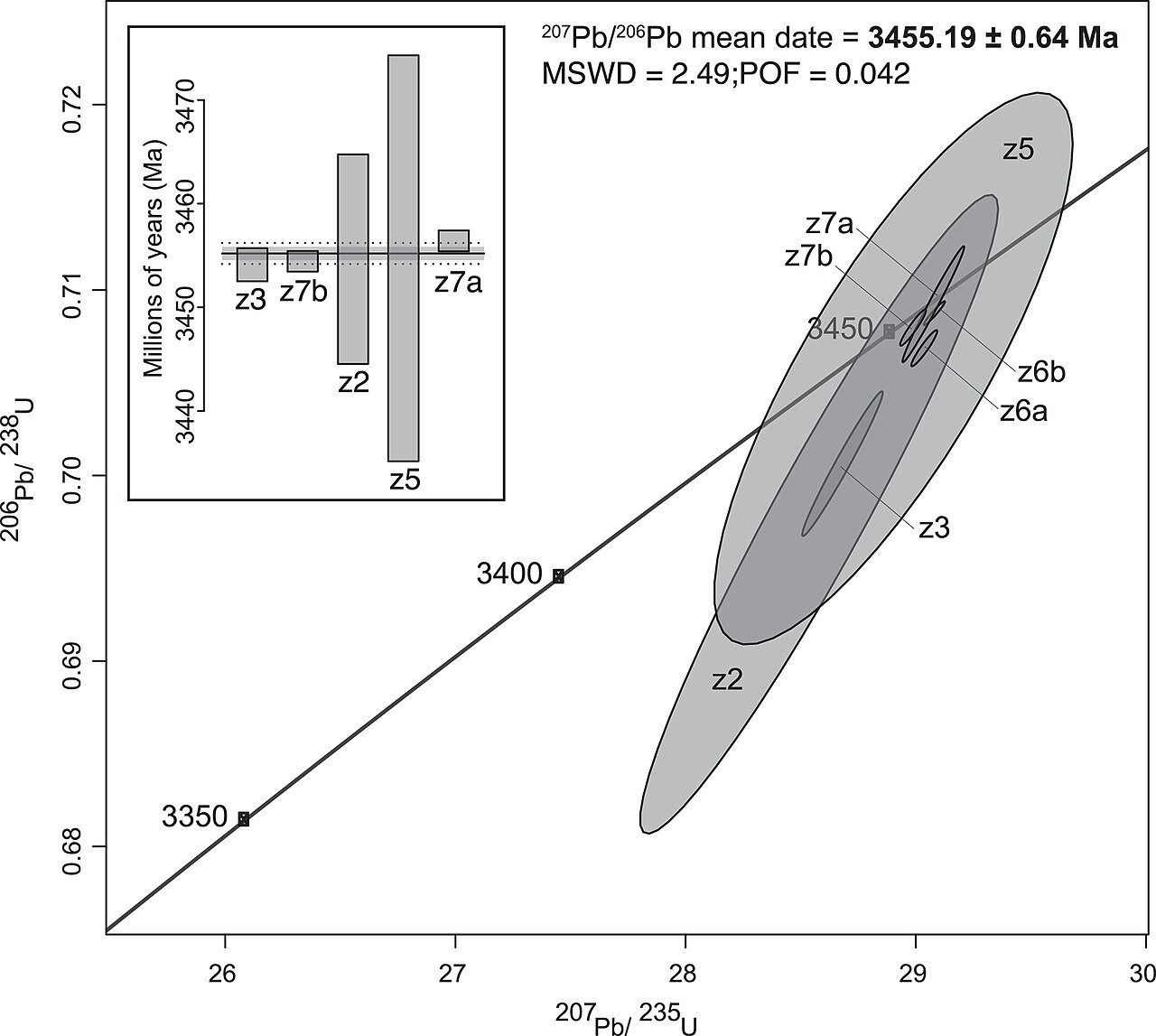

The significance of this concordance cannot be overstated. The uranium-lead system involves the alpha decay of uranium isotopes to lead. The potassium-argon and argon-argon systems involve the electron capture and beta decay of potassium-40 to argon-40. The samarium-neodymium system involves the alpha decay of samarium-147 to neodymium-143. The rubidium-strontium system involves the beta decay of rubidium-87 to strontium-87. Fission-track dating counts the damage trails left by spontaneous fission of uranium-238. These methods share no common parent isotope, no common daughter product, and no common decay mechanism. The only thing they share is the same underlying physics of radioactive decay — and, when applied to the same rocks, the same answer.12, 13
The Acasta Gneiss (~4.03 Ga)
The Acasta Gneiss, located in the Slave Province of Canada's Northwest Territories, contains some of the oldest known terrestrial rocks. Uranium-lead dating of zircon crystals extracted from the gneiss yields ages of approximately 4.03 billion years, as first reported by Bowring and Williams in 1999.1 Zircon is an exceptionally robust mineral for U-Pb geochronology because it incorporates uranium but excludes lead at the time of crystallization, providing a clean radiometric clock. The U-Pb system in zircon is further strengthened by the fact that it contains two independent decay chains — 238U to 206Pb and 235U to 207Pb — that must yield the same age if the system has remained closed.12
Independent confirmation of the Acasta Gneiss age comes from the samarium-neodymium isotope system, which relies on entirely different physics. Moorbath and colleagues applied Sm-Nd dating to the same rock unit and obtained ages concordant with the U-Pb results, supporting an age of approximately 4.0 billion years for the protolith.3 The agreement between two systems that involve different elements, different decay modes (alpha decay for both, but with different energies and half-lives), and different geochemical behaviours in the rock provides strong evidence that the measured age is real and not an artefact of any single method's assumptions.2
The Cretaceous–Paleogene boundary (~66 Ma)
The Cretaceous–Paleogene (K-Pg) boundary, formerly known as the K-T boundary, marks the mass extinction event that ended the age of the non-avian dinosaurs approximately 66 million years ago. This boundary has been dated with exceptional precision by multiple independent methods. Renne and colleagues applied both U-Pb dating and 40Ar/39Ar dating to volcanic ash layers and impact-related materials at the boundary, obtaining concordant ages of 66.043 ± 0.043 million years by 40Ar/39Ar and 66.038 ± 0.049 million years by U-Pb.4, 5
The 40Ar/39Ar method and the U-Pb method are mechanistically independent. The former measures the accumulation of argon-40 from the electron capture decay of potassium-40 (half-life 1.25 billion years), while the latter measures the accumulation of lead from the alpha decay of uranium (half-lives of 4.47 billion and 704 million years for U-238 and U-235 respectively). The fact that these two unrelated radioactive clocks agree to within tens of thousands of years on an event 66 million years in the past is a stringent test of the underlying physics.4, 14
Additional corroboration comes from magnetostratigraphy. The K-Pg boundary falls within a well-defined interval of the geomagnetic polarity timescale (Chron 29r), and the independently calibrated reversal chronology yields an age consistent with the radiometric dates. The convergence of radiometric, magnetostratigraphic, and biostratigraphic evidence on the same age for this boundary exemplifies the power of concordance as a test of geochronological reliability.14
The Bishop Tuff (~0.76 Ma)
The Bishop Tuff is a widespread volcanic ash deposit in eastern California, produced by a catastrophic eruption of the Long Valley Caldera approximately 767,000 years ago. Because it is geologically young enough to be dated by several different techniques yet old enough to produce measurable daughter isotope accumulations, the Bishop Tuff has served as a key test case for intercalibrating radiometric methods.7
Conventional potassium-argon (K-Ar) dating of sanidine feldspar phenocrysts from the Bishop Tuff yields ages of approximately 0.76 million years. High-precision 40Ar/39Ar dating, which is a more refined variant of the K-Ar method, yields concordant ages of 767.1 ± 0.9 thousand years.8 Fission-track dating of zircon crystals from the same tuff — a method that counts the radiation damage tracks left by spontaneous fission of uranium-238, an entirely different physical process from the radioactive decay measured by K-Ar and Ar-Ar — yields ages in close agreement, approximately 740–770 thousand years depending on the analyst and the track-annealing model employed.9
The concordance among K-Ar, 40Ar/39Ar, and fission-track ages for the Bishop Tuff is significant because the three methods rely on completely different physical phenomena. Potassium-argon and argon-argon dating measure the accumulation of a noble gas from electron capture decay. Fission-track dating counts physical damage from spontaneous nuclear fission. No single systematic error — whether in decay constants, in initial conditions, or in sample contamination — could cause all three methods to converge on the same incorrect age.13
Meteorites (~4.56 Ga)
The age of the solar system is established by radiometric dating of meteorites, which are fragments of asteroids and other small bodies that have remained largely unaltered since the solar system's formation. The concordance of multiple dating methods applied to meteorites is among the most impressive in all of geochronology. Lead-lead (Pb-Pb) dating of calcium-aluminium-rich inclusions (CAIs) in primitive chondritic meteorites yields ages of 4,567.30 ± 0.16 million years, as determined by Bouvier and Wadhwa.9 Amelin and colleagues obtained concordant Pb-Pb ages from multiple meteorite classes.10
These Pb-Pb ages are confirmed by the 87Rb-87Sr (rubidium-strontium) isochron method, which yields ages of approximately 4.56 billion years for the same meteorite suite. The 147Sm-143Nd system and the 176Lu-176Hf system provide further concordant results.11, 12 Additionally, extinct short-lived radionuclides such as 26Al (half-life 0.72 million years) and 182Hf (half-life 8.9 million years) provide relative chronologies among meteorites that are fully consistent with the absolute ages determined by the long-lived systems.11
The convergence of at least four independent isotopic systems on an age of 4.56 billion years for the formation of the solar system is a definitive test. Each system involves different elements with different geochemical properties, different decay modes, and different half-lives spanning orders of magnitude. The probability of all four yielding the same answer by coincidence, in the absence of a real formation event at that time, is negligibly small.9, 12
Why concordance matters
The concordance of independent dating methods is the single most powerful argument for the reliability of radiometric geochronology. Each radiometric system is, in essence, an independent physical experiment with its own set of assumptions: that the system has remained closed to gain or loss of parent and daughter isotopes, that the decay constant is known accurately, and that the initial daughter isotope abundance can be determined or corrected for. These assumptions can be individually tested and are routinely verified by the isochron method and by concordia diagrams for U-Pb dating.12, 13
The critical point is that no single systematic error can produce concordant ages across methods that rely on different physics. If uranium decay rates were wrong, potassium-argon ages would not be affected. If potassium-argon systems were prone to argon loss, uranium-lead ages would not be compromised. If some unknown process systematically altered all radiometric clocks, it would need to alter alpha decay, beta decay, electron capture, and spontaneous fission by exactly the right amounts to produce identical ages — a conspiracy of errors that strains credulity beyond any reasonable threshold.13 The observed concordance, repeated across geological events spanning the full range of Earth history from hundreds of thousands to billions of years, is the expected result of methods that are measuring real time accurately.12, 14
Concordant ages from independent dating methods1, 4, 8, 9
| Geological event | Method 1 | Method 2 | Method 3 |
|---|---|---|---|
| Acasta Gneiss | U-Pb: ~4.03 Ga | Sm-Nd: ~4.0 Ga | — |
| K-Pg boundary | U-Pb: 66.04 Ma | Ar-Ar: 66.04 Ma | Magnetostratigraphy: concordant |
| Bishop Tuff | K-Ar: ~0.76 Ma | Ar-Ar: 0.767 Ma | Fission track: ~0.74–0.77 Ma |
| Solar system (meteorites) | Pb-Pb: 4.567 Ga | Rb-Sr: ~4.56 Ga | Sm-Nd: ~4.56 Ga |
Non-radiometric confirmation
The concordance argument extends beyond radiometric methods to include entirely non-radiometric chronometers. Dendrochronology (tree-ring counting) provides an independent annual-resolution chronology extending to approximately 14,000 years before present. Varve chronology from annually laminated lake sediments, such as the Lake Suigetsu record in Japan, extends the independent annual count to approximately 52,800 years. Ice-core annual layer counting in Greenland reaches approximately 60,000 years.14 Where these non-radiometric chronologies overlap with radiometric dates, they agree within their stated uncertainties. The Lake Suigetsu varves, for example, have been calibrated against more than 800 radiocarbon measurements on terrestrial plant macrofossils, and the varve-counted ages and radiocarbon ages are concordant across the full 40,000-year overlap interval. This agreement between counting-based methods (which involve no nuclear physics whatsoever) and decay-based methods (which rely entirely on nuclear physics) provides an especially compelling form of cross-validation.12, 13
References
The age of the Bishop Tuff: new results from multiple electron microprobe zircon dating
The age of the solar system redefined by the oldest Pb-Pb age of a meteoritic inclusion