Overview
- Desert varnish is a thin (typically 5–500 micrometre), dark coating of manganese and iron oxides mixed with clay minerals that accumulates on exposed rock surfaces in arid and semi-arid environments over thousands to hundreds of thousands of years, formed through a process that concentrates manganese from atmospheric dust and precipitation far beyond its abundance in the underlying rock.
- Microlaminations within desert varnish — alternating layers enriched in manganese or iron — record shifts between wetter and drier climate conditions, providing a paleoclimate proxy that can be correlated with independently dated climate records spanning the late Quaternary.
- Because varnish develops on stable rock surfaces only after they are exposed, its presence, thickness, and chemical stratigraphy have been used as relative age indicators for geomorphic surfaces, alluvial fans, and stone artefacts in archaeological contexts — though absolute dating of the varnish itself remains methodologically challenging.
Desert varnish is a thin, dark coating of manganese and iron oxides mixed with clay minerals that develops on exposed rock surfaces in arid and semi-arid environments worldwide. First described systematically by Alexander von Humboldt in the early nineteenth century and studied extensively throughout the twentieth, the coating ranges in thickness from approximately 5 to 500 micrometres and is remarkably enriched in manganese — typically 20–30 percent manganese oxide by weight — relative to both the substrate rock and the atmospheric dust from which much of its material derives, where manganese concentrations rarely exceed 1 percent.1, 2 Despite more than a century of investigation, the precise mechanism by which manganese is concentrated by a factor of 50 to 200 above its environmental background remains a subject of active research, with competing hypotheses invoking microbial oxidation, abiotic photochemical reactions, and clay-mineral adsorption processes.3, 4, 5

Composition and formation
The chemical composition of desert varnish, first characterised in detail by Potter and Rossman in 1977, consists primarily of clay minerals (typically 60–70 percent by weight, dominantly illite and mixed-layer clays), manganese oxides (birnessite and related phyllomanganates), and iron oxides (hematite and goethite), with minor amounts of silica, alumina, and trace elements including barium, cobalt, nickel, and lead adsorbed onto the manganese oxide phases.1, 16 The clay minerals form the structural matrix of the coating, cementing manganese and iron oxide particles into a cohesive, layered film that adheres tenaciously to the rock substrate.16
The source of the material in desert varnish is primarily atmospheric dust and aerosol deposition rather than leaching from the underlying rock. This was demonstrated convincingly by studies showing that varnish of identical composition develops on substrates ranging from quartz sandstone (which contains negligible manganese) to basalt (which is manganese-rich), and that the rare earth element and trace element signatures of varnish more closely match those of regional dust sources than those of the underlying lithology.12, 2 Dust particles settle on rock surfaces and are wetted by dew, fog, or infrequent rainfall; the dissolved manganese and iron are then fixed in oxidised form on the rock surface through mechanisms that remain debated. Dorn and Oberlander proposed in 1981 that manganese-oxidising bacteria and fungi play a central role, enzymatically catalysing the oxidation of soluble Mn2+ to insoluble Mn4+ oxides.4 Subsequent work has confirmed the presence of manganese-oxidising microorganisms in varnish, though whether they are the primary agents of manganese fixation or merely inhabitants of an abiotic coating remains contested.6, 13 Laboratory experiments by Krinsley and colleagues have produced varnish-like coatings under abiotic conditions, suggesting that clay mineral surfaces may catalyse manganese oxidation independently of biological activity.5
Microlaminations and paleoclimate
When examined in cross-section by scanning electron microscopy or transmission electron microscopy, desert varnish reveals a finely laminated internal structure consisting of alternating layers enriched in manganese (appearing dark) and layers enriched in iron relative to manganese (appearing lighter, often orange-brown). Tanzhuo Liu's pioneering work in the 1990s demonstrated that these microlaminations record alternating periods of relatively wet and relatively dry climate: manganese-rich layers are deposited under more alkaline, wetter conditions that favour microbial or abiotic manganese oxidation, while iron-rich, manganese-poor layers accumulate during drier, more acidic conditions.7, 8
Liu calibrated the varnish microlamination sequence against the independently dated SPECMAP deep-sea oxygen isotope record, identifying a consistent stratigraphy of wet and dry intervals over the last approximately 300,000 years that could be correlated across multiple sites in the American Southwest, the Negev Desert, and other arid regions.8, 11 This varnish microlamination (VML) dating method assigns ages to geomorphic surfaces by matching the sequence of manganese-rich and iron-rich layers in their varnish coatings to the calibrated reference stratigraphy. While the technique has been applied to date alluvial fan surfaces, lava flows, glacial moraines, and debris-flow levees in the western United States with results that are broadly consistent with cosmogenic nuclide and luminescence ages, it requires careful sample selection and has been subject to debate over reproducibility and the subjectivity of layer correlation.9, 3
Surface age estimation
Beyond microlamination analysis, the progressive development of desert varnish on exposed rock surfaces has long been used as a qualitative to semi-quantitative relative age indicator in geomorphological and archaeological studies. In the deserts of the American Southwest, the degree of varnish development on alluvial fan surfaces provides a visual index of relative age: Holocene surfaces are lightly varnished or unvegetated, while Middle and Late Pleistocene surfaces bear thick, continuous, dark coatings.2, 15 An earlier quantitative approach, cation-ratio dating, attempted to use the progressive leaching of mobile cations (potassium and calcium) relative to immobile titanium within the varnish as a chronometric tool. However, this method was shown to suffer from serious problems of cation mobility, environmental contamination, and irreproducibility, and it has been largely abandoned as a reliable absolute dating technique.10, 3
Archaeological applications
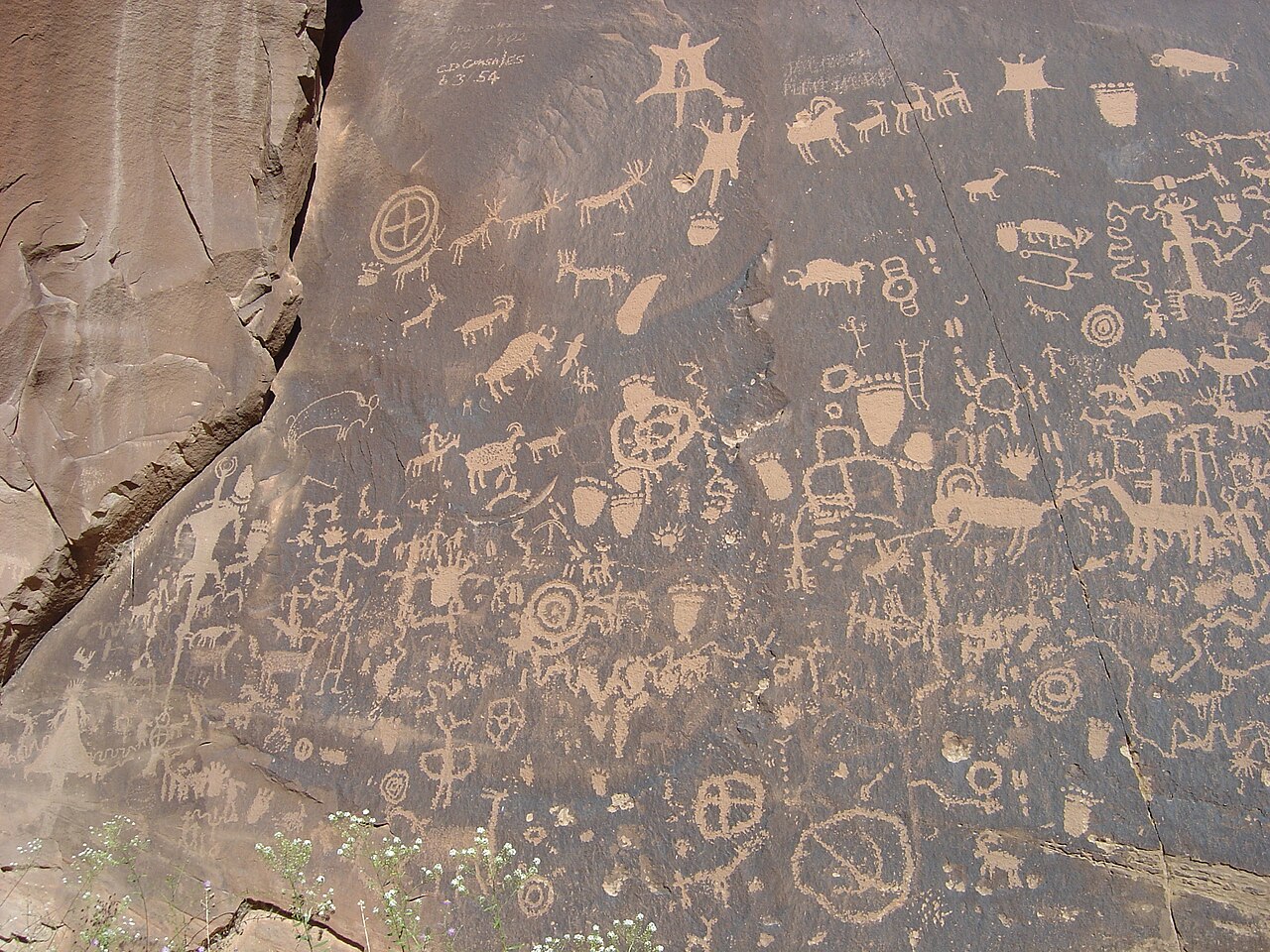
Desert varnish intersects with archaeology in two principal ways. First, petroglyphs — images pecked or incised into rock surfaces — remove the existing varnish coating, and the degree to which varnish has re-formed over the exposed grooves provides a relative age indicator for the rock art. In regions such as the Coso Range of eastern California, where petroglyph panels span thousands of years of production, differences in the thickness and microlamination sequence of re-varnished surfaces have been used to establish relative chronological sequences for the art.14, 15 Second, stone tools and lithic artefacts found on desert surfaces accumulate varnish after they are discarded, and the degree of varnishing has been used as a rough age indicator in surface archaeological surveys — though the many variables affecting varnish development rate (microenvironment, substrate lithology, aspect, and local dust flux) limit the precision of such estimates.15, 2
Desert varnish also preserves microenvironmental and atmospheric records of potential archaeological and environmental significance. Trace elements and isotopic signatures trapped in the varnish during accretion can record changes in atmospheric dust composition, anthropogenic lead pollution, and other environmental signals over the lifetime of the coating.3, 12 Although the slow, discontinuous, and environmentally variable growth rate of desert varnish limits its utility as a stand-alone dating method compared to techniques such as cosmogenic nuclide exposure dating or luminescence dating, its widespread occurrence in arid landscapes and its capacity to record both surface exposure history and paleoclimate variability ensure that it remains a valuable — if methodologically demanding — tool in the geomorphologist's and archaeologist's toolkit.3, 9
References
Microlaminations in rock varnishes as paleoclimate indicators: calibration to the SPECMAP record
Rock varnish microlamination dating of late Quaternary geomorphic features in the drylands of western USA
Varnish microlaminations: a new paleoenvironmental and geomorphic age-determination tool
Desert varnish and the importance of atmospheric dust in the formation of coatings on rock surfaces