Overview
- Earth accreted from the solar nebula approximately 4.567 billion years ago, a date anchored by uranium-lead ages of calcium-aluminium-rich inclusions in primitive meteorites — the oldest solids formed in the solar system.
- Within the first 30 to 50 million years of Earth’s history, the planet underwent wholesale internal differentiation: dense iron and nickel sank to form the metallic core while lighter silicate minerals rose to form the mantle, releasing gravitational energy equivalent to several hundred million years of solar heating and leaving a planet partially or wholly molten.
- The Moon formed from debris ejected when a Mars-sized body called Theia struck the proto-Earth around 4.51 billion years ago; the near-identical oxygen isotope ratios of lunar and terrestrial rocks, combined with the Moon’s low iron content and the Earth-Moon system’s high angular momentum, make this giant impact hypothesis the only model consistent with all available evidence.
The Earth is approximately 4.54 billion years old, a number anchored by multiple independent lines of evidence converging on the same answer with remarkable precision. This age is not inferred from a single measurement but from the agreement among radiometric dates obtained from primitive meteorites, lunar rocks, and the oldest terrestrial minerals — each of which records a different moment in the long sequence of events that transformed a diffuse cloud of gas and dust into a differentiated, geologically active planet.1, 2 The story of Earth’s formation spans the first hundred million years or so of the solar system’s history and encompasses some of the most energetic events in the planet’s entire geological record: the gravitational collapse of a rotating nebula, the progressive sticking together of particles into a world, a catastrophic internal overturn that created the metallic core, and a collision violent enough to spin off a companion body that became the Moon. Understanding this formative interval is the foundation upon which all subsequent Earth history rests, and it is only in the last few decades — through meteorite geochemistry, lunar sample analysis, and high-resolution numerical simulations — that scientists have assembled a coherent picture of how it unfolded.

The solar nebula hypothesis
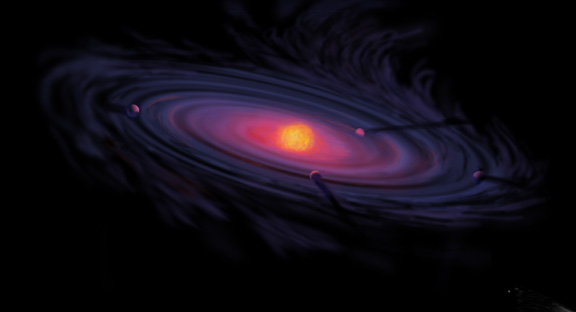
The modern understanding of planetary formation descends from the nebular hypothesis, first proposed independently by Immanuel Kant in 1755 and elaborated mathematically by Pierre-Simon Laplace in 1796. In its original form, the hypothesis held that the solar system formed from a rotating cloud of gas that contracted under its own gravity, flattened into a disk, and condensed at its center into the Sun while the surrounding disk material eventually coalesced into planets. The broad outline proved correct, and contemporary planetary science has refined it into a detailed physical picture supported by observations of protoplanetary disks around young stars in star-forming regions such as the Orion Nebula.19
In the modern account, the process began when a region of the interstellar medium — enriched with heavy elements from earlier generations of stars and possibly triggered into collapse by the shockwave from a nearby supernova — reached a density sufficient for gravity to overcome thermal and magnetic support. As the cloud collapsed, conservation of angular momentum caused it to spin faster and flatten into a protoplanetary disk roughly 100 astronomical units across, with the young Sun accumulating at its center. The disk was compositionally stratified by temperature: close to the nascent Sun, only refractory materials — silicates, oxides, and metals — could condense as solids; farther out, beyond what planetary scientists call the frost line, water ice and other volatile compounds became stable. The terrestrial planets formed in the inner, rocky zone, which determined their bulk silicate and iron-nickel composition.16, 19
The earliest solids to form in the solar disk are preserved in the least-processed meteorites — chondrites — as microscopic calcium-aluminium-rich inclusions (CAIs) and silicate chondrules. CAIs are assemblages of minerals such as anorthite, melilite, and spinel that condensed directly from the nebular gas at temperatures above 1,300 K. Their uranium-lead ages, refined repeatedly since the 1990s, now converge on 4,567.30 ± 0.16 million years ago, making them the oldest dated solids in the solar system and defining the anchor point for the entire chronology of solar system formation.2, 17 Earth’s age of 4.54 ± 0.05 Ga is measured from this baseline, representing the time required for the planet to fully accrete and differentiate after those first solids condensed.1
Accretion from planetesimals
The transformation from dust to planet proceeded in stages of increasing scale. Within the protoplanetary disk, sub-micron dust grains settled toward the midplane and collided gently enough to stick together through electrostatic forces, growing into millimetre- to centimetre-sized aggregates. These aggregates continued to accumulate, reaching metre scale and eventually kilometre-scale bodies called planetesimals — objects large enough for gravity to become the dominant force governing their interactions. Once planetesimals formed, the accretion process accelerated dramatically through a positive feedback known as runaway growth: larger bodies exert stronger gravitational attraction, sweeping up smaller neighbors more effectively and growing faster still, until a small number of planetary embryos dominated their orbital zones.19
Numerical simulations of the final stage of terrestrial planet formation show that planetary embryos — bodies ranging from roughly the mass of the Moon to the mass of Mars — underwent chaotic gravitational interactions over tens of millions of years, colliding and merging in a series of giant impacts before the surviving bodies settled into stable orbits. The timescale for this late-stage accretion is constrained by the hafnium-tungsten (Hf-W) isotopic system, which records the timing of metal-silicate separation. Because hafnium is lithophile (rock-loving) and tungsten is siderophile (iron-loving), the ratio of tungsten-182 to tungsten-184 in a planet’s silicate mantle records when its iron core segregated from the overlying rock. Tungsten isotope data from terrestrial rocks indicate that Earth’s core formation was largely complete within 30 to 50 million years of CAI formation, placing the bulk of accretion firmly in the first 50 million years of solar system history.18
The composition of the accreting material was not uniform throughout this interval. Dynamical models and geochemical evidence suggest that Earth accreted from a mixture of bodies formed at different heliocentric distances, with contributions ranging from highly reduced, volatile-poor inner solar system material to more oxidized, volatile-bearing bodies from farther out. This heterogeneous accretion left its imprint in the chemical composition of the bulk silicate Earth, and ongoing research into hydrogen isotopes in Earth’s interior suggests that a significant fraction of the planet’s water may have been delivered by materials resembling carbonaceous chondrites during the later stages of accretion rather than solely by a late veneer of comets or asteroids.3, 14
The iron catastrophe and core-mantle differentiation
As the proto-Earth grew through successive giant impacts, the kinetic energy of infalling material and the decay of short-lived radioactive isotopes — principally aluminium-26 and iron-60, which were abundant in the early solar system but have since decayed to negligible levels — generated enormous quantities of heat. If accretion proceeded rapidly enough, this heat could not escape to space and the interior of the growing planet began to melt. Once a threshold melt fraction was exceeded, a process sometimes called the iron catastrophe was initiated: droplets and pools of liquid iron, being denser than molten silicate, percolated downward through the rocky mantle and coalesced into a growing metallic core at the planet’s center.5
This differentiation event released an enormous additional pulse of gravitational potential energy — estimates suggest on the order of 2 × 1030 joules, roughly comparable to the total solar energy intercepted by Earth over several hundred million years — as the dense iron descended through thousands of kilometers toward the center. The release of this energy further heated the planet, driving the silicate mantle toward wholesale melting and establishing the magma ocean conditions that characterized the early Earth. The internal structure that emerged from differentiation — a dense iron-nickel core overlain by a silicate mantle — is the fundamental architecture that all subsequent geological processes have worked within.4, 5
The chemical consequences of differentiation were profound. Iron is the fourth most abundant element in Earth’s bulk composition, but its segregation into the core stripped the silicate mantle of most of its native iron as well as the siderophile trace elements — nickel, cobalt, platinum-group metals — that prefer to partition into metal over silicate at high temperatures. The concentrations of these elements in the mantle are higher than would be predicted by equilibrium partitioning at low pressures, a discrepancy that can be resolved if metal-silicate equilibration occurred at the high pressures of a deep magma ocean (roughly 40 to 60 GPa, corresponding to depths of about 1,000 to 1,500 km), where partition coefficients become less extreme. This evidence from siderophile element geochemistry independently confirms that core formation was a deep, high-temperature process consistent with the magma ocean scenario.5
The giant impact and the Moon’s formation
Among the giant impacts that characterized the final stage of Earth’s accretion, one stands out for its consequences: the collision between the proto-Earth and a Mars-sized planetary embryo, conventionally named Theia, approximately 4.51 billion years ago. The giant impact hypothesis for the Moon’s origin was proposed independently by William Hartmann and Donald Davis and by Alastair Cameron and William Ward in 1975 and 1976, respectively, motivated by the anomalous properties of the Moon that no earlier formation model could explain satisfactorily.7
The Moon has several distinctive characteristics that constrain its origin. Its bulk density is low relative to Earth (3,346 kg/m3 versus 5,515 kg/m3), consistent with an iron-depleted composition in which the metallic component is largely absent from the mantle and crust — the Moon has a very small core amounting to only about 1 to 2 percent of its total mass. The Earth-Moon system also has unusually high angular momentum compared to other planet-satellite pairs in the solar system. Furthermore, lunar rocks returned by the Apollo missions are strongly depleted in volatile elements, consistent with formation from high-temperature ejecta, while being enriched in refractory elements. None of these properties are easily explained by capture, fission, or co-accretion models; the giant impact hypothesis accounts for all of them simultaneously.6
In the standard model, Theia struck the proto-Earth at a low angle and moderate relative velocity — a grazing blow rather than a head-on collision — when Earth had already reached roughly 90 percent of its final mass. The impactor’s iron core merged with Earth’s existing core, while an enormous quantity of rocky material from both bodies was vaporized and ejected into orbit, forming a hot disk of silicate vapor and melt droplets. Within decades to centuries, this debris ring accreted into the Moon. Because the ejected material came predominantly from Theia’s silicate mantle and from the outer layers of the proto-Earth, it was iron-poor, explaining the Moon’s low density and small core.6 Numerical simulations by Robin Canup and colleagues in the late 1990s and 2000s were the first to demonstrate that an impactor of roughly 0.1 Earth masses striking at the right angle and speed could reproduce the mass and angular momentum of the Earth-Moon system with acceptable accuracy.6
The most compelling geochemical evidence for the giant impact is the oxygen isotope composition of lunar rocks. Oxygen has three stable isotopes — 16O, 17O, and 18O — whose ratios vary in a characteristic way across solar system bodies, reflecting their different formation locations in the nebula. Different classes of meteorites have distinct oxygen isotope signatures, and Earth itself has a well-defined signature that differs from Mars, the Moon’s parent body in impact models, and from most chondrite groups. High-precision measurements by Wiechert and colleagues in 2001, subsequently confirmed with improved techniques, showed that lunar rocks are indistinguishable from terrestrial rocks in their oxygen isotope composition to within about 0.005‰ — a similarity far beyond coincidence if the Moon had formed from an independently accreted body originating elsewhere in the solar system.8 This identity suggests that the impactor and proto-Earth were either compositionally similar (having formed at the same heliocentric distance) or that the violent mixing during the impact homogenized the oxygen isotope composition of the post-impact disk with that of Earth. The question of which interpretation is correct remains an active area of research, with some models invoking a more energetic, near-head-on impact that mixed materials more thoroughly.6, 8
The magma ocean, outgassing, and the primordial atmosphere
In the aftermath of the Theia impact, the proto-Earth was substantially or wholly molten, with a surface temperature estimated at 2,000 to 3,000 K and a magma ocean extending to perhaps several hundred kilometers depth or more. This magma ocean phase is a key transitional state between the undifferentiated accreting planet and the solid, layered Earth recognizable today. As the magma ocean cooled by radiating heat to space and convecting vigorously, minerals crystallized from the melt in an order governed by their melting temperatures — first dense, iron- and magnesium-rich phases such as bridgmanite (formerly called perovskite) near the base, and later lighter minerals toward the surface.9
The crystallization sequence of the magma ocean had long-term consequences for mantle structure and dynamics. Because the densest minerals crystallized first at depth while less dense cumulates accumulated at shallower levels, the resulting layered structure was gravitationally unstable. Instabilities in this cumulate pile likely drove an overturn event in which the denser deep cumulates sank and lighter material rose, establishing a compositionally heterogeneous mantle that has continued to evolve through convection ever since.9
The magma ocean also served as the primary source of Earth’s early atmosphere through volcanic outgassing. As the molten rock convected and degassed, volatile compounds dissolved in the melt were released into a growing atmosphere dominated by water vapor, carbon dioxide, and nitrogen, with minor amounts of sulfur dioxide, carbon monoxide, and hydrogen. Crucially, there was no free molecular oxygen in this primordial atmosphere — any oxygen produced was immediately consumed by reaction with reduced iron and other reducing species in the volcanic gases and the melt itself. The surface water initially released as steam remained in the vapor phase because temperatures were too high for liquid water to exist; only as the magma ocean solidified and surface temperatures fell below the critical point of water could oceans begin to condense.20 The oxygen isotope evidence from Jack Hills zircons, discussed below, indicates that this transition to liquid surface water had occurred by at least 4.3 to 4.4 billion years ago.10, 11
Formation of the first continental crust
The transition from a planet covered in magma to one with stable solid crust and liquid water oceans was geologically rapid but left few records. The oldest intact rock unit on Earth is the Acasta Gneiss of the Northwest Territories, Canada, dated by uranium-lead geochronology at 4.03 billion years. Yet the oldest known terrestrial materials are not rocks at all but individual mineral grains — zircon crystals recovered from ancient quartzite beds in the Jack Hills of Western Australia. These zircons, dated at up to 4,404 million years old, formed within magma at temperatures consistent with the crystallization of granitic or tonalitic crust, not basalt, and their oxygen isotope compositions indicate that the magma from which they crystallized had interacted with liquid water near the surface.10, 11
The implication is striking: within 150 million years of Earth’s formation, and within decades to centuries of the solidification of the magma ocean, the planet already had patches of continental crust and surface water. This “cool early Earth” hypothesis, advanced principally by John Valley and colleagues on the basis of Jack Hills zircon geochemistry, overturned a long-held view of the Hadean eon as a hellish, entirely molten interval incompatible with any form of stable geology. The atom-probe tomography study by Valley and colleagues in 2014 confirmed that the extreme age of the oldest Jack Hills zircons was not an artifact of lead redistribution within the crystal lattice, placing the date on the firmest possible analytical footing.11
The earliest continental crust differed in composition from the granite-dominated continents of today. The oldest crustal rocks from multiple Archean cratons belong to a suite of igneous rocks collectively known as TTG — tonalite, trondhjemite, and granodiorite — characterized by relatively high sodium, low potassium, and a geochemical signature consistent with partial melting of hydrated basaltic crust at moderate to high pressures. The TTG suite is thought to represent the dominant mode of continental crust generation in the Hadean and early Archean, produced where basaltic material at the base of thick oceanic-style crust melted in the presence of water, generating buoyant felsic magmas that intruded upward and solidified.15 The growth of continental crust from this process was initially slow, with most estimates suggesting that less than 10 to 20 percent of the present crustal volume existed before 3.0 billion years ago, though this figure is debated because the record is so heavily filtered by crustal recycling and erosion.
The late heavy bombardment
Between approximately 4.1 and 3.8 billion years ago, the lunar record preserves evidence of a pronounced spike in impact rates. Basin-forming impacts on the Moon — the events that created the large multi-ring basins such as Imbrium, Orientale, and Nectaris, whose rims and ejecta blankets were sampled by Apollo astronauts — cluster in this age range when their radiometric ages are measured. This apparent clustering led to the proposal in the 1970s that the inner solar system experienced a discrete episode of intense bombardment, the late heavy bombardment (LHB) or terminal cataclysm, distinct from the earlier period of declining impact rates following accretion.12
The Nice model of solar system dynamical evolution, developed in the 2000s by Gomes, Levison, Tsiganis, Morbidelli, and colleagues, provided a plausible dynamical mechanism: late gravitational interactions among the giant planets, triggered when Jupiter and Saturn crossed a mean-motion resonance, could have scattered large populations of outer solar system bodies onto planet-crossing orbits and driven a late pulse of bombardment in the inner solar system.13 However, the reality and interpretation of the LHB have been substantially revised since the concept was first proposed. More recent analyses of lunar basin ages argue that the apparent clustering results in part from sampling bias — Apollo missions disproportionately sampled the Imbrium basin ejecta — and that the impact flux may have declined more gradually from the end of accretion without a discrete spike. The question of whether a true cataclysm occurred or whether the lunar basin record reflects the tail end of a continuous decline remains unresolved and actively debated among planetary scientists.12
If a late heavy bombardment did occur, it would have had significant consequences for the early Earth: the largest impactors could have vaporized substantial portions of the oceans, sterilizing or severely stressing whatever early life may have existed. The Jack Hills zircon record shows no obvious discontinuity at the proposed LHB interval, and some zircons dated to this period retain oxygen isotope signatures consistent with water-rock interaction, suggesting that liquid water persisted even through whatever bombardment actually occurred.11, 12
Convergent age determination
The age of the Earth at 4.54 ± 0.05 billion years is not the product of a single measurement but emerges from the agreement of multiple independent geochronological systems, each exploiting a different radioactive decay scheme operating on a different timescale. The most fundamental anchor is the lead isotope composition of primitive meteorites. Clair Patterson’s landmark 1956 analysis of the Canyon Diablo iron meteorite, combined with data from several stony meteorites, defined the first precise age of the solar system using the uranium-lead system — a result that remains essentially unchanged by six decades of subsequent refinement.1
The convergence of evidence from multiple independent systems is what lends the age its credibility. Meteorite dating using uranium-lead, samarium-neodymium, and rubidium-strontium systems on different classes of primitive meteorites consistently yields ages between 4.55 and 4.57 Ga for the oldest solids, with the most precise CAI ages clustering at 4,567.3 Ma. Lunar rock dating from Apollo samples constrains the age of the Moon’s formation and the timing of lunar crustal crystallization to between 4.4 and 4.5 Ga, consistent with a Theia impact at approximately 4.51 Ga and subsequent rapid cooling and crust formation. The lead isotope composition of modern terrestrial rocks, when plotted on a lead-lead isochron diagram alongside meteorites, falls on a growth curve consistent with a starting composition equal to that of the solar system and an age of 4.54 billion years for the Earth’s lead reservoirs.1, 2
The internal consistency of this age across systems with entirely different parent-daughter pairs, half-lives, and geochemical behaviors constitutes one of the most powerful demonstrations of the reliability of radiometric dating. Any systematic error affecting one system (for instance, an incorrect decay constant) would have to conspire implausibly with errors in the other systems to produce the same incorrect age. The mutual agreement instead reflects a genuine chronology of solar system formation, providing the temporal framework within which all of Earth’s subsequent geological, biological, and climatic history is embedded.1, 17, 18
References
- Dalrymple, G. B. Age of the Earth. U.S. Geological Survey Open-File Report 91-20, 1991.
- Bouvier, A. & Wadhwa, M. The age of the Solar System redefined by the oldest Pb–Pb age of a meteoritic inclusion. Nature Geoscience 3: 637–641, 2010.
- Piani, L. et al. A non-chondritic model of the Earth formed from diverse primitive parent bodies. Science 369: 1110–1113, 2020.
- Walter, M. J. Formation of Earth’s earliest mantle. Earth and Planetary Science Letters 225: 253–269, 2004.
- Wood, B. J., Walter, M. J. & Wade, J. Core formation and the oxidation state of the Earth. Nature 441: 825–833, 2006.
- Canup, R. M. & Asphaug, E. The giant impact origin of the Moon. Nature 412: 708–712, 2001.
- Hartmann, W. K. & Davis, D. R. Origin of the Moon in a giant impact. Icarus 24: 504–515, 1975.
- Wiechert, U. et al. Oxygen isotopic constraints on the origin and differentiation of the Moon. Science 294: 345–348, 2001.
- Elkins-Tanton, L. T., Zaranek, S. E., Parmentier, E. M. & Hess, P. C. Magma ocean fractional crystallization and cumulate overturn in terrestrial planets. Earth and Planetary Science Letters 236: 1–12, 2005.
- Wilde, S. A., Valley, J. W., Peck, W. H. & Graham, C. M. Evidence from detrital zircons for the existence of continental crust and oceans on the Earth 4.4 Gyr ago. Nature 409: 175–178, 2001.
- Valley, J. W. et al. Hadean age for a post-magma-ocean zircon confirmed by atom-probe tomography. Nature Geoscience 7: 219–223, 2014.
- Bottke, W. F. & Norman, M. D. The late heavy bombardment. Annual Review of Earth and Planetary Sciences 45: 619–647, 2017.
- Gomes, R., Levison, H. F., Tsiganis, K. & Morbidelli, A. Origin of the cataclysm of the inner solar system. Nature 435: 466–469, 2005.
- Marty, B. The composition and major reservoirs of carbon on Earth after the main stage of accretion. Earth and Planetary Science Letters 313–314: 56–66, 2012.
- Martin, H., Smithies, R. H., Rapp, R., Moyen, J.-F. & Champion, D. Formation of the first continental crust. Lithos 79: 1–24, 2005.
- Palme, H. & O'Neill, H. St. C. Accretion of the Earth as seen by the non-chondritic composition of refractory elements. Treatise on Geochemistry (2nd ed.) 3: 1–39, 2014.
- Piralla, M. et al. Timing of the solar system’s earliest formation from doubly-differentiated rutile. Nature Communications 14: 6612, 2023.
- Kleine, T. et al. Rapid accretion and early core formation on asteroids and the terrestrial planets from Hf–W chronometry. Nature 418: 952–955, 2002.
- Chambers, J. E. Building terrestrial planets. Annual Review of Earth and Planetary Sciences 37: 321–344, 2009.
- Lammer, H. et al. Outgassing history and escape of the martian atmosphere and water inventory. Space Science Reviews 174: 113–154, 2013.
References
The age of the Solar System redefined by the oldest Pb–Pb age of a meteoritic inclusion
Magma ocean fractional crystallization and cumulate overturn in terrestrial planets: implications for Mars
Evidence from detrital zircons for the existence of continental crust and oceans on the Earth 4.4 Gyr ago
The composition and major reservoirs of carbon on Earth after the main stage of accretion
Accretion of the Earth as seen by the non-chondritic composition of refractory elements
Rapid accretion and early core formation on asteroids and the terrestrial planets from Hf–W chronometry