Overview
- The age of the oceanic crust increases systematically with distance from mid-ocean ridges, from zero-age basalt at the ridge axis to approximately 200 million years at the oldest margins — a pattern that was predicted by the seafloor spreading hypothesis and confirmed by deep-sea drilling and radiometric dating of ocean floor basalts.
- Magnetic anomaly stripes on the ocean floor, produced by periodic reversals of Earth's magnetic field recorded in cooling basalt, provide a continuous tape-recorder-like chronology of spreading history that matches independent biostratigraphic, radiometric, and astronomically calibrated age determinations.
- The absence of any ocean floor older than approximately 200 million years, despite the Earth being 4.54 billion years old, demonstrates that oceanic crust is continuously created at ridges and destroyed at subduction zones, providing direct evidence for the ongoing operation of plate tectonics over geological time.
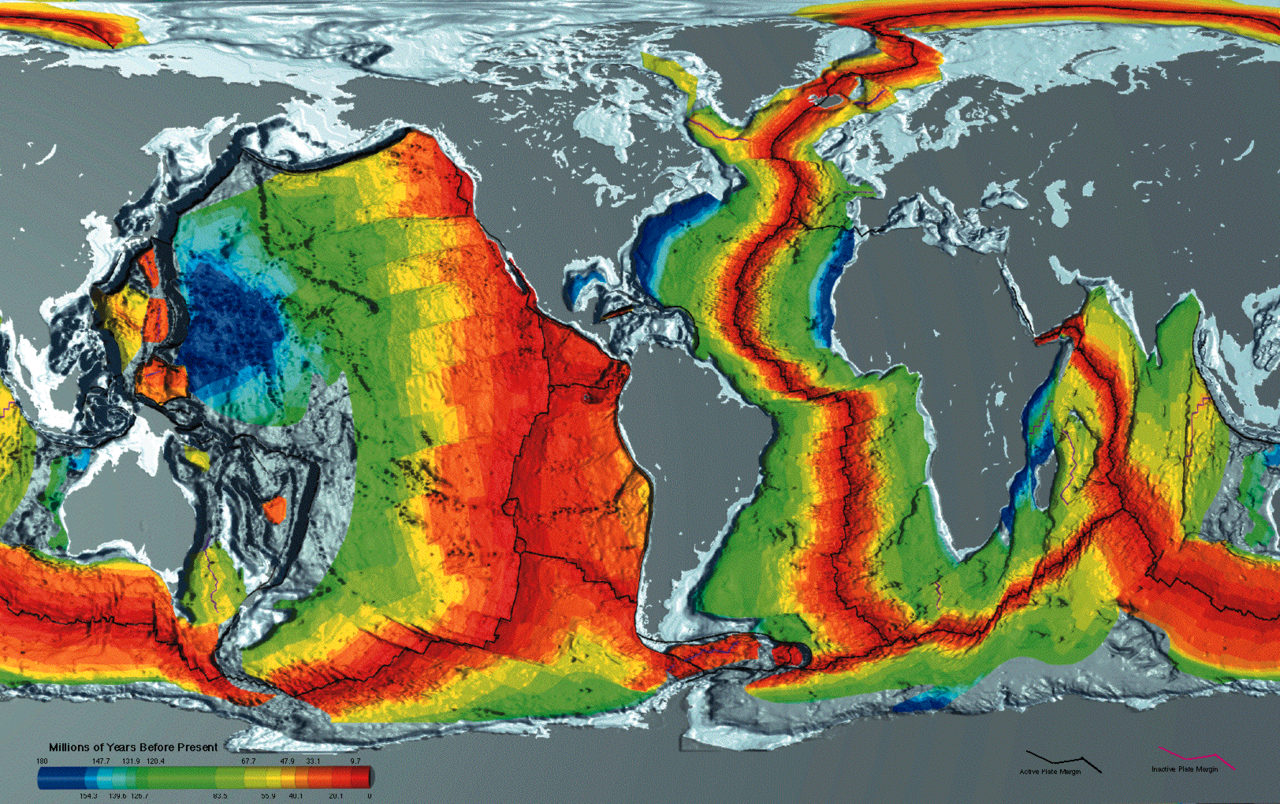
One of the most direct demonstrations of deep geological time and the ongoing operation of plate tectonics is the systematic age gradient of the ocean floor. The age of oceanic crust increases progressively with distance from mid-ocean ridges, where new crust is formed by volcanic eruptions, to the deep-sea trenches where old crust is consumed by subduction. This pattern, first predicted by Harry Hess in 1962 and confirmed by Frederick Vine and Drummond Matthews in 1963 through the interpretation of magnetic anomaly patterns, has since been verified by decades of deep-sea drilling, radiometric dating, and satellite-derived gravity mapping.1, 2, 5 The result is an ocean floor that serves as a continuously recording tape of Earth's tectonic and magnetic history, stretching back approximately 200 million years.7, 8

The seafloor spreading hypothesis
In his seminal 1962 paper, Harry Hess proposed that the ocean floor is not a permanent, ancient feature of the Earth but is continuously created at mid-ocean ridges and destroyed at subduction zones in a process he called "seafloor spreading."1 Hess envisioned the ridges as zones where hot mantle material rises to the surface, cools to form new oceanic crust (basalt), and then moves laterally away from the ridge axis as newer crust forms behind it, conveyor-belt fashion. If this hypothesis were correct, the ocean floor should be youngest at the ridges and progressively older toward the continental margins and subduction trenches — a prediction that was testable with the dating tools available in the 1960s.1, 10
The confirmation came swiftly. Vine and Matthews (1963) showed that the pattern of normal and reversed magnetic polarity recorded in the basalt of the ocean floor forms symmetric stripes on either side of the Mid-Atlantic Ridge.2 As newly erupted basalt cools through its Curie temperature, the magnetic minerals within it (primarily magnetite and titanomagnetite) become magnetized in the direction of the ambient geomagnetic field. Because Earth's magnetic field periodically reverses polarity — a phenomenon independently documented through radiometric dating of volcanic rocks on land — the ocean floor preserves a record of these reversals as alternating stripes of normally and reversely magnetized crust, youngest at the ridge and oldest at the margins.2, 3
Deep-sea drilling confirmation
The Deep Sea Drilling Project (DSDP), initiated in 1968, provided the definitive test of the age gradient prediction. By drilling into the sediment and basaltic basement of the ocean floor at sites chosen at progressively greater distances from the Mid-Atlantic Ridge, the DSDP demonstrated that the age of the oldest sediment immediately overlying the basaltic crust increased systematically with distance from the ridge axis.5 The basalt at the ridge crest was essentially zero-age, while cores recovered from the western Atlantic near the continental margin of North America yielded Jurassic-age sediments (approximately 170–180 million years old) at the base of the sedimentary column.5, 7
These results have been replicated and extended by the successor programs — the Ocean Drilling Program (ODP, 1983–2003) and the International Ocean Discovery Program (IODP, 2003–present) — which have drilled thousands of sites across all major ocean basins. The consistent finding is that sediment thickness increases with distance from the ridge (reflecting longer accumulation time on older crust) and that the age of the basal sediment, determined by biostratigraphy of calcareous nannofossils and planktonic foraminifera, agrees with the age predicted by the magnetic anomaly timescale.6, 11
The magnetic anomaly timescale
The magnetic stripes of the ocean floor have been calibrated against the independently determined geomagnetic polarity timescale to produce a detailed chronology of seafloor spreading rates. The geomagnetic polarity timescale is itself calibrated by radiometric dating of terrestrial volcanic rocks that record the same polarity reversals, providing an absolute age anchor for the marine magnetic anomaly sequence.6, 9 The most widely used calibration, that of Cande and Kent (1995), identifies over 300 polarity reversals spanning the past 160 million years, each correlated to specific magnetic anomaly numbers recognized on the ocean floor.9
The agreement between the magnetic anomaly ages and the radiometric/biostratigraphic ages obtained from drilling is consistently excellent. In the South Atlantic, for example, the age of the oldest ocean floor adjacent to the African and South American margins matches the time of continental separation predicted by plate reconstructions and confirmed by radiometric dating of the initial rift basalts.7, 8 In the Pacific, the oldest reliably identified magnetic anomalies (M-series anomalies) correspond to Late Jurassic time, approximately 155–170 million years ago, consistent with the biostratigraphic ages of basal sediments recovered from these areas by deep-sea drilling.8, 13
Age-depth relationship of the ocean floor
The age gradient of the ocean floor is correlated with a systematic increase in ocean depth away from the ridges. Young oceanic crust at the ridge axis is hot, thermally expanded, and therefore topographically elevated, typically at depths of 2,500–3,000 metres below sea level. As the crust moves away from the ridge and cools over millions of years, the lithosphere thickens by conductive heat loss to the overlying ocean, and the seafloor subsides.4, 12 The Parsons-Sclater model predicts that ocean depth increases approximately as the square root of crustal age for crust younger than about 70 million years, then flattens as the lithosphere approaches thermal equilibrium with the underlying asthenosphere.4
This age-depth relationship has been confirmed by bathymetric surveys across all ocean basins and is one of the most robust empirical relationships in marine geology. The agreement between the observed depth profiles and the predictions of thermal cooling models provides independent confirmation that the age gradient is real and that the ages assigned to the ocean floor by magnetic anomaly correlation are physically consistent with the thermal evolution of the lithosphere.4, 12
The absence of ancient ocean floor
A striking feature of the ocean floor age distribution is its upper limit: no ocean crust older than approximately 200 million years has been found anywhere on Earth, despite the age of the Earth being 4.54 billion years.7, 8, 14 This is precisely what plate tectonics predicts: oceanic crust is continuously recycled into the mantle at subduction zones, so no ocean floor survives indefinitely. The oldest preserved ocean crust is found in the western Pacific (approximately 190–200 million years old) and in the eastern Mediterranean (remnants of the Tethys Ocean, locally exceeding 270 million years in the form of preserved ophiolites on land).7, 13
This recycling process means that the ocean floor is geologically young relative to the continents, which preserve rocks as old as 4.03 billion years (Earth's oldest rocks). The contrast between the maximum age of the ocean floor and the age of the oldest continental rocks is itself powerful evidence for the long-term operation of plate tectonics: the continents, being less dense, are not subducted and accumulate geological history over billions of years, while the denser oceanic crust is continuously returned to the mantle.14, 15
Heat flow confirmation
The age gradient of the ocean floor receives further independent confirmation from measurements of heat flow through the oceanic crust. Young crust near the mid-ocean ridges conducts significantly more heat from the underlying mantle than old crust far from the ridges, exactly as predicted by thermal cooling models. Sclater and colleagues first demonstrated this systematic decline of heat flow with crustal age in the early 1970s, and subsequent global compilations have confirmed that heat flow decreases approximately as the inverse square root of age for young oceanic lithosphere, transitioning to a near-constant background level for crust older than about 80 million years.4, 16
The heat flow data provide a thermodynamic confirmation of the age gradient that is entirely independent of magnetic anomalies or biostratigraphy. The physics is straightforward: the mantle beneath the ridge is hot, and the newly formed lithosphere cools conductively as it moves away. The measured decline in heat flow with distance from the ridge matches the predictions of thermal plate models with remarkable fidelity, leaving no doubt that the crust has been cooling progressively over the timescales indicated by the magnetic anomaly chronology.12, 16
Digital plate reconstructions
The ocean floor age gradient has been mapped globally through digital age-grid models that synthesize magnetic anomaly identifications, biostratigraphic data, and satellite-derived gravity measurements into comprehensive reconstructions of oceanic crust age. The most widely used model, developed by Müller and colleagues, provides age assignments for virtually every point on the ocean floor at a resolution of 2 arc-minutes, revealing the complete pattern of spreading history across all ocean basins over the past 200 million years.7, 8 These digital age grids, implemented in plate reconstruction software such as GPlates, allow researchers to reconstruct past plate configurations, calculate absolute plate velocities, and track the opening and closing of ocean basins through deep time.18
The age-grid models also reveal asymmetries in spreading rates on opposite sides of mid-ocean ridges, jumps in ridge location, and the progressive consumption of oceanic plates at subduction zones. In the Pacific basin, the reconstructed age pattern preserves the record of plate reorganizations, including the reorientation of Pacific plate motion at approximately 47 million years ago that produced the bend in the Hawaiian-Emperor seamount chain — a feature independently confirmed by paleomagnetic data from seamount drilling.17, 18 These detailed reconstructions demonstrate that the age gradient is not merely a static snapshot but a dynamic record of plate tectonic processes operating continuously over hundreds of millions of years.
Significance for deep time
The ocean floor age gradient provides a particularly clear and visually compelling demonstration of deep time. The systematic progression from zero-age crust at the ridges to 200-million-year-old crust at the margins, confirmed by independent magnetic, biostratigraphic, radiometric, and thermal evidence, leaves no reasonable doubt that the ocean basins have been opening and closing over hundreds of millions of years.7, 8 The spreading rates calculated from the magnetic anomaly widths — typically 2–8 centimetres per year for most ridges, and up to 15 centimetres per year for the fastest segments of the East Pacific Rise — are independently confirmed by GPS measurements of present-day plate motions, demonstrating that the same process operating today has been operating for at least the past 200 million years.8, 15 The ocean floor age gradient thus stands as one of the most direct and independently verified lines of evidence for the reality of geological deep time and the continuous operation of plate tectonic processes over Earth's history.
References
Paleomagnetic constraints on mid-Cretaceous plate motions and the origin of the Hawaiian hot spot