Overview
- The Acasta Gneiss in Canada's Northwest Territories, dated at 4.03 billion years, is the oldest known intact rock unit on Earth and provides direct evidence that felsic continental crust existed within 500 million years of the planet's formation.
- The Nuvvuagittuq greenstone belt in northern Quebec contains rocks with disputed neodymium-142 isotopic signatures suggesting ages as old as 4.28 billion years, which would make them the oldest preserved crustal rocks on Earth, though most geochronologists favor a younger age of approximately 3.8 billion years.
- The extreme rarity of rocks older than 3.5 billion years reflects the relentless destruction of early crust by plate tectonics, subduction, and metamorphic recycling, meaning the few ancient terranes that survive are irreplaceable windows into Hadean and early Archean conditions.
Earth formed approximately 4.54 billion years ago from the accretion of dust and gas in the solar nebula, yet the oldest rocks preserved at the planet's surface are hundreds of millions of years younger than the planet itself.15, 24 The gap between the age of Earth and the age of its oldest surviving rocks reflects the violent conditions of the Hadean eon — a period of intense meteorite bombardment, widespread magma oceans, and the earliest stirrings of crustal recycling — followed by billions of years of plate tectonics and subduction that have continuously destroyed and remade the planet's outer shell.11, 17 The ancient rocks and minerals that have survived this relentless recycling are therefore extraordinarily rare and scientifically invaluable. They provide the only direct physical evidence of conditions on the early Earth: the composition of the first crust, the presence or absence of liquid water, the nature of early geodynamic processes, and the chemical environment in which life may have originated.
This article examines the principal localities where rocks and minerals older than approximately 3.5 billion years have been found, the geochronological methods used to date them, and the insights they provide into the Hadean and early Archean Earth. The most important of these localities include the Acasta Gneiss Complex in Canada (4.03 Ga), the Nuvvuagittuq greenstone belt in Quebec (disputed, up to 4.28 Ga), and the Isua Greenstone Belt in Greenland (3.7–3.8 Ga). Individual ancient minerals — particularly the Jack Hills zircons of Western Australia, dated as old as 4.374 billion years — extend the record even further back in time, though they survive only as tiny grains embedded in much younger host rocks.7, 8
Why ancient rocks are rare
Earth is the most geologically active body in the inner solar system, and this activity is precisely why so few ancient rocks survive. The planet's interior remains hot enough to drive mantle convection, which in turn powers the movement of tectonic plates across the surface. At subduction zones, oceanic lithosphere is pushed back down into the mantle, where it is heated, deformed, and chemically recycled. Continental crust is more buoyant and therefore more resistant to subduction, but it too is subject to intense deformation, metamorphism, partial melting, and erosion over geological time.17
The net effect of these processes is that the average age of the ocean floor is only about 80 million years — a tiny fraction of Earth's 4.54-billion-year history — while even the oldest continental crust has been extensively reworked by repeated episodes of mountain building, burial metamorphism, and granitic intrusion.22, 17 Any rock that has survived from the Hadean eon (prior to 4.0 Ga) or the early Archean (4.0 to 3.5 Ga) has done so by a combination of geological luck and tectonic circumstance: it must have avoided subduction, escaped melting, and endured billions of years of deformation without being so thoroughly metamorphosed that its original age signature was obliterated.
The contrast with other planetary bodies is instructive. The Moon, which lacks plate tectonics and has been geologically quiescent for approximately 3 billion years, preserves vast expanses of crust that are 4.3 to 4.5 billion years old. Meteorites — fragments of asteroids that have remained essentially unaltered since the birth of the solar system — record ages of 4.567 billion years with high precision.15 Earth's surface, by contrast, has been almost entirely resurfaced since the planet formed. The few surviving ancient terranes are not representative samples of the early crust but rather exceptional survivors of an otherwise comprehensive process of destruction and renewal.6, 11
The Acasta Gneiss Complex
The oldest known intact rock unit on Earth is the Acasta Gneiss Complex, located in the Slave Province of Canada's Northwest Territories, approximately 300 kilometres north of Yellowknife.
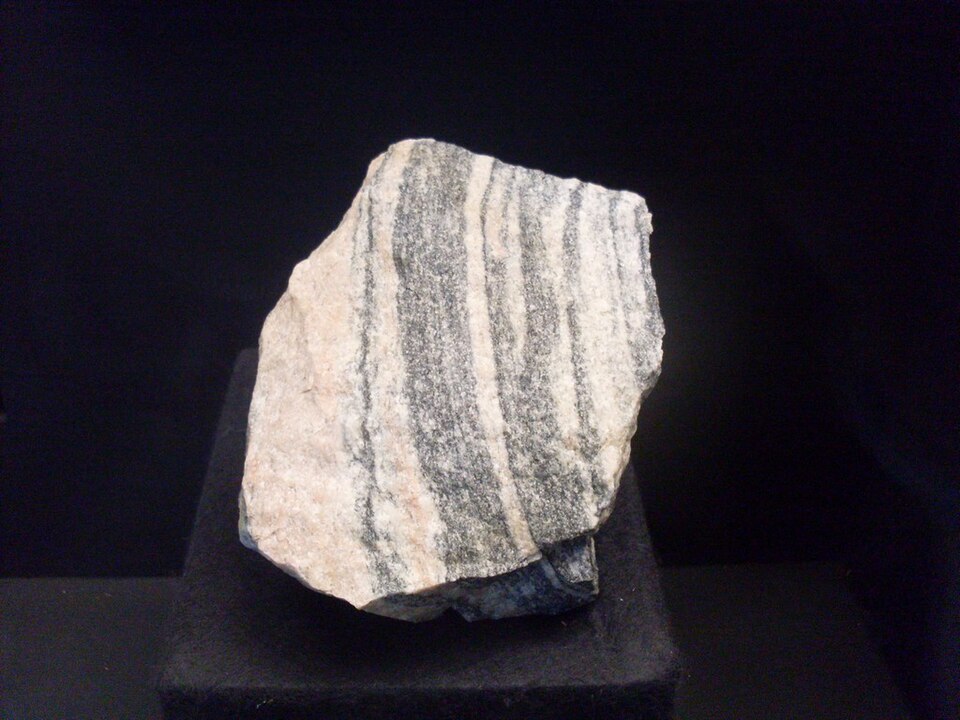

The complex was first identified in the early 1980s and was definitively dated in 1989 by Samuel Bowring and colleagues using uranium-lead (U–Pb) geochronology on zircon crystals extracted from a tonalitic gneiss sample. The oldest components of the Acasta Gneiss yielded concordant U–Pb ages of 4.03 billion years, making them the oldest known intact rocks on Earth by a significant margin.1, 4
The Acasta Gneiss Complex is not a single homogeneous rock body but rather a heterogeneous assemblage of variably deformed and metamorphosed felsic to intermediate gneisses — predominantly tonalite, granodiorite, and granite — with minor components of mafic rock. The complex spans a range of ages, from the oldest components at 4.03 Ga to younger intrusive phases dated at approximately 3.6 Ga, recording roughly 400 million years of repeated magmatic and metamorphic activity.13 The rocks have been subjected to multiple episodes of high-grade metamorphism and deformation, which have partially obscured their original textures and compositions. Nevertheless, careful geochemical analysis of the least-altered samples has provided important constraints on the nature of early crustal formation.
Geochemical studies of the Acasta Gneiss have revealed that the oldest components have compositions consistent with formation through the partial melting of pre-existing mafic crust in the presence of water, rather than through the direct differentiation of mantle-derived magmas. This observation has been interpreted as evidence that hydrous processes were already operating in the earliest stages of continental crust formation, and that some form of crustal recycling — possibly resembling modern plate tectonics, possibly not — was active by 4.0 Ga.14, 13 The trace-element patterns of the Acasta tonalites differ from those of modern subduction-zone magmas, however, suggesting that the geodynamic regime of the early Archean was distinct from the plate tectonics that operates today.14
The survival of the Acasta Gneiss is itself remarkable. The complex is located within the Slave craton, one of the ancient stable cores of the North American continent. Cratons are thick, cold, and mechanically strong blocks of lithosphere that resist deformation and subduction, effectively shielding the rocks within them from the destructive forces that recycle most of the planet's crust. Without the protective embrace of the Slave craton, the Acasta Gneiss would almost certainly have been destroyed long ago.6
The Nuvvuagittuq greenstone belt


The Nuvvuagittuq greenstone belt, located along the eastern shore of Hudson Bay in northern Quebec, Canada, has been at the centre of one of the most significant geochronological controversies of the twenty-first century. In 2008, Jonathan O'Neil and colleagues reported that rocks from the Nuvvuagittuq belt exhibited anomalies in the isotope neodymium-142 (142Nd), a radiogenic daughter product of the short-lived isotope samarium-146 (146Sm), which has a half-life of only 103 million years. Because 146Sm was effectively extinct within the first 500 million years of solar system history, any variation in 142Nd between rocks must reflect chemical differentiation events that occurred during that earliest interval. The 142Nd anomalies measured in the Nuvvuagittuq rocks were interpreted as evidence that the protolith — the original rock from which the current metamorphic rocks were derived — formed as early as 4.28 billion years ago, which would make it the oldest known terrestrial crust.3
This interpretation remains contested. Conventional U–Pb zircon dating of the Nuvvuagittuq rocks has yielded ages of approximately 3.75 to 3.82 billion years, consistent with an Eoarchean rather than a Hadean origin.20 Critics have argued that the 142Nd anomalies could reflect incomplete isotopic equilibration during later metamorphic events rather than a primary age signal, or that the samarium-neodymium system was disturbed by fluid-rock interaction during the intense deformation that the belt has experienced.20, 21 Proponents of the older age counter that the 142Nd signal is robust and cannot be produced by any post-Hadean process, and that the U–Pb zircon ages record a later metamorphic overprint rather than the original formation of the crust.3, 12
Subsequent work by O'Neil and Carlson in 2022 strengthened the case for a Hadean protolith age, presenting additional 142Nd data from the Nuvvuagittuq belt and arguing that the isotopic signatures are most parsimoniously explained by differentiation from a primitive mantle reservoir prior to 4.2 Ga.12 The debate is far from settled, however, and the age of the Nuvvuagittuq greenstone belt remains one of the most actively investigated questions in Precambrian geology. If the 4.28 Ga age is correct, the Nuvvuagittuq rocks would predate the Acasta Gneiss by approximately 250 million years and would represent the oldest preserved fragment of Earth's crust yet discovered.
Regardless of which age proves correct, the Nuvvuagittuq greenstone belt is scientifically important. The rocks include metamorphosed equivalents of basalt (amphibolite), ultramafic volcanic rocks, and banded iron formations, providing evidence that volcanic activity, chemical sedimentation, and possibly hydrothermal processes were occurring in the earliest stages of Earth's crustal evolution.19, 3
The Isua Greenstone Belt
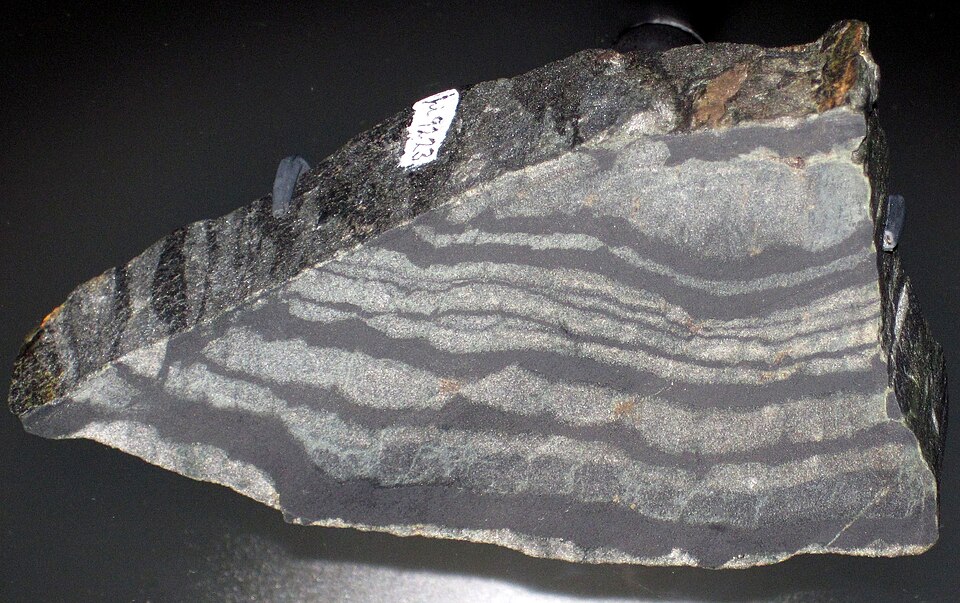
The Isua Greenstone Belt, located in the Isukasia region of southwestern Greenland approximately 150 kilometres northeast of Nuuk, is the oldest well-preserved supracrustal sequence on Earth. Supracrustal rocks are those that formed at or near the Earth's surface — volcanic lavas, sedimentary deposits, and chemical precipitates — as opposed to plutonic rocks that crystallized deep within the crust. The Isua belt has been dated by multiple geochronological methods to between approximately 3.7 and 3.8 billion years, placing it firmly in the Eoarchean era.9, 10
_(Eoarchean,_3.8_Ga;_Isua_Supracrustal_Belt,_southwestern_Greenland)_(15056531391).jpg)
The significance of the Isua Greenstone Belt lies not merely in its age but in the diversity and relatively good preservation of its constituent rocks. The belt contains metamorphosed equivalents of pillow basalts (volcanic lavas erupted underwater, recognizable by their characteristic rounded forms even after extensive deformation), banded iron formations (chemically precipitated sediments consisting of alternating layers of iron-rich and silica-rich minerals), and clastic sedimentary rocks including turbidites (sediments deposited by underwater gravity flows).10 The presence of pillow lavas provides strong evidence that liquid water oceans existed on the Earth's surface by at least 3.8 billion years ago. The banded iron formations indicate that the oceans contained significant dissolved iron, which in turn implies that the atmosphere and oceans were largely anoxic (oxygen-free) at this time, since dissolved iron is rapidly oxidized and precipitated in the presence of free oxygen.10, 2
The Isua belt has also been central to debates about the earliest evidence for life on Earth. In 2016, Nutman and colleagues reported the discovery of stromatolite-like structures — small, cone-shaped features interpreted as microbially constructed sedimentary structures — in 3.7-billion-year-old metacarbonate rocks from the Isua belt. If confirmed, these structures would represent the oldest known evidence of life on Earth, pushing back the record of biological activity by approximately 200 million years beyond the previously oldest accepted stromatolites from the Pilbara region of Western Australia.5 The interpretation remains debated, with some researchers arguing that the structures could have a non-biological origin, but the claim has focused intense scientific attention on the Isua belt as a potential window into the origin and earliest evolution of life.
Like the Acasta Gneiss, the Isua Greenstone Belt owes its survival to its location within a stable cratonic block — in this case, the North Atlantic Craton of Greenland. The rocks have been subjected to amphibolite-facies metamorphism and multiple phases of deformation, but they retain enough of their original chemical and structural signatures to permit detailed reconstruction of the environments in which they formed.9
Other ancient terranes
Beyond the Acasta, Nuvvuagittuq, and Isua localities, several other terranes preserve rocks older than approximately 3.5 billion years, contributing to the global inventory of Earth's most ancient crustal fragments.
The Narryer Gneiss Terrane and the Jack Hills of the Yilgarn Craton in Western Australia are home to the oldest known terrestrial minerals: detrital zircon crystals with U–Pb ages extending to 4.404 billion years.7, 8 These tiny, extraordinarily durable crystals survived the destruction of their original host rocks and were transported and redeposited as sedimentary grains in much younger (approximately 3.0 Ga) metaconglomerate and quartzite formations. Although the host rocks are not themselves Hadean in age, the zircons they contain preserve chemical and isotopic records of the crust from which they were eroded, providing the most direct geochemical evidence for conditions on Earth during the first few hundred million years of its history. The Jack Hills zircons are discussed in detail in a companion article.
The Barberton Greenstone Belt of South Africa and Eswatini, dated at approximately 3.2 to 3.55 billion years, is one of the best-preserved Paleoarchean volcanic and sedimentary sequences in the world. It contains excellently preserved pillow basalts, komatiites (ultramafic lavas that require mantle temperatures substantially higher than those observed today), cherts, and banded iron formations. The Barberton belt has been instrumental in reconstructing early Archean ocean chemistry, atmospheric composition, and volcanic processes.21
The Pilbara Craton of Western Australia, with rocks dated at 3.2 to 3.52 billion years, is the Barberton belt's counterpart in the Southern Hemisphere and contains some of the oldest widely accepted stromatolites — layered sedimentary structures produced by microbial communities. Together, the Barberton and Pilbara terranes constitute the best-preserved record of the Paleoarchean Earth and provide a crucial bridge between the fragmentary Eoarchean record (Isua, Nuvvuagittuq) and the more abundant geological record of the later Archean.2, 22
Earth's oldest known rock units and minerals1, 3, 7, 9, 21
| Locality | Age (Ga) | Rock type | Location | Dating method |
|---|---|---|---|---|
| Jack Hills zircons | 4.404 | Detrital zircon crystals | Western Australia | U–Pb zircon |
| Nuvvuagittuq greenstone belt | 4.28 (disputed) / 3.78 | Faux-amphibolite, ultramafic rocks | Northern Quebec, Canada | 146Sm–142Nd / U–Pb zircon |
| Acasta Gneiss Complex | 4.03 | Tonalitic gneiss | Northwest Territories, Canada | U–Pb zircon |
| Isua Greenstone Belt | 3.7–3.8 | Metabasalt, BIF, metasediments | Southwestern Greenland | U–Pb zircon, Sm–Nd |
| Barberton Greenstone Belt | 3.2–3.55 | Komatiite, basalt, chert, BIF | South Africa & Eswatini | U–Pb zircon |
| Pilbara Craton | 3.2–3.52 | Basalt, chert, stromatolites | Western Australia | U–Pb zircon |
How the oldest rocks are dated
Determining the age of rocks that are billions of years old requires geochronological methods capable of resolving vast timescales with high precision. The primary technique used for dating the Earth's oldest rocks is uranium-lead (U–Pb) geochronology, which exploits the radioactive decay of two uranium isotopes — 238U to 206Pb and 235U to 207Pb — each with a different half-life. Because the two decay systems operate independently, they provide an internal cross-check: if both systems yield the same age (a condition called concordance), confidence in the result is very high.23, 4
The mineral most commonly used for U–Pb dating is zircon (ZrSiO4), a remarkably durable silicate that incorporates uranium into its crystal structure during crystallization but strongly excludes lead. This means that any lead found in a zircon crystal today must have been produced by the radioactive decay of uranium since the crystal formed, making the initial conditions of the system well constrained. Zircon is also extremely resistant to chemical weathering, physical abrasion, and even high-grade metamorphism, which is why it can survive the destruction of its host rock and persist as a detrital grain for billions of years, as in the case of the Jack Hills zircons.7, 23
Modern U–Pb analysis is performed using instruments such as the sensitive high-resolution ion microprobe (SHRIMP), which focuses a beam of ions onto a polished surface of a zircon crystal and sputters atoms from a spot only 10 to 30 micrometres in diameter. This allows individual growth zones within a single crystal to be dated separately, resolving complex histories of crystallization, metamorphism, and lead loss that would be averaged out in conventional whole-grain analyses.1, 4 It was SHRIMP analysis that first established the 4.03 Ga age of the Acasta Gneiss and the 4.404 Ga age of the oldest Jack Hills zircons.
For rocks where zircon is absent or where the U–Pb system has been disturbed by later events, other isotopic systems can be employed. The samarium-neodymium (Sm–Nd) system, particularly the now-extinct 146Sm–142Nd chronometer, has been applied to the Nuvvuagittuq greenstone belt, as discussed above.3 The lutetium-hafnium (Lu–Hf) system, measured in zircon crystals, provides complementary information about the timing of crustal extraction from the mantle and has been used to argue that significant volumes of continental crust existed by 4.4 to 4.5 Ga, even though no intact rocks of that age survive.16
What the oldest rocks reveal about the early Earth
The ancient rocks and minerals discussed in this article are not merely curiosities of extreme age. They are the primary source of empirical evidence for conditions on the Hadean and early Archean Earth — a period for which no other direct record exists.
One of the most important insights from the oldest terrestrial materials is that liquid water was present on Earth's surface far earlier than was once assumed. The oxygen isotope compositions of the oldest Jack Hills zircons, dated at 4.3 to 4.4 Ga, indicate that they crystallized from magmas that had interacted with liquid water, implying the existence of oceans or at least substantial surface water within 150 million years of the planet's formation.18, 7 This finding contradicted the long-held view of the Hadean as an unremittingly hellish environment of continuous magma oceans and intense meteorite bombardment, and led John Valley and colleagues to propose the concept of a "cool early Earth" in which surface temperatures dropped below the boiling point of water much sooner than previously thought.18
The chemical compositions of the Acasta Gneiss provide evidence for the earliest formation of felsic (silica-rich) continental crust. The tonalitic compositions of the oldest Acasta rocks are consistent with generation through the partial melting of hydrated mafic crust at relatively low pressures, a process that requires water to be present in the source region.14, 13 This suggests that the fundamental processes of continental crust generation — the melting of water-bearing mafic precursors to produce silica-enriched magmas — were already operating by 4.0 Ga, approximately 500 million years after the planet formed.
The hafnium isotope compositions of ancient zircons from the Jack Hills and other localities have been used to argue that the process of extracting continental crust from the mantle was well underway by 4.4 to 4.5 Ga, and that the volume of continental crust may have been substantial even in the Hadean.16 This interpretation is not without controversy — some researchers argue that the hafnium data can be explained by repeated reworking of a small volume of crust rather than by early large-scale crustal production — but it reinforces the emerging picture of a Hadean Earth that was geologically active and hydrologically complex, not the barren wasteland of earlier imagining.11
The banded iron formations and pillow basalts of the Isua Greenstone Belt provide direct evidence for marine sedimentation and submarine volcanism at 3.7 to 3.8 Ga, confirming that oceans, volcanic activity, and chemical sedimentation processes closely resembling those of the modern Earth were well established by the early Archean.10 The possible stromatolites reported from Isua, if confirmed, would further imply that life had already evolved and was constructing macroscopic sedimentary structures by 3.7 Ga — only a few hundred million years after the end of the Late Heavy Bombardment, during which the inner solar system was subjected to a final intense pulse of large impacts.5
Early geodynamics and the onset of plate tectonics
One of the most debated questions in the study of Earth's oldest rocks is whether plate tectonics — the system of rigid lithospheric plates moving horizontally across the planet's surface, driven by mantle convection and slab pull at subduction zones — was operating in the Hadean and early Archean, or whether some fundamentally different geodynamic regime prevailed. The answer has profound implications not only for understanding the early Earth but also for understanding why Earth developed plate tectonics while Venus and Mars apparently did not.17
Several lines of evidence from the oldest rocks have been marshalled on both sides of this debate. Proponents of early plate tectonics point to the tonalite-trondhjemite-granodiorite (TTG) compositions of the Acasta Gneiss and other Eoarchean felsic rocks, which are broadly similar to the magmatic products of modern subduction zones. They also cite structural evidence from the Isua belt that has been interpreted as recording the collision and suturing of separate crustal blocks, analogous to the accretion of terranes at modern convergent margins.9 The oxygen isotope evidence for surface water at 4.3 to 4.4 Ga is consistent with the existence of oceanic crust that could potentially be subducted.18
Skeptics counter that the trace-element and isotopic signatures of the oldest felsic rocks differ in important details from those of modern arc magmas, and may instead reflect the melting of thickened mafic crust in a "stagnant lid" or "drip tectonics" regime in which dense lower crust founders into the mantle without the organized lateral plate motion that characterizes modern plate tectonics.14, 17 In such a regime, crustal recycling would still occur, but through vertical processes (gravitational instability, delamination, and small-scale convective overturn) rather than through the horizontal subduction of rigid plates. The geochemistry of the Acasta Gneiss, in particular, has been interpreted as more consistent with water-fluxed melting of mafic crust in a stagnant-lid setting than with conventional arc magmatism.14
Current consensus holds that some form of crustal recycling was active by at least 4.0 Ga, but that the transition to modern-style plate tectonics may not have occurred until sometime between 3.0 and 4.0 Ga, with the precise timing remaining uncertain.17, 11 The oldest rocks cannot by themselves resolve this question definitively, but they provide the essential empirical constraints against which geodynamic models must be tested.
Significance for understanding deep time
The study of Earth's oldest rocks is ultimately an exercise in recovering information from a planet that systematically destroys its own geological record. Every rock unit described in this article — the Acasta Gneiss, the Nuvvuagittuq greenstone belt, the Isua Greenstone Belt, the Barberton and Pilbara cratons — represents an improbable survivor, a fragment of ancient crust that escaped the recycling processes that have consumed virtually all of its contemporaries over the past four billion years.6, 11
Together, these ancient terranes establish several fundamental facts about the early Earth. Continental crust of felsic composition existed by at least 4.03 Ga, and possibly earlier.1, 16 Liquid water was present on the surface by 4.3 to 4.4 Ga.18, 7 Marine sedimentation, submarine volcanism, and chemical precipitation of iron formations were occurring by 3.7 to 3.8 Ga.10 Some form of crustal recycling was active throughout this period, though whether it took the form of modern plate tectonics remains an open question.17 And life may have been present by 3.7 Ga, within the first billion years of the planet's existence.5
These findings have reshaped scientific understanding of the Hadean eon, transforming it from a period of unrelieved chaos and inhospitability into one that was geologically dynamic, hydrologically active, and potentially habitable far earlier than was believed even two decades ago. The oldest rocks are not footnotes in the geological record; they are the foundation upon which our understanding of the first billion years of Earth history is built.11, 24
References
Rapid emergence of life shown by discovery of 3,700-million-year-old microbial structures
Evidence from detrital zircons for the existence of continental crust and oceans on the Earth 4.4 Gyr ago
The Isua supracrustal belt, southern West Greenland: part of a c. 3700–3800 Ma plate tectonic suture?
The 3.7–3.8 Ga Isua greenstone belt, SW Greenland: the world's oldest volcanic and sedimentary succession
The Acasta Gneiss Complex: geology, geochronology, geochemistry and implications for the earliest crust
The Barberton Greenstone Belt: a unique record of crustal development, surface processes and early life