Overview
- Behavioral modernity refers to a suite of cognitive and cultural capacities including symbolic thought, complex technology, planning depth, and innovation, whose archaeological signatures first appear in the African Middle Stone Age tens of thousands of years before the European Upper Paleolithic.
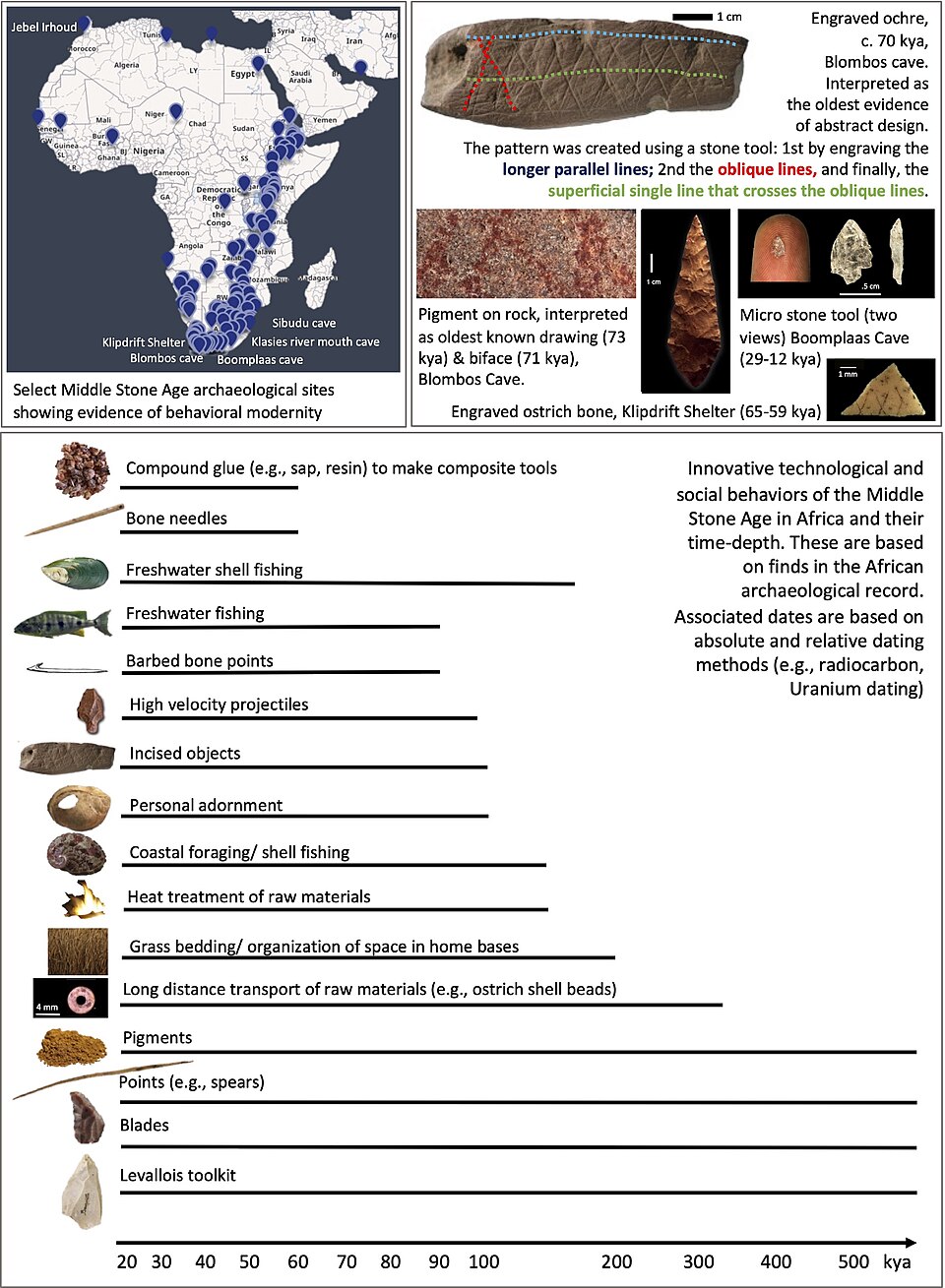
- Key African sites such as Blombos Cave, Pinnacle Point, Sibudu Cave, Diepkloof Rock Shelter, and Border Cave have yielded evidence of ochre engraving, shell bead manufacture, heat-treated stone tools, compound adhesives, and engraved ostrich eggshell containers dating from 164,000 to 44,000 years ago.
- The demographic hypothesis proposes that population size and connectivity, rather than a sudden genetic mutation, drove the accumulation and maintenance of complex cultural behaviors, explaining why innovations appeared episodically in Africa before becoming sustained in both Africa and Eurasia.
Behavioral modernity is a concept used in paleoanthropology and archaeology to describe the full suite of cognitive and cultural capacities that distinguish the behavior of recent Homo sapiens from that of other hominins and earlier human populations. The traits typically invoked as markers of behavioral modernity include symbolic thought expressed through art and personal ornament, complex multi-component technology, the systematic exploitation of diverse resources including marine foods, long-distance exchange networks, planning depth, and the capacity for rapid innovation.1, 12 When and how these capacities emerged has been one of the most intensely debated questions in human origins research since the late twentieth century. The debate has shifted fundamentally over the past three decades: where researchers once looked to the European Upper Paleolithic revolution around 40,000 to 50,000 years ago as the moment of transformation, a growing body of evidence from the African Middle Stone Age now demonstrates that many components of the behavioral package appeared far earlier on the African continent, accumulating gradually over a span of more than 100,000 years.1, 5, 11
Defining behavioral modernity
The concept of behavioral modernity emerged from attempts to explain a perceived discontinuity in the archaeological record: the apparent contrast between the relatively simple material culture of the Middle Paleolithic and Middle Stone Age and the elaborate symbolic and technological repertoire that appeared in the European Upper Paleolithic after approximately 45,000 years ago. Early formulations of the concept assembled a checklist of traits considered diagnostic of modern behavior, including blade technology, bone and antler tools, personal ornaments, pigment use, figurative art, structured use of domestic space, ritual burial, long-distance trade, and the exploitation of difficult or dangerous prey.1, 2 A population that displayed these traits was deemed behaviorally modern; one that did not was considered archaic in its behavior regardless of its anatomy.
Henshilwood and Marean critiqued this trait-list approach in a landmark 2003 review, arguing that the checklist was empirically derived from and specific to the European Upper Paleolithic record, rendering it problematic as a universal standard for assessing behavioral complexity in other regions, particularly Africa, where taphonomic conditions, raw-material availability, and ecological contexts differed fundamentally from those of Ice Age Europe.12 They proposed instead that the most reliable archaeological proxies for modern cognition are those that require symbolic mediation — that is, evidence that objects or marks were assigned arbitrary meanings shared within a social group, such as personal ornaments, abstract engravings, and the systematic use of pigment for non-utilitarian purposes. Ambrose had similarly argued that the manufacture of composite tools requiring the mental integration of multiple materials and production sequences served as a robust proxy for the planning depth and analogical reasoning considered central to modern cognition.18
Despite these refinements, the concept itself has remained contested. John Shea argued forcefully in 2011 that "behavioral modernity" is an essentialist and typological construct that conflates a qualitative judgment about cognitive capacity with the quantitative reality of behavioral variability. Using data from Middle Pleistocene East African sites, he demonstrated that the oldest known Homo sapiens populations already exhibited levels of behavioral variability indistinguishable from those of populations younger than 50,000 years, concluding that Homo sapiens has always been behaviorally variable and that the concept of a transition to "modernity" obscures more than it reveals.13
The Upper Paleolithic revolution model
The earliest and most influential model for the origin of behavioral modernity was the "revolution" or "great leap forward" hypothesis, associated most prominently with the American paleoanthropologist Richard Klein. In a series of publications beginning in the 1990s and culminating in his 2000 synthesis, Klein argued that although anatomically modern humans appeared in Africa between 200,000 and 150,000 years ago, they did not become behaviorally modern until approximately 50,000 years ago, when a sudden and dramatic transformation in material culture occurred — first in Africa and then in Europe following the dispersal of modern humans out of Africa.2 Klein proposed that this transformation was triggered by a fortuitous genetic mutation that reorganized the brain, perhaps conferring the capacity for fully syntactic language, and that this neural rewiring enabled the cascade of technological and symbolic innovations visible in the archaeological record.

The revolution model drew much of its empirical support from the European Upper Paleolithic, where the archaeological record does show a striking discontinuity beginning around 45,000 years ago: the sudden and nearly simultaneous appearance of blade and bladelet industries, bone and antler projectile points, figurative cave art, carved figurines, musical instruments, perforated shell and tooth ornaments, long-distance raw-material transport, and structured living floors.2, 19 When this European record was taken as the global standard for modern behavior, it appeared that pre-Upper Paleolithic humans everywhere — including the earliest anatomically modern Homo sapiens in Africa — were behaviorally primitive, creating a puzzling lag of 100,000 years or more between the appearance of modern anatomy and the emergence of modern behavior.
Klein's hypothesis was internally coherent but rested on two assumptions that subsequent research has challenged. The first was that the African archaeological record genuinely lacked evidence for symbolic and technologically complex behavior before 50,000 years ago. The second was that a plausible neural mechanism — a specific genetic mutation — could account for the sudden appearance of modern cognition. No candidate gene has ever been identified, and the African archaeological evidence accumulated since 2000 has progressively undermined the premise of a late, abrupt origin for the behaviors in question.1, 11
The African gradualist model
The most comprehensive challenge to the revolution model came from Sally McBrearty and Alison Brooks in their 2000 monograph "The revolution that wasn't." Examining the African Middle Stone Age (MSA) record in detail, they demonstrated that nearly every element of the supposed Upper Paleolithic revolution — blade and microlithic technology, bone tools, increased geographic range, specialized hunting, exploitation of aquatic resources, long-distance trade, systematic use of pigment, and art and decoration — could be identified at African sites tens of thousands of years earlier than their first appearance in Europe.1 Crucially, these traits did not appear suddenly and simultaneously, as the revolution model predicted, but instead emerged at sites widely separated in both space and time, suggesting a gradual, piecemeal assembling of the behavioral package over the course of the MSA.
McBrearty and Brooks argued that the perception of a sudden revolution was an artifact of Eurocentric bias in the discipline: because the European archaeological record had been studied far more intensively and over a much longer period than the African record, and because Upper Paleolithic Europe offered exceptional preservation conditions for organic materials such as bone, antler, and ivory, the European sequence had been taken as the norm against which all other regional records were judged. When the African evidence was examined on its own terms, the picture that emerged was one of deep-time behavioral evolution stretching back to at least 250,000 years ago, roughly coincident with the origin of Homo sapiens itself.1, 12
The gradualist model does not require a single genetic trigger. Instead, it proposes that the cognitive capacities underlying modern behavior evolved alongside the anatomical features of Homo sapiens through ordinary processes of natural selection, gene flow, and drift operating within subdivided African populations. The archaeological visibility of these capacities at any given site depended not only on whether the capacities existed but also on whether local ecological and demographic conditions favoured their expression and preservation.1, 9
Key archaeological evidence from Africa
The case for an early, African origin of behavioral modernity rests on a series of remarkable archaeological discoveries made since the late 1990s, concentrated in southern and eastern Africa. Collectively, these sites document the presence of symbolic thought, complex technology, and systematic resource exploitation far earlier than the revolution model allowed.

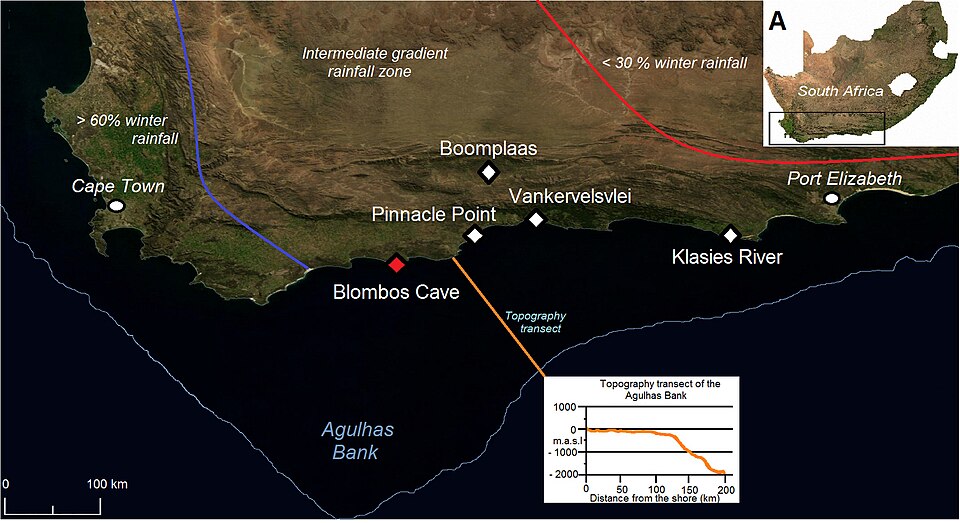
Pinnacle Point, on the southern coast of South Africa, has yielded the earliest known evidence for the systematic exploitation of marine shellfish, dated to approximately 164,000 years ago (Marine Isotope Stage 6), a period when much of Africa's interior was cold and dry. The associated deposits also contain ochre pigment, including pieces that appear to have been deliberately ground, and small bladelet tools, suggesting that coastal adaptation and pigment use were already part of the behavioral repertoire of early Homo sapiens during one of the harshest glacial episodes of the Middle Pleistocene.5, 22 Marean has argued that the southern Cape coast served as a refugium during MIS 6, where marine resources and the diverse plant foods of the Cape Floral Region sustained populations that might otherwise have perished, and that these populations may have been among the ancestors of all living humans.22
Blombos Cave, also in the southern Cape, has produced what is perhaps the most compelling body of evidence for early symbolic behavior. Two pieces of ochre engraved with deliberate cross-hatched geometric patterns were recovered from layers dated to approximately 77,000 years ago by thermoluminescence and optically stimulated luminescence, constituting the earliest known abstract engravings at the time of their publication in 2002.3 Subsequent excavations recovered an additional thirteen engraved ochre pieces from levels spanning approximately 75,000 to 100,000 years ago, demonstrating that engraving was not an isolated act but a sustained tradition.23 In 2018, Henshilwood and colleagues reported the discovery of a cross-hatched pattern drawn with an ochre crayon on a ground silcrete flake from approximately 73,000-year-old levels, representing the oldest known drawing.17 Blombos Cave has also yielded 41 perforated Nassarius kraussianus shells from the Still Bay layers, dated to approximately 75,000 years ago, that bear use-wear traces and ochre residues consistent with their having been strung as beads — the earliest known personal ornaments in Africa at the time of their description.4
The lithic technology of the Still Bay levels at Blombos is equally remarkable. The thin, finely shaped bifacial points that characterise the Still Bay technocomplex were produced using pressure flaking, a technique in which individual flakes are removed by pressing a pointed tool against the stone edge rather than striking it. Experimental replication by Mourre, Villa, and Henshilwood demonstrated that pressure flaking best explains the morphology of the Blombos points, pushing back the earliest known use of this technique by approximately 55,000 years relative to its previously documented appearance in the Upper Paleolithic.7 The silcrete from which many of these points were made had been deliberately heat-treated to improve its flaking properties, a process documented by Brown and colleagues at multiple South African MSA sites and dating to at least 72,000 years ago in the Still Bay layers.6
At Sibudu Cave in KwaZulu-Natal, Lyn Wadley documented compound adhesives made from plant gum mixed with red ochre and, in some cases, animal fat, used to haft stone tools into wooden handles. Experimental replication demonstrated that producing these adhesives required a sophisticated understanding of the chemical and physical properties of the ingredients, the ability to control temperature during curing, and the capacity to select task-appropriate recipes — cognitive demands that Wadley argued are equivalent to those involved in modern chemical engineering.16
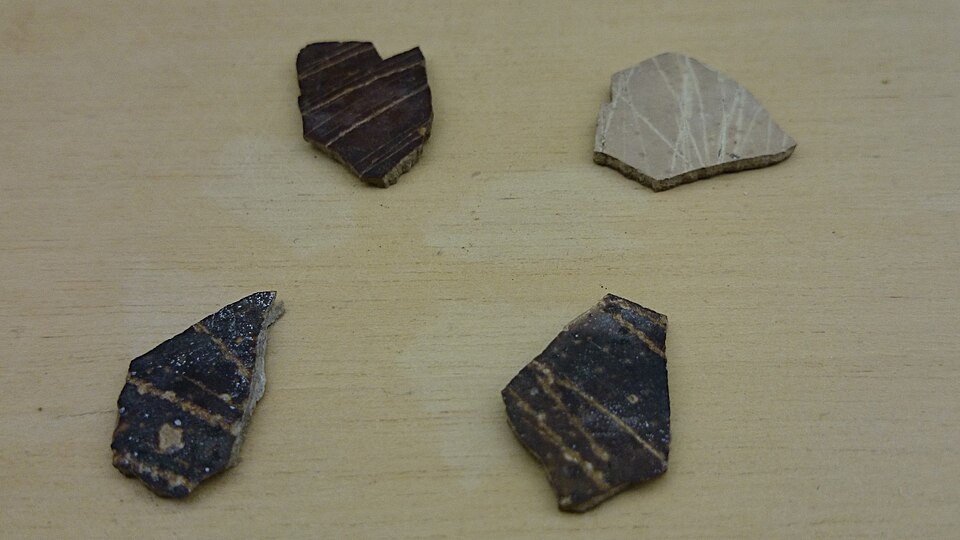
At Diepkloof Rock Shelter in the Western Cape, Texier and colleagues recovered 270 fragments of ostrich eggshell engraved with geometric patterns from Howiesons Poort levels dated to approximately 60,000 years ago. The engravings display a restricted set of motifs — principally hatched bands and subparallel-to-converging lines — that shift in frequency over time, suggesting a graphic tradition maintained across generations.14
At Border Cave, near the South African border with Eswatini, d'Errico, Backwell, and colleagues reported a toolkit from approximately 44,000-year-old Later Stone Age deposits that closely parallels the material culture of historic San hunter-gatherers, including notched bones interpreted as tallying devices, bone points resembling poisoned arrowheads, a wooden digging stick, and a lump of beeswax mixed with toxic Euphorbia resin that may have served as a hafting compound. Chemical analysis revealed ricinoleic acid residues on an incised wooden stick, consistent with its use as a poison applicator.15
Key African Middle Stone Age and early Later Stone Age evidence for behavioral modernity1, 3, 5, 15
| Site | Date (ka) | Key evidence |
|---|---|---|
| Pinnacle Point 13B | ~164 | Marine shellfish exploitation, pigment use, bladelets |
| Blombos Cave (MSA) | ~100–73 | Engraved ochre, shell beads, ochre drawing, pressure-flaked bifacial points, heat-treated silcrete |
| Sibudu Cave | ~70 | Compound adhesives for hafting, multicomponent tools |
| Diepkloof Rock Shelter | ~60 | Engraved ostrich eggshell containers, graphic tradition with shifting motifs |
| Border Cave | ~44 | San-like toolkit: bone arrowheads, poison applicator, beeswax hafting compound, notched bones |
Episodic versus gradual emergence
One of the most striking features of the African MSA record is that innovations do not simply accumulate in a linear progression toward modernity. Instead, complex technologies and symbolic behaviors appear at certain times and places, then vanish from the archaeological record for thousands of years before reappearing elsewhere. The Still Bay technocomplex, with its pressure-flaked bifacial points, engraved ochres, and shell beads, is restricted to a narrow window of perhaps a few thousand years around 72,000 to 71,000 years ago, according to the optically stimulated luminescence chronology of Jacobs and colleagues, who dated MSA sequences at nine South African sites.10 The subsequent Howiesons Poort, characterised by backed geometric segments and engraved ostrich eggshell, spans approximately 65,000 to 59,500 years ago.10 Between and after these technocomplexes, the archaeological record of southern Africa appears less technologically elaborate, leading some researchers to describe the pattern as one of episodic florescence and collapse.

This episodic pattern has been interpreted in multiple ways. Some scholars have suggested that the apparent disappearance of complex behaviors reflects genuine cognitive regression — that small, isolated populations lost innovations they could not maintain. Others have argued that the pattern is an artifact of sampling: the African archaeological record is far less intensively surveyed than the European record, and many regions and time periods remain essentially unknown. Lombard and Parsons challenged the notion of post-Howiesons Poort regression, arguing that the stone tool assemblages immediately following the Howiesons Poort are not as technologically impoverished as often claimed and that continuity in cognitive complexity can be demonstrated even in the absence of the most visually striking innovations.24
D'Errico and Stringer proposed a third interpretive framework in their 2011 review, distinguishing among three scenarios for the emergence of modern cultures: a revolution triggered by genetic mutation around 50,000 years ago, a gradual evolution within Homo sapiens beginning at least 200,000 years ago, and a "saltation" model in which innovations indicative of modern cognition appeared and disappeared repeatedly in both Africa and Eurasia between 200,000 and 40,000 years ago before becoming fully consolidated. They favoured the third scenario, arguing that it best accounted for the episodic character of the African MSA record and for the growing evidence of symbolic behavior among Neanderthals.11
The demographic hypothesis
A powerful explanatory framework for the episodic pattern of innovation in the MSA comes from the relationship between population size and cultural complexity. In 2004, Joseph Henrich developed a formal model demonstrating that larger populations are better able to maintain and accumulate complex cultural knowledge than smaller ones. In his model, each individual in a population attempts to learn the most complex skill present in the previous generation through social learning, but the probability of matching or exceeding the exemplar's skill level depends on the number of potential learners: larger populations contain more individuals, and thus a greater probability that at least one learner will innovate beyond the current level of skill. Below a critical population threshold, skills are progressively lost across generations because the chance of successful high-fidelity transmission becomes too low.8 Henrich illustrated this principle with the case of Tasmania, where a small, isolated population lost several complex technologies, including bone tool manufacture and fishing, over the course of the Holocene.
Powell, Shennan, and Thomas extended this framework to the Pleistocene archaeological record in a 2009 study published in Science. Using genetic estimates of past population sizes and agent-based simulations, they showed that the population densities attained in early Upper Paleolithic Europe were comparable to those present in sub-Saharan Africa at the times when modern behavioral traits first appeared in the MSA. Their model demonstrated that demography alone — specifically, the density of regional subpopulations and the degree of migratory contact between them — could account for the geographic and temporal variation in the first appearance of modern behavior without invoking any increase in cognitive capacity.9
The demographic hypothesis thus offers an elegant explanation for the episodic character of the African MSA record. When conditions favoured population growth and intergroup contact — for example, during wetter climatic phases or in resource-rich coastal environments — innovations could be invented, transmitted, and elaborated. When populations contracted during arid phases or became isolated by geographic barriers, the probability of losing complex technologies increased, and the archaeological record would show an apparent return to simpler material culture. The innovations were not lost because the cognitive capacity for modernity had disappeared, but because the demographic infrastructure necessary to sustain cumulative cultural evolution had been temporarily disrupted.8, 9, 11
The role of climate and environment
Climate fluctuations during the Middle and Late Pleistocene exerted a powerful influence on the demographic and ecological conditions under which early Homo sapiens populations lived, and researchers have increasingly linked the episodic appearance of complex behaviors to specific climatic contexts. The exploitation of marine resources at Pinnacle Point 164,000 years ago coincides with Marine Isotope Stage 6, one of the most severe glacial episodes of the Pleistocene, when Africa's interior was largely arid and the southern Cape coast may have functioned as one of the few habitable refugia on the continent.5, 22 The Still Bay and Howiesons Poort technocomplexes both fall within the early part of Marine Isotope Stage 4 and the preceding MIS 5a–4 transition, a period of global cooling, falling sea levels, and increased environmental unpredictability in southern Africa.10
Mellars proposed in 2006 that a major increase in the complexity of technological, economic, social, and cognitive behavior among certain African groups was triggered by rapid environmental changes around the transition from MIS 5 to MIS 4, roughly 70,000 to 60,000 years ago. He argued that this complex of behavioral changes, combined with possible demographic expansion of mitochondrial lineages L2 and L3 across Africa, ultimately drove the successful dispersal of modern human populations out of Africa and into Eurasia.19 In this model, environmental pressure acted as a catalyst, selecting for populations that could exploit diverse resources, plan over longer time horizons, and maintain the social networks necessary for information exchange and mutual support.
The relationship between climate and innovation is not straightforward, however. Not all episodes of environmental stress produced archaeological signatures of increased behavioral complexity, and some of the most elaborate MSA assemblages come from periods of relatively benign conditions. The demographic hypothesis suggests that climate operates indirectly: it influences population size and distribution, which in turn determine whether innovations can be sustained, rather than directly selecting for specific cognitive traits.9, 11
Neanderthal behavioral complexity
The question of behavioral modernity has been further complicated by mounting evidence that Neanderthals, long portrayed as the cognitively inferior foil to modern humans, possessed at least some of the symbolic and technological capacities traditionally considered unique to Homo sapiens. At the Spanish sites of Cueva de los Aviones and Cueva Antón, Zilhão and colleagues documented perforated and pigment-stained marine shells, along with lumps of yellow and red colorants, in Neanderthal-associated Middle Paleolithic deposits dated to approximately 50,000 years ago — at least 10,000 years before the arrival of modern humans in Europe. They argued that these finds constitute secure evidence for symbolic behavior among Neanderthals.20
In 2018, Hoffmann and colleagues reported uranium-thorium dates on carbonate crusts overlying cave paintings at three Spanish sites — La Pasiega, Maltravieso, and Ardales — indicating that the painted motifs, including hand stencils and geometric signs, are at least 65,000 years old, predating the arrival of modern humans in Europe by at least 20,000 years. If the dating is correct, these would be Neanderthal-produced cave art, a finding that would fundamentally challenge the assumption that symbolic expression through art is exclusively a Homo sapiens achievement.21 The Hoffmann dates have been contested by some researchers who question the association between the dated crusts and the underlying pigments, but the debate itself illustrates the extent to which the boundary between "modern" and "archaic" behavior has become blurred.
D'Errico and Stringer argued that the Neanderthal evidence necessitates a model in which innovations indicative of modern cognition are not restricted to a single species but arise independently in multiple hominin lineages, appearing and disappearing in response to demographic and environmental factors before becoming permanently established.11 If behavioral modernity is defined by a specific suite of archaeological traits, and if Neanderthals demonstrably possessed some of those traits, then either the concept must be redefined to accommodate a broader range of hominin cognition, or it must be recognised that the cognitive prerequisites for symbolic behavior were present in the last common ancestor of Homo sapiens and Neanderthals, perhaps as early as 500,000 to 600,000 years ago.
Is behavioral modernity a useful concept?
The cumulative effect of the African MSA evidence, the Neanderthal symbolic record, and the demographic models has been to call into question the utility of "behavioral modernity" as an analytical concept. Several influential critiques have been levelled. Shea argued that the concept is typological and essentialist, treating modernity as a qualitative state that a population either possesses or lacks, when in reality all human populations exhibit continuous variation in behavioral complexity depending on ecological, demographic, and historical context.13 Rather than asking "when did humans become modern?", Shea proposed that researchers should ask "what are the sources of behavioral variability in the human past?" — a question that leads to testable hypotheses about ecology, demography, and social organization rather than speculative claims about cognitive thresholds.
Henshilwood and Marean raised a complementary concern: because the trait list for behavioral modernity was derived from the European Upper Paleolithic, it inevitably biases assessment in favour of the European record and against regions with different preservation conditions, different raw-material environments, and different subsistence strategies. The absence of evidence for a given trait in Africa does not constitute evidence of its absence, particularly given that organic materials preserve far less readily in tropical and subtropical environments than in the cold, calcareous caves of Europe.12
D'Errico and Stringer observed that the three competing models for the origin of modern cultures — revolution, gradualism, and saltation — make different predictions about the taxonomic distribution of modern behaviors, the tempo of their appearance, and the role of climate and demography. They argued that distinguishing among these models requires not simply more data but a more explicit theoretical framework linking cognitive capacity, demographic structure, and cultural transmission, and that the binary label "modern" or "not modern" is too blunt an instrument for this task.11
Despite these criticisms, the concept retains currency in the field, in part because it captures a genuine and important empirical pattern: at some point in the Pleistocene, human populations began to generate material culture of a complexity and diversity without parallel among other primates or earlier hominins. Whether that transition is best described as a revolution, a gradual evolution, or an episodic accumulation shaped by population dynamics remains an open question. What is no longer in doubt is that the transition began in Africa, that it preceded the dispersal of modern humans to the rest of the world, and that understanding it requires integrating archaeological, genetic, climatic, and demographic evidence into a single explanatory framework.1, 9, 11, 13
References
The revolution that wasn't: a new interpretation of the origin of modern human behavior
Nassarius kraussianus shell beads from Blombos Cave: evidence for symbolic behaviour in the Middle Stone Age
Early human use of marine resources and pigment in South Africa during the Middle Pleistocene
Demography and cultural evolution: how adaptive cultural processes can produce maladaptive losses — the Tasmanian case
Ages for the Middle Stone Age of southern Africa: implications for human behavior and dispersal
The Origin of Modern Human Behavior: critique of the models and their test implications
Homo sapiens is as Homo sapiens was: behavioral variability versus “behavioral modernity” in Paleolithic archaeology
A Howiesons Poort tradition of engraving ostrich eggshell containers dated to 60,000 years ago at Diepkloof Rock Shelter, South Africa
Early evidence of San material culture represented by organic artifacts from Border Cave, South Africa
Compound-adhesive manufacture as a behavioral proxy for complex cognition in the Middle Stone Age
Why did modern human populations disperse from Africa ca. 60,000 years ago? A new model
Pinnacle Point Cave 13B (Western Cape Province, South Africa) in context: the Cape Floral kingdom, shellfish, and modern human origins