Overview
- The earliest known hominins—species more closely related to humans than to chimpanzees—date to between 7 and 4 million years ago and are found exclusively in Africa, documenting the first chapter of the human lineage after the split from our last common ancestor with chimpanzees.
- Fragmentary fossils of Sahelanthropus, Orrorin, Ardipithecus, and Kenyanthropus reveal that bipedal locomotion in some form evolved millions of years before any significant increase in brain size, overturning older models that linked upright walking to intelligence.
- The taxonomy and phylogenetic placement of these species remain actively debated, with disagreements over whether each truly belongs on the human side of the family tree or represents an extinct ape lineage convergently resembling hominins.
The earliest chapter of human evolution spans the interval from approximately 7 to 4 million years ago, a period when the lineage that would eventually produce Homo sapiens diverged from the lineage leading to modern chimpanzees and bonobos. Molecular clock estimates, calibrated against the primate fossil record, place this divergence at roughly 6 to 7 million years ago.2 The handful of hominin species known from this interval are represented by fragmentary and often contentious fossils discovered at sites scattered across Africa—from the Djurab Desert of Chad to the Tugen Hills of Kenya and the Middle Awash of Ethiopia. Together, they reveal that the human family tree was already branching and diverse within the first few million years after its origin.1, 8
A hominin is defined cladistically as any species more closely related to modern humans than to chimpanzees.8 In practice, identifying early hominins in the fossil record is challenging because the features that distinguish humans from apes—bipedal locomotion, reduced canine teeth, and enlarged brains—did not appear simultaneously. The earliest members of the lineage had ape-sized brains, ape-like bodies, and only incipient adaptations for upright walking. What unites them as potential hominins are subtle cranial and dental features, particularly small, non-honing canines and, in some cases, evidence for a more anteriorly positioned foramen magnum suggesting a degree of upright posture.1, 3
Sahelanthropus and Orrorin
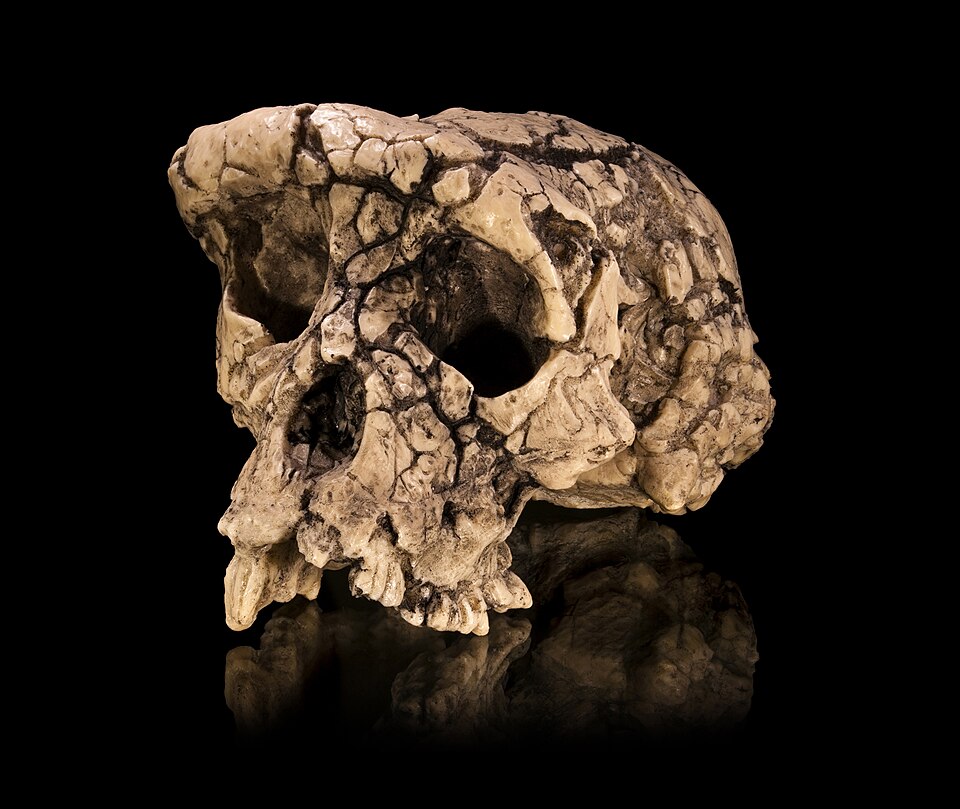
The oldest candidate hominin is Sahelanthropus tchadensis, represented primarily by a near-complete cranium (TM 266-01-060-1, nicknamed "Toumaï") discovered in the Djurab Desert of Chad in 2001 and dated to approximately 7 million years ago by cosmogenic nuclide methods.1, 6 The cranium combines a small, non-honing canine and an anteriorly positioned foramen magnum—features consistent with hominin status—with a chimpanzee-sized braincase of roughly 360 cubic centimeters.1 The publication of postcranial remains in 2022, including a femur and two ulnae, was interpreted by the describing team as evidence for habitual bipedalism, though independent analyses have questioned this conclusion, arguing that the femoral morphology is equally compatible with quadrupedal locomotion.4

Orrorin tugenensis, discovered in 2000 in the Tugen Hills of Kenya, is dated to approximately 6 million years ago and preserves postcranial elements that provide more direct evidence for bipedal locomotion.7 CT scans of the femoral neck reveal an asymmetric distribution of cortical bone—thicker inferiorly than superiorly—a biomechanical signature found in habitual bipeds but not in quadrupedal apes.7 At the same time, Orrorin retains curved finger bones and other features indicating significant arboreal activity, suggesting a locomotor repertoire that combined both tree climbing and upright walking on the ground.7, 8
Ardipithecus
The genus Ardipithecus includes two species from the Middle Awash region of Ethiopia: Ar. kadabba, dated to approximately 5.8–5.2 million years ago, and Ar. ramidus, dated to approximately 4.4 million years ago.3 The partial skeleton of Ar. ramidus nicknamed "Ardi" (ARA-VP-6/500), published in 2009 after 15 years of painstaking preparation, is one of the most informative early hominin fossils ever recovered. It preserves a striking mosaic of features: an opposable big toe suited for grasping tree branches combined with a pelvis restructured to support a degree of upright walking, small non-honing canines alongside a relatively prognathic face, and a brain only slightly larger than that of a chimpanzee.3
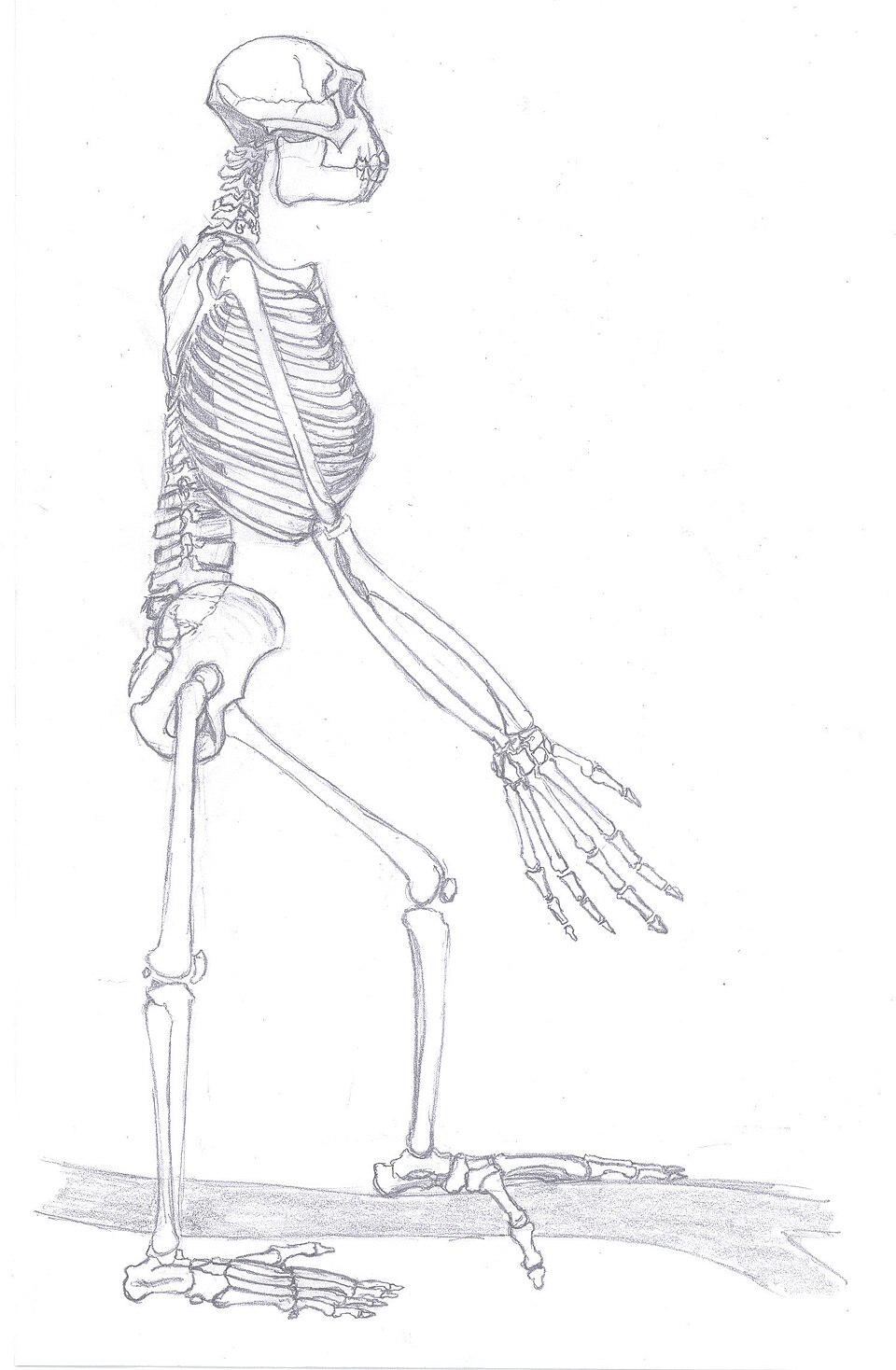

Ardi's woodland habitat was particularly significant. For decades, the dominant hypothesis held that bipedalism evolved as an adaptation to open savanna environments, driven by the need to see over tall grass or to travel efficiently between scattered food sources. The discovery that Ar. ramidus lived in a closed woodland with abundant tree cover overturned this scenario, demonstrating that upright walking preceded the spread of grasslands and arose in forested or wooded settings.3, 8
Kenyanthropus platyops
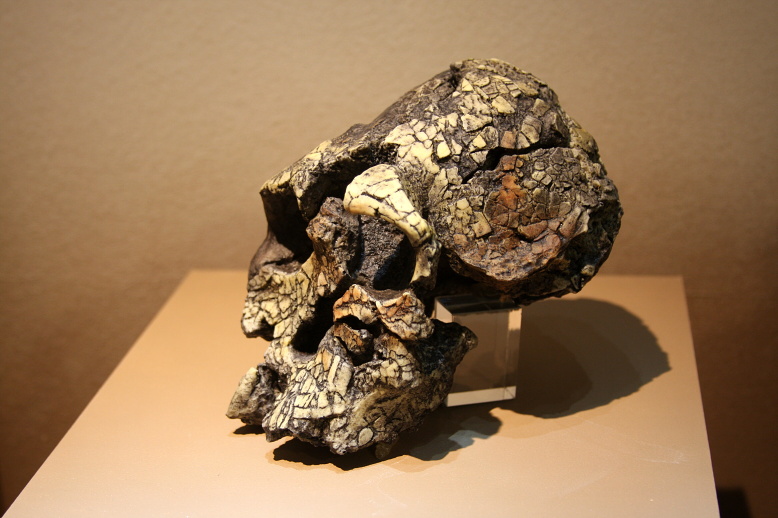
Kenyanthropus platyops, described in 2001 from a cranium discovered at Lomekwi in West Turkana, Kenya, dates to approximately 3.5 million years ago and adds yet another branch to the early hominin bush.5 The holotype cranium (KNM-WT 40000) is distinguished by an unusually flat face and small molars, features that set it apart from the contemporaneous Australopithecus afarensis and led its discoverers to erect a new genus.5
.JPG)
The validity of the genus remains debated: some researchers argue that the cranium is too distorted by matrix expansion to diagnose reliably, while others have used geometric morphometric analyses to support its distinctiveness.5, 8
Whether or not Kenyanthropus ultimately proves to be a valid taxon, its existence underscores a consistent pattern: at every time period for which the fossil record is reasonably complete, multiple hominin species coexisted in Africa. The single-species, straight-line model of human evolution has been replaced by a picture of a densely branching tree in which experimentation with different ecological strategies and anatomical configurations was the norm rather than the exception.8
Debates and significance
The phylogenetic placement of each of these early species remains contested. Critics of Sahelanthropus have argued that its features could equally be interpreted as those of an ancestral ape rather than a hominin, and the ongoing debate over its postcranial locomotion has not been fully resolved.4 Orrorin is known from limited material, and its relationship to later hominins is unclear.7 Even Ardipithecus, the best-documented of the group, has been subject to alternative interpretations of its locomotor capabilities.3
Despite these uncertainties, the earliest hominins collectively establish several fundamental points about human origins. First, the human lineage arose in Africa, consistent with the molecular evidence for an African origin of the human–chimpanzee divergence.2 Second, bipedal locomotion in some form was among the first distinguishing features of the lineage, appearing millions of years before any significant expansion of brain size.3, 8 Third, the earliest phase of hominin evolution was already characterized by diversity, with multiple lineages experimenting with different combinations of ancestral and derived traits. The linear "march of progress" is a myth; the reality was a complex, branching process from the very beginning.8
Environmental context
The environments in which the earliest hominins lived have proven as informative as the fossils themselves. Paleoenvironmental reconstructions based on associated faunal assemblages, stable carbon and oxygen isotopes, and paleobotanical evidence indicate that the earliest hominins occupied a range of habitats, but woodland and closed forest environments predominated. Ardipithecus ramidus is associated with woodland fauna including colobine monkeys, forest-adapted bovids, and other indicators of closed canopy or woodland habitats at Aramis.3 Sahelanthropus from the Djurab Desert of Chad lived in an environment reconstructed as a mosaic of gallery forest, woodland, and grassland bordering a large lake — a setting far removed from the open savanna once hypothesized as the cradle of bipedalism.1, 8
These environmental data have important implications for models of hominin origins. The "savanna hypothesis" — the idea that bipedalism evolved as an adaptation to open grassland environments — has been largely abandoned in its original form. The earliest bipeds lived in wooded or mosaic settings, suggesting that upright walking may have evolved for postural feeding, energy-efficient travel between scattered food patches, or carrying food and infants, rather than as a response to the challenges of open plains.3, 8 C. Owen Lovejoy proposed that bipedalism may have been favored in part because it freed the hands for provisioning mates and offspring, linking the origin of upright walking to changes in reproductive strategy and pair bonding rather than to any single ecological pressure.9
References
Cosmogenic nuclide dating of Sahelanthropus tchadensis and Australopithecus bahrelghazali