Overview
- Homo luzonensis is a species of archaic human formally described in 2019 from fossils found in Callao Cave on the island of Luzon in the Philippines, dated to at least 50,000 to 67,000 years ago by uranium-series methods, making it contemporaneous with Homo sapiens, Neanderthals, Denisovans, and Homo floresiensis.
- The species displays a mosaic of anatomical features combining primitive, Australopithecus-like curved finger and toe bones with derived, Homo-like small and simplified teeth, a combination not seen in any other known hominin and suggesting a complex evolutionary history potentially involving long isolation on an island.
- The discovery of Homo luzonensis, together with the earlier discovery of Homo floresiensis on Flores, demonstrates that hominin diversity in island Southeast Asia during the Late Pleistocene was far greater than previously recognised, and raises fundamental questions about how early hominins crossed open water to reach oceanic islands.
Discovery
The first evidence of an ancient human presence in Callao Cave came in 2007, when Armand Salvador Mijares and colleagues recovered a third metatarsal (foot bone) from the cave's deepest excavation layer during archaeological investigations in the Peñablanca limestone formation of northern Luzon.2, 14 Uranium-series dating of the bone itself yielded a minimum age of 67,000 years, making it the oldest direct evidence of a hominin on the Philippine archipelago at the time of discovery.2 The bone was small, falling within the size range of modern small-bodied human populations, but its morphology was sufficiently distinctive to warrant further investigation.2
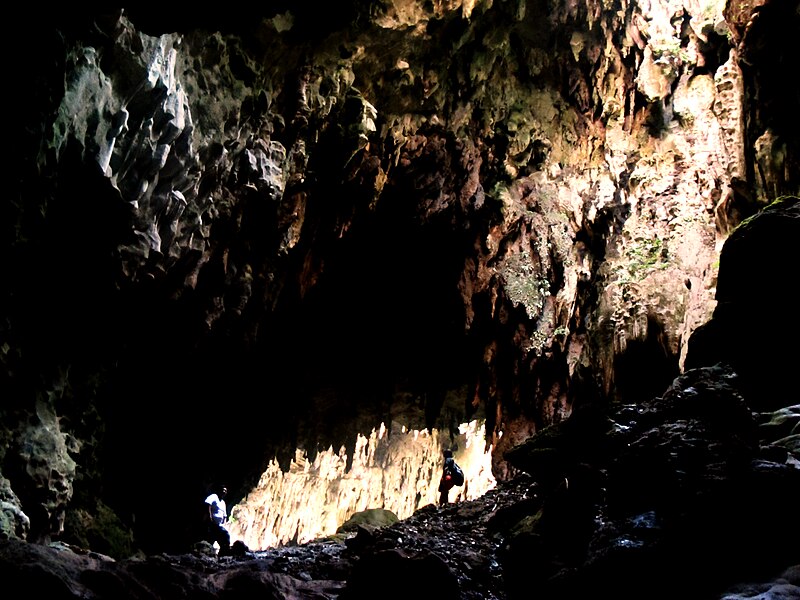

Subsequent excavations between 2011 and 2015 recovered additional fossils from the same stratigraphic layer and an adjacent layer, including seven teeth (five from the same individual), two hand phalanges, two foot phalanges, and a fragment of femoral shaft.1 In total, the material represents at least three individuals: two adults and one juvenile. The combination of features observed across these specimens was sufficiently unusual to justify the erection of a new species, Homo luzonensis, formally described by Florent Détroit and colleagues in April 2019.1
Callao Cave is a large limestone cave system located approximately 28 kilometres from the northeastern coast of Luzon in Cagayan Province.14 The fossiliferous deposits occur in a sequence of breccias and clays that also contain stone tools and faunal remains including deer, pigs, and freshwater turtles, indicating a habitable environment with access to diverse food resources.14, 9
Dental morphology
The teeth of Homo luzonensis are among the most diagnostically important elements of the hypodigm and display a combination of features not matched by any other known hominin species.1 The premolars are notably small and possess simplified crown morphologies with reduced cusp numbers, a derived condition shared with Homo sapiens and distinct from the larger, more complex premolars of Homo erectus and earlier Homo species.1, 15
The molars, however, are extremely small — among the smallest known for any species of Homo — and exhibit a unique combination of features including very simple occlusal surfaces and thin enamel.1 The upper premolars possess two or three roots, a condition considered primitive within the genus Homo and more commonly associated with australopithecines and early Homo species.1, 15 This mosaic of derived and primitive dental features is one of the primary justifications for recognising H. luzonensis as a distinct species rather than assigning the material to an existing taxon.1
Comparative analyses indicate that the dental dimensions and morphology of H. luzonensis do not fit comfortably within the range of variation of H. erectus, H. floresiensis, or H. sapiens, though individual teeth may overlap with one or more of these species in specific measurements.1, 10 The overall dental pattern is most consistent with a lineage that diverged from other Homo species at an early date and subsequently evolved its own distinctive suite of features during prolonged isolation.10
Postcranial morphology
The hand and foot bones of Homo luzonensis present an equally puzzling mosaic of features.1 The proximal hand phalanx (finger bone) is markedly curved, with prominent flexor sheath ridges and a degree of curvature comparable to that seen in Australopithecus and Homo naledi rather than in Homo sapiens or Homo erectus.1 Curved phalanges are generally interpreted as evidence of habitual arboreal locomotion or at least significant climbing behaviour, and their presence in a hominin dated to the Late Pleistocene is unexpected.1
The foot bones tell a similarly complex story. The original third metatarsal, while human-like in its overall proportions, is small and robust.2 A proximal foot phalanx recovered in the later excavations is strongly curved, again resembling the condition in Australopithecus more than in any known species of Homo.1 This combination of a human-like metatarsal with an ape-like phalanx suggests a foot that was adapted for bipedal walking but retained significant grasping capability, perhaps reflecting a partially arboreal lifestyle in the forested karst landscape of northern Luzon.1
The femoral shaft fragment preserves a thick cortex and small medullary cavity, consistent with a robust postcranial skeleton, but the fragment is too incomplete to provide reliable estimates of body size or proportions.1 No cranial material has been recovered from Callao Cave, which limits the ability to assess brain size, facial morphology, and other features that are typically used in hominin taxonomy.1
Dating and stratigraphy
The Homo luzonensis fossils derive from two stratigraphic units within Callao Cave. The original metatarsal was recovered from Layer 14, the deepest excavated layer, and returned a direct uranium-series age of at least 67,000 years before present.2 The teeth and additional postcranial elements were recovered from Layer 14 and the overlying Layer 13, with associated uranium-series dates on faunal remains indicating ages of approximately 50,000 to 67,000 years.1
These dates place H. luzonensis firmly within the Late Pleistocene, a period during which Homo sapiens was dispersing through island Southeast Asia and reaching Australia by at least 65,000 years ago.11, 12 The H. luzonensis dates overlap chronologically with the latest occurrence of Homo floresiensis on Flores (approximately 50,000 to 60,000 years ago) and with the presence of Denisovans inferred from genetic evidence in mainland and island Southeast Asian populations.4
The antiquity of hominin presence on Luzon extends far beyond the H. luzonensis fossils themselves. In 2018, Ingicco and colleagues reported stone tools and butchered rhinoceros bones from the site of Kalinga in the Cagayan Valley, dated by multiple methods to approximately 709,000 years ago.3 This dramatically older evidence indicates that hominins — probably Homo erectus or a related species — reached Luzon during the Middle Pleistocene, raising the possibility that H. luzonensis descended from an earlier colonisation event rather than representing a recent arrival.3
Island biogeography and water crossings
Luzon has never been connected to the Asian mainland by a land bridge during the Pleistocene, even during glacial periods when sea levels dropped by more than 120 metres.13 The island lies east of the Huxley Line (an extension of Wallace's Line), separated from the Sunda Shelf by deep-water straits that remained flooded throughout the Quaternary.13 Any hominin reaching Luzon would have needed to cross at least one open-water strait, though the minimum crossing distances would have been reduced during glacial lowstands to perhaps 10 to 25 kilometres.13
How early hominins accomplished these water crossings remains one of the most debated questions raised by the Philippine fossil record.3 The 709,000-year-old evidence from Kalinga predates any known evidence of watercraft construction by hundreds of thousands of years, making intentional seafaring by Homo erectus or a similar species seem unlikely.3 Alternative hypotheses include accidental transport on natural rafts of vegetation during storms or tsunamis, which has been documented for other terrestrial vertebrates colonising oceanic islands.8
The same biogeographic puzzle applies to Homo floresiensis on Flores, which is also separated from the mainland by deep-water barriers.4 The presence of archaic hominins on two separate oceanic islands in the Philippines and Indonesia suggests that over-water dispersal, whether intentional or accidental, may have been more common than previously assumed, with successful colonisation events occurring multiple times across the Middle and Late Pleistocene.3, 6
Comparison with Homo floresiensis
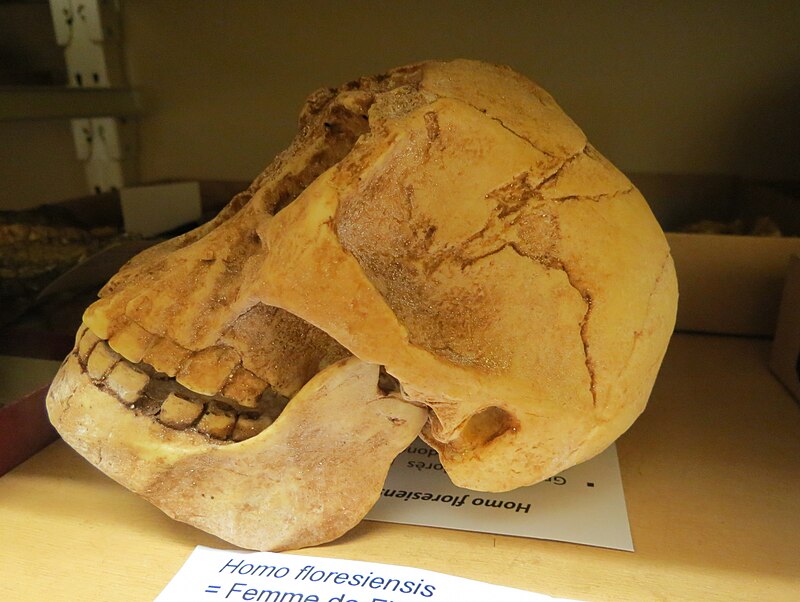
The discovery of Homo luzonensis inevitably invites comparison with Homo floresiensis, the small-bodied hominin from Liang Bua cave on Flores, Indonesia, described in 2004.4 Both species inhabited oceanic islands in Southeast Asia during the Late Pleistocene, both were small-bodied, and both exhibit mosaic combinations of primitive and derived features.1, 4 However, the two species differ significantly in their specific morphologies and cannot be assigned to the same lineage on current evidence.1, 10
.JPG)
Homo floresiensis is known from substantially more complete material, including a nearly complete skull and partial skeleton, permitting estimates of brain size (approximately 420 cubic centimetres) and body height (approximately 106 centimetres).4 Its feet are proportionally very long with a divergent hallux, and its wrist bones retain primitive morphologies distinct from both modern humans and H. luzonensis.7 The teeth of H. floresiensis are larger relative to body size than those of H. luzonensis and differ in detailed morphology, including crown shape and root number.1
Whether either species evolved from Homo erectus through island dwarfism or from an earlier, more primitive hominin ancestor remains unresolved.5, 6 The island rule, which predicts that large mammals evolve smaller body size on islands due to limited resources and reduced predation pressure, provides a plausible mechanism for body size reduction, and has been documented in insular elephants, deer, and hippos.8 However, some features of both species — particularly the primitive hand and foot morphologies — are difficult to derive from H. erectus through simple size reduction alone, raising the possibility of descent from a pre-erectus ancestor.6, 10
Implications for hominin diversity
The recognition of Homo luzonensis as a distinct species has substantially expanded the known diversity of the genus Homo during the Late Pleistocene.1 As recently as the 1990s, the prevailing consensus held that Homo sapiens was the sole surviving human species after the extinction of the Neanderthals, with H. erectus having disappeared from Asia by perhaps 300,000 years ago.5 The discoveries of H. floresiensis (2004), the Denisovans (2010), H. naledi (2015), and now H. luzonensis (2019) have revealed that the Late Pleistocene hosted a far more complex mosaic of human species than was previously imagined.1, 15
The mosaic morphology of H. luzonensis, combining features associated with Australopithecus (curved phalanges) and derived Homo (small, simplified teeth), challenges simple linear models of human evolution and suggests that evolutionary trajectories in isolated island populations could produce novel combinations of features through relaxed selection pressures, genetic drift, and adaptation to local environments.1, 10
Whether Homo sapiens interacted with or contributed to the extinction of H. luzonensis remains unknown. The chronological overlap between the two species suggests that modern humans were present in the Philippines at roughly the same time as H. luzonensis, and the Callao Cave deposits include later layers with H. sapiens remains dated to approximately 25,000 to 30,000 years ago.9 No evidence of interbreeding has been detected, though the absence of recoverable ancient DNA from the tropical cave environment makes genetic testing currently impossible.9
Future research
The fragmentary nature of the Homo luzonensis hypodigm — thirteen bones and teeth representing at least three individuals — leaves many fundamental questions unanswered.1 No cranial material has been recovered, so brain size and facial morphology remain unknown. Body size estimates are approximate, based on the small dimensions of the teeth and postcranial elements but lacking the complete long bones needed for reliable stature reconstruction.1
Continued excavation at Callao Cave and survey of other limestone caves in the Cagayan Valley and across Luzon offer the best prospects for recovering additional material.14 The island's extensive karst terrain contains thousands of caves, the vast majority of which have never been investigated for palaeontological or archaeological deposits.14 Recovery of cranial remains would be particularly valuable, as it would allow direct comparison of brain size with H. floresiensis and provide stronger evidence for or against the island dwarfism hypothesis.8
Advances in ancient protein analysis (palaeoproteomics) offer a potential alternative to ancient DNA for establishing phylogenetic relationships, even in tropical environments where DNA degrades rapidly.9 If collagen or other proteins can be extracted from the H. luzonensis fossils, proteomic analysis could determine whether the species is more closely related to H. erectus, H. floresiensis, or an earlier hominin lineage, resolving one of the central questions raised by the discovery.9