Overview
- The accumulation of over 1,800 Homo naledi fossils in the nearly inaccessible Dinaledi and Lesedi Chambers of the Rising Star cave system, with no stone tools, no animal bones, and no evidence of water transport, has led researchers to propose deliberate body disposal by a small-brained hominin.
- In 2023, the Rising Star team made the more extraordinary claim that H. naledi deliberately buried its dead in dug graves, used fire for illumination, and produced rock engravings, but peer reviewers and independent researchers found the evidence insufficient to support these conclusions.
- The debate over H. naledi mortuary behavior centers on a fundamental question: whether complex symbolic and funerary practices require large brains, or whether a hominin with a brain one-third the size of ours could have engaged in behaviors previously attributed only to Homo sapiens and Neanderthals.
The question of whether Homo naledi practiced deliberate body disposal or burial is one of the most contentious issues in contemporary paleoanthropology. The accumulation of more than 1,800 fossil specimens in the Dinaledi and Lesedi Chambers of the Rising Star cave system in South Africa, a species with a brain approximately one-third the size of a modern human's and dated to between 236,000 and 335,000 years ago, has challenged fundamental assumptions about the relationship between brain size and complex behavior.1, 3, 4 The debate has evolved through two distinct phases: an initial, widely discussed hypothesis of deliberate body disposal proposed in 2015, and a more ambitious set of claims about formal burial, fire use, and rock art advanced in 2023 that have met significant scientific resistance.2, 6, 7
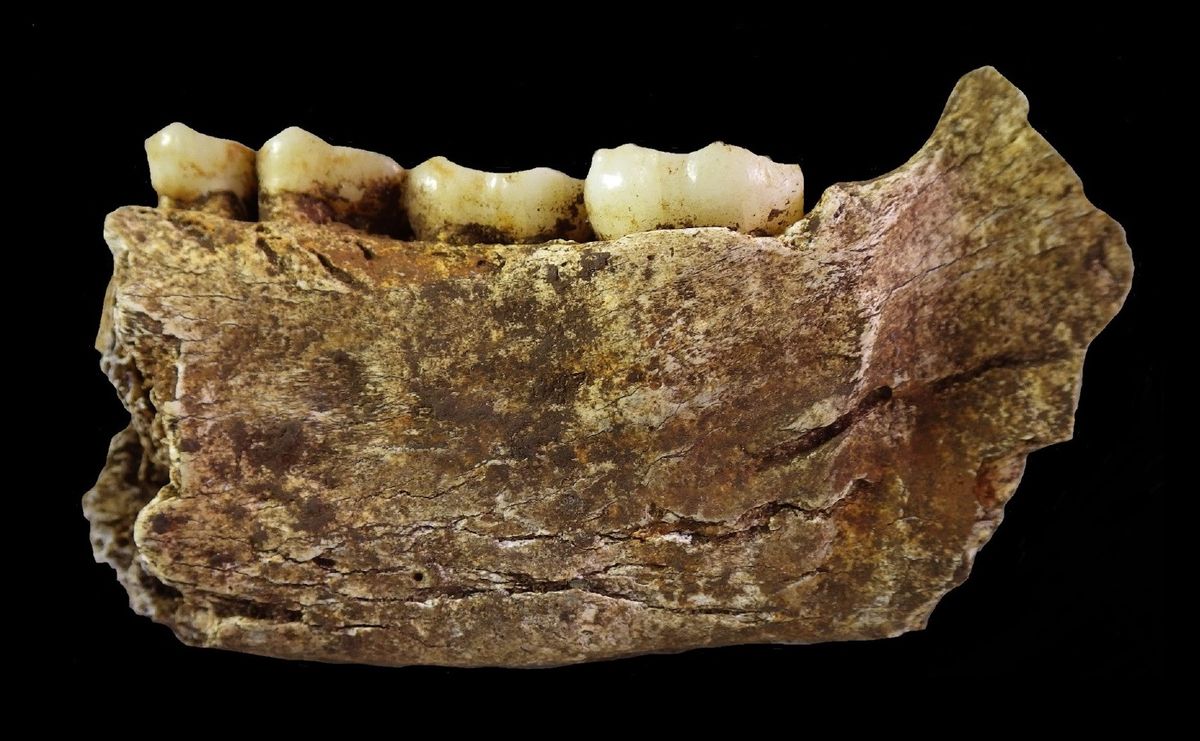

The taphonomic evidence
The case for deliberate body disposal rests on a distinctive taphonomic signature. The Dinaledi Chamber, where the majority of H. naledi fossils were found, lies approximately 30 meters below the surface and is accessible only through an extremely narrow passage roughly 18 centimeters wide, followed by a 12-meter vertical climb known as the Dragon's Back.2 Detailed geological analysis by Dirks and colleagues found no evidence of a former, more accessible entrance to the chamber, and the passage's dimensions would have prevented large carnivores from entering.2 The fossil assemblage itself is almost exclusively hominin: apart from a small number of owl bones and rodent remains near the surface, no animal bones, no stone tools, and no other archaeological material were found alongside the hominin remains.1, 2
The research team systematically evaluated and rejected alternative accumulation mechanisms. Water transport was ruled out because the bones show no signs of hydraulic sorting or rounding, and the sedimentological evidence indicates that the chamber was never subject to significant water flow capable of carrying complete bodies through the narrow entrance.2 Predator or scavenger accumulation was excluded because no carnivore tooth marks, no carnivore coprolites, and no carnivore remains were found, and the passage is physically inaccessible to hyenas, leopards, or other large predators known to accumulate bones in South African caves.2 A mass death event was considered unlikely because the individuals span a range of ages from infants to elderly adults, and the bones show evidence of having been deposited over a period of time rather than in a single catastrophic event.1, 2
The discovery of additional H. naledi remains in the Lesedi Chamber, a physically separate location within the same cave system that is also accessible only through constrained passages, strengthened the body disposal hypothesis. Hawks and colleagues argued that finding the same species in two independent, difficult-to-access chambers made coincidental accumulation increasingly implausible.4 The Lesedi assemblage includes at least three individuals, including a near-complete cranium (LES1) with an endocranial volume of approximately 610 cubic centimeters.4
The 2023 burial claims
In June 2023, Berger and colleagues submitted three preprints to eLife that went substantially beyond the body disposal hypothesis. The first paper claimed to identify at least two pit-like features in the Dinaledi Chamber floor that the authors interpreted as deliberately dug graves, with hominin bodies placed inside and then covered with sediment.6 The second paper reported the discovery of cross-hatched markings on a cave wall surface, interpreted as intentional engravings produced by H. naledi.8 The third paper described evidence of controlled fire use within the cave, including soot deposits on the ceiling and burnt bone fragments, which the team suggested indicated that H. naledi used fire for illumination while navigating the dark passages to access the burial chambers, a capacity previously documented at Middle Pleistocene sites such as Qesem Cave in Israel.9, 15
If substantiated, these claims would represent a radical revision of understanding about hominin cognitive evolution. Deliberate burial with dug graves is currently documented only in Homo sapiens and possibly Neanderthals, both of which possessed brains at least three times larger than that of H. naledi.11, 12 Rock engravings of any kind have never been attributed to a non-sapiens hominin. The combination of burial, engraving, and fire use would imply that H. naledi, with a brain of 465–610 cubic centimeters, was capable of symbolic cognition, planning, and cultural transmission at a level previously associated only with large-brained hominins.6, 8, 13
Scientific criticism
The 2023 claims met immediate and extensive criticism from the paleoanthropological community. Peer reviewers at eLife, where the papers were submitted, were unanimous in finding the evidence insufficient to support the conclusions. Reviewers noted that the supposed grave features lacked the clear morphological signatures of deliberate excavation, such as sharp-edged pit walls and distinct fill boundaries, that distinguish intentional burials from natural sedimentary processes including decomposition voids, root channels, and animal burrowing.6, 7 The cross-hatched markings were not convincingly distinguished from natural geological processes such as calcite dissolution or root etching.8
An independent assessment published by Martinon-Torres and colleagues in the Journal of Human Evolution provided the most comprehensive rebuttal. Their analysis found no scientific evidence supporting the claims of deliberate burial or rock art. When the authors attempted to replicate the geochemical analyses presented by Berger's team using standard protocols, they could not reproduce the reported results.7 The study also noted that the Rising Star team had not adequately eliminated natural taphonomic processes as explanations for the bone distributions, and that the supposed soot deposits had not been chemically characterized in sufficient detail to distinguish them from manganese oxide or other natural dark mineral coatings common in cave environments.7 A persistent concern raised by multiple critics is that no independent researchers have been granted access to the fossil site to verify the claims firsthand, a limitation that some regard as a significant impediment to scientific evaluation.7
Body disposal versus burial
A crucial distinction in this debate separates body disposal from burial. Body disposal, the deliberate placement or dropping of corpses in a specific location, is a simpler behavior that could be motivated by hygiene, predator avoidance, or other practical concerns and does not necessarily require symbolic reasoning.2, 5 Burial, by contrast, implies the intentional excavation of a pit, placement of the body, and covering with sediment, behaviors that in living humans are deeply intertwined with ritual, mourning, and concepts of an afterlife.10 Many researchers who accept the body disposal hypothesis for the Dinaledi assemblage reject the burial hypothesis, viewing the two as categorically different claims requiring different levels of evidence.7
The body disposal hypothesis remains the most widely accepted explanation for the H. naledi assemblages, though even this interpretation has its skeptics. Some researchers have proposed that the hominins may have entered the cave voluntarily, perhaps seeking water or shelter, and became trapped, though the demographic profile of the assemblage, spanning infants to elderly adults, makes this scenario difficult to sustain for every individual.2 Others have suggested that there may have been a once-accessible entrance to the chamber that has since been sealed by geological processes, though no physical evidence of such an entrance has been identified despite extensive survey of the cave system.2
Implications for cognitive evolution
Whatever the resolution of the burial debate, the H. naledi assemblages raise profound questions about the cognitive capabilities of small-brained hominins. If even the more conservative body disposal hypothesis is correct, it implies that H. naledi was capable of navigating in complete darkness through narrow, vertical passages; of transporting or guiding dead or dying individuals through those passages; and of repeatedly using the same location for this purpose over time.2, 14 These behaviors presuppose spatial memory, group coordination, and possibly some form of social learning, capacities that are cognitively non-trivial regardless of whether they constitute "symbolic" behavior in the anthropological sense.5, 13
Endocast analysis by Holloway and colleagues has shown that despite its small volume, the H. naledi brain displayed a frontal lobe organization more similar to Homo than to australopiths, with features in the region corresponding to Broca's area that may indicate enhanced cognitive or communicative abilities beyond what brain size alone would predict.13 This finding lends at least some plausibility to the idea that brain organization, rather than brain volume, may be the more relevant variable for understanding hominin behavioral complexity. The debate over H. naledi mortuary behavior ultimately challenges paleoanthropologists to articulate more precisely what they mean by terms like "symbolic thought" and "behavioral modernity," and to reconsider whether these capacities are best understood as a single cognitive package tied to brain size or as a mosaic of abilities that evolved at different times in different lineages.5, 13
References
Geological and taphonomic context for the new hominin species Homo naledi from the Dinaledi Chamber, South Africa
241,000 to 335,000 years old rock engravings made by Homo naledi in the Rising Star Cave system, South Africa
Evidence for the repeated use of a central hearth at Middle Pleistocene (300 ka) Qesem Cave, Israel
Almost Human: The Astonishing Tale of Homo naledi and the Discovery That Changed Our Human Story