Overview
- The Mousterian is the Middle Paleolithic stone tool industry that dominated western Eurasia and parts of North Africa from roughly 300,000 to 40,000 years ago, defined by flake tools struck from carefully prepared cores — especially via the Levallois technique — and most strongly associated with Neanderthals in Europe and with both Neanderthals and early Homo sapiens in the Levant.
- Named after the rockshelter of Le Moustier in the Dordogne, the industry is conventionally divided into five facies (Typical, Quina, Ferrassie, Denticulate, and Mousterian of Acheulean Tradition) following François Bordes's 1961 typology, though whether these represent distinct cultural traditions, functional toolkits, or different stages in the reduction and resharpening of the same blanks remains one of the most debated questions in Paleolithic archaeology.
- Mousterian assemblages document hafted weapons, birch-tar adhesives, planned mobility across landscapes, the formal burial of the dead at sites such as La Ferrassie and Kebara, and a long behavioral record that frames the late Neanderthals not as cognitive primitives but as the makers of a sophisticated, regionally variable Middle Paleolithic that lasted nearly a quarter of a million years.
The Mousterian is the dominant stone tool industry of the Middle Paleolithic in western Eurasia, characterized by flake tools — primarily side scrapers, points, denticulates, and notches — struck from cores that knappers carefully shaped in advance, most often by means of the Levallois technique.6, 7 First recognized at the rockshelter of Le Moustier in the Dordogne region of southwestern France in the 1860s, the industry takes its name from that type site and is most strongly associated with Neanderthals, although in the Levant and North Africa it was also produced by early Homo sapiens.8, 6 Mousterian assemblages span an enormous interval — conventionally about 160,000 to 40,000 years ago in Europe, and as much as 300,000 to 40,000 years ago when their predecessors and Levantine analogues are included — making the industry one of the longest-lasting technological traditions in the human record.6, 28
The Mousterian occupies a pivotal place in the history of Paleolithic archaeology. Its formal subdivision into five facies by the French prehistorian François Bordes in 1961 framed two generations of research, and the ensuing Bordes–Binford debate over what those facies meant — ethnic groups, functional toolkits, or stages of resharpening — helped define the modern theoretical landscape of the field.1, 5, 3 The industry is also the cultural backdrop against which the late Neanderthals lived, hafted weapons with birch-tar pitch, hunted large game, buried their dead, and ultimately disappeared as Homo sapiens spread across Europe between roughly 45,000 and 40,000 years ago.4, 11, 16
Discovery and naming
The Mousterian takes its name from Le Moustier, a complex of two superimposed rockshelters cut into the limestone cliffs above the Vézère River near the village of Peyzac-le-Moustier in the Dordogne department of southwestern France.8 The site was first investigated in 1863 by the English banker and amateur prehistorian Henry Christy together with the French paleontologist Édouard Lartet, who recovered flake tools and faunal remains from deposits exposed in the upper shelter.8 The artifacts were of a type unknown from earlier Acheulean horizons, and within a generation of the discovery the term "Mousterian" had become standard shorthand for the flake-based industries of the European Middle Paleolithic.7, 8
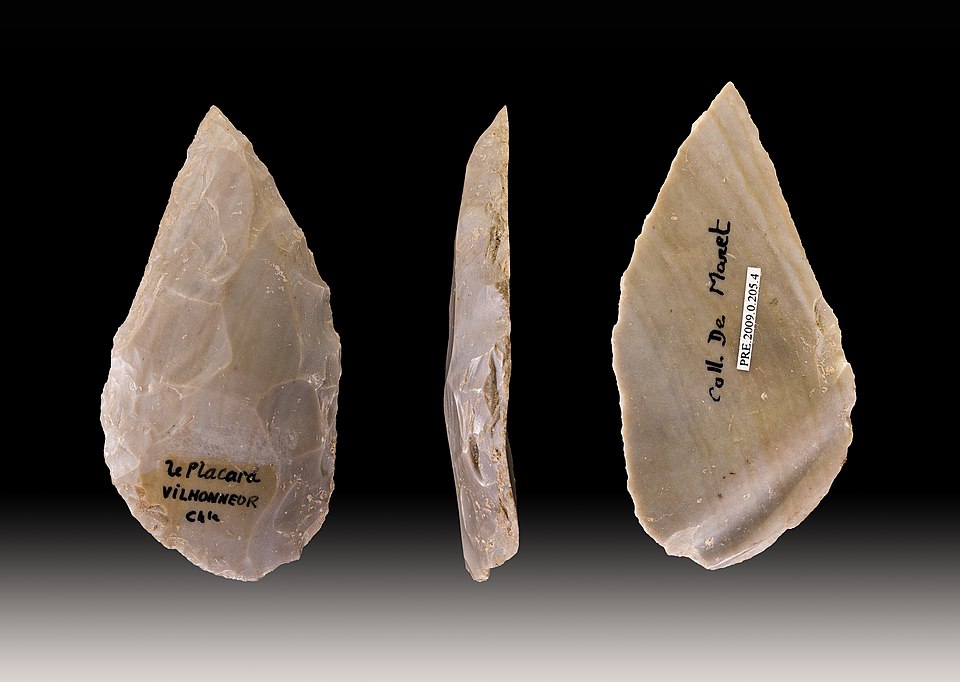
.jpg)
Le Moustier itself preserves up to ten Mousterian levels in the lower shelter, layered with hearths, charcoal, burned flint, and the dense lithic debris of long-term occupation.8 Thermoluminescence dating of 34 burnt flints from the upper Mousterian deposits, published by Hélène Valladas and colleagues in 1986, returned ages spanning roughly 56,000 to 40,000 years ago, providing one of the first independently dated chronologies for late Neanderthal occupation in southwestern France.9 The site is also the find spot of a juvenile Neanderthal skeleton excavated in 1908 and conventionally referred to as Le Moustier 1, recently re-dated to about 45,000 years before present and now associated with adhesive residues that combine ochre and bitumen as a hafting compound.8, 18
The classification was given its rigorous, statistical form by the Bordeaux prehistorian François Bordes, whose 1961 monograph Typologie du Paléolithique ancien et moyen defined a list of 63 standardized tool types and a quantitative procedure for comparing assemblages by relative frequency.1 Bordes's typology became the lingua franca of Middle Paleolithic archaeology in Europe and remains the framework against which subsequent reanalyses are usually staged, even by researchers who reject its underlying cultural interpretation.1, 25
Chronology and distribution
In Europe, classic Mousterian assemblages span roughly the last interglacial and the early last glacial cycle, falling broadly between 160,000 and 40,000 years ago.6 When prepared-core industries that share the same general technological organization — including the Levantine Levallois-Mousterian and various early Middle Stone Age assemblages — are added in, the chronological envelope extends back to approximately 300,000 years ago at the start of the Middle Paleolithic.6, 28 The end of the Mousterian in western Europe is marked by the appearance of the early Upper Paleolithic Aurignacian, conventionally dated between about 43,000 and 40,000 years ago, after which Mousterian assemblages disappear from the record.4, 11
Geographically, the Mousterian extends from the Atlantic margins of Iberia, France, and Britain across central and eastern Europe to the Caucasus and the foothills of the Altai, and southward through the Levant into northern Arabia and the Maghreb.6, 13, 21 Sites such as Mezmaiskaya in the northern Caucasus and Okladnikov and Chagyrskaya in the Russian Altai document Mousterian-style industries deep into Asia, while the Maghrebian Mousterian intergrades with the contemporary Aterian along the southern Mediterranean coast and the northern Sahara.21, 22 Across this vast range, prepared-core flake production is the unifying technological signature, though raw materials, regional traditions, and tool frequencies vary considerably from one area to another.15, 25
Technology and prepared cores
The Mousterian belongs to Mode 3 in the lithic classification scheme proposed by the British prehistorian Grahame Clark, in which the diagnostic operation is the production of flakes from cores whose form has been carefully prepared in advance.28 The dominant prepared-core method is the Levallois technique, in which a knapper shapes a core to a predetermined convex geometry — trimming the periphery, establishing a striking platform, and managing the upper surface — and then detaches a single flake whose final size and outline closely match a mental template held throughout the sequence.14, 15 Levallois flakes can take the form of broad ovate blanks, elongated points used as the tips of hafted weapons, or true blades, depending on how the upper surface is configured.14, 22
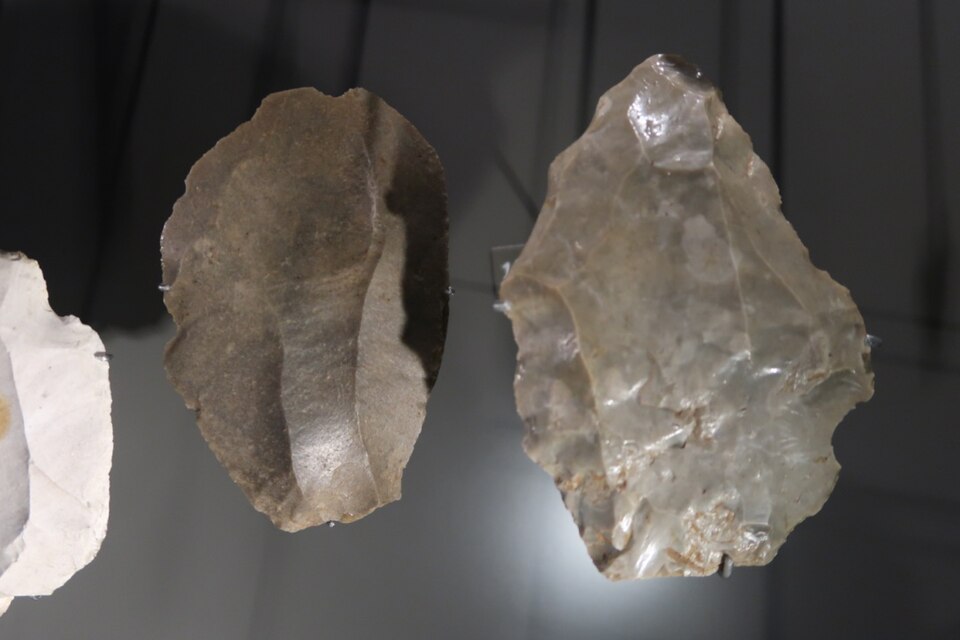

Other reduction strategies coexist with the Levallois system in Mousterian assemblages. Discoidal cores, in which flakes are removed centripetally around a roughly circular preform, are common in many regions and become especially prominent in late Middle Paleolithic horizons.25, 26 The Quina reduction system, characteristic of the Charentian facies in southwestern France, produces thick, asymmetric flakes with broad cortical backs that serve as ideal blanks for the steeply retouched scrapers that dominate Quina toolkits.3, 26 Bipolar percussion, on-anvil reduction, and unprepared platform cores are also documented, often in contexts of poor raw material or expedient tool use.26
The standard Mousterian tool inventory includes side scrapers (racloirs) of many varieties, transverse and convergent scrapers, Levallois and Mousterian points, denticulated edges, notched flakes, end scrapers, and (in some assemblages) small bifaces and backed knives.1, 7 Bordes's 63-type list provides a fine-grained vocabulary for describing this variation; in practice, scrapers in their many forms typically dominate the retouched component of an assemblage, while points, denticulates, and bifaces vary more conspicuously between facies and sites.1, 3
Bordes's five facies
On the basis of the relative frequencies of tool types in Middle Paleolithic assemblages from southwestern France, Bordes distinguished five Mousterian facies and interpreted each as the cultural signature of a distinct human group: the Typical Mousterian, the Quina Mousterian, the Ferrassie Mousterian (these last two grouped together as the Charentian), the Denticulate Mousterian, and the Mousterian of Acheulean Tradition (MTA), which he further divided into types A and B.1, 3 Each facies was defined by characteristic proportions of scrapers, points, denticulates, bifaces, Levallois flakes, and other indices computed from the tool counts.1
The five Mousterian facies after Bordes 19611, 3, 25
| Facies | Diagnostic features | Levallois index | Type sites |
|---|---|---|---|
| Typical Mousterian | Moderate scrapers, few denticulates, few or no bifaces; balanced inventory | Variable, often moderate to high | Combe-Grenal layers, Le Moustier (lower shelter) |
| Quina Mousterian (Charentian) | Scrapers exceed 50–80% of tools; thick, steeply retouched, often transverse; rare bifaces; non-Levallois Quina flake production | Low | La Quina, Combe-Grenal layers 17–26 |
| Ferrassie Mousterian (Charentian) | High scraper percentages similar to Quina but produced on Levallois blanks; thinner, more invasive retouch | High | La Ferrassie, Combe-Grenal lower layers |
| Denticulate Mousterian | Denticulates and notches dominate (often more than 35–55%); few scrapers; rare bifaces and points | Variable | Combe-Grenal layer 20, Pech de l'Azé II |
| Mousterian of Acheulean Tradition (MTA) | Cordiform, sub-cordiform, and triangular handaxes; backed knives; type A scraper-rich, type B blade- and knife-rich | Generally moderate | Pech de l'Azé I, Le Moustier (upper levels) |
The Charentian, named for the Charente department of southwestern France, takes in both the Quina and Ferrassie facies, which share an unusually high frequency of scrapers but differ sharply in how the supporting blanks are produced. Quina assemblages are made on thick, cortical-backed flakes struck from non-Levallois cores by the so-called Quina method, while Ferrassie assemblages rest on Levallois flakes that yield thinner blanks and more invasive scraper retouch.3, 26 The Denticulate Mousterian is dominated by toothed and notched edges and contains few scrapers or bifaces, a configuration that some researchers interpret as a butchery and woodworking toolkit.3, 22 The MTA, the latest of the five in southwestern France, is the only facies in which true bifaces persist into the Middle Paleolithic, and its small cordiform and triangular handaxes are recognizably distinct from the larger and more variable Acheulean forms that preceded them.3, 25
The Bordes–Binford debate
Bordes himself read the five facies as evidence that distinct cultural groups had occupied the Dordogne over tens of thousands of years, leaving their tradition-specific toolkits in different layers of the same caves — a model that treated assemblage variability as essentially ethnic.1, 25 Beginning in the mid-1960s, the American archaeologist Lewis Binford and his collaborator Sally Binford challenged this interpretation in a series of papers arguing that variability in Mousterian assemblages reflects different activities carried out at different sites, not different cultures.5 On their reading, a Quina-rich layer was a site where heavy hide-working and butchery were dominant, while a denticulate-rich layer represented a site of woodworking or plant processing. Functional needs, not ethnic identity, dictated which tool types appeared in which proportions.5
The Bordes–Binford debate framed the field through the 1970s and 1980s and was joined by a third, technological line of explanation in the 1980s when Harold Dibble proposed that many of Bordes's Mousterian scraper "types" were not finished tools at all but rather different stages in the progressive resharpening and rejuvenation of the same basic blanks.2 A simple side scraper, repeatedly resharpened along one edge, becomes a double scraper; further reduction and the addition of work on a second edge converts it into a convergent or transverse scraper; with enough use, the original outline is lost entirely and the artifact may be discarded as a small, exhausted form.2 On this reduction model, the relative frequencies of Bordian scraper types in an assemblage are partly an artifact of how heavily the tools were curated, which depends in turn on raw material availability and mobility patterns.2, 3
Nicolas Rolland and Harold Dibble's 1990 synthesis combined the technological and functional arguments and proposed that Mousterian variability is best understood as a combination of raw material economics, reduction intensity, and the kinds of activities carried out at each site, with cultural tradition playing a smaller role than Bordes had supposed.3 Subsequent work has refined the picture further: the chaîne opératoire approach developed in French Paleolithic archaeology examines complete reduction sequences from raw material acquisition through tool discard, while Gilliane Monnier and others have argued that some Bordian facies do correspond to coherent technological traditions even after reduction effects are accounted for.25, 26 The debate, in short, has not been resolved so much as decomposed into a set of more tractable questions about how stone tool assemblages form.25
Key sites
Combe-Grenal, a rockshelter in the Dordogne excavated by Bordes between 1953 and 1965, preserves the longest and most fully described Mousterian sequence in western Europe. Its 64 stratigraphic levels span much of the last glacial cycle and contain examples of every major facies, including the long Quina sequence in layers 17–26 within which the anomalous Denticulate Mousterian of layer 20 is intercalated — a pattern that figured centrally in Dibble and Rolland's reanalysis of facies variability.3, 26 La Quina, on the Voultron stream in the Charente, gave the Quina facies its name and yielded a series of Neanderthal remains alongside its dense scraper-rich assemblages.1, 3
La Ferrassie, a deep cave flanked by two rockshelters near Savignac-de-Miremont in the Dordogne, is the type site of the Ferrassie facies and one of the most important Neanderthal burial sites known.10, 27 Excavated initially by M. Tabanou in 1896 and then more systematically by Denis Peyrony and Louis Capitan from 1905 onward, with later campaigns by Henri Delporte in 1968–1973 and again in 1984, the site has yielded eight Neanderthal individuals: two adults, several children and infants, and two fetuses, recovered from a thin Mousterian horizon.27, 10 A 2020 analysis by Antoine Balzeau and colleagues argued on stratigraphic, taphonomic, and contextual grounds that the La Ferrassie 8 child — a roughly two-year-old discovered in 1973 — was deliberately buried by Neanderthals, supporting earlier interpretations of the adult burials at the site.10 A 2020 radiocarbon program by Sahra Talamo and colleagues placed the Mousterian deposits in a window broadly compatible with late Neanderthal occupation in the Aquitaine before the arrival of Homo sapiens.11
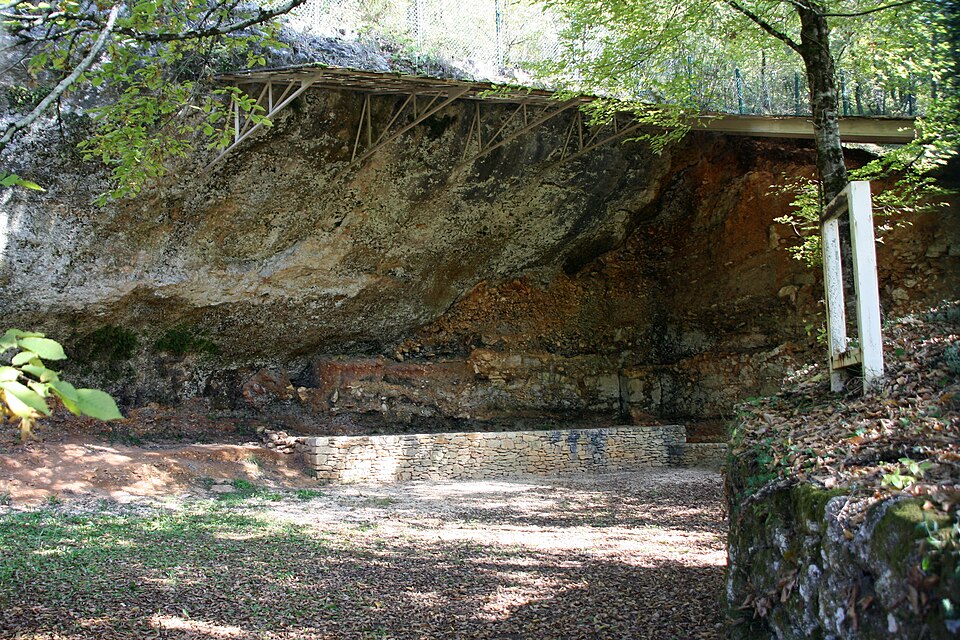

Pech de l'Azé I and II, two adjacent caves in the Dordogne, are the principal type sites for the MTA and Denticulate Mousterian respectively. The MTA at Pech de l'Azé I features small, well-made cordiform handaxes alongside backed knives, scrapers, and Levallois flakes, and has been the subject of long-running revisions of its chronology and assemblage composition.3, 25 Outside southwestern France, key sites include Tabun Cave on Mount Carmel in Israel, whose long Mousterian sequence in the upper levels spans roughly 200,000 to 45,000 years ago and yielded the partial Neanderthal female Tabun 1 along with thousands of Levallois flakes, points, and scrapers.13 Kebara Cave, also on Mount Carmel, contains a thick Mousterian sequence between approximately 60,000 and 48,000 years ago, with hearths, faunal remains, and the Kebara 2 male Neanderthal skeleton dated by thermoluminescence on burnt flints to about 60,000 years ago and excavated from a deliberate burial pit.12
Further afield, Mezmaiskaya Cave in the northern Caucasus has produced Mousterian assemblages associated with Neanderthal infants and a recently described bone projectile point that pushes the antiquity of bone-tipped weapons back into the Middle Paleolithic; sites in the Altai such as Chagyrskaya document a distinctive eastern Mousterian linked to a population of Neanderthals that left ancient DNA in the same cave system as the Denisovans.22, 6
Hafting and composite tools
The Mousterian provides some of the earliest unambiguous evidence for hafting — the practice of mounting stone tools onto wooden or bone handles to make composite implements. The clearest evidence comes from preserved adhesives. At Königsaue in Saxony-Anhalt, Germany, two lumps of birch tar dated by radiocarbon to roughly 48,000 years ago bear the impressions of stone flakes and wooden handles, indicating that the tar was used as a binding agent on a bifacial Mousterian tool.16 Birch tar must be distilled from birch bark by controlled heating and exclusion of oxygen, and a series of experimental studies has argued that even the simplest production methods require multiple steps and a measure of planning.16, 17
How much cognitive complexity such production implies is debated. Patrick Schmidt and colleagues have shown experimentally that birch tar can be obtained by relatively simple aboveground combustion of bark, which they argued reduces the cognitive ceiling required for the Königsaue finds.17 A subsequent 2023 analysis of the molecular composition of the Königsaue lumps themselves, however, indicated that they were produced by a more elaborate underground distillation procedure, supporting the interpretation that Neanderthals had a cumulative tradition of birch-tar manufacture rather than an opportunistic discovery.16 A 2024 study by the same group identified a still more complex hafting compound at Le Moustier itself, where Middle Paleolithic adhesive residues consist of a mixture of ochre and bitumen rather than birch tar.18
Bitumen-based adhesives appear at multiple Mousterian sites in the Caucasus, the Levant, and northern Syria, while pine resin combined with beeswax has been documented at Italian cave sites associated with Neanderthals.22 Use-wear and residue analyses on Mousterian flakes and scrapers from Mezmaiskaya Cave by Bruce Hardy and colleagues identified haft polish, plant fibers, animal residues, and bitumen on a substantial fraction of the studied tools, indicating that hafting was not a rare or experimental practice but a routine component of the Middle Paleolithic toolkit.22 Wooden hafts themselves rarely survive, but at Poggetti Vecchi in Italy, charred boxwood implements interpreted as digging sticks demonstrate that Neanderthals routinely shaped wood with stone tools as well as the reverse.22
Hunting and subsistence
The Mousterian was made by accomplished large-game hunters. Faunal assemblages from Mousterian sites across Europe are dominated by red deer, reindeer, horse, bison, aurochs, ibex, wild boar, and at higher latitudes by woolly mammoth and woolly rhinoceros, and most analyses indicate that Neanderthals were the primary accumulators of these bones rather than scavengers of carnivore kills.4, 23 Stable isotope studies of Neanderthal collagen consistently place them at the top of the Late Pleistocene food web, with nitrogen-15 values comparable to those of obligate carnivores such as wolves and hyenas, indicating a diet heavily reliant on the meat of large herbivores.23
Mousterian points and Levallois points are interpreted as the tips of hafted thrusting and possibly throwing spears. Use-wear studies have identified impact fractures on points from sites in France, Italy, the Iberian Peninsula, and the Caucasus, and the Mezmaiskaya bone projectile reported in 2025 indicates that Neanderthals were also producing organic projectile tips.22 The Schöningen wooden spears from Lower Saxony, recovered from lakeshore deposits associated with horse butchery and dated to between roughly 300,000 and 200,000 years ago, are technically pre-Mousterian in age but are commonly cited as evidence that hominins of broadly Neanderthal ancestry were capable of crafting throwing weapons by the early Middle Paleolithic.24
Other lines of evidence point to a flexible subsistence base. Mousterian sites preserve plant residues on tools, charred seeds and tubers, marine shellfish on the Iberian and Italian coasts, and bird and small-mammal remains processed for meat and feathers. Such finds indicate that the Middle Paleolithic diet was not exclusively megafaunal even though large mammals dominated the macroscopic faunal record.22, 23
Behavior, burial, and symbol
Mousterian sites contain the earliest widely accepted evidence for the deliberate burial of the dead. La Ferrassie in the Dordogne yielded eight Neanderthal individuals from a single thin Mousterian layer, including infants and fetuses interred in close association with adults; the 2020 reanalysis of the La Ferrassie 8 child concluded that the placement of the body, the absence of carnivore damage, and the lack of evidence for natural sediment infill point to deliberate interment.10 At Kebara Cave in Israel, the Kebara 2 skeleton was discovered articulated and lying on its back in a shallow pit cut into the Mousterian deposits; thermoluminescence dating of burned flints from the same horizon places the burial at roughly 60,000 years ago.12 Similar Middle Paleolithic burials are documented at La Chapelle-aux-Saints, Shanidar, Amud, and elsewhere across the Mousterian world.4, 12
The question of Neanderthal symbolic behavior beyond burial is more contentious but the picture has shifted considerably since Paul Mellars surveyed the field in The Neanderthal Legacy in 1996.4 Mellars cautiously read the Mousterian record as showing planning depth, technological flexibility, and sophisticated subsistence behavior but relatively little of the personal ornamentation, figurative imagery, and elaborated symbolic material that characterize the Upper Paleolithic.4 Subsequent finds — pierced and pigmented marine shells from Cueva de los Aviones and Cueva Antón in Spain, raptor talons from Krapina in Croatia, engraved bone fragments from Bacho Kiro and a few other sites, and uranium-thorium dates on red pigment in Iberian caves that predate the arrival of Homo sapiens — have steadily expanded the catalogue of behaviors that can plausibly be attributed to Mousterian-era Neanderthals.22, 18 The ochre-and-bitumen adhesive at Le Moustier itself, with its multi-component recipe and high investment of time and effort, has been cited as evidence of cumulative cultural transmission within Mousterian populations.18
The Mousterian outside Europe
In the Levant, the Mousterian (often called the Levantine Mousterian) is conventionally divided into three phases following the stratigraphy of Tabun Cave: an early Tabun D phase emphasizing Levallois blades and elongated points, a middle Tabun C phase with broad oval Levallois flakes, and a late Tabun B phase with shorter, broader Levallois points.13 Crucially, the Levantine Mousterian is associated with both Neanderthals and early Homo sapiens: the Neanderthal remains from Tabun, Kebara, Amud, and Dederiyeh date to roughly 80,000–55,000 years ago, while the early modern human remains from Skhul and Qafzeh date to between approximately 130,000 and 90,000 years ago and are associated with Mousterian assemblages technologically indistinguishable from those of their Neanderthal contemporaries.13, 6 The Levant therefore documents the only known case in which two distinct hominin species made what is conventionally called the same archaeological industry.13, 4
In North Africa, the situation is more complicated still. The Maghrebian Mousterian shares many features with the European industry — Levallois reduction, scrapers, points — but it overlaps in time and space with the Aterian, a related industry distinguished primarily by tanged or stemmed tools that are interpreted as hafting modifications.21 A 2013 reanalysis by Eleanor Scerri argued that, aside from the presence or absence of tangs, there are no consistent technological or chronological distinctions between the Aterian and the Maghrebian Mousterian, and that they are best understood as variants of a single Middle Stone Age tradition rather than as separate industries.21 The makers in North Africa were anatomically modern Homo sapiens, not Neanderthals, and the Maghrebian Mousterian/Aterian therefore documents the early Middle Stone Age of our own lineage.21
The application of the term "Mousterian" outside western Europe has been criticized on the grounds that it imports a typological framework developed for southwestern France into archaeological contexts where it may obscure as much as it reveals; some specialists prefer "Middle Stone Age" for sub-Saharan Africa and "Middle Paleolithic" as a generic chronological label, reserving "Mousterian" for the European Bordian sense.21, 25
The end of the Mousterian
In western Europe, Mousterian assemblages are progressively replaced after about 45,000 years ago by industries belonging to the early Upper Paleolithic. The most prominent of these, the Aurignacian, appears across central and western Europe between roughly 43,000 and 40,000 years ago and is generally attributed to incoming populations of Homo sapiens.4, 11 Sandwiched between the latest Mousterian and the Aurignacian in parts of France and northern Spain are the Châtelperronian and several other "transitional" industries (the Uluzzian in Italy, the Szeletian in central Europe, the Bohunician further east), each of which combines Middle Paleolithic-style flake tools with Upper Paleolithic features such as blade production, end scrapers, and bone implements.19, 20
The Châtelperronian, characterized by curved backed points and a blade-based reduction system, has been the focus of an unusually contentious debate over authorship. Two key sites — the Grotte du Renne at Arcy-sur-Cure and La Roche-à-Pierrot at Saint-Césaire — were long cited as the basis for attributing the Châtelperronian to Neanderthals, on the grounds that Neanderthal skeletal remains had been recovered in apparent stratigraphic association with Châtelperronian artifacts. A 2012 radiocarbon program by Jean-Jacques Hublin and colleagues argued that the chronology at Grotte du Renne and Saint-Césaire was consistent with a Neanderthal authorship of the Châtelperronian.19 A 2018 reanalysis of the Saint-Césaire sequence by Brad Gravina and colleagues, however, concluded that the lithic and stratigraphic data did not provide reliable evidence for a direct Neanderthal–Châtelperronian association at that site, leaving the question of who made the Châtelperronian unresolved.20
Whoever made the transitional industries, the chronological pattern is clear: the Mousterian disappears from the European record between approximately 42,000 and 39,000 years ago, the same window in which the last Neanderthals can be securely dated.11 By about 40,000 years ago, the western European archaeological record is dominated by Upper Paleolithic blade industries made by anatomically modern humans, and the Mousterian — after a run of well over 100,000 years — is gone.4, 11
Significance
The Mousterian is the longest-lasting and best-documented stone tool tradition associated with a non-sapiens hominin. It encompasses essentially the entire material record of Neanderthal life in Europe, much of the early Middle Paleolithic record of Homo sapiens in North Africa and the Levant, and provides the comparative baseline against which the technological behavior of late archaic and early modern humans is measured.4, 6 The combination of prepared-core flake production, hafted composite tools, large-game hunting, deliberate burial, and now apparently symbolic behavior documented at Mousterian sites has reshaped earlier views of Neanderthals as cognitively impoverished cousins of modern humans and supports a picture in which the behavioral gap between late Neanderthals and contemporary Homo sapiens is much narrower than once supposed.10, 18, 22
The industry's interpretive history is no less important than its content. The Bordes–Binford debate forced Paleolithic archaeology to confront questions about how much the spatial and temporal patterning of stone tools can tell us about prehistoric behavior, and Dibble's reduction-model challenge demonstrated how a discipline could be transformed by reconsidering assumptions that had become invisible through long use.2, 3, 25 The questions Bordes raised in 1961 — What is a tool type? What does a typological frequency distribution mean? Are the patterns we see in stone the residue of culture, function, raw material, time, or cognition? — remain central to the analysis of the Middle Paleolithic record more than six decades later.1, 25
References
Typologie du Paléolithique Ancien et Moyen. By François Bordes (review and bibliographic record)
A Preliminary Analysis of Functional Variability in the Mousterian of Levallois Facies
The new 14C chronology for the Palaeolithic site of La Ferrassie, France: the disappearance of Neanderthals and the arrival of Homo sapiens in France
The emergence of the Levallois technology in the Levant: A view from the Early Middle Paleolithic site of Misliya Cave, Israel
Production method of the Königsaue birch tar documents cumulative culture in Neanderthals
Ochre-based compound adhesives at the Mousterian type-site document complex cognition and high investment
Radiocarbon dates from the Grotte du Renne and Saint-Césaire support a Neandertal origin for the Châtelperronian
No Reliable Evidence for a Neanderthal-Châtelperronian Association at La Roche-à-Pierrot, Saint-Césaire
Functional characterization of Mousterian tools from the Caucasus using comprehensive use-wear and residue analysis
European Neanderthals revised: New interpretations of dietary and behavioral evidence
The wooden artifacts from Schöningen's Spear Horizon and their place in human evolution
Another Mousterian Debate? Bordian facies, chaîne opératoire technocomplexes, and patterns of lithic variability in the western European Middle and Upper Pleistocene